A cafe owner in Chicago called me last month, genuinely confused. He'd been buying "100% Arabica" for years, but his new supplier sent a sample that tasted... off. Bitter. Flat. He sent it to a lab. It was cut with 30% Robusta. He'd been paying an Arabica premium for a blend. His pain was double: he'd been overcharged, and his customers had been drinking inferior coffee without knowing it. The difference between these two species isn't academic trivia. It's money, it's flavor, it's your brand's integrity.
Arabica and Robusta differ in genetics, growing conditions, physical appearance, flavor chemistry, and caffeine content. Arabica is a delicate, high-altitude plant producing oval beans with complex sweetness and bright acidity. Robusta is a hardy, low-altitude plant producing round beans with bitter, earthy flavors and nearly double the caffeine. One is a premium ingredient; the other is a utilitarian crop.
So, what does this mean when you're looking at a green coffee offer? It means you need to know what you're buying—visually, chemically, and commercially. I grow both species on our 10,000 acres in Baoshan. I sell both. They each have a purpose. But misrepresenting one as the other is fraud. Let me walk you through the differences so you never get fooled, and so you can make the right choice for your blend, your roast, and your customer.
What Are the Physical Differences Between Arabica and Robusta Beans?
Before you taste, you look. The green bean itself tells a story. If you know what to look for, you can spot a Robusta bean mixed into an Arabica lot in seconds. It's the first QC check I teach new cuppers in our lab. Your eyes are a free sorting machine.
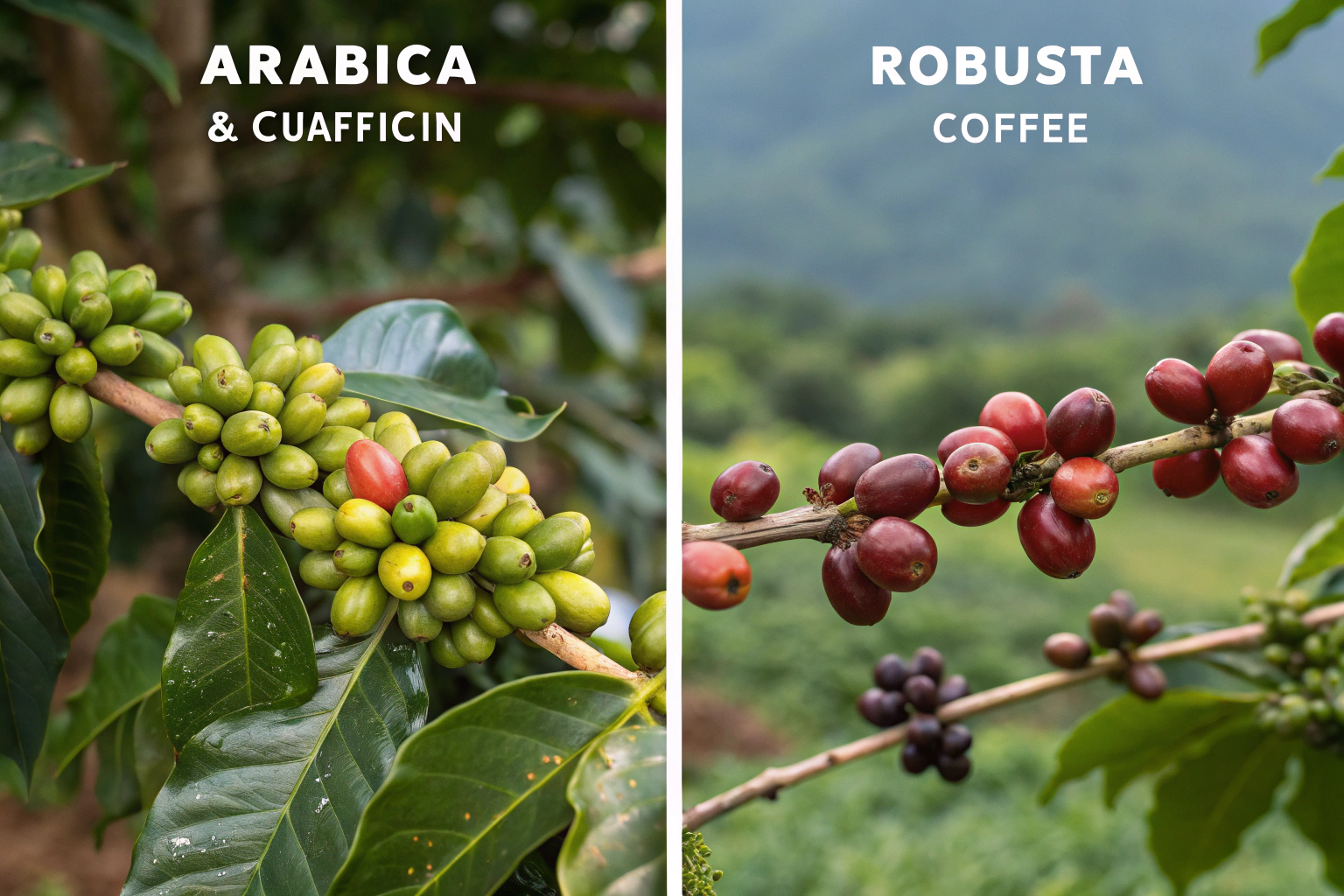
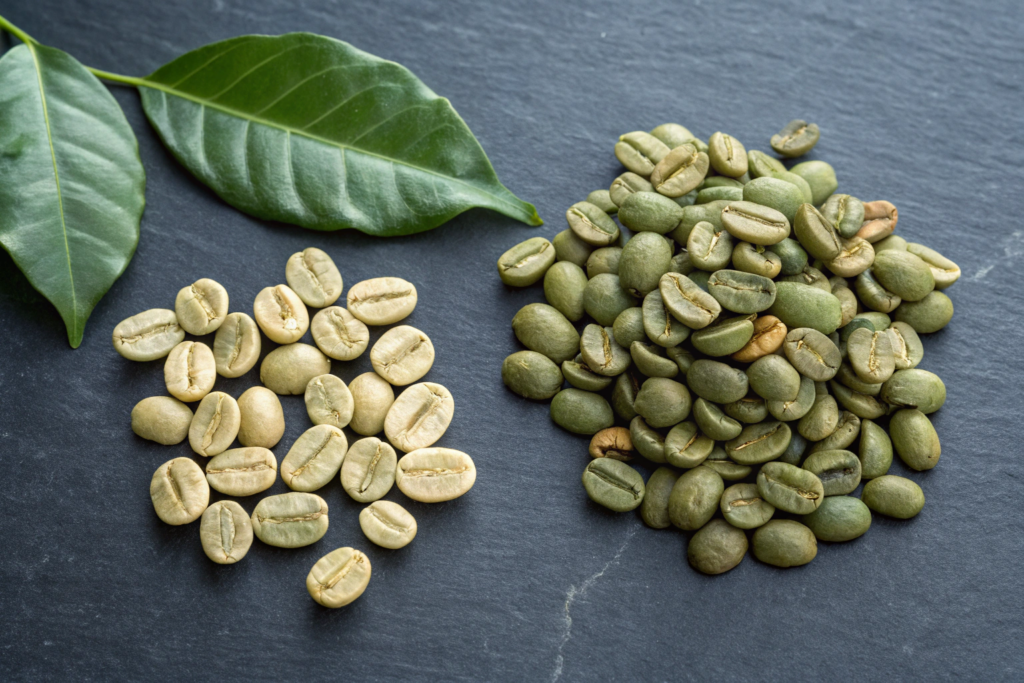
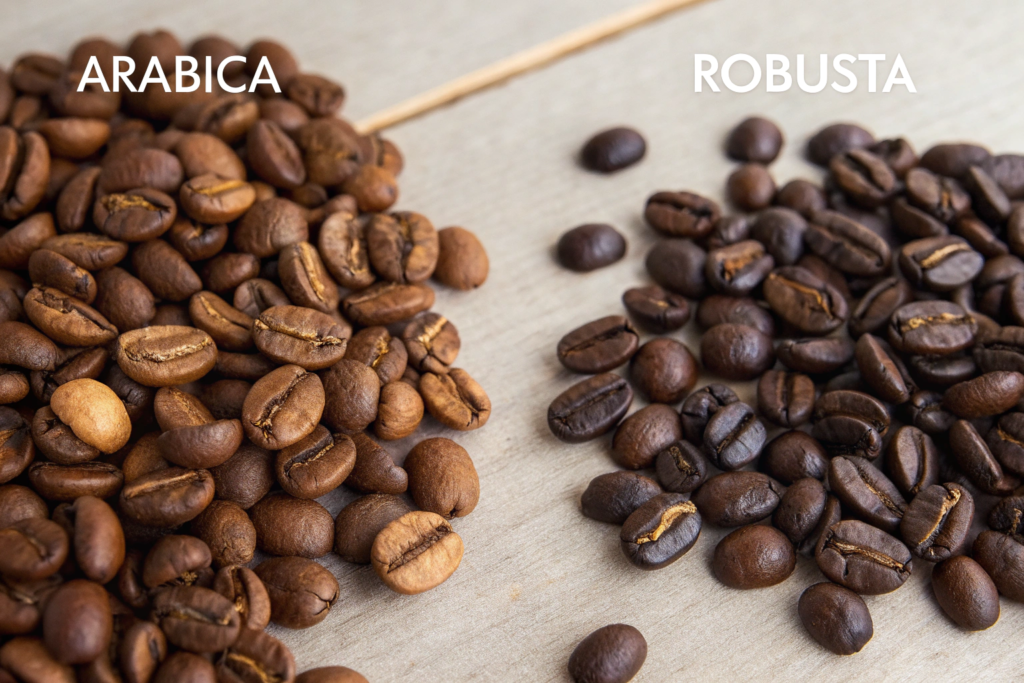
Arabica beans are larger, oval-shaped, and flat, with a distinctive S-shaped or curved center crease. Robusta beans are noticeably smaller, rounder, and plumper, with a straight or barely curved center crease. Arabica leaves are smaller and darker green; Robusta leaves are large, broad, and light green.
Grab a handful of green beans and spread them on a table. The Arabica beans should be fairly uniform in their elongated, pill-like shape. Look at the center cut—the seam that runs down the middle of the flat side. On an Arabica, it's wavy, like a meandering river. On a Robusta, it's a straight line, like it was drawn with a ruler. The size difference is also obvious. An 18-screen Arabica is substantial. A Robusta at the same screen size is denser and more compact. The density matters for roasting. Robusta is harder, heavier. It rattles in the roaster drum differently. It absorbs heat differently. I'll sometimes find a few Robusta floaters in a cheap Arabica lot—beans that don't look quite right. They're the little round ones, the oddballs. Under a UV light, they fluoresce differently too, but the naked eye check is fast and effective. The plant itself is also distinct. Arabica is a shorter, bushier tree, usually kept at 2-3 meters for picking. Robusta can grow into a proper tree, 5-8 meters tall, with larger, ribbed leaves. At BeanofCoffee, our Arabica blocks and Robusta blocks are visually distinct from a distance. The Robusta trees just look... coarser. Bigger, wilder, more vigorous.
How to Identify Bean Defects Unique to Each Species?
Defects aren't random. They're species-specific. Understanding the typical weaknesses of each type helps you grade a lot faster and decide if the price matches the quality.
For Arabica, the most common defects are insect damage from the coffee berry borer and sour beans from poor picking or processing. The berry borer is a tiny beetle that burrows into the cherry and lays eggs. An Arabica cherry is softer and sweeter, so it's an easy target. You'll see small, neat holes in the green bean—sometimes one, sometimes multiple. A sour bean happens when an overripe or fallen cherry ferments before drying. It looks darker, slightly brown, and smells like vinegar when you cut it. For Robusta, insect damage is less common because the higher caffeine content acts as a natural pesticide. The borers don't like it. But Robusta has its own problem: fungal damage. Because Robusta is often processed cheaply and dried on bare ground, it's prone to ochratoxin A and visible mold spots. Look for beans with a white, powdery coating or black, sooty patches. Another Robusta-specific defect is the "elephant bean"—a malformed, fused bean that looks like a small peanut. These happen more often in Robusta due to its genetics. A few elephant beans won't ruin a lot, but a high count suggests poor seed selection. When you're inspecting a sample, sort 350 grams onto a black velvet board and pick out every defect. The Green Coffee Association grading standards give you the exact counts allowed per grade. Knowing the typical defects of each species tells you whether the supplier is sorting properly or just bagging and shipping.
Why Does Bean Density Matter for Roasting and Shipping?
Density is the hidden variable that quietly messes up your roast profiles. Arabica beans, grown at high altitude, are less dense. Robusta beans, grown at low altitude, are much denser. This affects everything from shipping weight to heat transfer.
Let's start with shipping. A 60-kilo bag of Robusta takes up less physical space than a 60-kilo bag of Arabica. Robusta is heavier per liter. You can fit more weight of Robusta into a container. This matters for freight cost calculations. If you're paying a flat rate per container, Robusta gives you more beans for the same shipping cost. It's a small logistics advantage. Now, roasting. Density dictates how heat moves into the bean. A dense Robusta bean is like a small rock. The heat hits the surface and struggles to penetrate the center. You need more energy, longer roast times, and higher charge temperatures. If you drop Robusta into a drum pre-heated for Arabica, the outside will scorch while the inside stays raw. An Arabica bean, with its lower density and more porous structure, accepts heat more willingly. The Maillard reaction unfolds at a steadier pace. This is why a washed Arabica can handle a fast, bright roast profile, while a Robusta demands a slower, more deliberate approach. The density also affects degassing. Robusta holds onto CO2 longer post-roast. Your valve bags will stay puffed up for weeks. With Arabica, the degassing is more predictable and faster. If you're switching between species on the same roaster, you need to purge the machine and adjust your gas pressure. The difference is that significant. A moisture meter is your friend here, but a simple heft test—feeling the weight of the beans in your palm—already gives you a clue. Dense beans feel heavy for their size. Light beans feel airy. That tactile check can save you a ruined batch. The Specialty Coffee Association roasting guidelines cover density adjustments in detail for professional roasters.
How Do Flavor Profiles Differ Between the Two Species?
The flavor gap is the whole ball game. You can argue about growing costs, logistics, and certifications all day. But in the cup, there's no debate. Arabica and Robusta taste like different beverages. If you've only ever drunk commercial blends, you might not know the taste of pure Robusta. It's a shock.
Arabica delivers a smooth, sweet, and complex cup with bright acidity and notes of fruit, chocolate, nuts, and flowers. Robusta tastes earthy, woody, and aggressively bitter, with a flat body and a lingering, harsh aftertaste. Arabica is a melody. Robusta is a drumbeat—loud and simple.
Let me describe a typical cupping session in our lab. I roast a sample of our high-grown Catimor to a light-medium. I roast a sample of our cleanest Robusta to the same degree. I grind them. The Arabica dry fragrance is sweet—caramel, maybe a hint of dried apricot. The Robusta smells like roasted peanuts and something slightly smoky, like burnt toast. We add hot water. The Arabica crust blooms with a fruity, floral aroma. The Robusta crust is nutty, earthy, almost savory. We break the crust. The Arabica is alive. It hits the sides of the tongue with a crisp, malic acidity—green apple or plum. Then the sweetness rolls in: brown sugar, milk chocolate. The finish is clean and disappears quickly. The Robusta is heavy. It coats the back of the tongue with a dry, astringent bitterness. There's no acidity to lift it. Just a monochrome, woody, grain-like flavor. The aftertaste hangs around, and not in a good way. It's the bitterness from the high chlorogenic acids and caffeine. You can't roast this away. You can darken the roast to carbonize the bitterness into a more uniform charcoal taste, but you'll never find the fruit and floral notes because they aren't in the bean. The lipids—the fats that carry aroma—are half the level of Arabica. The sugar content is lower. The chemistry dictates the flavor. For a buyer, this means Arabica is the choice for any coffee that will be drunk black or marketed as specialty. Robusta has its place—in very dark Italian espresso blends for body and crema, or in instant coffee where the bitterness is masked by processing.
Can Processing Methods Narrow the Flavor Gap?
This is a fair question. If we take a Robusta and process it like a specialty Arabica—hand-pick only ripe cherries, wash it carefully, dry it on raised beds—can it taste good? The answer is yes, but with a hard ceiling. Fine Robusta is a real category. It's cleaner, less earthy, and more palatable than commodity Robusta. But it never crosses over into Arabica territory.
Fine Robusta, when processed meticulously, loses the worst of its defects. The rubbery, burnt-tire notes of cheap Vietnamese Robusta come from poor picking and dirty drying. A washed Fine Robusta eliminates those. What's left is a clean, neutral cup. It's like a blank canvas. You might get some nutty, cereal notes. Maybe a hint of dark cocoa. The body is thick and syrupy. It's actually quite pleasant in an espresso blend—adds a massive crema and a smooth, heavy texture. But it lacks acidity. Acidity in coffee is the sparkle, the brightness, the lemon or apple or berry tang. Arabica has organic acids—citric, malic, tartaric—built into its genetics. Robusta simply produces very little of these. You can't ferment or wash your way to acidity if the precursor compounds aren't in the cherry. So, a Fine Robusta is a very good version of a limited flavor spectrum. It's like polishing a rock. You can make it shiny and smooth, but it won't become a diamond. For a roaster, this means Fine Robusta is a blending tool, not a standalone specialty product. I sell a small amount of Fine Robusta to clients who want a clean crema booster. They use it at 5-10% in their espresso blend. It does the job perfectly without introducing the baggy, bitter defects of cheap Robusta. But if you're looking for a single-origin coffee to feature on your menu, Fine Robusta won't get you there. The flavor ceiling is a cupping score around 80-82. Specialty Arabica starts at 80 and goes up to 90+. The Coffee Quality Institute Robusta program has developed cupping standards specifically for Fine Robusta to recognize this limited but real quality spectrum.
How Does Caffeine Content Affect the Drinking Experience?
Caffeine is not just a stimulant. It's a flavor compound, and it's intensely bitter. Robusta's caffeine content ranges from 2.2% to 2.7%. Arabica's is 1.2% to 1.5%. That's roughly double. The bitterness you taste in Robusta isn't just from roasting or defects—it's chemically built into the bean.
This affects your customer's experience in two ways. First, the immediate taste. That sharp, metallic bitterness on the finish is the caffeine hitting the bitter taste receptors on the back of your tongue. It's a physical sensation, not a subtle flavor note. You can't mask it with milk. You can only dilute it. Second, the physiological effect. A cup of Robusta contains significantly more caffeine than a cup of Arabica. Some people want that—the jittery, eye-opening punch. But the specialty coffee drinker usually wants the opposite. They want a clean, sustained energy lift without the anxiety and crash. Arabica provides that smoother experience. The lower caffeine also means Arabica can be enjoyed throughout the day. An afternoon espresso with Robusta might keep you up until 2 AM. An afternoon Arabica is a gentler lift. For a cafe, this matters. Your customers might love the bold, strong kick of a Robusta-heavy blend in the morning. But if that's all you serve, they're unlikely to order a second cup. And they might blame the jitters on your brand. I've seen cafes quietly lose afternoon customers because their "house espresso" was a cheap, high-caffeine blend that people couldn't tolerate after noon. Switching to a high-quality Arabica base changed the drinking frequency and the customer satisfaction. The Healthline article on caffeine in coffee breaks down the exact amounts per cup. It's a useful resource to understand why the bean you choose changes the consumer experience beyond just flavor.
How Do Growing Conditions and Costs Compare?
The price gap between Arabica and Robusta isn't random. It's a direct reflection of the cost to produce a kilo of green coffee. These two plants have completely different economic models. One is a high-maintenance luxury crop. The other is an industrial commodity. Understanding this helps you appreciate why you pay more for Arabica and why a super-cheap Arabica offer is suspicious.
Arabica costs significantly more to grow because it demands high elevation, cool climates, careful hand-picking, and intensive disease management. Robusta thrives at low altitudes, tolerates heat and humidity, resists pests naturally, and can be mechanically harvested. The labor input per kilo for Arabica is roughly triple that of Robusta.
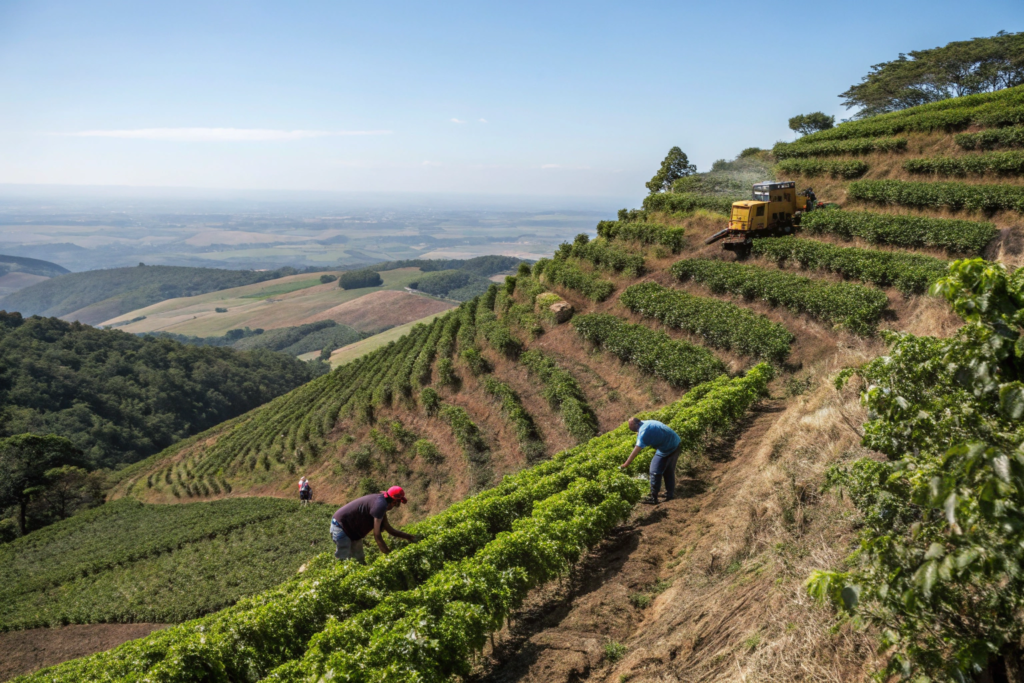
Let's put numbers on this. Our Arabica blocks in Baoshan sit at 1,200 to 1,600 meters. The slopes are steep. Every cherry is hand-picked, selectively, with pickers returning to the same tree three or four times over a harvest season. A picker might harvest 100-150 kilos of cherry per day. Our Robusta blocks sit at 600-800 meters. The land is flatter. The cherries ripen more uniformly. We can strip-pick, taking the whole branch in one pass. The same picker can harvest 300-400 kilos of Robusta cherry per day. That's a 2-3x labor productivity gap. Then there's inputs. Arabica is susceptible to coffee leaf rust. We spray copper fungicide. We prune aggressively to improve airflow. Robusta's leaves are thick and waxy—the rust fungus can't penetrate. No spraying needed. Arabica needs shade trees to protect it from direct sun. Robusta loves full sun. More inputs, more labor, more management. And yield: an Arabica tree produces fewer cherries than a Robusta tree of the same age. The Robusta tree is simply more vigorous. When you buy a kilo of Arabica, you're paying for the mountain, the shade, the selective picking, the disease control, and the lower yield per tree. When you buy Robusta, you're paying for a plant that grows almost like a weed, with minimal intervention. That's why the commodity price of Robusta is historically 50-60% lower than Arabica. If someone offers you Arabica at Robusta prices, either they're losing money, or it's not Arabica.
What Role Do Climate and Altitude Play in Quality?
Altitude isn't just a number. It's a biological clock. The higher you go, the cooler the nights. Cool nights slow down cherry maturation. A slow maturation means the bean spends more time on the tree, absorbing sugars and developing complex acids. This is the engine of Arabica quality.
Arabica's ideal temperature range is 15-24°C. That band is found at high altitudes in the tropics—1,200 meters and above. In our Baoshan farm, the daytime temperature might hit 24°C, but at night it drops to 10-12°C. This diurnal swing is massive. The plant goes into slow motion at night, concentrating its metabolic energy into the bean. Robusta's ideal temperature is 22-30°C. It's a heat-loving, humidity-loving plant. It thrives at sea level to 800 meters. The cherry matures fast. But that speed is a quality killer. A fast-maturing bean is starchy, not sugary. It lacks the time to convert organic acids into the complex, pleasant forms. Instead, it accumulates chlorogenic acids—the precursors to bitterness. This is why altitude is a shorthand for quality. A high-altitude Robusta is an oxymoron—it wouldn't grow well. A low-altitude Arabica is a disaster—it would taste flat and woody. So, the geography dictates the crop. And the crop dictates the price. When a buyer asks me why our Catimor from Baoshan tastes better than a Vietnamese Arabica, the answer is altitude. Vietnam's coffee belt is mostly lower and hotter, suitable for Robusta. Yunnan's high mountains are perfect for slow-maturing Arabica. The USDA climate zones and World Coffee Research's climate suitability maps show this clearly. Terroir isn't marketing. It's soil, temperature, and elevation, all of which hit your invoice as a cost of production.
Why Is Arabica More Vulnerable to Pests and Diseases?
Arabica is a delicate princess genetically. Robusta is a battle-hardened warrior. The difference traces back to their origins and their chromosomes. Arabica is an allotetraploid—it has four copies of each chromosome, a result of an ancient natural hybridization between two other coffee species. Robusta is a diploid—two copies. This genetic difference has huge practical implications.
Arabica's genetic diversity is narrow. Most Arabica plants in the world are descendants of a very small handful of trees. This inbreeding means they share the same weaknesses. Coffee leaf rust (Hemileia vastatrix) is a fungus that thrives in warm, humid conditions. It loves Arabica leaves. The spores land, germinate, and burrow into the leaf tissue, sucking out nutrients. An infected tree drops its leaves and starves. The 2012-2013 leaf rust epidemic devastated Central American Arabica farms. Robusta, as the name suggests, is resistant. Its leaf structure is thicker. Its chemical defense system—high caffeine and high chlorogenic acids—is toxic to many pests. Coffee berry borer? Prefers the softer, sweeter Arabica cherry. Robusta's harder, more bitter cherry is less appealing. This disease susceptibility means Arabica requires active pest management. We scout our fields. We use targeted spraying when needed. We plant rust-resistant varietals like Catimor, which is a natural hybrid of Arabica and Robusta that borrows Robusta's rust resistance while retaining Arabica cup quality. This hybrid vigor is the future of sustainable Arabica farming. Pure Arabica varietals like Bourbon or Typica are flavor goldmines but disease time bombs. They require perfect management. That management cost goes into the price. When you buy a washed Bourbon from a high-altitude farm, you're partly paying for the fungicide, the labor hours of scouting, and the risk premium. The CABI Coffee Leaf Rust resource offers a deep dive into the biology of this disease and the global efforts to combat it.
How to Choose the Right Species for Your Coffee Business?
Choosing between Arabica and Robusta isn't about good versus bad. It's about your business model, your customer base, and your brand identity. A truck stop diner and a third-wave specialty cafe have different needs. The mistake is defaulting to one without thinking through the trade-offs.
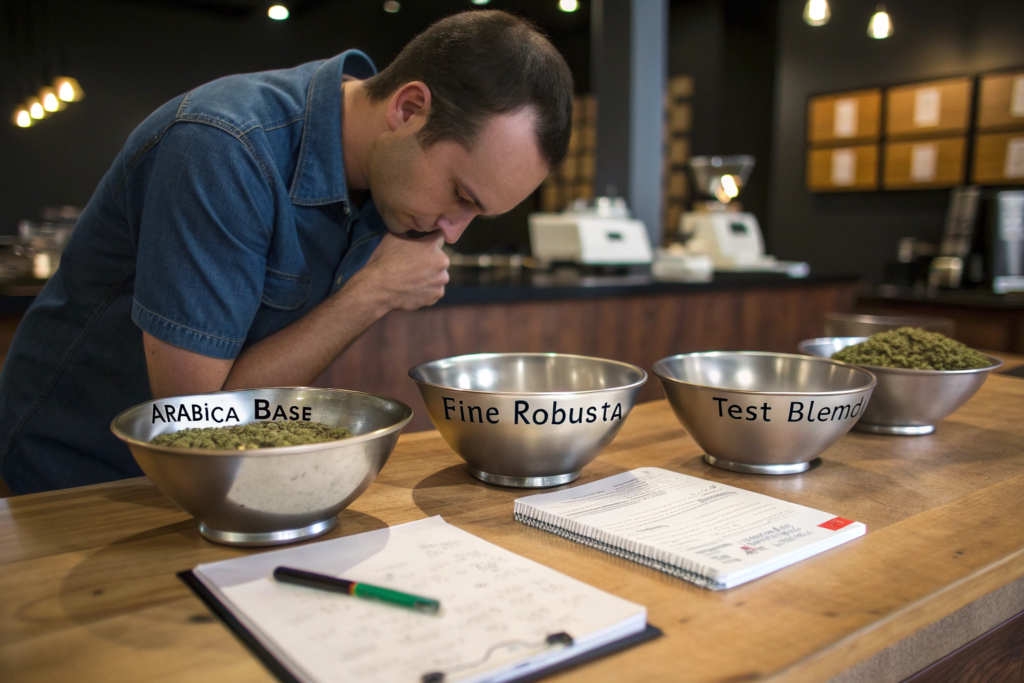
Choose Arabica if your brand is built on flavor complexity, specialty marketing, and black coffee consumption. Choose a clean, high-grade Robusta as a blending component if you need crema enhancement, cost reduction, or a high-caffeine product. The smartest approach is often a deliberate blend—an Arabica base with a small, intentional Robusta percentage for structure and value.
Your customer tells you what to buy. If your menu features single-origin pour-overs and the roast date is printed on the bag, you need Arabica. Period. Your customer expects acidity, sweetness, and a story. Give them a Robusta, and they'll think you burned the roast. If your business is high-volume espresso in a traditional Italian style—short, intense shots drunk with sugar—a blend with 10-15% high-grade Robusta makes sense. The Robusta adds a thick, velvety body and a persistent crema that holds up to sugar and milk. The dark roast tames the bitterness. Your customer isn't looking for fruit notes; they want power and texture. If you're a commercial roaster supplying offices and restaurants with drip coffee, you might be tempted to use cheap Robusta to hit a price point. Be careful. A low-quality Robusta introduces earthy, baggy flavors that even cream and sugar can't hide. A better strategy is to use a value-oriented Arabica from an undervalued origin—like our Yunnan Catimor—as your base. It costs less than a Colombian Supremo but tastes clean and sweet. You hit your budget without sacrificing drinkability. The customer might not know why your coffee tastes better than the competitor's, but they'll notice. At BeanofCoffee, we help clients design blends that match their market position. It's not about selling the most expensive bean. It's about selling the right bean for the job.
When Does It Make Sense to Use Robusta in a Specialty Setting?
There's a quiet revolution happening with Robusta in specialty coffee. It's no longer a dirty secret. Roasters are openly listing Robusta on their blend labels, not as a cheap filler, but as a deliberate ingredient. This transparency is changing the conversation.
The scenario where Robusta makes sense in specialty is when you want a specific textural and visual result. Espresso crema is the most obvious. A 100% Arabica espresso, especially a light roast, can have a thin, fast-dissolving crema. A shot with 10% Fine Robusta has a thick, tiger-striped crema that lingers. For a barista, that's a joy to work with. It also holds up better in milk drinks. The Robusta's strength cuts through the fat and sweetness of the milk, giving the latte a distinct coffee presence rather than a milky wash. Another scenario is cold brew. Robusta cold brew is intense, chocolatey, and hugely caffeinated. Some specialty shops market a "power hour" cold brew made with a high percentage of clean Robusta. It's an honest product—it's strong, it's bold, and the customer knows exactly what they're getting. The key, always, is quality and transparency. Never slip Robusta into a blend silently to save money. Your customers will notice the flavor shift, even if they can't articulate it. They'll just think your coffee "got worse." Label it. Explain it. "We add 10% hand-sorted, washed Indian Kaapi Royale Robusta to our espresso blend for crema and body." That's a selling point, not a confession. If you're sourcing Fine Robusta, demand a pre-shipment sample and cup it critically. Look for cleanliness—no musty, earthy, or moldy notes. A good Fine Robusta should taste neutral, grainy, and slightly nutty. It should be a canvas, not a distraction. The Barista Guild resources can help your team learn how to present and extract Robusta-inclusive blends professionally.
How to Spot Arabica-Robusta Mix Fraud When Sourcing?
Fraud happens. Even with certificates, even with trusted relationships, beans get mixed. A trader might "improve" an Arabica lot by adding cheaper Robusta beans that look similar after roasting. Your defense is vigilance at the green stage.
I train my team to do a simple green bean audit on every incoming lot, and I encourage buyers to do the same. Take a 350-gram sample. Spread it on a black tray. First, look for physical shape. The curved crease of Arabica versus the straight crease of Robusta is the fastest giveaway. If you see any round, small beans with a straight line, pull them out. Second, do a water test. Robusta beans are denser than Arabica. Dump the sample in a beaker of water. The Robusta beans tend to sink faster and stay at the bottom. Arabica beans are slightly more buoyant at first. This isn't a perfect test, but it's a quick visual. Third, a UV light can help. Arabica fluoresces a different shade than Robusta under certain wavelengths. A cheap handheld UV flashlight from a hardware store works. Fourth, and most definitively, send a sample to a lab for species verification. Labs use genetic testing or chemical markers (like 16-O-methylcafestol, which is present in Robusta but not Arabica) to identify adulteration. If you suspect a supplier is cutting your Arabica, don't accuse without evidence. Do the lab test. Get the data. Then present it calmly. A supplier who values the relationship will fix the problem—maybe it was a genuine mistake at their mill. A supplier who gets defensive and denies the lab result is someone you stop doing business with. Protecting your brand means verifying your supply chain. The International Coffee Organization's coffee fraud resources offer guidance on species verification and industry standards for authenticity. It's worth familiarizing yourself with their protocols.
Conclusion
Arabica and Robusta are not the same product. They look different, they grow differently, they process differently, and they taste radically different. Arabica is the choice for flavor, complexity, and the specialty experience. Its oval beans, slow mountain maturation, and high sugar content create the fruity, sweet, aromatic cups that define modern coffee culture. Robusta is the choice for strength, body, and utility. Its round beans, fast lowland growth, and high caffeine deliver a bitter, earthy, powerful punch that has a legitimate place in traditional espresso blends and instant coffee. The risk is in the mix—paying for Arabica and getting Robusta silently blended in. The opportunity is in the intention—using each species deliberately to achieve a specific product goal.
At BeanofCoffee, we grow and export both. Our high-altitude Catimor Arabica is a specialty-grade bean with the brightness and sweetness your customers expect. Our washed Fine Robusta is a clean, honest ingredient for blenders who need body and crema without the earthy defects. We don't confuse the two, and we don't let our clients confuse them either.
If you want to cup the difference yourself, my export director, Cathy Cai, can send you sample kits of our Arabica and Robusta, roasted and green. She can also provide lab verification reports and help you design a blend that hits your quality and budget targets. Reach her at: cathy@beanofcoffee.com.