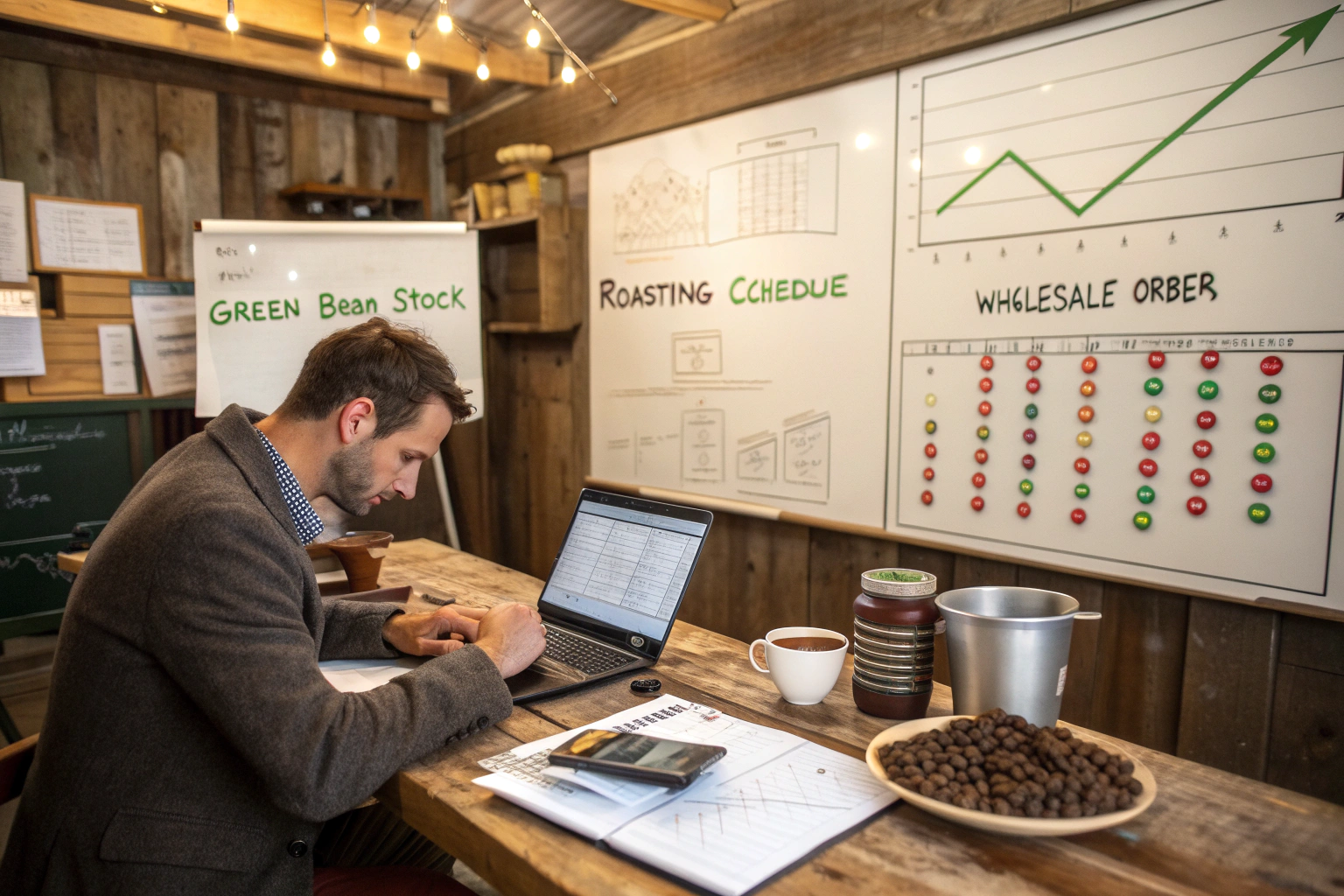
A roaster I know in Portland nearly went under two years ago. Not because his coffee was bad. His coffee was excellent. He failed because he was always running out of his best-selling single origin and sitting on pallets of a seasonal lot nobody asked for. He forecasted with his gut. "This Ethiopian will fly off the shelf." It didn't. The Colombian he under-ordered sold out in two weeks. His wholesale accounts started complaining about inconsistency. Two cafes left. He called me in a panic, asking if I could air-freight a pallet of our Baoshan to cover the gap. The air freight cost more than the coffee. He survived, but the scar tissue is still there.
Forecasting coffee demand for a roastery requires combining historical sales data with seasonal consumption patterns, wholesale account projections, and green coffee harvest calendars. The process moves from an annual volume plan to quarterly purchase orders to monthly roast schedules, with built-in safety buffers that account for both supply chain disruptions and unexpected demand spikes.
Demand forecasting is not clairvoyance. It is a discipline. It combines looking backward at what sold and looking forward at what is coming. A roaster who does it well sleeps through the night. A roaster who does it poorly is always fighting fires.
What Data Should You Analyze to Build a Baseline Demand Forecast?
The best predictor of future demand is past demand. But raw sales data is not a forecast. It is the raw material for one. The roaster's job is to extract the signal from the noise. How much coffee did you sell last year? Not just in total. Month by month. Product by product. Channel by channel.
Building a baseline demand forecast starts with analyzing at least two years of historical sales data, broken down by month, by product category, and by sales channel. This data reveals the underlying consumption trend, the seasonal peaks and troughs, and the growth or decline trajectory of each part of the business.
A roaster who sold 20,000 pounds of coffee last year with 15% growth over the previous year has a starting point. The baseline for next year is around 23,000 pounds, assuming the trend continues. But that baseline is just the first number. It gets adjusted for everything else: new wholesale accounts opening, old ones closing, a new retail bag launch, a price increase that might suppress volume, a marketing push that might spike it. The baseline is the skeleton. The adjustments put the flesh on it.

How Should You Segment Sales History by Product and Channel?
Not all sales are equal in forecasting value. A wholesale account that orders 200 pounds every Tuesday like clockwork is highly predictable. A retail subscription that fluctuates with gift-giving seasons is less so. A one-time large order for a corporate event is noise.
Segment the sales data into meaningful categories. Wholesale accounts, each tracked individually with their order history and growth trajectory. Retail bags sold through the roastery cafe and website. Online subscriptions with monthly churn and acquisition rates. Seasonal or limited-release products that sell out quickly and are not reordered. Each segment has its own pattern. Wholesale may be flat but stable. Retail may be growing but seasonal. The forecast for each segment is built separately and then combined into the total volume plan.
What External Factors Should Influence Your Forecast Adjustment?
The roastery does not exist in a vacuum. External factors can override historical trends. A new competitor opening across town. A major employer in the city closing down. A sudden surge in coffee prices that forces a retail price increase.
Economic conditions matter. In a recession, consumers may trade down from specialty coffee to supermarket brands, or they may treat specialty coffee as an affordable luxury and maintain spending. The direction is not always predictable, but the awareness should be present. Weather patterns matter. A hot summer boosts cold brew and iced coffee sales. A cold winter boosts hot drip and espresso. A roaster in a city with distinct seasons should model the seasonal swing explicitly. The baseline forecast must be stress-tested against these external variables.
How Do Coffee Harvest Calendars Affect Your Purchasing Plan?
Coffee is not manufactured. It is grown. It has a harvest season. A roaster who treats green coffee like paper cups, something you reorder when the box runs low, will constantly be buying whatever is available at whatever price the spot market demands. The alternative is to plan purchasing around the harvest calendar.
The coffee harvest calendar dictates when fresh crop is available from each origin. A roaster should build their annual purchasing plan backward from these harvest windows, buying enough from each origin during its harvest season to cover demand until the next harvest. This approach maximizes freshness, optimizes pricing, and secures supply before the best lots are allocated.
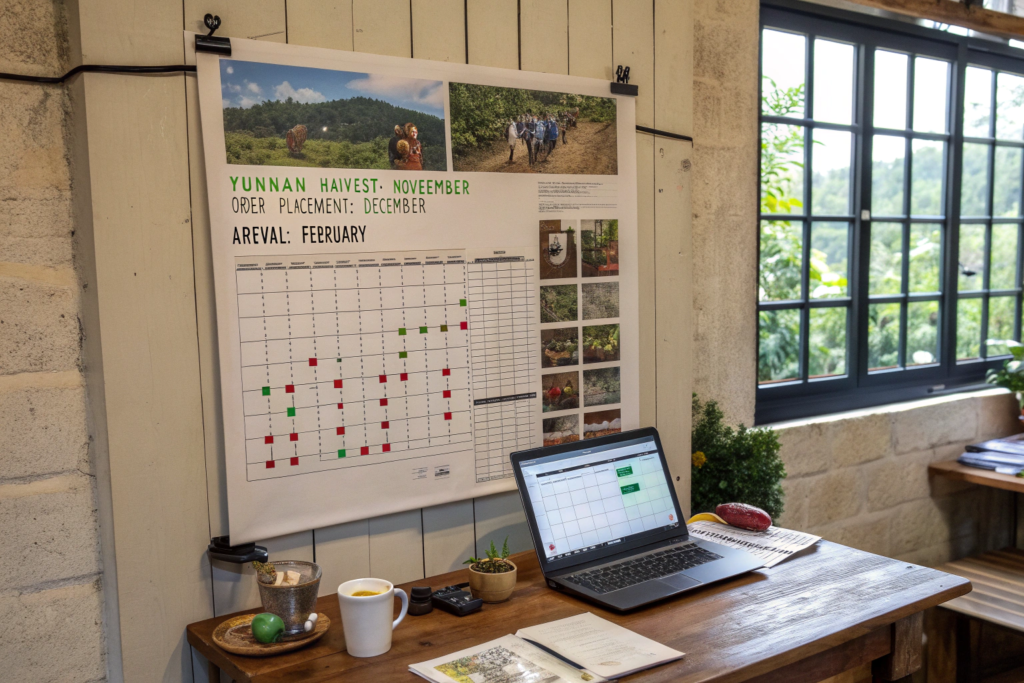
For our Yunnan Arabica, the harvest runs from November to February. The ideal buying window is during harvest, December to January, when the coffee is fresh and pricing reflects harvest economics. A roaster who plans to sell Yunnan single origin year-round needs to buy their annual volume during this window. If they wait until July and try to buy Yunnan on the spot market, the coffee will be older, the best lots will be gone, and the price will likely be higher.
How Should You Align Purchasing Cycles with Harvest Seasons?
The alignment is a math problem with a calendar. Start with the annual volume forecast for each origin-specific product. Divide by the number of months that product is on the menu. Multiply by the number of months between the harvest purchase and the next year's harvest arrival.
For example, a roaster sells 300 pounds of Yunnan single origin per month. They want it on the menu year-round. Annual need is 3,600 pounds. The new crop arrives in February. The roaster should buy the full 3,600 pounds during the December-January harvest window. The coffee ships in February-March, arrives in March-April, and covers the menu until the next harvest cycle. The same calculation applies to every origin on the menu. The result is a purchasing calendar that spans the year, with different buying windows for different origins.
What Is the Role of Forward Contracts in Supply Stability?
A forward contract is an agreement signed before or during harvest, locking in volume and price for delivery later. It is the single most effective tool for aligning demand forecasting with supply security.
A roaster with a forward contract knows the coffee is reserved. They know the price. They can plan their menu and their retail pricing with confidence. The farmer knows the coffee is sold. The forward contract eliminates the scramble for spot inventory when the previous supply runs out. It transforms the buyer-supplier relationship from a series of one-off transactions into a planned partnership.
What Inventory Buffer Strategies Protect Against Forecast Errors?
No forecast is perfect. The question is not whether the forecast will be wrong. The question is how wrong and in which direction. A good forecasting system includes buffers that absorb error without breaking the business.
Inventory buffer strategies protect against forecast errors by maintaining safety stock of core products that never drops below a defined minimum, building flexibility into the production schedule to accelerate or decelerate roasting in response to real-time demand signals, and diversifying the supplier base so that a single origin shortage does not halt production entirely.
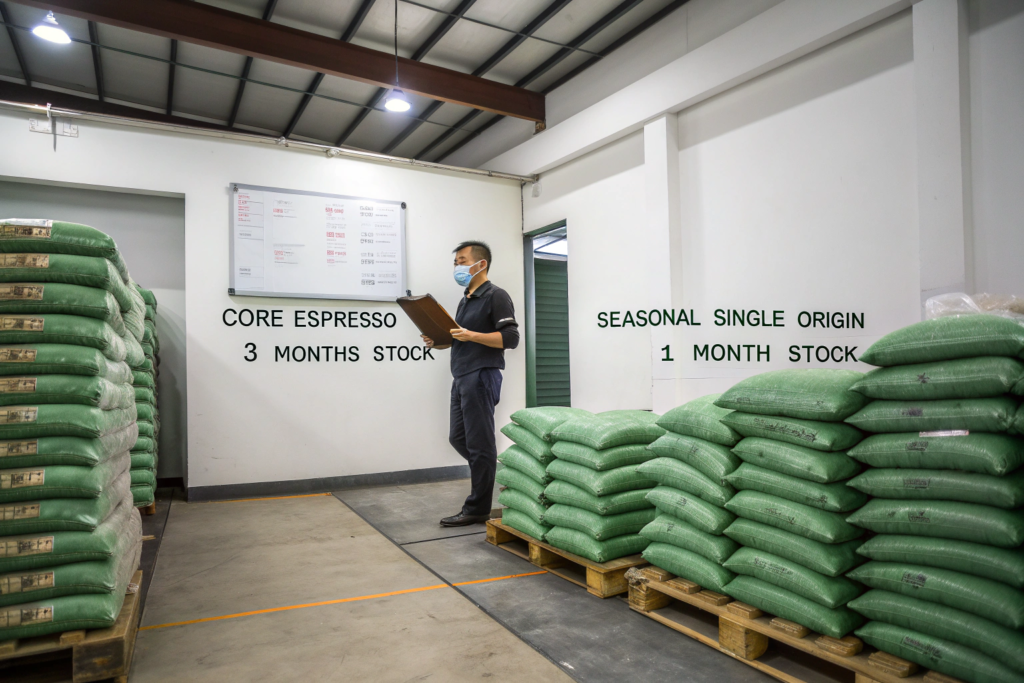
A safety stock is a quantity of green coffee held in reserve above the forecasted need. For a core espresso blend sold year-round, the safety stock might be two to four weeks of average sales volume. If a wholesale order spikes or a shipment is delayed, the safety stock covers the gap. The cost of holding safety stock is the storage space and the working capital tied up in inventory. The cost of not holding safety stock is a stockout. Stockouts lose customers. The inventory math usually favors the buffer.
How Much Safety Stock Is Appropriate for Core Blends?
The safety stock level for a core blend depends on three variables: the predictability of demand, the lead time for replenishment, and the cost of a stockout.
A core espresso blend with stable, predictable weekly demand and a four-week lead time from supplier might need a safety stock of two weeks of inventory. If demand is more volatile, the buffer increases. If the supplier is overseas and the lead time is uncertain, the buffer increases further. The calculation is a balance. Too little safety stock risks stockouts. Too much ties up cash and ages the coffee. The buffer quantity should be reviewed quarterly and adjusted as conditions change.
When Should You Diversify Suppliers to Mitigate Risk?
Supplier diversification is insurance. A roaster who depends on a single origin for a single product is exposed. If that origin has a crop failure, a shipping disruption, or a quality problem, the product is dead.
Diversification does not mean sourcing every product from five different suppliers. It means having backup options. A core blend might be built on two coffees from different origins that can substitute for each other if one becomes unavailable. A relationship with a second supplier, even if not used regularly, provides a lifeline. The roaster who has only ever bought from one source has no plan B. The roaster who has qualified a backup supplier and knows the coffee will work in the blend has options.
How Can Seasonal Trends and Promotions Be Modeled in a Forecast?
Coffee demand is not flat across the year. It breathes. It has a pulse. The holidays push demand up. The post-holiday lull drops it. Summer changes what people buy. A forecast that assumes every month is average will miss the real shape of the business.
Seasonal demand modeling requires identifying the historical demand uplift or decline for each month relative to the annual average, mapping promotional campaigns to their expected impact based on past campaign data, and adjusting the baseline forecast upward or downward to reflect these known seasonal and promotional patterns.
A roaster who sold 2,000 pounds in December and 1,200 pounds in January last year, and the year before that, should not forecast 1,600 for both months. The December forecast should be higher. The January forecast should be lower. The seasonal index, the ratio of a given month's sales to the monthly average, turns a flat annual forecast into a shaped monthly plan.
How Do Holiday Blends and Seasonal Offerings Impact Volume?
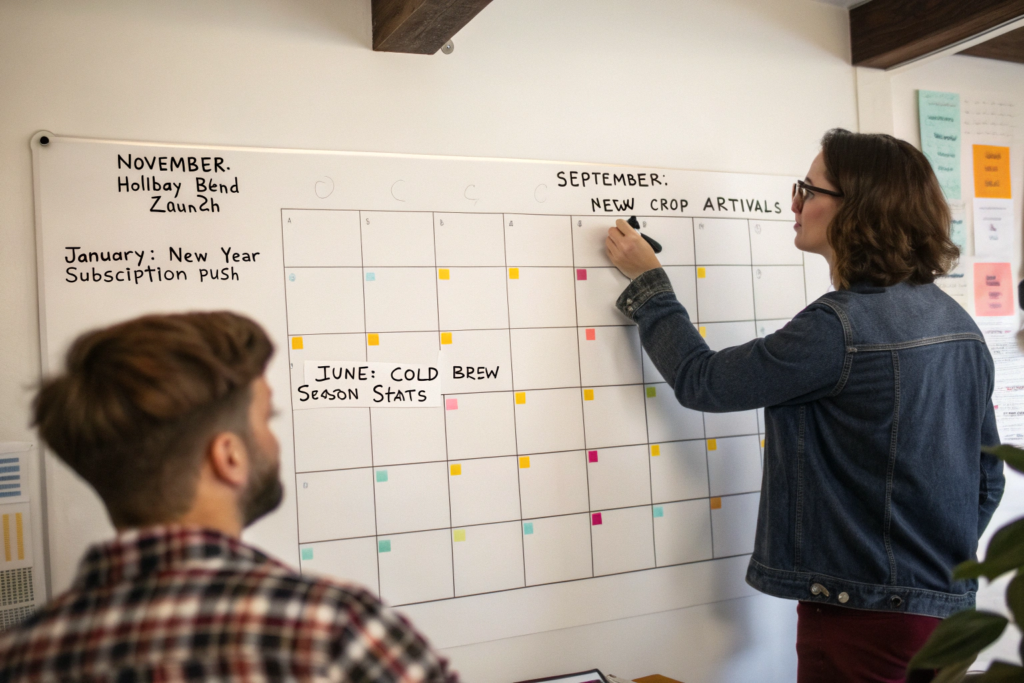
Holiday blends and seasonal offerings are demand drivers, not just menu rotations. A well-marketed holiday blend can spike December volume 30% above baseline. A pumpkin spice or summer cold brew seasonal can pull in customers who do not buy the core products.
But seasonal offerings also introduce forecasting complexity. The sales window is short. The packaging is often custom and ordered in advance. Over-forecasting leaves the roaster with branded bags and green coffee they cannot sell until next year. Under-forecasting leaves money on the table and frustrates customers. The solution is to treat seasonal products as a separate forecast line item, based on the previous year's seasonal sales with a modest growth assumption. The seasonal green coffee purchase should be sized to the seasonal forecast, not to the year-round blend need.
What Data Should Inform a Promotional Lift Assumption?
Not all promotions work equally well. An email blast to the subscriber list might generate a 10% lift. A discount code promoted on social media might generate a 25% lift. A collaboration with a popular local bakery might generate a 50% lift for that week.
The only way to forecast promotional lift accurately is to measure it historically. A roaster should track every promotion: the channel, the offer, the cost, and the resulting sales bump. After a year of tracking, patterns emerge. The email blast reliably drives a 10-15% bump. The social media discount drives 20-30% but with lower margin. These historical lift factors become the adjustment coefficients in next year's forecast.
Conclusion
Demand forecasting for a roastery is not about predicting the future with perfect accuracy. It is about reducing uncertainty to a manageable level and building systems that handle the remaining uncertainty gracefully. The discipline combines historical sales analysis, harvest calendar alignment, safety stock buffers, and seasonal adjustment. The output is not a single number. It is a range, with a base case, a downside case, and an upside case. The roaster purchases to the base case, holds safety stock for the downside, and has a plan for the upside.
The roaster who forecasts well buys the right coffee, at the right time, in the right quantity. They pay harvest prices, not spot premiums. They carry enough inventory to cover demand but not so much that coffee ages. They launch seasonal products with confidence. They sleep well.
If aligning your purchasing with the harvest calendar and securing reliable supply is part of your forecasting strategy, we can help. Our Yunnan Arabica harvest runs from November to February. Forward contracts signed during harvest lock in fresh crop at harvest pricing for delivery when you need it. Contact Cathy Cai at cathy@beanofcoffee.com to discuss your volume forecast and how we can structure a supply plan that matches your demand curve. Let's plan ahead, together.