I sat in a conference room in Geneva last December with a dozen other coffee exporters. The EU Deforestation Regulation was the only topic. The mood was tense. A German trader raised his hand and said, "Half my suppliers cannot provide a farm polygon map. They don't even have GPS. What do I tell my customers?" The room was silent. Nobody had a good answer. Then a Dutch importer spoke up. "I am switching origins. I need suppliers who are ready. I cannot gamble on compliance." That was the moment I realized EUDR is not just a regulation. It is a sorting mechanism. It divides the coffee world into those who can prove their product is clean and those who cannot.
The EU Deforestation Regulation impacts coffee importers by legally requiring them to prove that every coffee lot entering the European Union was not grown on land deforested after December 31, 2020. This mandates full geolocation traceability to the specific farm plot, a due diligence statement backed by verifiable data, and carries penalties of up to 4% of annual EU turnover for non-compliance. The regulation is reshaping sourcing relationships, raising compliance costs, and accelerating the shift toward direct trade with large, organized producers.
EUDR is not a suggestion or a voluntary certification. It is law. As of December 2025, large companies must comply. Small and medium enterprises have until mid-2026. After that, any coffee entering the EU market without the required documentation is illegal. The era of anonymous coffee in Europe is over.
What Exactly Does the EU Deforestation Regulation Require from Coffee Importers?
The regulation is formally called Regulation 2023/1115. It covers coffee, cocoa, palm oil, soy, cattle, and wood. For coffee, it applies to both green beans and roasted coffee entering the EU market. The core obligation is simple to state but complex to execute.
EUDR requires coffee importers to collect the geolocation coordinates of every farm plot that produced the coffee, verify through satellite data and risk assessment that no deforestation occurred on that land after the cutoff date, and submit a due diligence statement to the EU information system before the coffee clears customs. Without this digital dossier, the shipment is rejected at the border.
The geolocation requirement is the hardest part. For farms over four hectares, the importer must provide polygon maps showing the exact boundaries of the production area. For farms under four hectares, a single GPS point is acceptable, but the farmer must still prove the land was not deforested. The importer must also conduct a risk assessment. If the coffee comes from a country classified as high-risk, the importer must take additional steps, potentially including on-site audits. The regulation applies retroactively to the cutoff date. Land cleared in 2019 is fine. Land cleared in 2021 is not. The coffee grown on that 2021 land is illegal in the EU, period.
What Is a Due Diligence Statement and Who Submits It?
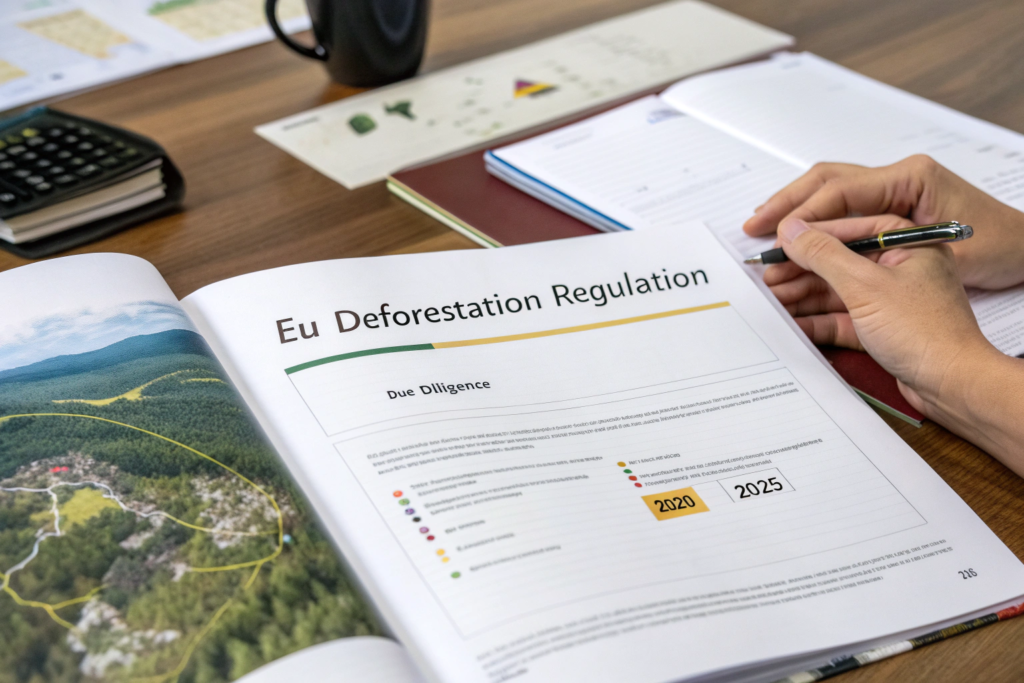
The due diligence statement is the legal declaration that the importer has done the required checks and the coffee is deforestation-free. It is submitted electronically through the EU's online information system before the coffee is placed on the market.
The statement includes the importer's registration details, the commodity type, the country of production, the geolocation data of the plots, the volume of the shipment, and a confirmation that the risk assessment was conducted and no significant risk was found. The system generates a reference number. The customs authority checks this number when the coffee clears the border. Without it, the coffee does not enter. The importer is legally responsible for the accuracy of the statement. If the statement is later found to be false, the importer faces the penalties, not the exporter. This legal liability is driving importers to demand far more documentation from their suppliers than ever before.
How Are Penalties Structured Under the Regulation?
The penalties are designed to be a deterrent, not a cost of doing business. The regulation specifies fines of up to 4% of the operator's total annual EU turnover. For a large coffee importer, this is a catastrophic number.
Beyond fines, penalties include confiscation of the non-compliant coffee, confiscation of revenues gained from selling non-compliant coffee, and temporary exclusion from public procurement and public funding. The reputational damage of a public enforcement action may be even more costly. A roaster or importer found to have placed deforestation-linked coffee on the EU market will face consumer backlash and potential delisting by retail partners. The market pressure reinforces the legal pressure.
How Does EUDR Change Coffee Sourcing Strategies for European Roasters?
European roasters are rethinking their entire supply chain. The days of buying anonymous "Colombian Excelso" from a broker and calling it a day are over. Every lot now requires a paper trail back to a specific piece of land. This is forcing changes in who roasters buy from and how they structure their sourcing relationships.
EUDR is driving European roasters to consolidate their supplier base around larger, well-organized producers and cooperatives that can provide the required geolocation and deforestation data. Smallholder farmers in regions without digital land registries or organized cooperative support are at risk of being excluded from the EU market entirely. Direct trade relationships with data-capable origins are becoming a competitive necessity.
The roaster who previously sourced from twenty different small suppliers is now looking to source from five suppliers who can deliver full documentation. The transaction cost of collecting and verifying geolocation data from dozens of fragmented sources is too high. The risk of one non-compliant lot contaminating the entire supply chain is too great. Consolidation is the rational response. This benefits origins like Yunnan, where coffee production is organized into large estates and well-managed cooperatives with access to digital mapping tools.
Why Is Smallholder Access to the EU Market at Risk?
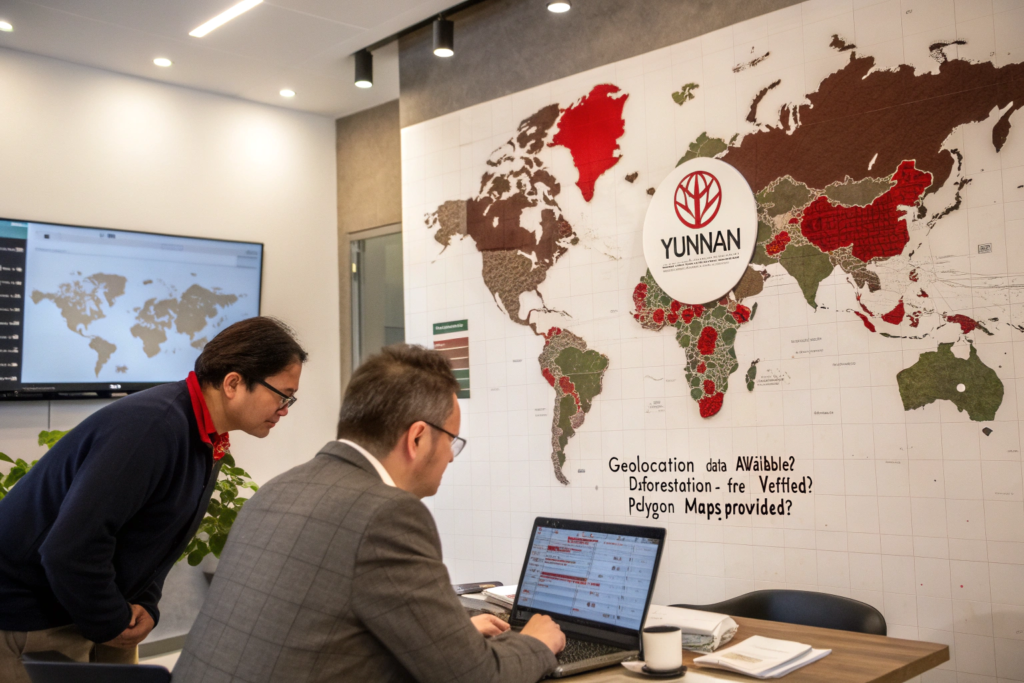
Smallholder coffee farmers produce a significant portion of the world's specialty coffee. But many of them operate on small plots of land without formal land titles, GPS devices, or digital record-keeping. They sell their cherries to local collectors, who aggregate them and sell them up the chain. The traceability is broken at the first step.
Under EUDR, the importer needs the geolocation of the specific farm. If the farmer cannot provide it, the collector cannot provide it, the exporter cannot provide it, and the coffee cannot enter the EU. The regulation risks creating a two-tier market. Smallholders who are part of a cooperative that invests in digital mapping and compliance support can survive. Smallholders operating independently, without that support structure, may be shut out. Some European buyers are already reducing purchases from regions known for fragmented smallholder supply chains and shifting volume to origins where estate production or strong cooperative structures make compliance easier.
How Are Direct Trade Relationships Becoming a Compliance Advantage?
Direct trade, where the roaster buys directly from the producer without intermediaries, offers a structural advantage under EUDR. The shorter the supply chain, the fewer the links where data can be lost, altered, or fabricated. A direct relationship also allows the roaster to verify the geolocation data personally.
When a roaster visits the farm or conducts a video audit, they can confirm that the polygon map matches the actual land. They can walk the boundary with a GPS device. They can see that the forest adjacent to the coffee plot is standing. This personal verification is more robust than relying on a chain of intermediaries. Direct trade relationships are becoming not just a quality preference but a risk management strategy. The roaster who knows their farmer, has walked the land, and trusts the data sleeps better at night when the EUDR compliance audit comes.
What Traceability Technologies Are Essential for EUDR Compliance?
EUDR compliance is impossible without technology. Paper records and verbal assurances are insufficient. The regulation requires verifiable, geo-referenced data that can be cross-checked against satellite imagery and shared with regulators electronically. This is a digital challenge as much as an agricultural one.
The essential technologies for EUDR compliance include GPS-enabled farm mapping tools that generate polygon boundary data, satellite monitoring platforms that provide historical forest cover analysis, blockchain or cloud-based traceability systems that track lot identity from farm to export, and QR code labeling that links physical coffee bags to their digital compliance dossier.
The farm polygon is the foundational data unit. Using a smartphone app or a dedicated GPS device, a farmer or technician walks the perimeter of the coffee plot. The app records the latitude and longitude coordinates and generates a polygon file, typically in GeoJSON or KML format. This polygon is then overlaid on satellite imagery from the cutoff date, December 31, 2020, using a platform like Global Forest Watch or a commercial provider. The comparison shows whether the land inside the polygon was forested on that date and whether it has been cleared since.
How Does Satellite Monitoring Verify Deforestation-Free Claims?
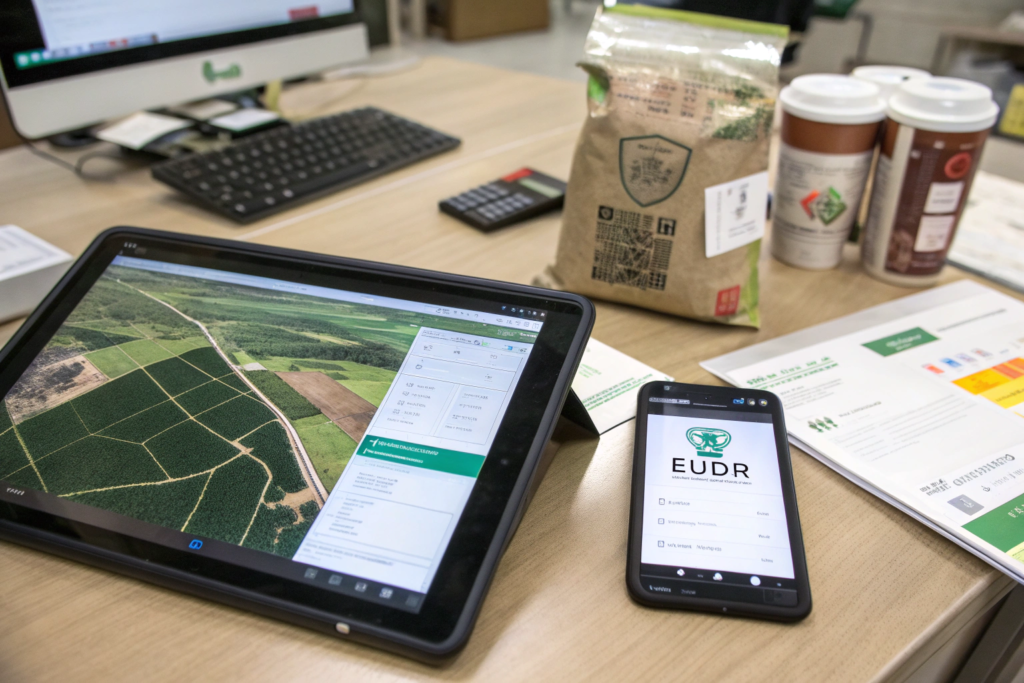
Satellite monitoring is the verification engine of EUDR. The regulation does not require importers to physically inspect every farm. But it does require them to use satellite data to assess deforestation risk. The technology has advanced rapidly in recent years.
Public platforms like the EU's Copernicus program and the University of Maryland's Global Forest Watch provide free access to satellite imagery with resolutions sufficient to detect forest cover change. Commercial providers offer higher resolution imagery and automated analysis. The importer or exporter uploads the farm polygon to the platform. The platform analyzes satellite images of that area from multiple dates. If the analysis shows forest cover on December 31, 2020, and no loss after that date, the lot passes the deforestation check. If the analysis is inconclusive or shows forest loss, the lot requires further investigation or rejection.
Can Blockchain Secure the Chain of Custody from Farm to Cup?
Blockchain is a digital ledger that records transactions in an immutable, transparent sequence. For coffee, it can record every custody transfer: farmer to processor, processor to exporter, exporter to importer, importer to roaster. Each transfer is a block. The blocks are cryptographically linked.
Under EUDR, blockchain provides chain of custody integrity. The geolocation data and deforestation verification are attached to the initial lot record. Every subsequent transaction links to that record. The importer can trace the coffee back to the verified origin with confidence that the data has not been tampered with. Blockchain does not replace the need for accurate initial data. If a farmer enters false coordinates, the blockchain faithfully records false coordinates. But it does prevent the data from being altered later in the chain, which addresses one major vulnerability in traditional paper-based traceability.
What Are the Cost Implications of EUDR for the Coffee Supply Chain?
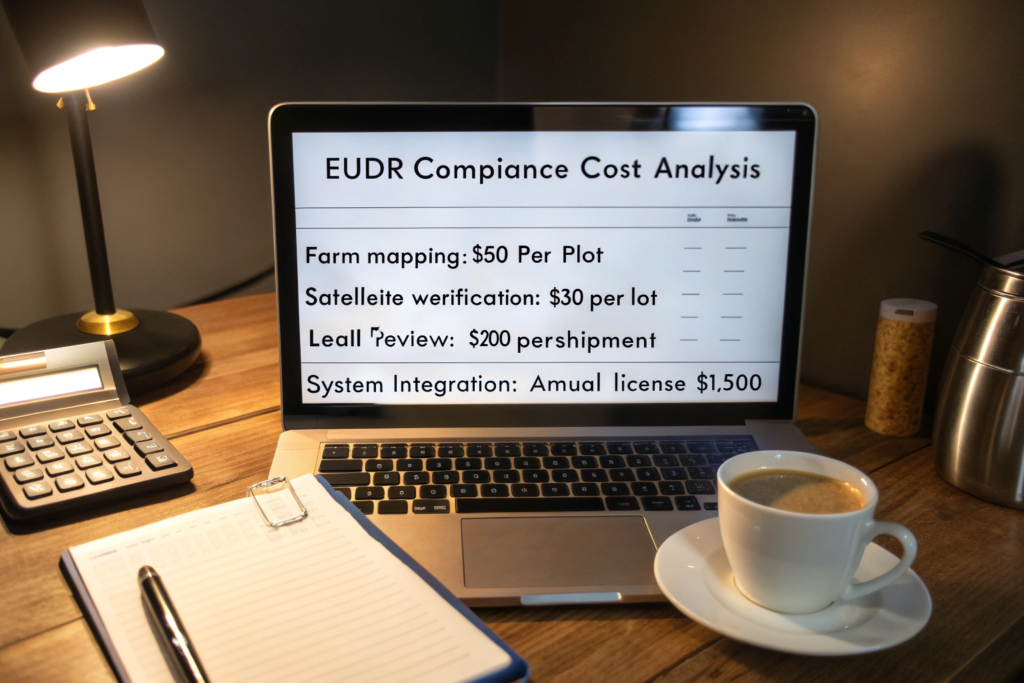
Compliance is not free. Mapping farms, running satellite analyses, maintaining digital traceability systems, and conducting legal reviews all cost money. These costs flow through the supply chain and ultimately land on someone's balance sheet. The question is who pays.
The cost implications of EUDR for the coffee supply chain include direct compliance costs for farm mapping and satellite verification, increased administrative overhead for due diligence documentation, potential price premiums for EUDR-compliant coffee, and the risk that non-compliant origins dump coffee into non-EU markets at depressed prices, disrupting global price dynamics.
The direct costs are modest per bag but significant in aggregate. Mapping a small farm polygon might cost $20 to $50. Satellite verification might cost $10 to $30 per lot. The due diligence statement filing is a fixed administrative cost per shipment. For a large estate like ours, these costs can be spread over thousands of bags and are manageable. For a smallholder cooperative, the per-kilogram cost of mapping hundreds of tiny plots is much higher and may require external funding.
Who Bears the Cost of Farm Mapping and Data Collection?
The cost allocation is still being negotiated across the industry. The regulation places the legal obligation on the importer, but the practical data collection must happen at origin. The farmer or exporter is the one with access to the land.
In many supply chains, the exporter is absorbing the mapping cost as a cost of maintaining EU market access. Some cooperatives are using donor funding or government subsidies to map their members' farms. Some importers are sharing the cost with their suppliers. In our case, we have invested in mapping our entire estate and integrating the data with our export documentation system. The cost is part of our operational overhead. We do not charge a separate EUDR fee. We see compliance as a baseline requirement for selling into the European market, not an optional add-on.
Will EUDR-Compliant Coffee Command a Premium Price?
In the short term, yes, there will be a premium for verified deforestation-free, fully traceable coffee. The supply of EUDR-compliant coffee is currently less than the demand from European buyers who must have it. Basic economics suggests a price gap.
Some importers are already offering a premium of 5 to 15 cents per pound for lots with complete EUDR documentation. The premium reflects the reduced risk and the avoided cost of conducting the due diligence themselves. However, this premium is likely temporary. As more producers become compliant and the supply of documented coffee increases, compliance will become the new baseline. The premium will fade. What will remain is a discount for non-compliant coffee. Coffee that cannot enter the EU will be redirected to other markets, creating oversupply pressure and lower prices in those non-EU markets.
How Is Yunnan Coffee Positioned for EUDR Compliance?
Yunnan coffee is not just ready for EUDR. It is structurally advantaged by it. The regulation plays to the strengths of how coffee is grown and managed in China's primary coffee province. While other origins scramble to map smallholder plots and build digital systems from scratch, Yunnan's organized production model is already close to compliance.
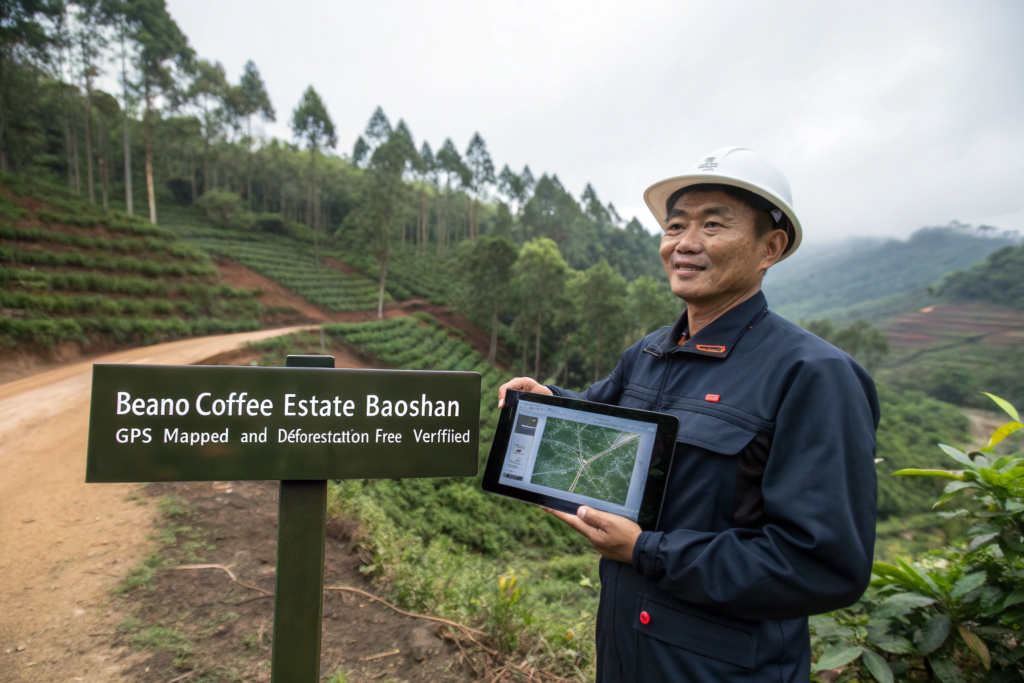
Yunnan coffee is well-positioned for EUDR compliance because the province's coffee sector is dominated by large, professionally managed estates and well-organized cooperatives with clear land tenure, digital mapping capability, and government-supported agricultural infrastructure. The deforestation risk is inherently low because coffee in Yunnan is typically planted on established agricultural land, not recently cleared forest.
The land tenure system in China provides a compliance advantage. Land ownership is clearly defined. Farm boundaries are documented in government registries. The conversion of forest to agricultural land is strictly regulated. There is no large-scale frontier deforestation dynamic in Yunnan of the kind that occurs in some tropical origins. Our coffee trees were planted on land that has been agricultural for generations. The satellite evidence supports this.
Why Does Yunnan's Farm Structure Simplify Compliance?
Most of Yunnan's specialty coffee comes from estates like ours, not from millions of dispersed smallholders. An estate is a single legal entity with clear boundaries and centralized management. Mapping one estate of 1,000 hectares is far simpler than mapping 2,000 smallholder plots of half a hectare each.
The data collection is centralized. We map our farm once. We update the data as needed. Every bag we export traces back to a mapped, verified polygon. There is no aggregation risk, no mystery about which farm contributed which cherries. The lot is 100% from known, verified land. This simplifies the importer's due diligence dramatically. One polygon, one verification, one compliance dossier for the entire shipment.
What Should European Buyers Ask Yunnan Suppliers About EUDR?
Buyers should not assume that every Yunnan supplier is automatically compliant. They should verify. The questions to ask are specific and testable.
First, ask for the farm polygon data in a standard format like GeoJSON or KML. A supplier who cannot provide this is not ready. Second, ask for the satellite verification report showing forest cover on December 31, 2020, and no deforestation after that date. Third, ask whether the supplier has integrated this data into a digital traceability platform that can feed into the EU's due diligence system. Fourth, ask for a sample due diligence dossier for a recent lot to review the quality of the documentation. A supplier who can provide all of this without hesitation is EUDR-capable.
Conclusion
The EU Deforestation Regulation is the most significant regulatory change to hit the coffee industry in a generation. It is not a voluntary sustainability standard. It is a legal market access requirement. For European coffee importers and roasters, the choice is stark. Source EUDR-compliant coffee with full geolocation traceability, or lose access to the world's largest coffee market.
The regulation creates winners and losers. The winners are origins and producers who have invested in traceability, digital systems, and direct trade relationships. The losers are fragmented smallholder supply chains without the resources to map and verify. The price dynamics will shift. The sourcing map will be redrawn.
Yunnan coffee enters this new era with structural advantages. Large estates with clear land tenure. Digital mapping already in place. Deforestation-free history verifiable by satellite. A supply chain short enough to maintain data integrity from farm to port.
If you are a European buyer preparing for full EUDR enforcement, we are ready to show you our compliance infrastructure. We can provide polygon maps, satellite verification reports, and complete due diligence dossiers for every lot we export. Contact Cathy Cai at cathy@beanofcoffee.com to request a sample compliance dossier and to discuss how our EUDR-ready Yunnan Arabica can secure your supply chain for the European market. The deadline is approaching. The time to build compliant supply lines is now.