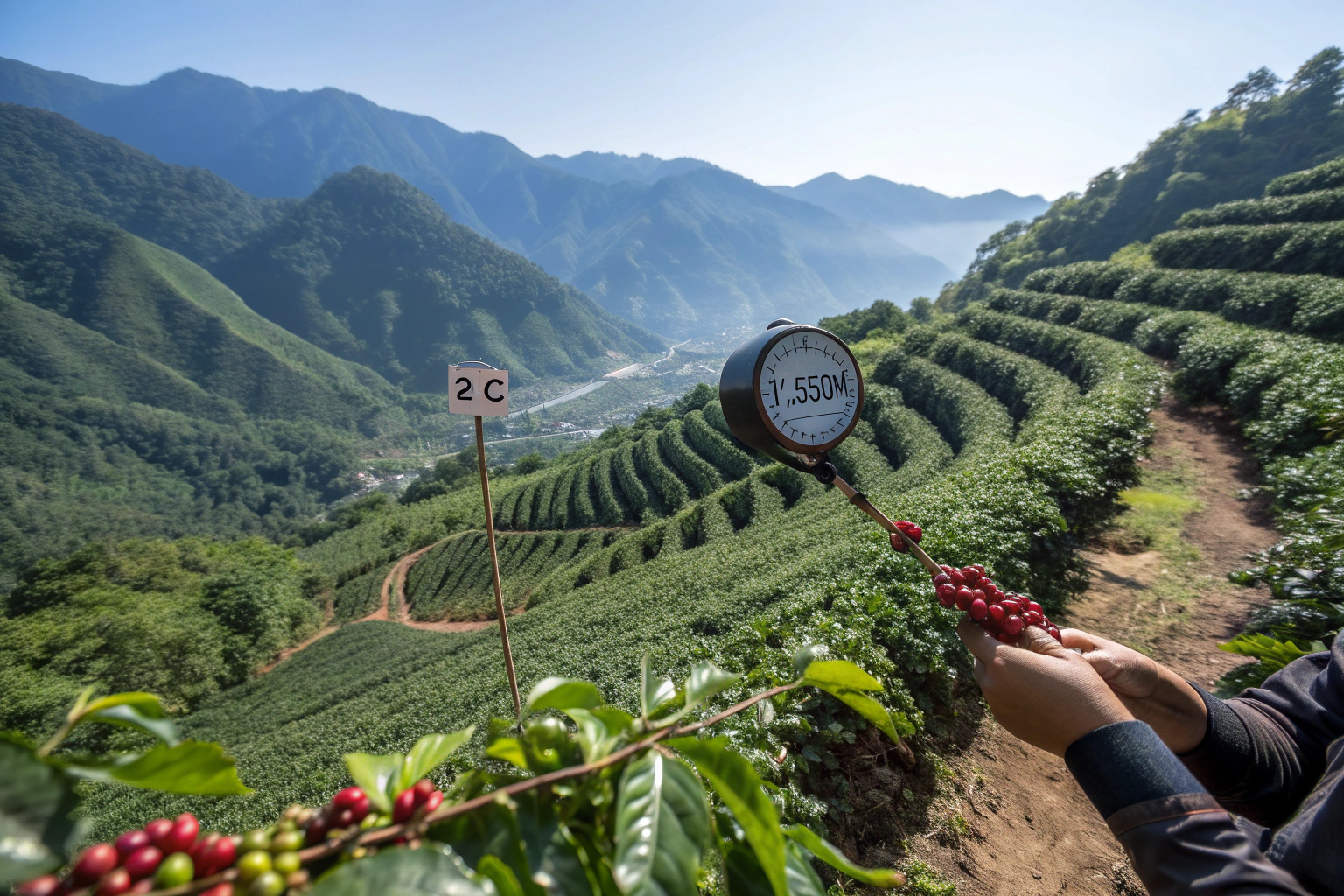
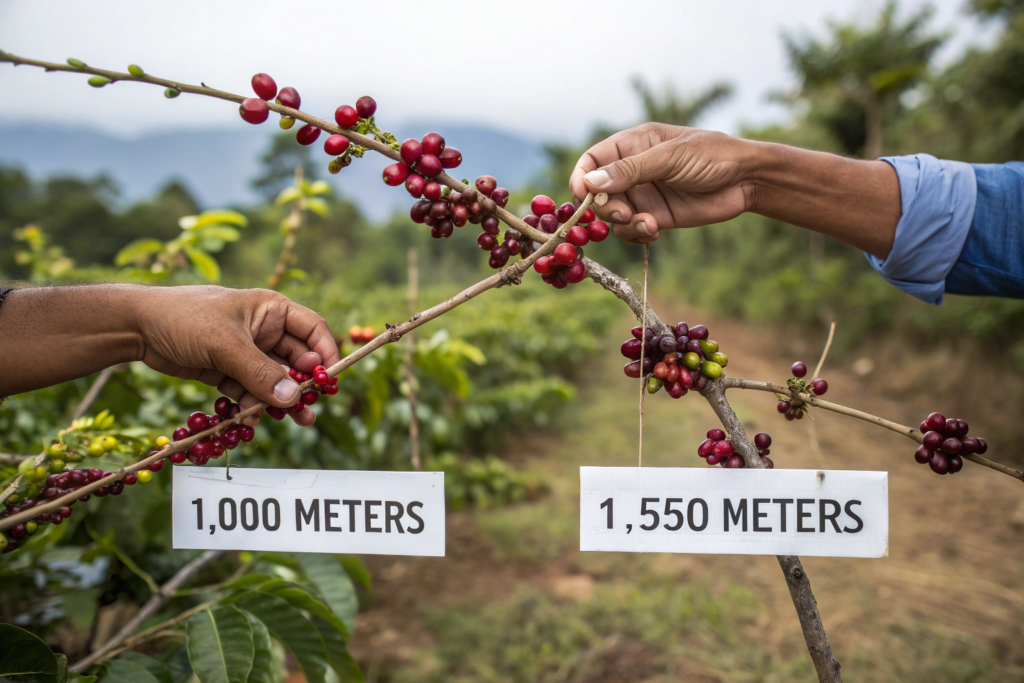
I once walked a buyer from Seattle through two blocks of our farm on the same afternoon. The first block sat at 1,000 meters. The Catimor cherries there were red and plentiful. The second block sat at 1,550 meters, near the top of our property. The cherries were smaller, darker, and harder to the touch. The buyer bit into one from each block. The low-altitude cherry tasted sweet and simple. The high-altitude cherry tasted sweet but also complex, with a bright sharpness that made his eyes widen. Same variety. Same soil type. Same farm. The only meaningful difference was 550 meters of elevation.
Yunnan's high altitude produces better Arabica beans because cooler temperatures at elevations above 1,300 meters slow the coffee cherry's maturation, giving the bean more time to accumulate sugars and develop complex organic acids. The wide diurnal temperature swing stresses the bean beneficially, concentrating its flavor compounds and creating the dense cellular structure that roasts evenly and extracts beautifully.
Altitude is not just a number on a bag. It is a flavor engine. Every meter of elevation changes the physics of how a coffee tree grows and the chemistry of what the bean inside the cherry becomes. Yunnan's mountainous terrain, with coffee planted from 800 meters up to 1,600 meters and beyond, provides a natural laboratory for this altitude effect.
How Does High Altitude Slow Down Cherry Maturation?
A coffee cherry is a fruit, and fruits ripen on a schedule dictated by temperature. Warmer temperatures speed up the biological clock. Cooler temperatures slow it down. This is basic plant physiology. At sea level in the tropics, a coffee cherry might take six or seven months from flowering to harvest. At 1,500 meters in Yunnan, that same variety takes eight or nine months.
High altitude slows cherry maturation because the lower ambient temperature reduces the rate of enzymatic reactions inside the fruit. The extended hang time on the branch allows the bean to accumulate more polysaccharides, the complex sugars that during roasting caramelize into the sweet, heavy body and deep chocolate notes characteristic of high-grown Yunnan Arabica.
The slowdown is not just a delay. It is a qualitative change. A fast-ripened cherry converts its sugars quickly and the bean inside fills with simple carbohydrates. A slow-ripened cherry undergoes a longer period of sugar accumulation and conversion. The bean stores more energy as complex sugars. When roasted, these complex sugars break down into a wider range of flavor compounds. The result is a cup with more depth, more sweetness, and a heavier mouthfeel.
What Chemical Changes Happen Inside a Slow-Ripening Bean?
The inside of a maturing coffee bean is a chemical factory. Sugars are being synthesized from photosynthesis. Organic acids are being formed and then partially broken down. Aromatic precursors are being assembled. The speed of the factory determines the final product mix.
At cooler high-altitude temperatures, the enzyme systems that build sugars operate more efficiently than the systems that break them down. The bean accumulates a higher net concentration of sucrose. The organic acids, particularly malic acid and citric acid, accumulate to higher levels because the respiration rate that would normally burn them for energy is slowed. The bean also develops thicker cell walls with more structural lipids. These lipids carry aromatic compounds that survive roasting and contribute to the coffee's fragrance and aftertaste.
Why Do High-Altitude Cherries Have a Longer Harvest Window?
The harvest window is the period during which cherries on the same tree or same block reach optimal ripeness. In low-altitude, warm conditions, cherries ripen quickly and somewhat uniformly. The window is short. If you do not pick within a week or two, the cherries overripen and ferment on the branch.
In high-altitude, cool conditions, cherries ripen more slowly and less uniformly. The window stretches to three or four weeks. This is a practical advantage for quality-focused farms. A longer harvest window means pickers can make multiple passes, selecting only the perfectly ripe cherries each time. The selective picking, repeated over weeks, produces a lot with minimal underripe and overripe beans. The labor cost is higher, but the cup quality is dramatically better.
What Is the Role of Diurnal Temperature Variation in Bean Density?
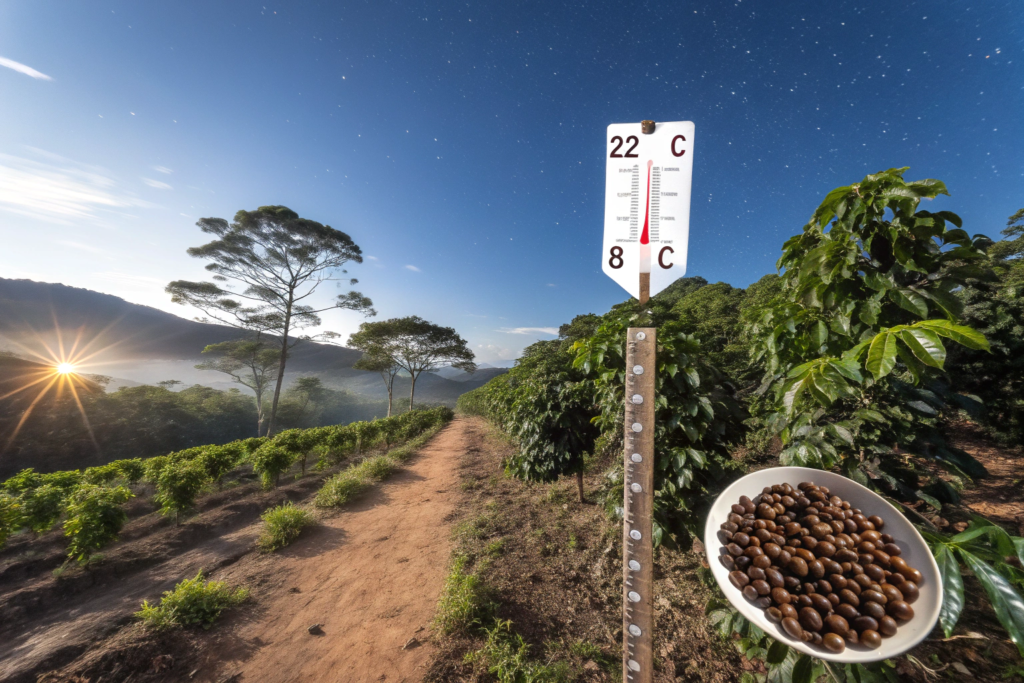
Yunnan's coffee mountains do not just have cool days. They have cold nights. A typical November day in our Baoshan farm might reach 22°C by noon. That same night, the temperature drops to 8°C or even lower. The 14-degree gap between day and night is called the diurnal temperature variation. It is one of Yunnan's greatest quality assets.
Diurnal temperature variation improves bean density by forcing the coffee seed to adapt to nightly cold stress. The cold nights slow respiration dramatically, reducing the consumption of sugars the plant produced during the day. The bean retains more dry matter, its cells pack together more tightly, and the resulting green bean is physically harder and denser than beans grown in consistently warm conditions.
A dense bean is a roaster's friend. It conducts heat evenly. It cracks audibly and predictably. It rewards the roaster with a wide sweet spot between underdeveloped and overdeveloped. Low-density beans from warm, low-altitude farms are softer. They roast unevenly. The outside scorches before the inside develops. The window for a good roast is narrow and unforgiving.
How Does Bean Density Translate to Roasting Performance?
When you drop a charge of green coffee into a hot drum roaster, the beans absorb heat from the metal and the air. A dense bean has a compact internal structure. Heat penetrates slowly and evenly from the surface to the center. The bean requires more energy to reach first crack, but once it does, the development is uniform.
A less dense bean heats faster but unevenly. The surface temperature races ahead of the core temperature. The outside is ready for first crack while the inside is still drying. The roaster is forced to choose: either slow the roast to let the inside catch up, which risks baking the outside, or proceed with the crack and accept an underdeveloped center. Neither is optimal. High-altitude Yunnan beans, with their density, make the roaster's job easier. The roast is more forgiving. The margin for error is wider. Consistency, batch to batch, is higher.
Can You Physically See the Difference in High-Altitude Green Beans?
Yes, and experienced buyers look for these visual cues. A high-altitude bean typically has a tighter, more closed center cut, the little seam that runs down the middle of the flat side of the bean. The bean appears more compact, less spread open.
The color is often a deeper, more intense blue-green or olive, depending on the processing. The surface texture is denser and smoother. A low-altitude bean often has a wider, more open center cut and a lighter, less saturated color. These are visual proxies, not chemical measurements. But a trained eye can estimate altitude from a sample of green beans with reasonable accuracy. The bean's appearance is a physical record of the conditions in which it grew.
Why Are Yunnan's Mountains Uniquely Suited for High-Altitude Coffee?
Not all high-altitude coffee regions are created equal. Altitude alone does not guarantee quality. The specific geography of Yunnan, the combination of latitude, mountain ranges, and river systems, creates conditions that amplify the benefits of elevation while mitigating its risks.
Yunnan's mountains are uniquely suited for high-altitude coffee because the province sits at the northern edge of the coffee belt, around 25 degrees north, where the high elevation compensates for the latitude disadvantage. The Gaoligong Mountains create rain shadows and microclimates, and the Lancang River valley moderates temperatures and generates protective morning fog.
At 25 degrees north, Yunnan is further from the equator than almost any other major Arabica origin. This latitude should be too cold for coffee. The high elevation should make it even colder. But the mountainous topography creates a thermal belt. Cold air drains downhill into the valleys at night. The hillsides, where the coffee is planted, stay warmer than the valley floor. The result is a narrow elevation band, roughly 1,200 to 1,600 meters, where temperatures are ideal for Arabica. Above that band, frost risk becomes too high. Below that band, the quality advantages of altitude fade.
How Does the Lancang River Valley Influence High-Altitude Coffee?
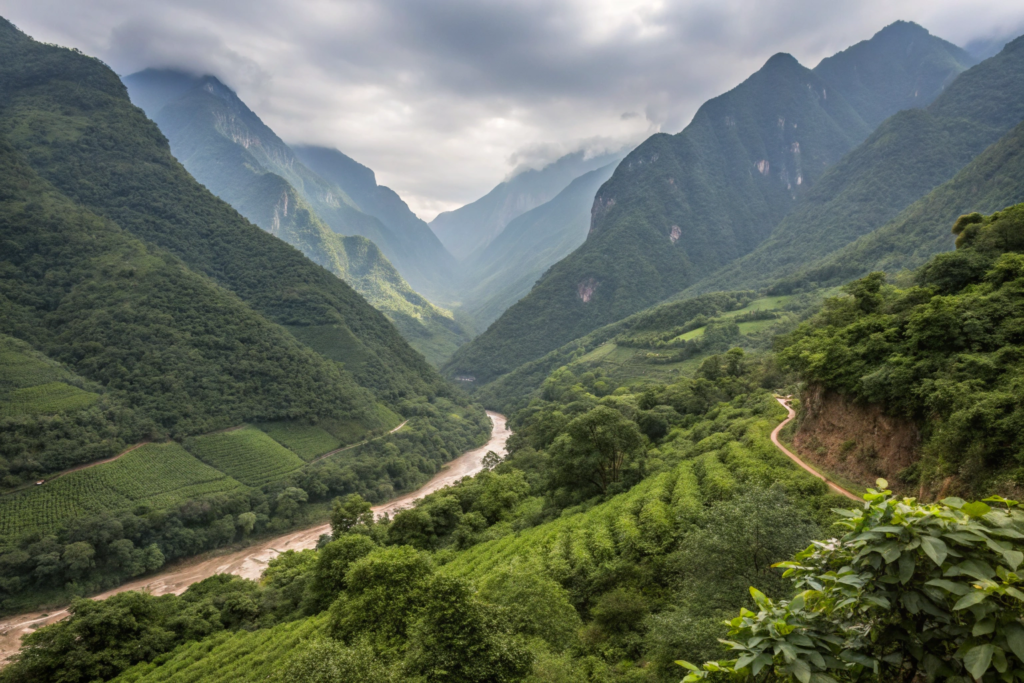
The Lancang River, which becomes the Mekong River downstream, is the lifeblood of Yunnan's coffee region. The river carves a deep valley through the province, and the coffee farms climb the slopes above it. The river is more than a water source. It is a climate moderator.
The river acts as a thermal buffer. Water has high heat capacity. It warms slowly and cools slowly. At night, when the mountain air turns cold, the river releases stored heat, warming the lower slopes and protecting the coffee from frost. In the morning, the temperature difference between the warm river and the cool mountain air generates fog. The fog rolls up the valleys and blankets the coffee trees for the first hours of daylight. This fog diffuses the morning sun, softening the light and slowing the start of photosynthesis. The cherries warm gradually. The daily temperature ramp is gentle, not a sharp spike. The fog also raises morning humidity slightly, reducing water stress on the trees.
What Microclimates Exist Within Yunnan's High-Altitude Zones?
Yunnan is not a single climate. It is a mosaic of microclimates shaped by mountain aspect, slope angle, and proximity to water. A south-facing slope at 1,500 meters receives more direct sun and is warmer than a north-facing slope at the same altitude. The coffee on the south slope ripens faster and produces a slightly softer cup.
The Baoshan region, where our farm sits, benefits from the rain shadow of the Gaoligong Mountains. The mountains block the harshest monsoon weather, creating a slightly drier climate with a more defined dry season. Pu'er, further south, is lower on average and wetter. Its high-altitude zones produce a different cup, often lighter in body with tea-like notes. Lincang, with some of the highest farms in Yunnan above 1,600 meters, produces beans with pronounced floral and citrus notes. The microclimate differences within a single province give roasters a palette of flavor profiles to choose from, all sharing the structural advantages of altitude.
How Does Altitude Affect Pest and Disease Pressure on Coffee Trees?
Pests and diseases are not evenly distributed across a coffee farm. They have temperature preferences. Most coffee pests and pathogens thrive in warm, humid conditions. As altitude increases and temperature drops, the pressure from these biological threats decreases naturally.
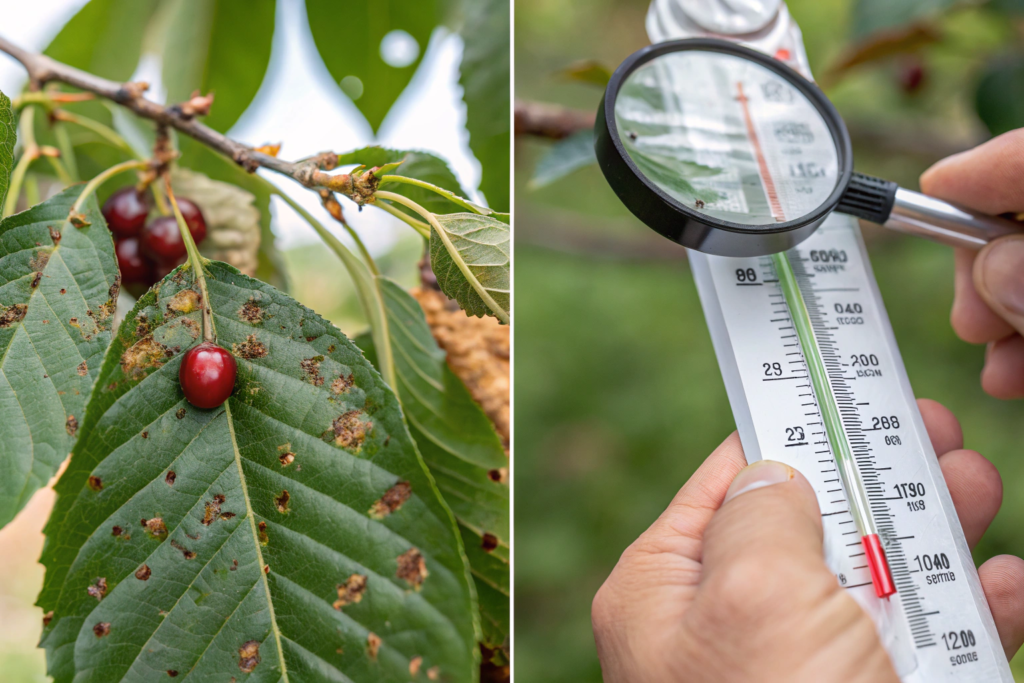
High altitude reduces pest and disease pressure on coffee trees because many of the most damaging coffee pests, including the coffee berry borer and coffee leaf rust, are temperature-limited. The cooler conditions above 1,300 meters slow their reproduction cycles and reduce their survival rates, allowing farmers to grow healthier trees with fewer chemical interventions.
This natural pest suppression is a significant quality advantage. A tree that is not fighting off pests or fungal infections channels more energy into cherry development. The bean is healthier. The cup is cleaner. The farmer also applies fewer pesticides, which reduces the risk of chemical residues in the green coffee and supports organic certification.
How Does the Coffee Berry Borer Respond to Altitude?
The coffee berry borer, or broca, is the most destructive insect pest in global coffee production. The female beetle bores into the coffee cherry and lays eggs inside the bean. The larvae eat the bean from the inside. The damage creates entry points for mold and produces off-flavors.
Broca thrives in warm conditions. Its reproductive cycle accelerates with temperature. At sea level in the tropics, broca can complete multiple generations in a single harvest season. At 1,500 meters in Yunnan, the cooler temperatures slow the beetle's metabolism. The reproductive rate drops. In some high-altitude zones, the temperature is low enough that broca populations cannot establish permanently. The pest pressure is seasonal and manageable rather than constant and overwhelming. This is a structural advantage of Yunnan's high-altitude coffee that requires no chemical inputs.
Does Altitude Affect Coffee Leaf Rust Incidence?
Coffee leaf rust is a fungal disease that attacks the leaves of the coffee tree, reducing photosynthesis and weakening the plant. Severe infections defoliate the tree entirely. Rust thrives in warm, wet conditions with temperatures between 21°C and 25°C and high humidity.
At Yunnan's high-altitude farms, temperatures during the critical wet season are often below the optimal range for rust spore germination. The cool nights, in particular, suppress fungal growth. The dry harvest season further limits rust because the fungus needs liquid water on the leaf surface to infect. The combination of cool temperatures and a defined dry season makes Yunnan's high-altitude zones naturally less conducive to rust than many other origin regions. This does not eliminate the need for rust management, but it reduces the pressure and allows farmers to use cultural controls, like pruning for airflow, rather than relying on fungicide sprays.
Conclusion
Altitude is not a marketing claim in Yunnan. It is a measurable, tasteable driver of coffee quality. The cool temperatures slow cherry maturation, building sugar and acid complexity inside the bean. The cold nights create the diurnal stress that produces dense, hard beans that roast evenly and extract beautifully. The Lancang River and the Gaoligong Mountains shape microclimates that moderate extremes and suppress pests. The result is a cup with heavy body, deep sweetness, and a clean finish that competes with the best high-grown coffees anywhere.
For a roaster, understanding altitude is understanding what you are buying. A Yunnan coffee labeled "1,550 meters" is not the same product as a Yunnan coffee labeled "1,000 meters." The altitude is the quality specification. It predicts density, roasting behavior, and cup profile.
If you want to taste the altitude difference directly, we can send you samples from two blocks of our farm, one at 1,200 meters and one at 1,550 meters, same variety, same processing. Cup them side by side. The elevation will speak for itself. Contact Cathy Cai at cathy@beanofcoffee.com and ask for the Altitude Comparison Sample Set. She will include the GPS coordinates and elevation data for each block, so you can verify the mountain as well as taste it.