I learned this the hard way. A few years back, I shipped a perfect container of washed Yunnan Arabica to a buyer in Oakland. The coffee was beautiful. The ship arrived on time. Everything looked great. Then, a single missing stamp on a fumigation certificate triggered a hold. The container sat at the terminal for 18 days. Demurrage fees ate up $3,600. The buyer called me, furious. He was right to be angry. Since that day, I've treated customs clearance not as an afterthought but as a core part of my export service. If you, Ron, value timeliness and security, you need to see this process the same way.
To successfully clear coffee through U.S. Customs, you must pre-file the Importer Security Filing, present a complete document set including a valid Phytosanitary Certificate and Bill of Lading, correctly classify the shipment under the right HS code, and satisfy all FDA Prior Notice requirements before the vessel docks.
You can't hand this off to the cheapest broker and forget it. You're the Importer of Record. The legal responsibility sits on your shoulders. But don't worry. I've walked dozens of first-time buyers through this from the China side. Let me break it all down for you, step by step.
What Essential Documents Clear U.S. Customs for Coffee?
Documents are the skeleton of your import. Without the right bones, the whole body collapses. I keep a master checklist taped to my desk in Baoshan. I've used it for every container I've shipped to North America, Europe, and Australia. If one paper is missing, the CBP officer stops your shipment. A stopped shipment costs you storage fees. And storage fees, Ron, kill your carefully negotiated price advantage.
The mandatory document package includes the original Bill of Lading, the detailed Commercial Invoice, the Packing List, the Certificate of Origin, and the Phytosanitary Certificate issued by the plant protection authority in the exporting country.
Let's look at the two documents that often cause the biggest headaches, the Phyto and the Certificate of Origin. Understanding these saves you money and time.
Why Does the Phytosanitary Certificate Hold Everything Up?
Green coffee is a raw agricultural seed. It can carry insects, larvae, or fungal spores. The USDA and CBP take this threat extremely seriously. A Phytosanitary Certificate proves that an official plant health agency inspected the beans and found them free of quarantine pests.
We obtain this certificate from the local CIQ office right here in Yunnan. An inspector comes to our warehouse before loading. They pull samples. They lab-test them. Only after passing does the certificate get issued. It's a government guarantee. If your supplier cannot produce this document, or offers you a fake, you are importing contraband. CBP will either fumigate the beans at your expense or order them destroyed. I've seen it happen to unlucky buyers. Don't let it happen to you.
How Does the Certificate of Origin Directly Affect Your Tax Bill?
This one hits your wallet directly. The Certificate of Origin proves where the coffee was grown and processed. It seems simple, but it carries real financial weight. U.S. tariff rates often vary depending on the country of origin.
Without a valid certificate, the customs officer applies the default highest rate. With a proper certificate showing Chinese origin, your green coffee generally enters duty-free or at a very low rate under normal trade relations. The difference can be thousands of dollars on a single container. I always recommend buyers check the current trade situation between the U.S. and China. If tariffs shift, your landed cost shifts. I don't control trade policy, but I make sure your paperwork is perfect so you never pay a penalty out of negligence.
Why Does the Coffee HS Code Determine Your Clearance?
A common mistake new importers make is writing "coffee" on the customs forms and hoping for the best. Customs doesn't work on descriptions. It works on numbers. The Harmonized System code is a global numeric fingerprint for your product. One wrong digit can trigger a completely different tariff rate or flag your shipment for an intensive, time-consuming examination.
The HS code matters because it defines the exact duty rate, determines which FDA requirements apply, and controls whether your specific product is even admissible into the United States.
At BeanofCoffee, we always print the correct HS code on the commercial invoice. But you must verify it matches your own entry documents. The broker works for you. They input what you tell them. If we give you the right code and your broker changes it, that's a problem on your side.
What Is the Correct HS Code for Raw Green Arabica?
Let's get specific. Raw, unroasted, non-decaffeinated green coffee falls under a specific heading in the tariff schedule. For green Arabica, the code is typically 0901.11.00. For green Robusta, it's 0901.12.00.
Why does this split matter for you, Ron? You're buying premium Arabica from us. If your broker accidentally files it under the Robusta code, the entry is incorrect. A mismatch between the cargo and the declaration can trigger a physical examination. Examinations cost money and eat up your timeliness. A simple, avoidable error on a 10-digit code can delay your whole container by a week or more.
How Do Roasted and Decaf Codes Differ?
This is equally important if you ever expand your sourcing. Roasted coffee, even whole bean, is processed food. It falls under a different code, usually 0901.21.00. Decaffeinated coffee, whether green or roasted, has its own set of codes.
The classification fundamentally changes how the FDA views the product. Green coffee is raw agricultural material. Roasted coffee is processed for human consumption. The FDA holds processed food to stricter labeling and facility registration standards. So, if your broker accidentally files your green beans under a roasted code, you'll face questions about manufacturing facility registrations that simply don't apply. Keep it accurate. Raw is raw. Processed is processed. The code must match the physical state of the bean.
How to Calculate All Import Duties and Fees Accurately?
Tariffs feel like a black box to many buyers. They create anxiety. But they don't have to. A landed cost model turns the unknown into a predictable number. I build these models with my clients. When you know the FOB price and the freight cost, you can predict the customs bill with over 95% accuracy.
To calculate your total import cost, take the FOB invoice value, multiply it by the applicable duty rate from the HS code, then add the Merchandise Processing Fee, the Harbor Maintenance Fee, and any applicable broker fees.
A safe exporter gives you a clean, accurate commercial invoice. The invoice value is the number CBP uses for assessment. Never ask me to lower the declared value to reduce your tax. That's customs fraud. It can get your entire container seized and your importer privileges revoked. A trustworthy partner protects your business, not your short-term tax bill.
What Exactly Is the Merchandise Processing Fee?
Besides the actual tariff duty, the government charges you a service fee for handling the paperwork. This is the Merchandise Processing Fee, or MPF. It's an ad valorem charge on the entered value, with a defined minimum and maximum per entry.
For a formal entry, the MPF is a small percentage but tops out at a capped maximum. For informal entries under $2,500, it's a flat, lower fee. This fee surprises beginners. They budget for duty but forget the MPF. It's not huge, but it's a real cost. I always tell my new clients to add a $500 to $600 buffer for all these small administrative charges. It's better to over-budget and be happy than to under-budget and scramble for cash at the last minute.
How Does the Harbor Maintenance Fee Apply?
Your coffee arrives by ocean vessel. It docks at a U.S. port. The government charges a Harbor Maintenance Fee on the value of the cargo to fund port dredging and waterway upkeep. The rate is quite small, just 0.125% of the cargo value.
It's a tiny cost on paper. But like the MPF, it must be paid before the terminal releases your container. If you ignore it on the invoice, your payment is incomplete. The gate won't open for your trucker. The driver bills you waiting time anyway. So, the small fee creates a big delay. Know every single line item on the customs bill. Timeliness demands it.
How to Prepare for and Survive an FDA Hold?
An FDA hold is the nightmare scenario for coffee importers. Your ship docks on time. The CBP entry files correctly. Then, a red alert appears in the system: "Detained for FDA Review." Your coffee is now legally frozen. You cannot sell it. You cannot move it. The terminal storage meter is running daily. The anxiety is real.
To survive an FDA hold, you must have filed a confirmed Prior Notice before the vessel's arrival, maintain proof that the coffee is free of banned pesticides, and hold a recent third-party laboratory analysis for Ochratoxin A and other mycotoxins that the FDA specifically screens for.
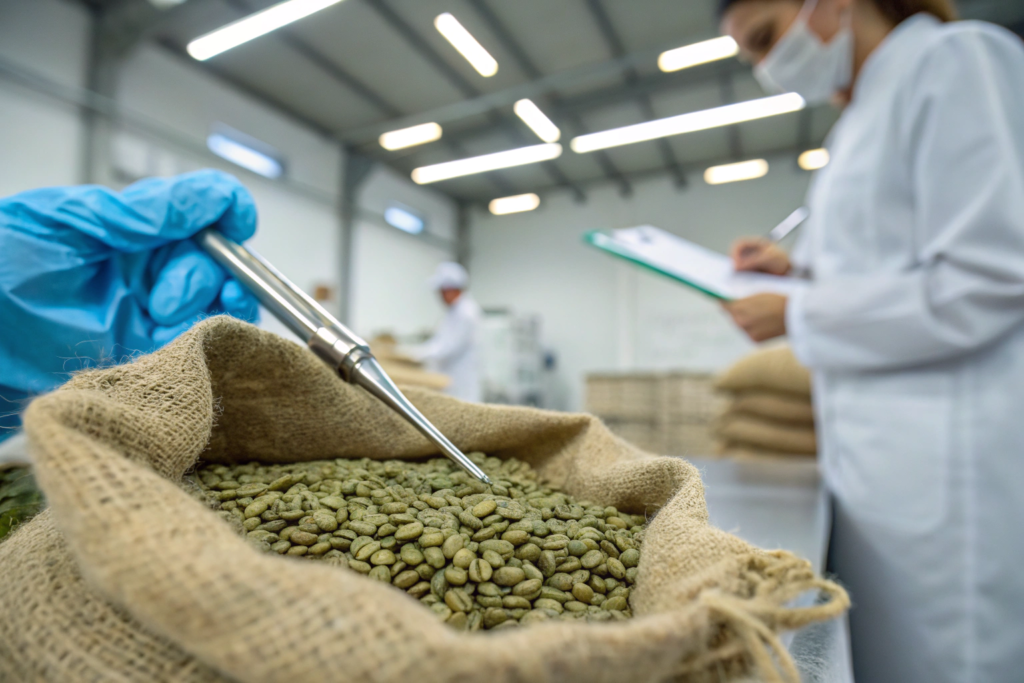
The FDA worries about two main things: chemical residues and biological toxins. Moldy beans produce Ochratoxin A, a serious health hazard. Banned pesticide residues are equally unacceptable. Preparation is your only defense.
What Is the FDA Prior Notice and When Must You File?
Before your coffee even leaves the Chinese port, information must flow electronically to the FDA. This filing is called Prior Notice. It tells the agency exactly what is coming, who produced it, and which U.S. port will receive it.
Without a valid Prior Notice confirmation number, your entry faces automatic refusal at the border. The filing window is strict. It must be submitted no more than 15 calendar days before arrival and no fewer than 4 hours before the vessel docks, if I recall the regulation correctly. Your customs broker handles this on your side. We handle the exporter data on ours. Both halves must connect perfectly. A late filing is just as bad as no filing at all.
How Does Pre-Shipment Testing Speed Up Release?
This is my strongest recommendation to every buyer. Demand a pre-shipment lab analysis from your supplier before the container loads. We send samples of every export lot to an independent laboratory like Eurofins or SGS. They test for over 400 pesticide residues and for Ochratoxin A levels.
We share that full report with the buyer before the ship sails. Now, if the FDA holds the container at the port of entry, you are armed. You can immediately present a clean, recent, professional lab result. This demonstrates good faith and often accelerates the review process. Without it, the FDA takes its own sample, sends it to their own lab, and you wait. Sometimes, you wait for weeks. Sometimes months. If you value security and timeliness, insist on the independent lab report. We at BeanofCoffee provide this proactively because it protects both of us.
Conclusion
Customs clearance tests your preparation, not your luck. You can't wing it and expect a smooth result. We covered the essential documents: the Phytosanitary Certificate that proves pest-free status, and the Certificate of Origin that keeps your tax bill legal and low. We looked at the critical HS code, 0901.11.00 for your green Arabica, and the small fees like the MPF and Harbor Maintenance that still stop trucks if ignored. And we talked about the FDA hold, the Prior Notice system, and the power of a pre-shipment lab test.
The common thread through all of this is partnership. You need a supplier in China who treats your paperwork with the same seriousness they apply to the coffee quality. A missing stamp in Baoshan can freeze your container in Long Beach just as surely as a bad roast can lose a customer. The supply chain does not end at our farm gate. It ends at your roastery door, with the beans cleared and delivered on time.
We move hundreds of containers of Yunnan specialty coffee through U.S. ports every season. We know the brokers, the testing protocols, and the tightrope of compliance. If you want a direct, honest walkthrough of the exact entry process for your first or your next container, please contact our logistics lead. Cathy Cai handles this daily and can forward you a sample of our standard document set so you can review it yourself. Reach her at cathy@beanofcoffee.com. Let's get your coffee cleared without the drama.