
I wish I could give you one fixed number. It would make my life easier. And yours too, Ron. You want a price. Fast. Clear. No games. I respect that deeply. But here is the uncomfortable truth. The FOB price for Chinese Arabica moves. It moves with the commodity market. It moves with the diesel price for trucks. It moves with the availability of empty containers in Yantian or Shanghai. If I quote you a price today and you come back in three weeks, that number might be a lie. And I refuse to lie to a partner. So instead, let me teach you the math.
The current FOB price for Grade 1 washed Chinese Arabica from Yunnan typically sits in a range between $2.60 and $3.40 per pound, depending on the cup score, the specific milling quality, the type of bag, and the real-time container freight index. This price hands you the goods and the documents at the ship's rail in a named Chinese port.
I'm not hiding behind a range. I'm giving you the formula. The base bean cost, the processing, the truck, the port fees. It's all on the table. You can audit it. If a supplier quotes you $1.80, I want you to laugh. Not because it's a good deal, but because it's physically impossible unless the beans are floor sweepings. Let's break down the real numbers.
What Makes Up the Real FOB Price Component?
Most importers look at the final number and try to hack away at it. That's a mistake. You have to hack the components, not the total. The FOB price is a suitcase. Inside it, you have the bean, the mill, the bag, the truck, and the terminal. If you squeeze the wrong part, you break the quality. I learned this the hard way when I let a client negotiate away the GrainPro bag to save 5 cents. The coffee arrived flat. He blamed me. Now I don't let buyers cut corners they don't understand.
The real FOB price components include the farm gate cherry price converted to green equivalent, the dry milling and sorting loss, the food-grade bagging cost, the domestic land transport from Baoshan to the port, and the Chinese customs declaration and terminal handling charges.
Each of these has a floor. You can't pay a trucker below his diesel cost. You can't pay a picker below her daily wage. So, a fair FOB price respects these floors. When you see a price, ask for the breakdown. A trustworthy Arabica supplier will give it to you. A scammer will give you a round number and a smile.
How Does Cherry Price Convert to FOB Price?
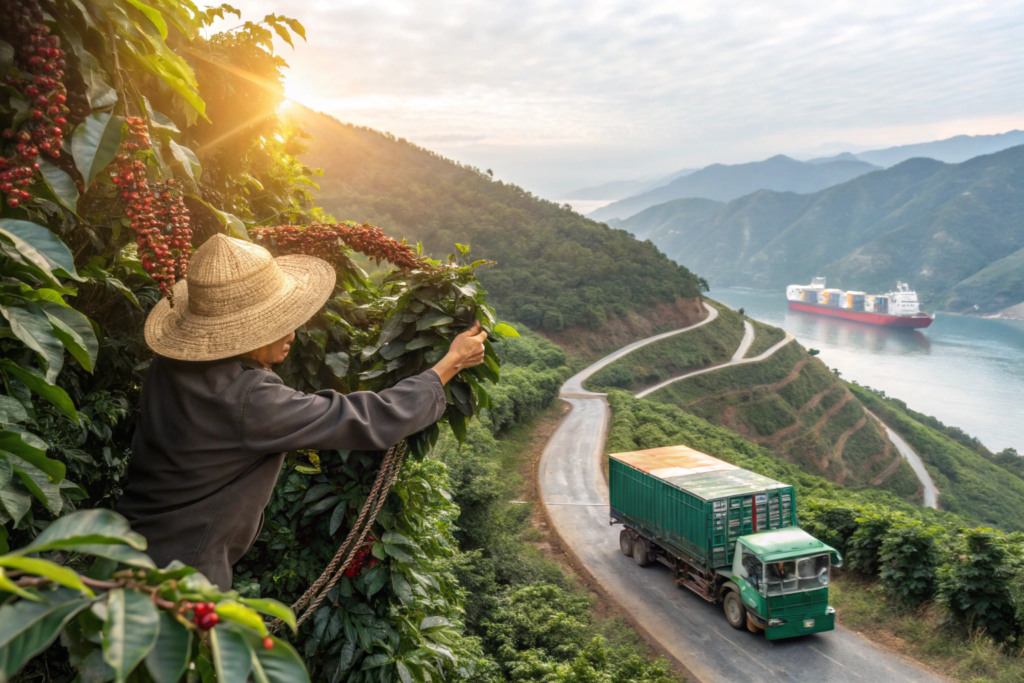
It takes about 6 kilos of red cherry to make 1 kilo of exportable green bean. That's the first shock for most buyers. You are paying for water weight that gets pulped and dried away. If the farm gate cherry price is 4 RMB per kilo, the green bean raw material cost is already 24 RMB per kilo, just in fruit.
Then the mill takes its cut. The parchment is hulled. The beans are graded by size and density. Defects are removed by hand or machine. Another 15% to 20% of the weight disappears. So, your 24 RMB base just became closer to 30 RMB per kilo of green bean. That's about $1.90 per pound, just for the raw material sitting at the mill door. If someone sells you a finished FOB product below that, they are losing money. Or they are selling you past-crop garbage.
Why Does Trucking Cost Fluctuate So Much?
Yunnan is mountains. Not flat highways. A truck loaded with 20 tons of coffee has to crawl down winding roads from Baoshan to the coast. It burns diesel. And diesel prices in China follow the global oil market.
A few years ago, a truck run to Shenzhen cost around 12,000 RMB. When oil spiked, it hit 18,000 RMB. That difference is about 5 to 8 cents per pound, just gone, swallowed by the gas tank. I can't control oil prices. But I show my buyers the trucking receipt. If you see a long-term contract, we can lock in a rate with a driver. Without a contract, the spot trucking market eats your margin. That's just the reality of exporting from Baoshan Yunnan. We are landlocked. Good coffee comes from hard places.
How Does Container Freight Index Impact Today's FOB Offer?
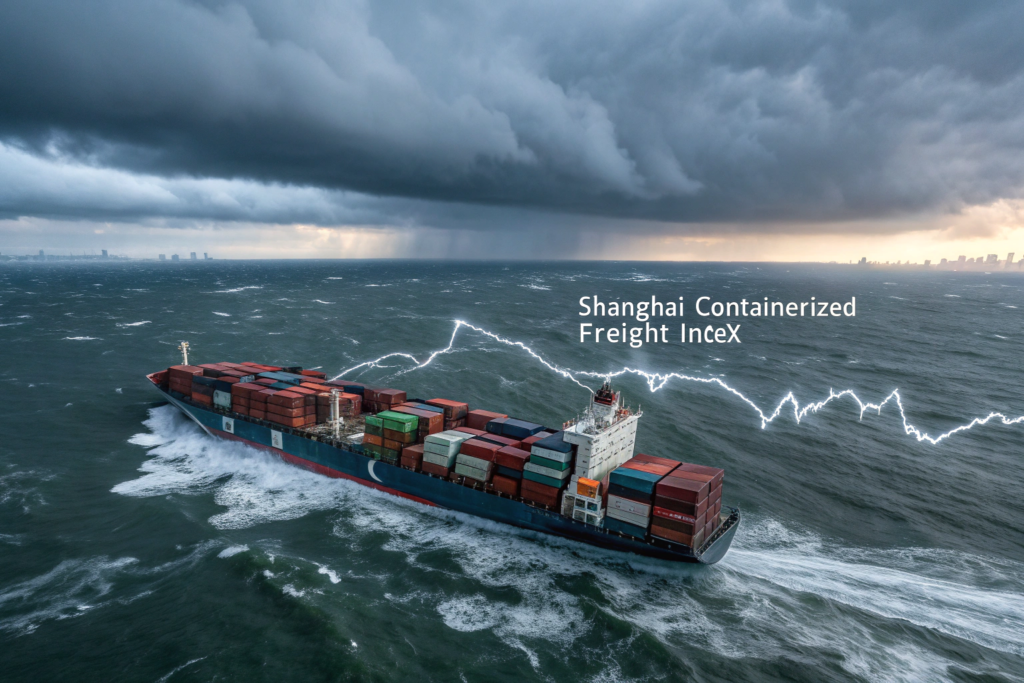
The ocean is not free. And right now, it's unpredictable. The Shanghai Containerized Freight Index is the pulse of our export economy. It tells me the price of a slot on a ship. When the Red Sea crisis hit, ships went around Africa. Transit time went up by two weeks. Available containers in China went down. Prices went up four times, sometimes five.
The container freight index directly shifts the competitive landscape of FOB offers because a sudden spike in sea freight forces Chinese exporters to either inflate the FOB price to match the shipping line's surcharge or to temporarily freeze spot sales until the market stabilizes.
At BeanofCoffee, we watch the index daily. If you ask for a quote, I check the spot rate to Los Angeles or Hamburg that morning. Not last week. Last week's rate is history. This matters for your timeliness too. A cheap shipping line often has blank sailings. They skip the port. Your container sits. A slightly more expensive line leaves on time.
How Do Peak Season Surcharges Work?
Shipping lines are businesses. They know when demand is high. Before Christmas, before the Chinese New Year, everyone wants to ship. So, the carriers slap on a Peak Season Surcharge. It's a simple supply-and-demand play. Fewer slots, more cargo, higher price.
This surcharge can add $300 to $800 per container, sometimes more. It appears on the invoice as a separate line item. It's not hidden. But it is sudden. I always warn my clients. If you want a shipment in September, book the space in August. If you wait for the last minute, you pay the PSS. A safe and reliable buyer plans the peak season in advance.
What Is the Best Port to Minimize Logistics Cost?
We have a choice. Shenzhen ports like Yantian and Shekou are closer to Yunnan. Shanghai and Ningbo are further. Closer ports mean cheaper trucking but sometimes higher terminal fees. Distant ports mean higher trucking but often more frequent sailings to the U.S. East Coast.
I usually run a dual quote for new clients. One via Yantian, one via Shanghai. You, Ron, with your focus on price and timeliness, can choose the better balance. Yantian might save you $200 on trucking. But Shanghai might leave one day earlier and arrive two days faster. A two-day delay in the U.S. can cost you more in warehousing than the trucking difference. We analyze this case by case. There's no universal best port. Only the best port for the specific sailing schedule that week.
Why Does Cup Score Add a Premium to the Base Price?
Not all Arabica is equal. You know this. A commercial grade bean that goes into a supermarket blend is not the same as a specialty bean that a roaster sells for $18 a bag. The difference is the cup score. It's a number from 0 to 100. It measures fragrance, acidity, body, sweetness. A score of 80 is specialty. A score of 85 is excellent. Above 87, the price curve goes steep.
Cup score adds a premium because quality is scarce. A high-scoring lot represents a tiny fraction of the total harvest on the farm, and the labor required to sort and process it is exponentially higher, driving up the base cost before the coffee even reaches the dry mill.
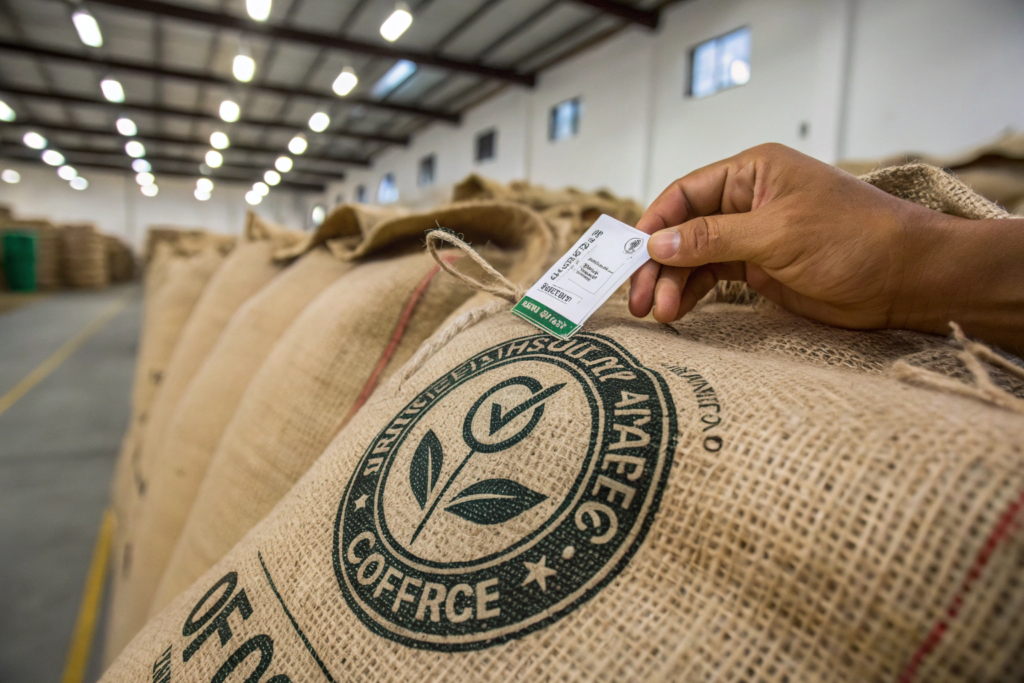
If you want an 86-point washed Catimor from our 10,000-acre plantation, you pay for the sorting. You pay for the extra floating of cherries. You pay for the slow, shaded drying on raised beds. If you want an 80-point bulk lot, you pay less, but you get less flavor. I don't hide this. I give you the cupping form with the quote.
How Much More Does an 85-Point Coffee Cost?
Let's put a number on it. An 80-point Yunnan Arabica might be our base line. An 85-point lot from the exact same farm, maybe even the same hillside, can cost $0.40 to $0.80 more per pound. Maybe more, depending on the buyer's competition for that lot.
Why the jump? Because to get that extra 5 points, we have to hand-sort out every slightly under-ripe bean. Three women sorting on a belt for one whole day might only clean 500 kilos. That labor is expensive. And the yield drops. You are buying the best 60% of the harvest, not the whole pile. The bottom 40% gets sold off as commercial grade. So, the high-scoring bean carries the cost of the rejected beans on its back.
Can You Verify the Cup Score Before Shipment?
You are in America. I am in China. How do you know the cup score is real? Don't trust my word alone. I encourage my buyers to send a sample to an independent third-party cupping lab in their own country. Or use a shared standard.
We cup to the Specialty Coffee Association protocol. But our palate and your palate might differ slightly. So, a smart buyer requests a pre-shipment sample, cups it themselves or hires a lab, and only then approves the full container. The FOB quote includes the cost of shipping that small sample. It's a tiny insurance cost for a huge purchase. I insist on this process. It protects both of us from a dispute later.
How to Lock In a Fair FOB Price Contract?
The spot market is a gamble. If you need to buy coffee every month for your roastery, you can't gamble on the weekly price. You need a contract. A contract doesn't have to be a chain. It's a shield. It protects you from a price spike in July. It protects me from a price crash in November. We both get predictability.
To lock in a fair FOB price contract, you negotiate a fixed differential over the benchmark commodity price, agree on a shipment schedule that balances your inventory needs with my harvest cycle, and clarify the force majeure clauses that handle shipping disasters.
This is how the large company buyers operate. They don't email me every month asking for a new quote. They set the structure once. Then we execute. It saves time. It saves stress. And honestly, it usually saves money in the long run.

What Is a Differential Contract?
This is the professional way to buy. You don't fix a flat price. You fix a differential. You say, "I will pay the C market price plus, or minus, 20 cents." The C market is the global benchmark for Arabica futures. It bounces around. The differential stays solid.
This separates the external market risk from the internal quality premium. If the C market drops by 30 cents, your price drops too. You benefit. If the market spikes, my margin doesn't inflate because the differential is fixed. It's fair. It's transparent. It's how serious importers and exporters do business. It requires trust, but it builds more trust.
How Do Long-Term Commitments Reduce Price Risk?
I have a buyer in Australia who signs a 12-month contract with me every February. He takes two containers a month. Because of that commitment, I give him a 5% discount on the differential. I can plan my processing, my working capital, my bag purchases. He gets a better, stable price.
This is the opposite of hunting for the cheapest spot deal on Alibaba. A long-term partnership rewards both sides. For you, Ron, with your focus on efficient pricing, this model solves the "quote anxiety." You know your cost of goods for the whole fiscal year. You can sell your roasted coffee forward without fear of an input cost surprise. It's a mature, reliable way to trade. If you want to see what a draft of such a contract looks like, Cathy Cai handles these negotiations daily. Her desk is the bridge between the farm math and your business needs. Just reach out to her at cathy@beanofcoffee.com.
Conclusion
We started with a simple question. What's the price? The real answer is a web of factors. Cherry picking costs, mountain diesel trucking, container freight index spikes, cupping scores, and contract structures. There is no single number on a chalkboard. There's only the number that fits your specific requirements for quality grade, timing, and volume.
The trap is to fixate on the absolute cheapest quote. The cheapest FOB price usually hides a trap. An old crop bean, a fake certification, a container that doesn't exist. The smart move is to understand the components, verify the physical sample, and lock in a fair differential that weathers the global shipping storms.
We know this game. We farm 10,000 acres of it. We truck it, we cup it, we ship it. We've made the expensive mistakes so our buyers don't have to. If you want to stop guessing and start planning, send an email. Ask for a sample and a current cost breakdown tailored to your port. Contact Cathy Cai at cathy@beanofcoffee.com. She'll build the numbers with you, honestly and fast.