
I recall a tense moment with a buyer named Ron during a video call. He stared at my quote on the screen and just shook his head. "This price," he said, "is ten cents higher than the going rate in Brazil." He was ready to walk away. He didn't want a sales pitch. He wanted an explanation that made financial sense. That pressure is real. But that conversation changed how I think about negotiation. It's not a fight. It's an alignment of value.
Effective negotiation of wholesale coffee prices hinges on shifting the conversation away from pure per-pound cost and towards total value, leveraging forward contracts, volume commitments, and logistical efficiency to create a win-win margin for both the roaster and the producer.
Here is a hard truth I have learned managing 10,000 acres in Yunnan. The lowest price almost always comes with a hidden tax. That tax might be inconsistent quality, a delayed ship date, or a container of beans that doesn’t match the sample. A good negotiation secures a price that keeps your business competitive and my farm sustainable. If you squeeze too hard, the farmer cuts corners. That helps no one.
What Factors Should You Analyze Before Starting a Price Negotiation?
Walking into a negotiation without data is like roasting without a thermometer. You might get lucky, but you will probably ruin the batch. Before you even ask for a discount, you need to do your homework. Most buyers skip this. They just ask, "What's your best price?" That is a weak position to start from.
Before negotiating, you must analyze the C-market futures baseline, the specific harvest calendar of the origin country, and the seller's inventory pressure points. Knowing these three factors instantly positions you as a serious buyer who cannot be easily misled.
If you know the C-market price for Arabica just dipped 5%, you have a benchmark. If you know the new harvest in Yunnan starts shipping in December, and you are buying the tail end of the old crop in October, you know the seller wants to clear the warehouse. That is your leverage. An often overlooked detail is the shipping container availability. If there is a shortage of containers in China, the freight cost spikes. Trying to squeeze the FOB price when freight just doubled is futile. Focus on the total landed cost instead.

How Do C-Market Prices Impact Your Arabica Bargaining Power?
The Intercontinental Exchange (ICE) for Arabica futures drives the commodity price. But here is the thing: specialty coffee doesn't always follow the C-market blindly. Still, it sets the mood. If the C-market is at $1.50, and a farmer offers you specialty-grade beans at $2.50, that $1.00 differential is where you negotiate.
We look at the differential closely. Why is it a dollar over? Because our Baoshan Catimor cups at 84 points, has a specific screen size, and is traceable. But if the C-market crashes to $1.20, that differential feels bigger to you. You expect the absolute price to drop. I need you to understand that my cost of picking—paying workers to select only red cherries—doesn't drop just because a trader in New York pressed the sell button. We can negotiate on the differential, maybe shave 10 or 15 cents, but expecting specialty coffee to hit the commodity floor price is unrealistic. It ignores the human cost on the ground.
Why Is the Harvest Calendar Crucial for Timing the Deal?
Timing is everything. Honestly. If you contact me in January, right after our harvest rush, my cash flow is tight. I've just paid hundreds of pickers and processing staff. I might be eager to sell a spot container to refill the bank account. That is your moment to strike a sharp deal on spot coffee.
But if you contact me in August, six months before harvest, you are negotiating for future delivery. My price will be firmer. I don't have the coffee yet. I don't know the exact yield. I am quoting a price based on projected costs plus a risk margin. You cannot bargain as hard here, but you secure the freshest crop. A common mistake is a buyer trying to apply spot negotiation tactics to a forward contract. It doesn't work. Pick your timing based on your risk appetite. Do you want the cheapest possible old crop, or a safely contracted new crop?
| Negotiation Factor | Spot Buying Strategy (Old Crop) | Forward Contract Strategy (New Crop) |
|---|---|---|
| Seller's Cash Flow | Tight after harvest, open to discounts | Stable, planning future expenses |
| Buyer's Leverage | High, can take immediate delivery | Medium, securing guaranteed supply |
| Price Flexibility | 10-15% discount potential on FOB | 3-5% discount potential, mostly on terms |
| Quality Risk | Slight age, fading acidity | Peak freshness, but sample is predictive |
| Logistics | Immediate booking, subject to spot rate chaos | Calm planning, locked-in forwarder rates |
How Do You Build a Long-Term Supply Partnership That Lowers Costs?
You know, the cheapest coffee I ever sold was to a one-time buyer. The best value I ever gave was to a partner of ten years. There is a big difference. A transactional relationship is a zero-sum game. You try to take a dollar from my pocket, I try to take one from yours. A partnership focuses on growing the pie so we both get a bigger slice.
A long-term supply partnership lowers costs by eliminating sourcing friction, creating shared R&D investment in quality, and stabilizing the supply chain so efficiently that the per-unit administrative and logistics cost drops year over year.
Think of it like this: If we sign a three-year agreement, I can invest specifically in the varietal you need. I can plant a block of pure Arabica just for you. The first year, costs are high. By the third year, yields stabilize. We share the savings. You don't get that from a spot-buy on Alibaba. You get that by visiting the farm, shaking my hand, and committing.

Can Volume Commitments Stabilize Pricing for Roasters?
Yes, they can. And here is the math. If you guarantee you will buy five containers a year from me, my operational planning becomes flawless. I know exactly how much parchment to buy from my outgrower neighbors. I know the exact schedule for the dry mill. This efficiency saves me about 5 to 7 cents per pound on processing and storage.
I pass half of that saving back to you in a discounted yearly fixed price. You lock in your margin for 12 months. You don't have to worry about Ron's problem—the price creeping up every time he reorders. A flat, fixed annual price is a superpower for a roaster budgeting for wholesale clients. You can tell your cafes, "The price of this espresso blend will not change for a year." They love that stability. And it comes purely from your volume commitment to us.
How Does Exclusive Sourcing Reduce Supplier Risk?
When you put all your eggs in one basket, you watch that basket like a hawk. That is our job. If you exclusively source your Yunnan Arabica from BeanofCoffee, you become a priority client. When there is a container shortage, you get the first box allocated, not the spot buyer who paid a few cents more. When we produce a micro-lot that scores an 88, you get first right of refusal.
This reduces your risk of supply disruption. You also save on the hidden cost of qualifying new suppliers. Qualifying a new farm is expensive. You need lab tests, visits, sample roasting, and time. By sticking with us, you amortize that qualification cost over hundreds of bags. The price per bag might be static, but your "cost of sourcing" plummets. An often overlooked detail is the paperwork familiarity. Our export team knows your specific organic handling certificates by heart. We don't make labeling mistakes. Those errors with a new supplier can cost you a re-inspection fee at the port.
What Are the Most Effective Phrases to Use During Coffee Price Talks?
Words matter. The way you ask for a discount changes the answer you get. If you say, "This is too expensive, can you cut it?", you sound like you are bargaining at a flea market. You disrespect the product. Instead, you need to use collaborative language that frames the issue as a problem we can solve together.
Effective negotiation phrases reference objective standards, link price requests to specific business challenges like competitive markets or volume thresholds, and always ask for a concession in return for a commitment. It turns a demand into a trade.
I have a mental red flag. When a buyer says, "I can get this cheaper in Brazil," I know they are bluffing, or they are comparing Grade 3 to Grade 1. I usually reply, "You can, but can you get this specific 84-point washed Yunnan profile there?" If you are serious, don't compare apples to oranges. Compare my coffee to my coffee, and ask how we can adjust the volume or payment terms to hit your target.
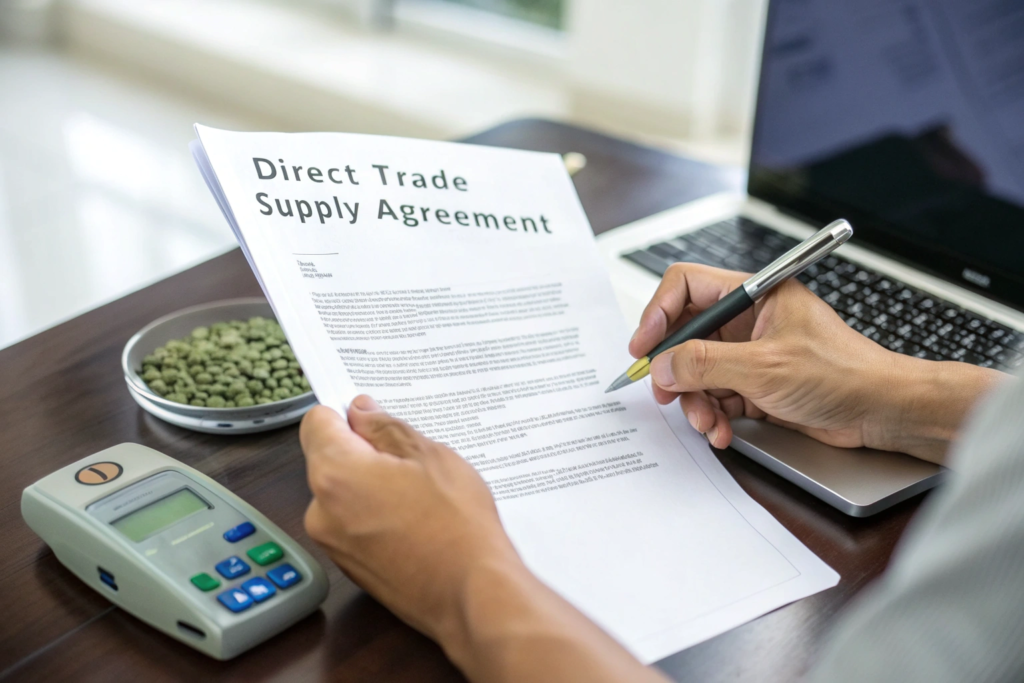
How to Ask for a Discount Without Insulting the Seller?
Don't ask for a discount. Ask for an opportunity. Instead of saying "Drop the price by 20 cents," say this: "We are trying to land this at $4.50 on the shelf. With your current FOB plus freight and our roasting loss, we are at $4.80. Can we look at the logistics math or the payment terms to bridge that 30-cent gap?"
See the difference? You show me your math. You show me you have a specific problem. Now I can help. Maybe I can switch you to a slightly different screen size that is mechanically cheaper to sort. Or maybe I can suggest a slower sea freight line that costs less, if your schedule allows it. Another effective line is, "If we double the volume for the next quarter, can we revisit the price?" I love that question. It's a fair trade. More volume means I can consolidate production runs. It's a win-win. It is not an insult; it’s a business proposition.
What Payment Terms Unlock Better Wholesale Rates?
Cash is oxygen. In the coffee export business, waiting 60 days for a wire transfer after sight kills a farmer's cash flow. If you want a price concession, offer to pay fast. A Telegraphic Transfer (T/T) against a scanned Bill of Lading, or even a partial advance payment, is worth a lot to me.
I will often slice 2% or 3% off the invoice if a buyer pays 50% upfront and 50% against the shipping documents. Why? Because I don't have to go to the bank for high-interest working capital loans to pay my parchment suppliers. Your cash advance funds the milling and bagging. That direct cost saving goes straight to your discount. Don't underestimate this. A difference of 2% net terms can be bigger than the profit margin on the coffee itself. If you have the balance sheet strength, use it as a negotiation tool. It’s the cheapest money you’ll ever spend.
Why Is Quality Consistency Worth a Higher Wholesale Price?
You get what you pay for. It's a cliché, but in coffee, it's a physical reality. A cheap bag of beans often looks like a mosaic of different colors and sizes. You will find black beans, sour beans, and insect-damaged beans. When you roast that, the small beans burn while the big beans stay underdeveloped. The resulting cup tastes like an ashtray mixed with lemon peel.
Paying a higher wholesale price for consistent quality buys you a predictable roasting curve, a standard cup profile your customers trust, and the elimination of the manual labor required to re-sort inferior beans before they hit your hopper.
I often tell customers: take a sample of my $3.00 per pound bean and a sample of a $2.00 per pound bean. Weigh out 100 grams of each. Spread them on a table. Pick out the defects by hand. You will spend 15 minutes cleaning up the cheap beans. What is your labor rate? That 15 minutes of sorting just erased the $1.00 you saved. With our pre-shipment quality control, you open the GrainPro bag and pour it straight into the hopper. Zero waste. Zero labor.
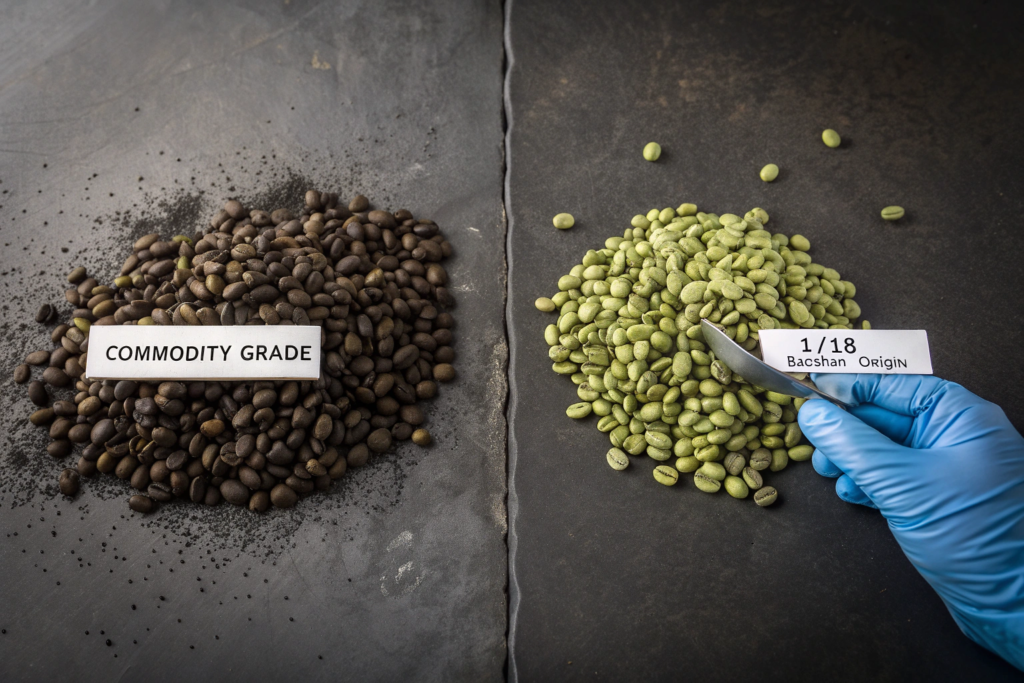
How Do Defect Counts Translate to Roasting Loss?
Let's talk about the specific numbers. Specialty Coffee Association rules say a specialty grade must have zero primary defects in 350 grams. A standard commercial grade allows for many defects. If you buy a cheap batch with 15 full black beans per sample, you have a problem. A single black bean ruins a whole French press.
When you roast a defective lot, you also deal with weight loss. A bean with a bored hole from a berry borer weighs less but takes up the same space. You are paying for air. But worse, these defective beans absorb heat differently. They cause tipping and scorching in the drum. The roast is uneven. To hide the bitterness, you have to roast darker. Now you have lost the origin character and lost weight to carbonization. The total cost of ownership becomes higher than the premium coffee. It's a false economy.
Is Sensory Stability the Key to Retail Success?
A cafe owner once screamed at me over the phone. Not really screamed, but he was upset. "The coffee tastes different!" he said. It was a blend he bought from a commodity trader. The trader had substituted a similar-looking bean from a different country to save money. The flavor profile shifted.
With our single-origin Arabica, sensory stability is the whole game. We stake our reputation on it. When your customers wake up and brew that specific bag of Yunnan coffee, their brain expects a specific taste—the caramel sweetness, the dried cherry note. If it's different, they think something is wrong. Maybe the water is bad. Maybe the cafe changed the recipe. They lose trust. For retailers, sensory stability reduces complaints and returns. That safety is priceless. It’s a buffer against churn. You pay a premium for the calm of knowing the phone won't ring with an angry barista on the other end.
Conclusion
Negotiating coffee prices is not about winning a verbal duel. It is about understanding the math that sits between Baoshan City and your roasting machine. For a buyer like Ron, who needs a sharp price and a rock-solid timeline, the cheapest offer is often a trap.
True cost savings hide in the efficiency of the partnership. It is in the seasonal timing of your order. It is in the volume commitment that lets me, the farmer, plan better. It is in the fast payment terms that cut out the bank. And it is in the quality consistency that stops you from wasting labor on cleaning beans.
If you strip away the romance, it comes down to reliability. You need a partner who ships exactly what you cupped, exactly when you need it.
I want to invite you to test that reliability yourself. Let's skip the "best price" small talk. Tell us your annual volume target and your desired flavor profile. We will build a custom pricing structure that protects your margin and our farm. Reach out to our team at BeanofCoffee. You can email Cathy Cai directly at cathy@beanofcoffee.com to start the conversation. Let's find a deal that actually makes sense for both of us.