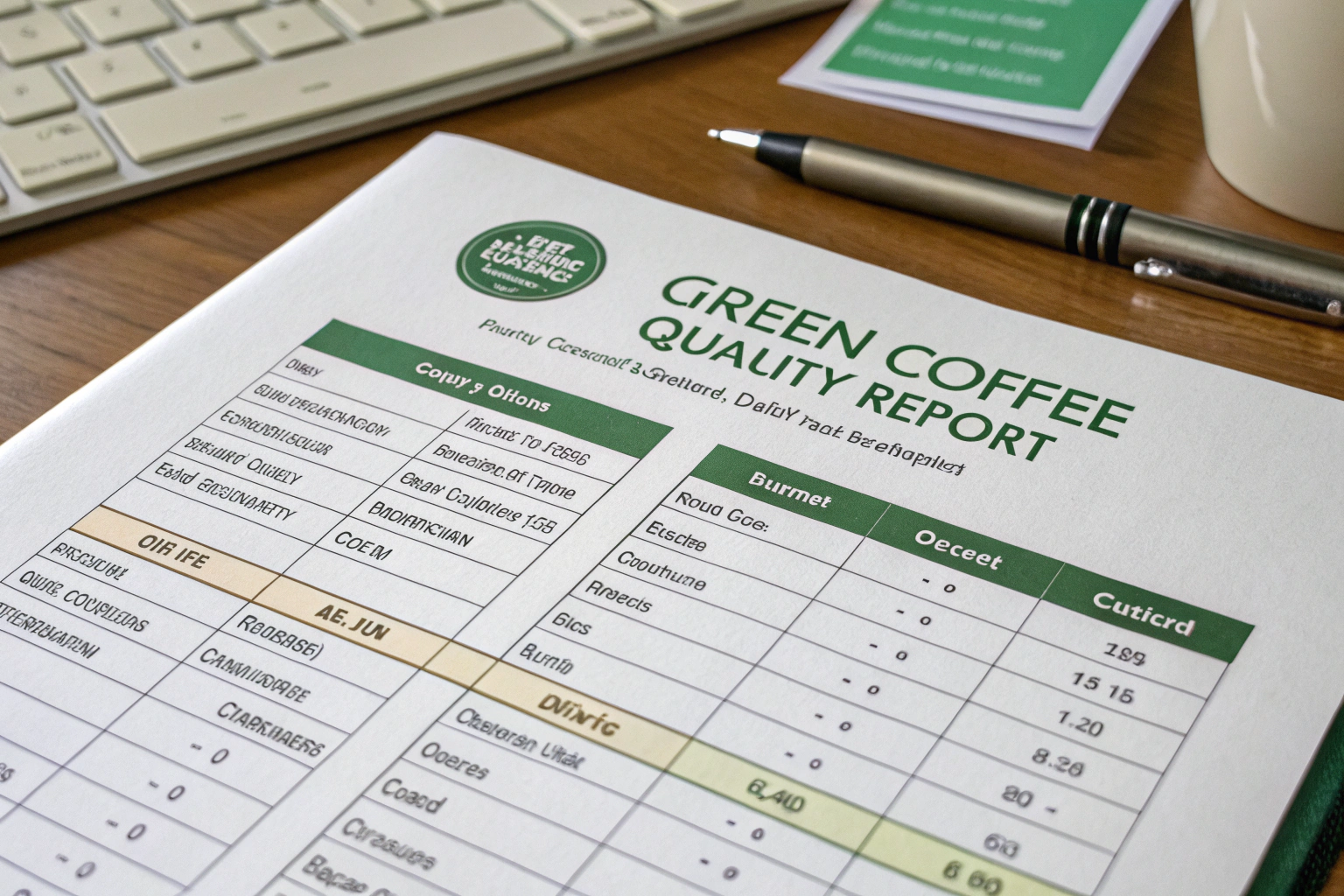
Last month, I almost lost a container of our Yunnan Catimor to a simple paperwork error. The quality report said one thing. The samples said another. The buyer in Texas panicked. I did too, for about an hour. Then I sat down and really read the report—not just glanced at the score. The problem was not the beans. It was a lab technician using a slightly different screen size than the contract specified. A small detail. A huge lesson. If you source green coffee from China, or anywhere really, that report in your hand is not just a formality. It is a conversation with the coffee itself. But you need to know how to listen.
A correct reading of a green coffee quality report starts not with the final score, but with the physical analysis of the bean. You must verify the screen size, defect count, and moisture content first. These physical truths dictate the coffee's shelf life, roast potential, and real value. Only after that does the sensory cup score earn its context. This is the professional sequence we follow at BeanofCoffee. Skipping to the cupping notes is the most common mistake I see experienced buyers make.
So, you have a PDF from a supplier. Maybe it is from a third-party lab like SCA, or our in-house report at BeanofCoffee. The numbers look fine. An 83, an 85. But a number without a story is a risk. Over the next few minutes, I will walk you through how I read these reports for our 10,000-acre farm in Baoshan. We will go step by step, from the moment the bag is opened for sampling to the final flavor note. This is the exact method I taught our export team to prevent costly misunderstandings with buyers in Europe and Australia.
What Do the Physical Measurements in a Green Coffee Report Mean?
I once had a buyer from Melbourne reject a pre-shipment sample because the moisture content read 12.5%. He thought it was too high. I asked him to check the report's reference method. The lab used a capacitance meter, not the oven-dry method. The true reading? 11.8%. Perfectly safe. The instrument just needed calibration. These are the moments that define a trusted partnership. The physical analysis section looks boring. It is a table of numbers. But it is the most honest part of the report. It cannot charm you with words like "jasmine" or "caramel." It just states facts.
The physical measurements in a green coffee report are the non-negotiable biological and structural facts of the bean. They quantify density, size distribution, drying precision, and the physical integrity of the lot. These numbers tell you exactly how the coffee will behave in a roaster, how much weight it will lose, and whether it will arrive moldy after a month at sea. This section is the ultimate truth-teller.
Think of it this way. Cupping scores can drift by half a point because the water was a degree too hot or the taster had a cold. Physical metrics do not lie. They are your check against fraud and honest mistakes alike. Let's break down the two specific areas you will see on a report from our lab at BeanofCoffee.
Why Is Moisture Content More Than Just a Percentage?
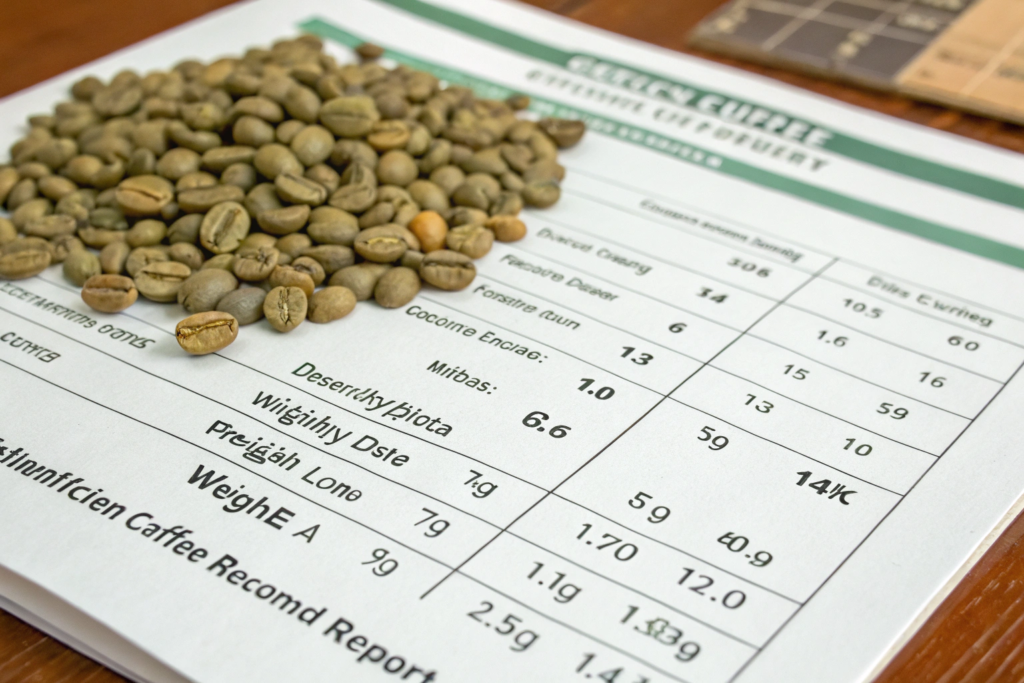
We shipped a lot of washed Arabica to a roaster in Greece last spring. The certificate showed a water activity (Aw) of 0.53. They only looked at the moisture percentage, which was 11.2%. They were satisfied. But I was happier about the Aw number. You see, moisture content tells you how much water is in the bean. Water activity tells you if that water is available for mold and bacteria to use. A bean can have 12% moisture but low water activity if it was dried slowly and correctly.
Here is the critical distinction. If your report only shows moisture content, you are missing half the picture. For long sea voyages to North America or Europe, I demand water activity between 0.53 and 0.59. This is the SCA standard for water activity safe zone. If moisture is 10% but water activity is 0.65, that coffee is risky. It means the water is sitting in the bean in a way that microbes can access it. I have seen this happen with coffees dried too fast under mechanical dryers. The outside reads dry. The inside is unstable.
Ask your supplier for the meter brand too. A cheap handheld unit can be off by 1%. We use calibrated lab-grade equipment. This is not just about quality. It is about weight and profit. If you buy coffee at 12% moisture instead of 10%, you are paying for water weight that will evaporate during roasting. You are losing money before the coffee even hits the roaster.
How Do Screen Size and Defect Count Impact Your Roast?
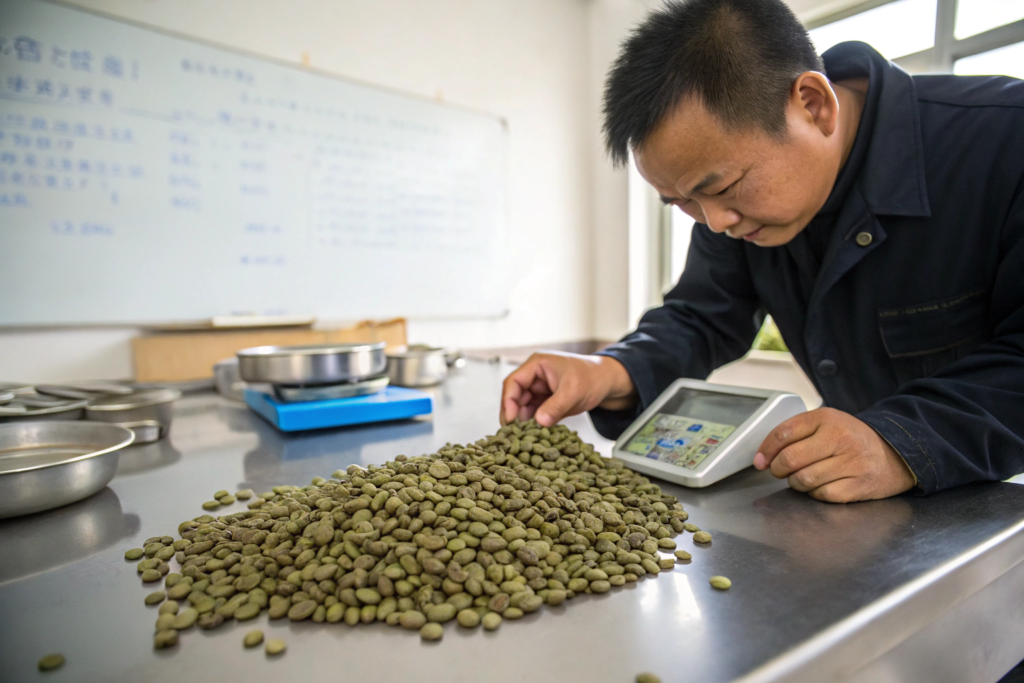
Honestly, screen size is where I see the most corner-cutting. A report might say "Screen 18." But is that 90% above screen 18, or just 50%? The difference matters. A lot. Big, uniform beans roast evenly. Small, mixed sizes create a nightmare in a drum roaster. The little beans scorch. The big beans stay under-roasted. You get a bag of peanut-shell and ash flavors.
I use the defect count the way a doctor uses a blood test. A report showing 2% primary defects is a loud alarm. You might think, "It's just 2%." But those full-black beans and sours will ruin a hundred pounds of perfectly good coffee. Here is a simple table I keep in my head when reading a physical analysis:
| Defect Type | Acceptable Limit (per 350g) | Impact on Cup |
|---|---|---|
| Full Black | 0 | Fermented, dirty, stinker note |
| Sour Bean | 1-2 max | Vinegar-like, sour fruit |
| Insect Damage | 2-3 max | Musty, earthy, past-crop flavor |
| Broken Beans | 5-10 | Uneven roast, bitterness |
I source Catimor from our Baoshan farm. It is a dense bean. It screens well, often at 17/18. But for Robusta, which we also export, the screen size is completely different. You might look for a screen 14 or 16. The key is to match the report’s screen analysis to the specific variety. A generic "Grade 1" stamp means nothing without the breakdown. Check the tolerance. That tells you the true uniformity of the lot.
How Can You Verify the Safety and Certification Claims on a Report?
I remember a potential client in New York. He sent me a competitor's report, asking if I could match the "Organic certified" price. The price was so low it made my head spin. I looked at the certificate number. I went to the certifier's public database. The certificate was expired by six months. The seller just kept putting the logo on the paperwork. The buyer almost paid for a lie. In the commodity world, a logo is a promise. But a promise without a valid, traceable number is just decoration.
Verifying safety claims is not about trust. It is about verification. You do this by cross-referencing the certification body's accreditation and running the certificate number on their official public registry. A genuine report will cite the lab's ISO 17025 accreditation. For organic claims, it links directly to a USDA or EU database entry. Without this chain of custody, the paper is worthless.
Here is the hard truth. It costs us money to maintain proper USDA organic certification on our Baoshan plantation. It costs money to test for pesticides and heavy metals. If a price seems magically cheap, the "safety" section of their report is the first place I look for fraud. Let’s dig into the two parts of this that keep a buyer like you awake at night.
How Do You Know If a Certification Is Still Valid for Your Shipment?
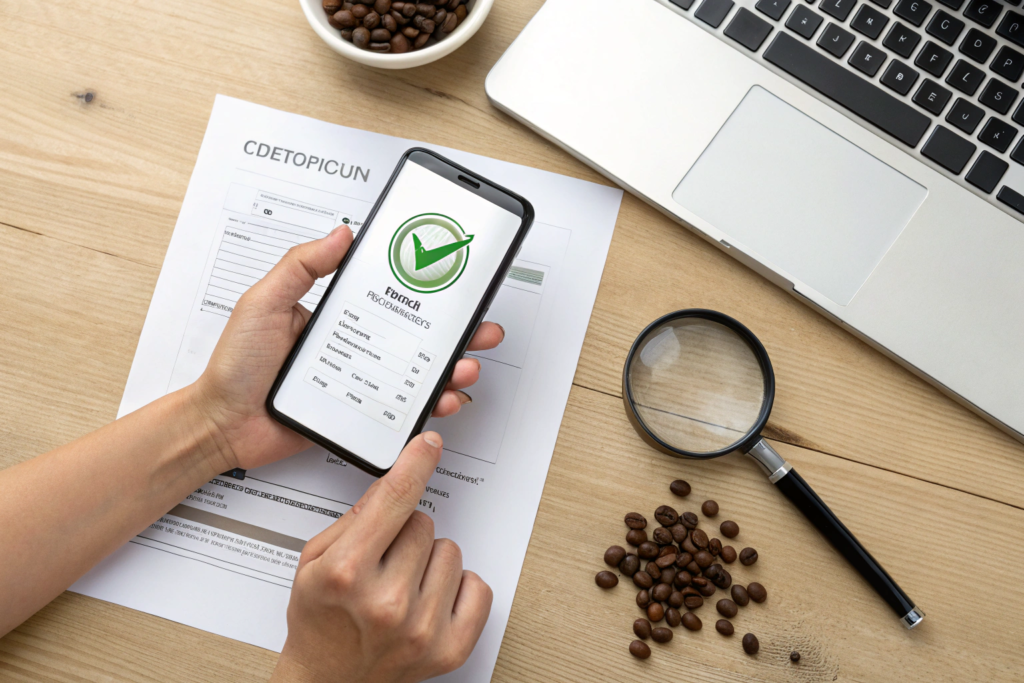
You get the PDF. The logo looks right. The format looks professional. Stop. Do not trust the PDF. I tell my export team that a PDF is just a digital opinion. The source of truth is the certifier's live database. For Europe, you check the EU Organic Farming database. For North America, you use the USDA Organic Integrity database. Look up the operation name exactly as it appears on the report. Check the scope. Does it cover "coffee" or "green coffee exporter"? If the scope is blank or says "fresh vegetables," run.
Another way to look at this is through the transaction certificate (TC) system. Every organic shipment from China to Europe must have a valid TC in the TRACES system. Ask your supplier for a screenshot of the TRACES entry, not just the certificate PDF. A blocked or invalid TC means your coffee will be detained at the port of Rotterdam or Hamburg. I have seen it happen. The demurrage fees pile up daily. You want to check the certificate’s last renewal date. Organic certs typically renew annually. If the report is dated October 2026 but the cert expires in August 2026, something is broken. Ask for the updated scope certificate before you send a single dollar.
What Pesticide Residue Tests Should a Chinese Coffee Report Include?
A UK client once asked me: "Your coffee is clean, right?" I replied: "Define clean." He could not. So I sent him our multi-residue test panel. It lists over 600 compounds. Silence on his end, then a polite email confirming the order. That list showed him what clean actually means.
For Chinese coffee, especially from Yunnan, the minimum test you need is for the big three banned organochlorines: DDT, Endosulfan, and Lindane. But you also need modern fungicides like Carbendazim. Our Baoshan farm sits at elevation. We manage pests with altitude and shade, not heavy chemistry. But a proper report proves this.
Ask for a lab report from an ISO 17025 accredited lab. SGS, Eurofins, or Intertek are the heavy hitters here. The report must show the Limit of Quantification (LOQ). It is not enough to see "Not Detected." You need to know how sensitive the test was. An LOQ of 0.01 mg/kg is the gold standard. An LOQ of 0.1 mg/kg is cheaper, but it might miss tiny traces that still violate EU MRL laws. Here is the scary part—EU maximum residue limits are sometimes ten times stricter than US limits. So, what passes for a US buyer might get rejected by a German one. Your report must specify which market’s MRLs it is checked against.
What Do the Sensory and Cupping Scores Actually Represent?
So, the physical beans are solid. The pesticide report is clean. Now you flip to the cupping score. This is the sizzle. This is where business gets emotional. An 82, an 84, an 86. I have seen buyers treat these numbers like Olympic scores—absolute and definitive. They are not. A score is a calibrated opinion, a snapshot of a specific day, a specific roast, a specific palate. Our head cupper in Baoshan once gave an 84.5 to a washed Catimor. The SCA-certified lab in Shanghai gave the same sample an 83. Both were right, in their own context.
The sensory scores in a report quantify aromatic complexity, the balance of acidity and body, and the absence of taste defects. They are derived from a strict protocol of fragrance, aroma, break, and tasting using the SCA cupping form. An 80-84.99 is a solid specialty lot with clean acidity. An 85+ is an exemplary coffee with distinctive character and sweetness. Below 80, you are in commercial territory where price usually matters more than story.
Knowing how to read this section saves you from paying specialty prices for commercial coffee. But it also stops you from rejecting a beautiful 83-pointer just because it is not an 85. The difference is often just a matter of roast development or water chemistry in the lab. Let’s look at the two specific dimensions that define the "body" of the report.
How Should You Interpret the Acidity and Body Scores?
Acidity is the soul of Arabica. But it is also the most misunderstood word. When I say high acidity, I do not mean sour. I mean bright, crisp, like a green apple or a lemon. Our Yunnan Arabica often has a malic acidity. Think red apple, not green. It is softer, rounder. The report might score this a 7.5 or an 8.0 on the SCA scale.
Body is the weight of the coffee on your tongue. Is it like water, or is it like milk? A high body score usually comes from a high elevation, dense bean, or specific processing. Our washed Catimor might score a 7.25 in body. A natural processed Catimor from the same farm might hit an 8.0. It is thicker, syrupier.
So, what does this mean for you as a buyer? It means you must match these scores to your roast style. If you plan a light Nordic roast, you need a coffee scoring above 8.0 in acidity. The heat will highlight that brightness. If you plan an espresso blend, a 7.5 acidity with an 8.0 body is a dream. The body holds up against milk. A coffee with 9.0 acidity and 6.5 body as a single-origin espresso? That could taste like harsh lemon juice. The numbers are relative to the intended use.
What Is the Difference Between Fragrance, Aroma, and Flavor Notes?
You know, one thing that tripped me up early on was the "fragrance vs. aroma" thing. The report has separate boxes for them. Fragrance is the dry ground coffee smell. Aroma is the wet coffee smell after you pour the hot water. It is the "break." If the fragrance is score 7.5 (nutty, sweet) but the aroma jumps to 8.25 (floral, honey), the coffee has hidden complexity. The hot water released it.
Flavor is the combination of taste and smell when the coffee is actually in your mouth. This is the mid-palate note. The report might say "black tea, brown sugar, hint of stone fruit." Do not just read the fancy words. Look at the score. An 8.0 flavor score with simple descriptors is better than a 7.5 with exotic words like "mangosteen." Words are for marketing. The number is for quality control.
I look for a rising pattern. If fragrance is low, aroma is higher, and flavor is highest, you have a coffee that blooms in the roast. Our Baoshan beans do this well. If the numbers drop from aroma to flavor, the coffee might have a great smell but a watery, hollow taste. That is a defect not easily fixed by a roaster. A balanced set of scores—all within a half-point range—shows a stable, honest coffee. It will not surprise you badly on the cupping table.
Why Does Logistics Data Matter on a Quality Report?
A coffee quality report rarely stands alone. It is attached to a shipment. I had a client in Long Beach panic because his coffee tasted "baggy." It was a 12-month-old crop. The cupping score was from six months ago. The coffee had crossed the equator twice. The quality report was technically not a lie. It just described a ghost. The coffee that arrived was a shadow of what was tested. This is why you ignore the logistics context at your own peril.
Logistics data on a report—crop year, ICO mark, packing date, and shipping conditions—transforms a static quality statement into a time-sensitive warranty. It bridges the gap between the lab table in Kunming and your roastery in Chicago. If the report is older than 3 to 6 months, the quality information is not fresh enough to base a spot purchase on, without a resample.
A truly useful report connects the identity of the container to the identity of the cup. It proves the coffee tested is the coffee shipped. This is where a lot of fraud slips in. A beautiful sample, a perfect report, and then a container of something else. The paper trail is your defense.
How Do Crop Year and Container Conditions Affect Freshness?
This is a detail that is easy to miss. A report might say "Crop Year: 2025/26." If you are buying in July 2026, that coffee could be 18 months old. Arabica stored in a dry, cool warehouse at high elevation can hold quality. Robusta or coffee stored in a hot, humid port city will fade fast. Yunnan's Baoshan has natural cold storage benefits. Our warehouses sit at 1,600 meters. The coffee sleeps well. But a lab report does not reflect warehouse conditions unless it specifies the sample pull date.
Ask for the "Sample Pull Date." It is different from the "Report Date." I have seen reports issued in April for a sample pulled in January. Those three months matter. Look for a mention of the shipping method. A container with a liner bag versus a loose-stuffed container? Huge difference in humidity control. A high moisture content coffee shipped without a liner bag to Europe in winter will sweat. The report might have shown 11.5% moisture. By the time it reaches Hamburg, the top layer could be 13% and moldy. The paper was accurate. The packaging decision was not.
Also check for the ICO identification code. This 14-digit code links the coffee back to the specific farm and export lot. If the report has an ICO code, you can trace it back through the supply chain. If it is missing, ask why. For specialty lots from our Baoshan farm, we include this as standard practice. It is not just a number. It is proof of origin.
How Do You Use a Report to Confirm Shipping Schedule Reliability?
You talked about timeliness being a pain point. I get that. You order coffee for a seasonal blend launch. It arrives late. The moment has passed. The quality report has a hidden use here. It is a timestamp.
Here is how I think about it. Look at the report date and the Bill of Lading date. A short gap means the coffee was ready and shipped fast. A long gap means the coffee was sitting, waiting for a vessel, or the seller was consolidating a container. That wait time degrades quality. It also signals logistics competence. A seller who sends a report dated September 5th and a Bill of Lading dated September 10th is organized. A seller with a September 5th report and an October 28th Bill of Lading has a logistics problem. The coffee aged another two months in standby. You are paying for two months of shelf life decay.
Also, the report can confirm if you got what you booked. A client booked a premium screen 18 lot. The Bill of Lading said "Arabica Grade 1." But the packing list attached to the report showed screen 16/17 distribution. The quality report was physically correct. The sales contract was wrong. By matching the screen analysis on the report to the booking confirmation, we caught the mistake before the container left the port of Shanghai. We renegotiated the price. Without that report detail, the buyer would have opened the container in Vancouver and eaten the loss.
Conclusion
We started with a near disaster over a screen size mix-up. We end with a simple reality. A green coffee quality report is a contract between a farm in Baoshan and a roaster in America. It is written in two languages. One is the scientific language of moisture meters and defect counts. The other is the sensory language of acidity and body. You cannot trust a report by just looking at the total score. You take it apart. You check the physical measurements first. Are the beans alive and stable? Then you verify the safety. Are the organic certificates valid, or is it just a logo? Then you read the cupping notes as a story, not as a fixed judgment.
Every number on that paper is a negotiation point. The moisture tells you about value. The water activity tells you about safety. The screen size tells you about roast uniformity. The crop year, combined with the Bill of Lading date, tells you about freshness and logistics integrity. Ron, I know you care about price and timeliness. I know you hate surprises. That is why we do not just farm coffee on our 10,000 acres. We document it. We want our report to reach you before our container does. Because a good quality report is the one that accurately predicts what you taste six weeks later in your cupping room.
If you are tired of reports that read like fairy tales, let’s talk. You need a supplier who treats a cupping score as a guarantee, not a guess. From our farm in Yunnan directly to your roastery, we can walk you through a real report for a lot of Catimor or Arabica that fits your price target and your timeline. Reach out to our team. Contact Cathy Cai at cathy@beanofcoffee.com. Send us your specs, your target FOB price, and your preferred shipment window. Let us show you a quality report that actually makes sense.