A new client once hesitated before placing his first large order. He had cupped the sample, and it was beautiful. But he had been burned before by a supplier whose quality looked good on the surface but hid a food safety failure. I knew exactly what he needed, and I was waiting for him to ask. Before he could, I sent him an email. "I know you're about to request a third-party lab test for this lot," I wrote. "Here is the direct link to the official SGS portal. Our lot number is BOC-26-14A. Please verify the Ochratoxin A and pesticide panel right now, and let me know when you're ready to proceed." He called me five minutes later. "I just verified it," he said. "Let's ship the coffee." The transaction was transformed from a moment of anxiety into an act of mutual, verified trust.
To request a third-party lab test from your coffee bean supplier, you must send a clear, specific email asking for a "lot-specific, multi-residue analysis from an ISO 17025 accredited laboratory," specifying the exact tests you need, and demanding that the resulting Certificate of Analysis includes the lab's unique report number, the test's Limit of Quantification (LOQ), and an exact match to your contracted lot number.
This is not an accusation. It is a standard, professional, and expected part of modern coffee sourcing. A legitimate supplier will have this data ready. Let me explain exactly how to make the request and what a compliant response looks like. At Shanghai Fumao, this is a cornerstone of our Quality Control program.
How Do You Frame the Request to Get the Right Test the First Time?
Asking for a "lab test" is too vague. A clever but unscrupulous supplier could send you a cheap, generic test from a non-accredited lab that screened for only a handful of chemicals and has no forensic link to your specific coffee. You need to ask for a specific, legally-defensible document. The precision of your language in the email is what gets you the right result. You must sound like an informed, professional buyer who cannot be easily fooled.
To get the right test, you must frame the request with technical precision, explicitly asking for an analysis from a named, accredited laboratory, specifying the exact analytical method, and demanding that the results be reported with their specific Limits of Quantification (LOQs) and be unequivocally linked to your specific contracted lot number.
Why Must the Laboratory Be ISO 17025 Accredited?
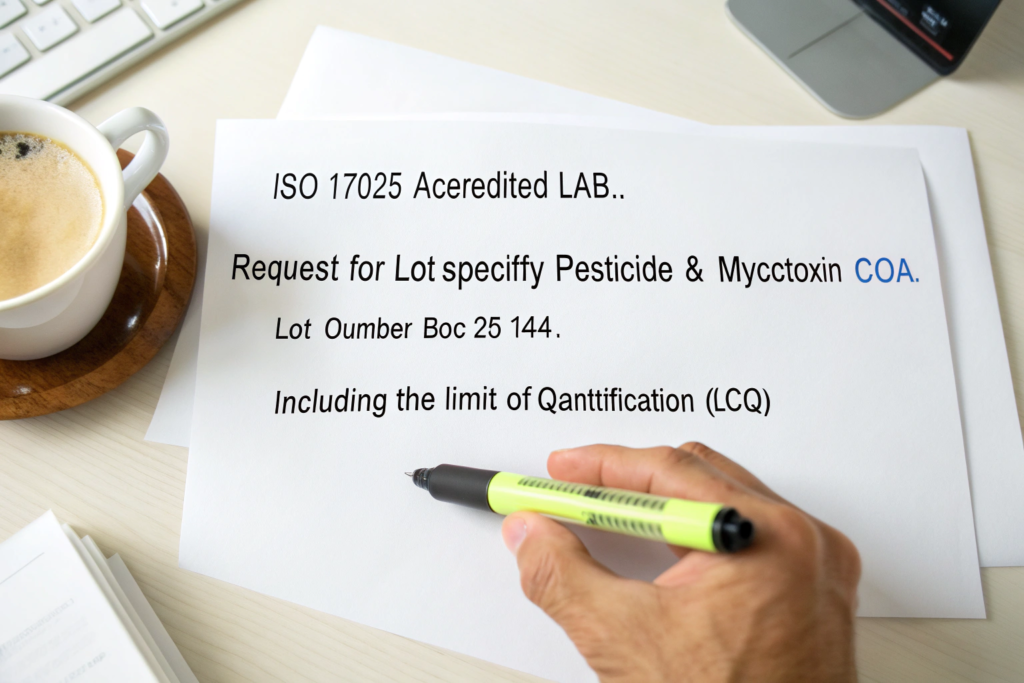
You can buy a "Certificate of Analysis" from a fake online certificate mill for $50, and it will look impressive with a gold seal and a fancy signature. This document is legally worthless and gives you a false sense of security. The entire credibility of a test rests on the competence and independence of the laboratory that performed it, which is why you must demand a specific, globally recognized accreditation.
ISO 17025 is the international standard for the competence of testing and calibration laboratories. An accredited lab has been audited by a national body to prove its equipment is calibrated, its technicians are trained, and its methods are scientifically valid. A report from an ISO 17025 lab is accepted by customs authorities, organic certifiers, and in a court of law. You can independently verify the lab's accreditation on the body's website. It is the only type of lab report that provides real, defensible protection for your business. You can search for accredited labs through bodies like ANAB in the U.S.
How Do You Specify the "Scope" of the Test to Cover Key Risks?
You must not just ask for "a pesticide test." A cheap, basic test might only screen for 50 common pesticides and have a high detection limit, potentially missing a residue of a banned chemical that is present at a lower, but still illegal, level. You need to specify the comprehensiveness of the test.
For mycotoxins, specifically request a screen for Ochratoxin A with a Limit of Quantification (LOQ) ideally less than 1.0 part per billion (ppb). For pesticides, you should request a "multi-residue panel" that screens for 400-500+ compounds using the gold standard methods of GC-MS/MS and LC-MS/MS. This broad-spectrum screen should be tailored to the origin's potential risks. For example, you can reference the specific tightened MRLs we discuss in What Are the New EU Pesticide MRLs for Coffee Beans in 2026?. Asking for this specific test panel tells the supplier that you understand food safety science.
What Should a Complete and Trustworthy CoA Look Like?
You have sent your precise request, and the supplier has emailed you a PDF. You cannot just glance at it and file it away. You must know how to read it like an auditor. A trustworthy CoA is not just a list of numbers; it is a legal document with specific, non-negotiable forensic identifiers. If any of these key elements are missing, the document's integrity is compromised, and it should be rejected.
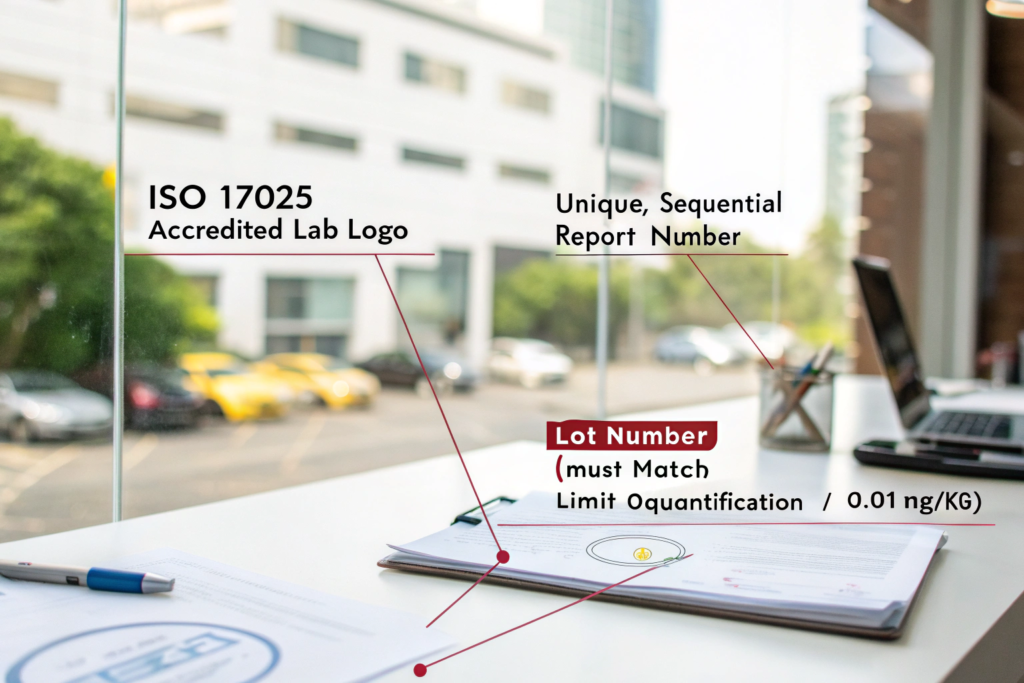
A complete and trustworthy CoA must be a clear, unaltered PDF direct from the lab, prominently display the lab's full name and ISO 17025 accreditation number, contain a unique and sequentially verifiable report number, explicitly list the lot number that perfectly matches your contract, and report the results for each analyte with their specific Limits of Quantification (LOQs).
This is your checklist. Before you trust a single number on the report, you verify these details. The report number is your key to independent truth. As we explain in our guide on How to Ensure My Coffee Beans Are Not Contaminated with Ochratoxin A?, the lot number is the forensic link that proves the test belongs to your coffee.
How Do You Read the "Limit of Quantification" for a Pesticide or Ochratoxin A?
A result that simply says "Not Detected" is meaningless, and potentially dishonest, without knowing the sensitivity of the test that was performed. A cheap, insensitive test could easily report "Not Detected" while missing a residue that a more rigorous test would catch. You must look at the LOQ.
The Limit of Quantification (LOQ) is the lowest concentration of a substance that the laboratory's instrument can reliably measure. For Ochratoxin A, a trustworthy report will aim for an LOQ of less than 1.0 parts per billion (ppb) or at least less than 5.0 ppb. For pesticides, the gold standard is an LOQ of 0.01 mg/kg for the majority of compounds, as this aligns with the EU's strict default MRL. A result of "< 0.01 mg/kg" from a test with an LOQ of 0.01 mg/kg proves the residue is not present at a legally significant level. A supplier who provides a report with these specific LOQs is providing you with the highest standard of analytical evidence.
Why Is the "Chain of Custody" Date a Critical Anti-Fraud Detail?
A test result is a snapshot in time. A clever fraudster could send you a clean test from a batch of coffee that was processed two years ago, but the specific lot you are buying today might be completely different. The date of analysis and the chain of custody are crucial pieces of forensic evidence that link the test to the present reality.
The Certificate of Analysis must include the date the sample was received and analyzed by the lab. This date should make logical sense. It must be a date that is after your specific lot was milled and prepared for export and before the container was shipped. A test from six months ago is not a valid test for your coffee. The chain of custody document that accompanies a true Pre-Shipment Sample (PSS), which we detail in How to Get a Pre-Shipment Sample Approved for Coffee Wholesale?, provides this timeline. An unbroken, dated chain of custody from the moment the sample was drawn to the lab is your best defense against a "recycled" test.
How Do You Use the CoA to Independently Verify the Test Results?
A beautiful PDF with all the right logos can still be a complete forgery, created in a graphics program in under an hour. The final, and most powerful, step in this process is to bypass the document entirely and go directly to the source of truth: the laboratory's own secure database. This is the act that separates a trusting buyer from a protected one.
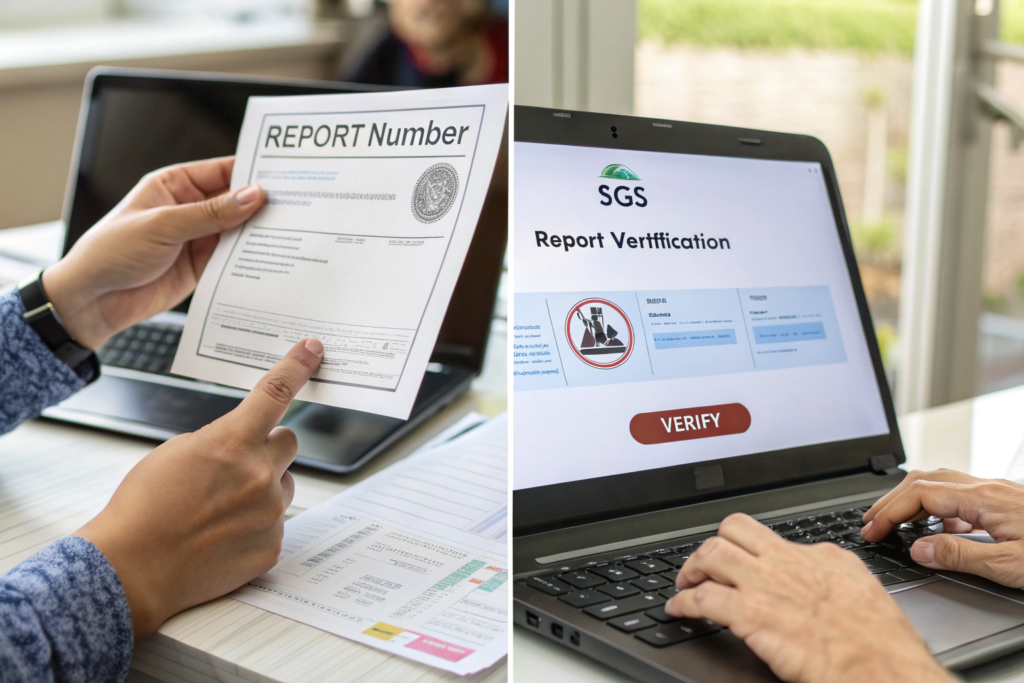
You must independently verify the CoA's authenticity by navigating directly to the testing laboratory's official website—never using a link provided by the supplier—locating their public "Report Verification" portal, and entering the unique report number from the CoA to retrieve the original, unalterable results from the lab's own database.
If the report number pulls up the correct results, the CoA is authentic. If you get an error, you have uncovered a fraud. This five-minute check can save you tens of thousands of dollars and a food safety crisis. At Shanghai Fumao, we actively encourage all our partners to do this. Our reports are designed to survive your deepest scrutiny.
How to Use the SGS or Eurofins "Online Report Verification" Portal?
The world's most respected laboratories, such as SGS and Eurofins, make independent verification easy because their business model depends on the integrity of their reports. They provide a public, client-facing tool for this exact purpose. Using it is simple and requires no special training.
First, open a new browser and navigate directly to the www.sgs.com or www.eurofins.com website. Look for a clearly labeled tab, often found in the footer or under a "Services" or "Resources" menu, called "Verify a Certificate," "Report Verification," or "Authenticate a Report." You will be prompted to enter the report number, and possibly a certificate number, exactly as they appear on your document. After completing a simple CAPTCHA, the lab's system will pull up the original, official report. You should then carefully compare this verified report, line by line, with the PDF your supplier sent. This is the definitive check.
What Should You Do If a Supplier Refuses or Delays This Request?
This is a critical moment of truth. A transparent, professional supplier will respond to a request for a third-party lab test promptly and with all the necessary information. A supplier who stalls, makes excuses, or becomes defensive is revealing a serious problem, and their response is a major red flag that you must not ignore.
A refusal to provide a third-party CoA is not a minor negotiation impasse. It is a deeply suspicious and unacceptable response. Your course of action must be decisive. You must stop the transaction immediately. Do not release any payment and inform the supplier that the order is on hold pending the receipt of the complete, verifiable documentation. A supplier who is not willing to provide a third-party food safety test is not a partner you can trust with your brand's reputation or your customers' health. At Shanghai Fumao, we provide our partners with a complete, pre-verified documentation package. A request for a test is always met with an immediate, transparent, and compliant response.
Conclusion
Requesting a third-party lab test from your coffee supplier is a simple, powerful act of professional self-defense. It is the standard by which a serious buyer separates a legitimate, transparent partner from a risky, opaque vendor. The process is straightforward: you must frame the request with technical precision, know how to read the resulting CoA for its critical forensic details, and then perform the definitive act of independent verification against the lab's public database.
A supplier who is transparent and confident in their product will not only welcome this scrutiny but will have the data ready to provide. Their willingness to be verified is the true test of their trustworthiness.
At Shanghai Fumao, we operate on the principle of radical transparency. We believe that our quality and safety should be an open book, independently verified and easily checked by you.
If you are planning your next shipment and want to experience this transparent, data-driven partnership firsthand, I invite you to request a complete lot-specific lab report. Email Cathy Cai. Ask for a "Third-Party Lot-Specific CoA for Our Current Grade 1 Lot." Contact Cathy at: cathy@beanofcoffee.com