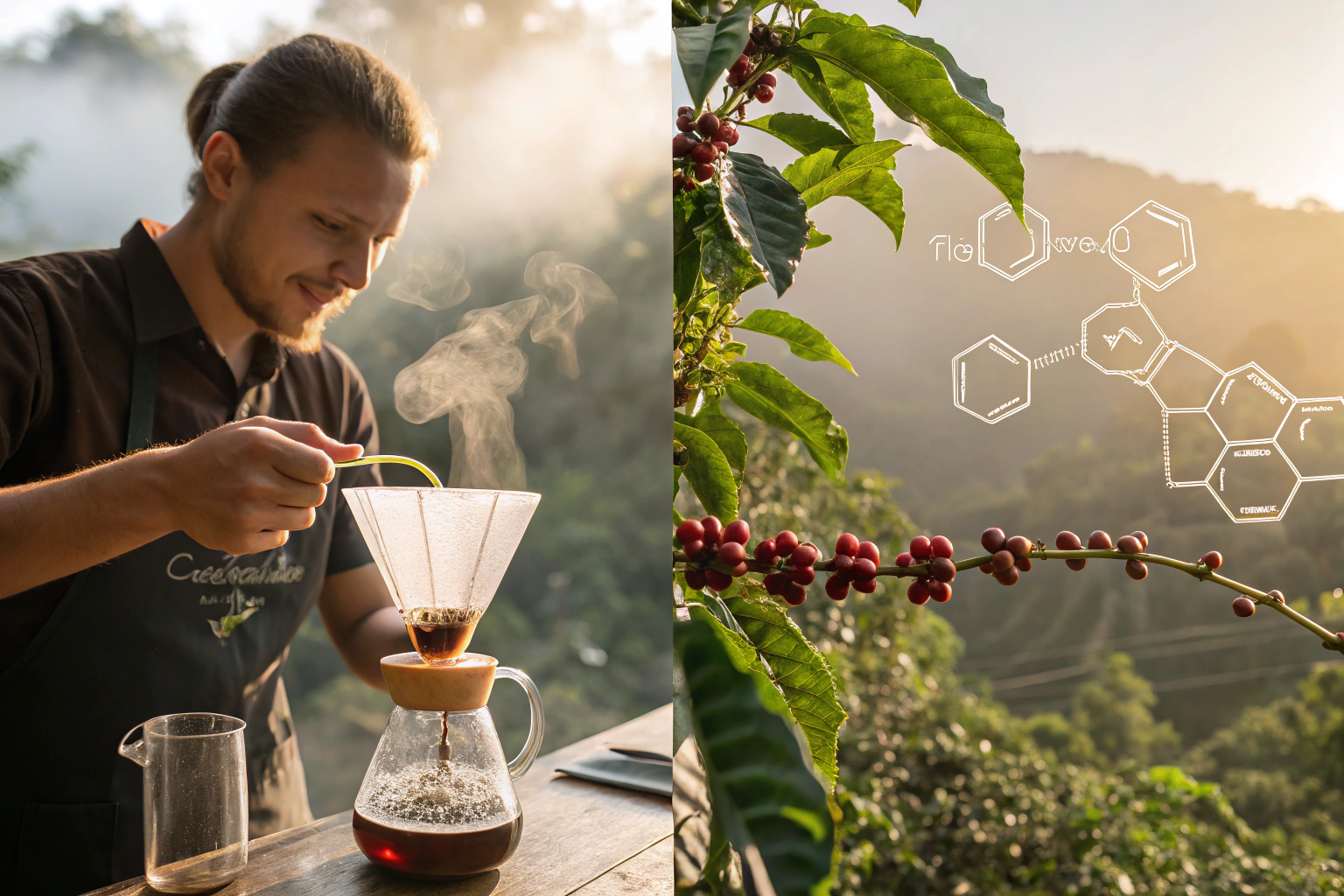
A buyer from a wellness-focused roastery in California called me last year. "My customers want decaf taste without decaf processing. They want something natural. But everything I find tastes thin or synthetic." He had tried chemically decaffeinated Colombians. He tried Swiss Water Process lots. His customers complained. "Where is the flavor? Why does this taste like cardboard?"
I told him about a small plot we had in Baoshan. A variety called Laurina. It grows slowly. It yields less. But its caffeine content is naturally half that of standard Arabica. No chemicals. No processing tricks. Just genetics. He flew to a trade show in Shanghai a month later. Cupped the lot. Scored it 86. Placed an order the same afternoon.
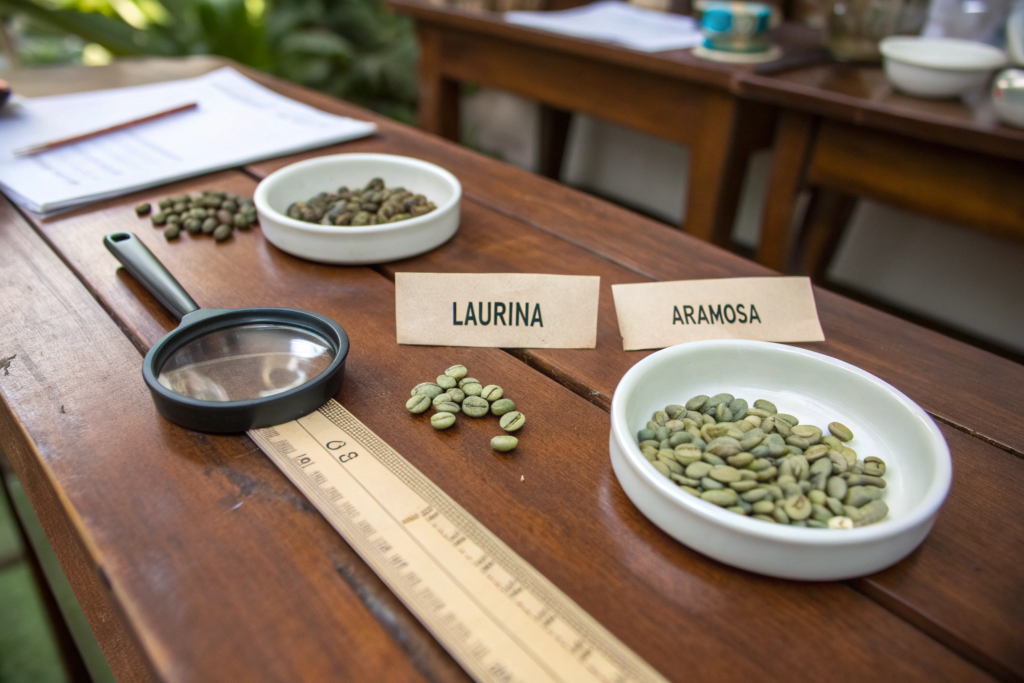
Sourcing low caffeine coffee beans naturally means seeking out specific varietals like Laurina and Aramosa that contain genetically lower caffeine levels, or selecting high-altitude, shade-grown Arabica lots which naturally develop slightly less caffeine than their sun-grown, low-altitude counterparts.
The market for naturally low-caffeine specialty coffee is growing. Health-conscious consumers. Evening coffee drinkers. Pregnant customers who are told to limit intake but refuse to give up their morning ritual. These buyers are willing to pay a premium if the flavor experience stays intact. Let me guide you through what actually works.
What Coffee Varieties Are Naturally Low in Caffeine?
Most coffee buyers think there are two coffee species. Arabica and Robusta. Arabica has about 1.2 to 1.5 percent caffeine by weight. Robusta has 2.2 to 2.7 percent. But within Arabica, there are rare varietals that break that rule entirely.
Laurina, sometimes called Bourbon Pointu, is the most famous. It originated on Réunion Island in the Indian Ocean. The plant produces about 0.6 percent caffeine by weight. That is roughly half of standard Arabica. The beans are tiny and pointed. The plant is fragile. Yields are low. But the cup quality can be extraordinary—floral, delicate, with a tea-like clarity that standard Bourbon never achieves.
Aramosa is another low-caffeine varietal. It is actually a natural hybrid between Arabica and a wild species called Racemosa. Racemosa is nearly caffeine-free. The hybrid Aramosa inherits that trait partially, containing roughly 0.7 to 0.9 percent caffeine. It grows well at lower altitudes and is more disease-resistant than Laurina. Naturally low caffeine varietals like Laurina and Aramosa contain approximately 50 to 60 percent less caffeine than standard Arabica due to a genetic mutation that reduces caffeine synthase activity during bean development.
There are also experimental crosses like AC1 and AC2, developed by breeding programs, but these are not yet commercially available at volume. What is available now in Yunnan? Mostly Laurina, on a few farms willing to put in the extra care.
Why Is Laurina Coffee So Rare and Expensive?
Supply and demand is part of it. But the real driver is agronomic difficulty.
Laurina trees are weak. They do not compete well with weeds. They need shade. They need consistent moisture. They are susceptible to coffee leaf rust and coffee berry disease. Many farmers who try Laurina rip out the trees after two harvests because the yield per tree is so low it does not cover labor costs.
A standard Catimor tree in Yunnan produces about 3 to 5 kilograms of cherry per season, depending on age and pruning. A Laurina tree produces 0.5 to 1.5 kilograms. Less than half. Sometimes less than a third. And the cherries are smaller, which makes hand-picking slower and more expensive.
The processing also requires more care. The small beans dry faster and more unevenly. They are more prone to cracking during hulling. The yield from cherry to exportable green bean is lower than standard Arabica. All of this adds cost at every stage.
A roaster buying Laurina from Shanghai Fumao is paying for rarity, for agronomic risk, and for a varietal story that sells. The FOB price per pound often runs two to three times higher than standard Catimor. The retail bag price must reflect that. But the wellness-focused customer segment does not flinch at a premium price for a natural product that fits their lifestyle.
Does Altitude Affect Caffeine Content in Coffee Beans?
Yes. And the relationship is not what some buyers assume.
Coffee plants produce caffeine as a natural pesticide. The caffeine paralyzes and kills insects that try to eat the cherries. At higher altitudes, insect pressure is lower. The plant allocates less energy to caffeine production and more to growth and sugar development. High-altitude Arabica—above 1,500 meters—generally contains slightly less caffeine than low-altitude Arabica of the same varietal.
The difference is small. Maybe 0.1 to 0.3 percentage points. A coffee grown at 1,600 meters might have 1.1 percent caffeine, while the same varietal at 1,000 meters has 1.4 percent. This is not enough to market the coffee as "low caffeine" on its own. But it does make a difference for a health-conscious drinker who drinks four cups a day.
Combine high altitude with a low-caffeine varietal like Laurina, and you get the mildest natural cup possible. Grown at 1,600 meters in Baoshan, Laurina can drop to 0.5 percent caffeine—among the lowest in the world for a non-decaffeinated coffee. That combination is what specialty wellness brands should target.
For more agronomic data on this, World Coffee Research has published variety catalogs that include caffeine content ranges for different Arabica cultivars grown at various altitudes.
How Does Natural Low Caffeine Coffee Taste Compared to Swiss Water Process?
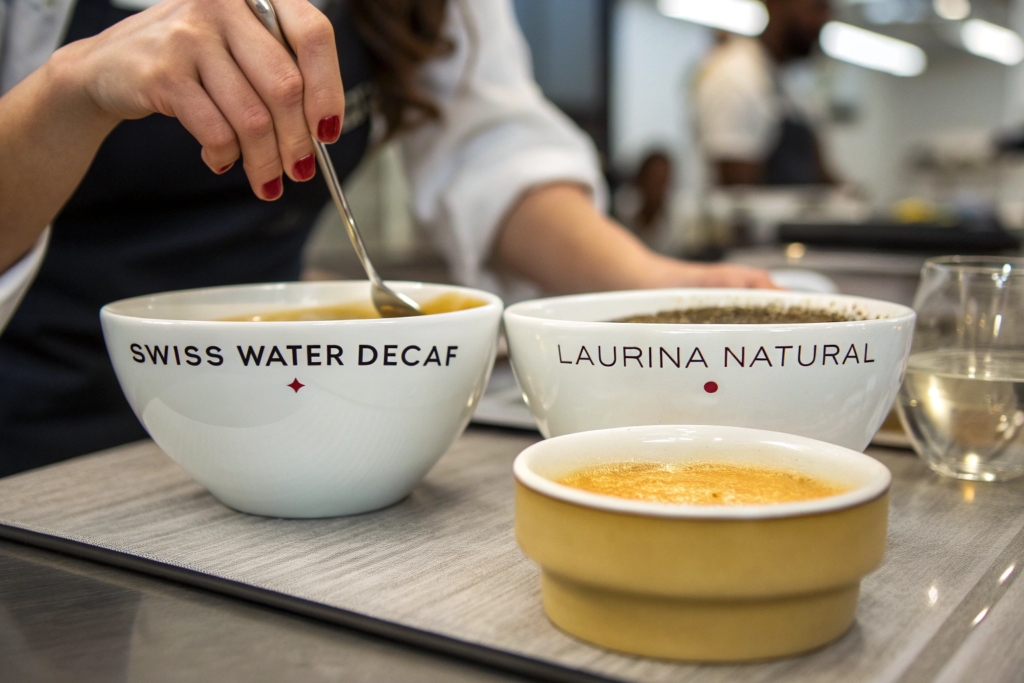
I have cupped a lot of decaf coffee. I have cupped Swiss Water Process Ethiopians that started with 88-point potential and ended up scoring 82. Something gets lost. Not always. But often. The process removes caffeine, but it also strips out volatile aromatics, lipids, and soluble solids that contribute to body and flavor.
Laurina and Aramosa taste like coffee. Full stop. There is no process intervention. The bean is intact. All its original compounds—except caffeine—are still in their natural proportions. The cup tastes complete.
Naturally low caffeine varietals like Laurina offer a fuller, more complex flavor than decaffeinated coffees because the bean's chemical structure is never altered by water, solvent, or carbon dioxide extraction. The result is a cup with intact acidity, body, and aromatic fidelity.
A washed Laurina from Yunnan cups with notes of white tea, citrus blossom, and green apple. The body is light, silky, and delicate. A Swiss Water Process decaf, by contrast, often cups with muted acidity, a slightly papery aftertaste, and a thinner body. The difference is noticeable even to non-professionals. For a specialty roaster selling to health-conscious customers, that flavor gap is the entire value proposition.
What Is the Flavor Profile of Yunnan Grown Laurina?
Last season, we processed a micro-lot of washed Laurina from a plot at 1,620 meters in Baoshan. Here are the cupping notes from my log:
| Cupping Attribute | Score | Description |
|---|---|---|
| Fragrance/Aroma | 8.5 | White tea, honeydew melon, jasmine |
| Flavor | 8.6 | Green grape, white peach, hint of lemon zest |
| Aftertaste | 8.3 | Clean, lingering sweetness, very mild |
| Acidity | 8.4 | Soft citric, like tangerine, not sharp |
| Body | 7.8 | Light bodied, silky, tea-like |
| Balance | 8.5 | Delicate, transparent, no rough edges |
| Overall | 86.0 | Elegant and gentle, ideal for filter |
This profile is not for everyone. If your customers drink dark-roasted espresso with milk, Laurina will taste thin and underwhelming. But if your customers drink Chemex or V60, black, and they pay attention to subtlety, this coffee will delight them.
The natural low caffeine aspect becomes a conversation starter. The customer drinks the coffee. Enjoys it. Then reads the label: "Naturally contains 50% less caffeine. No decaffeination process." That is a powerful marketing message. It reassures the customer that they are drinking something pure, unaltered, gentle.
Can Swiss Water Process Match the Flavor Integrity of Laurina?
Honestly, no. Not yet. And I say that with respect for the Swiss Water Process. It is the best decaffeination method available. Better than ethyl acetate. Better than methylene chloride. But it is still an extraction process. And extraction is never perfectly selective.
Here is what happens. The green coffee is soaked in hot water to open its pores. Then it is passed through activated charcoal filters that trap caffeine molecules. The problem is that caffeine molecules are similar in size and polarity to some flavor compounds. The charcoal captures some of those too. The result is a coffee that is 99.9 percent caffeine-free, but also partially flavor-free.
Laurina, by contrast, has all its flavor compounds intact. The caffeine is simply lower because the plant produced less of it. The flavor complexity is untouched. The aromatics are complete. The finish is clean, not papery. For a roaster who wants to charge a specialty price for a wellness product, Laurina is the more defensible option. You can find more technical comparisons between decaf methods on the Specialty Coffee Association website under their sensory science resources.
How to Build a Low Caffeine Coffee Sourcing Program?
Low caffeine sourcing is not a spot-buying game. The volumes are too small. The varietals are too specific. You need a program. A relationship. A commitment that spans multiple harvests.
Here is the approach I recommend to roasters who want to develop a low-caffeine line. First, book a small trial lot of Laurina or Aramosa. Cup it. Roast profile test it. Get your production team familiar with the bean's behavior in the drum. Laurina beans are smaller and denser than standard Arabica. They roast differently. They can scorch if the charge temperature is too high.
Second, test the market. Release it as a limited drop. Gauge customer response. Collect feedback on flavor and on the low-caffeine messaging. If it sells out quickly and customers ask for more, you have a signal.
Third, negotiate a forward contract for a larger volume next harvest. Laurina production is tiny. If you wait until harvest to start asking, the lot will be gone. You need to reserve it months in advance.
Building a natural low-caffeine coffee program requires forward contracting with a farm that grows Laurina or Aramosa, developing a dedicated roast profile for the smaller bean density, and creating packaging that educates consumers on the difference between natural low caffeine and processed decaffeination.
The Shanghai Fumao team works directly with Laurina growers in Yunnan to allocate micro-lots for forward booking. We cup each lot separately and provide detailed caffeine content estimates based on varietal genetics and altitude.

What Certifications Matter for Low Caffeine Coffee Marketing?
The wellness consumer segment cares about certifications. More than the average specialty coffee buyer.
Organic certification matters. A customer who buys low-caffeine coffee for health reasons likely also wants it free of synthetic pesticides. Rainforest Alliance or Fair Trade adds credibility, though these certifications are less common on micro-lots.
The most direct certification for this product is a lab-tested caffeine content report. A third-party lab can measure the exact caffeine concentration in the green coffee. Results typically come back in percentage by weight. Publish that number on the retail bag. "Lab-tested: 0.62% caffeine by weight. Standard Arabica: 1.2%." That transparency builds trust faster than any marketing claim.
I recommend also adding a brief note about the varietal genetics. "This Laurina coffee is naturally low in caffeine. No chemicals. No extraction process. Just a rare variety grown for gentle energy." That sentence on a bag answers the customer's unspoken question: "Is this real, or is this marketing hype?" For official guidance on labeling, the FDA provides regulations on food product claims in the US, including how caffeine content can be described.
How Do You Manage Inventory for a Seasonal Low-Caffeine Micro-Lot?
Micro-lot management is different from managing a year-round blend component. The volume is fixed. When it sells out, it sells out. You cannot reorder mid-season.
I advise roasters to do the math before they buy. If you purchase 150 kilograms of Laurina, and your average weekly sales of limited-release coffee are 15 kilograms, you have roughly ten weeks of supply. Plan the launch date accordingly. Do not launch in January if you need the coffee to last through summer. Launch when you have enough shelf life remaining to sell through without rushing or discounting.
Also, communicate the scarcity honestly. "Harvest 2025. Only 200 kilograms produced. Once gone, next release will be Harvest 2026." This messaging creates urgency without manipulation. The customer understands the agricultural reality. They respect the transparency. And they buy more bags upfront.
Storage conditions matter for micro-lots that sit longer. Use GrainPro bags. Keep water activity below 0.55. Store in a cool, dry area of the warehouse. For more on inventory practices, the Coffee Quality Institute publishes guidance on green coffee storage and shelf-life optimization.
Can You Blend Laurina With Standard Arabica for a Balanced Low-Caffeine Product?
Some roasters do exactly this. Laurina is expensive. It is also very delicate. A 100 percent Laurina roast might lack the body and intensity that some customers want.
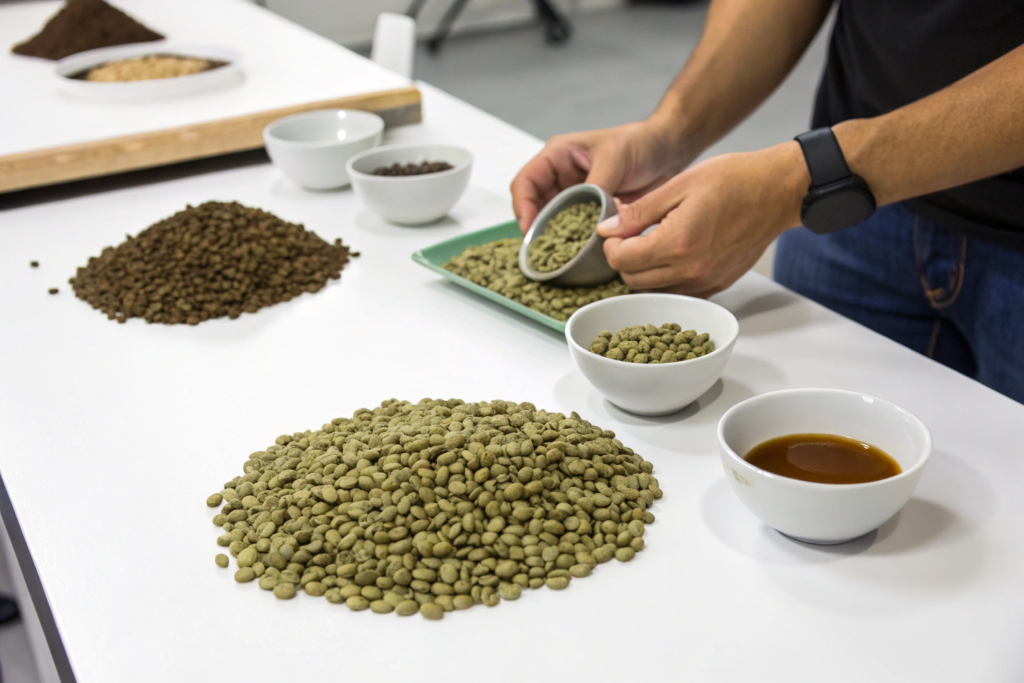
Blending Laurina with a clean washed Catimor at a 50/50 ratio achieves something interesting. The caffeine content lands around 0.8 to 0.9 percent. Still lower than standard Arabica. Still marketable as "reduced caffeine, naturally." But the body improves. The flavor adds chocolate and nut notes that round out the floral tea character. The blended cost per pound is lower, allowing a more accessible retail price.
Blending Laurina with a standard washed Arabica base at ratios between 30 and 50 percent creates a product with reduced caffeine content, improved body, and a more approachable flavor profile at a lower blended green cost than 100 percent Laurina.
One of my US buyers does a 70/30 blend: 70 percent washed Catimor, 30 percent Laurina. The caffeine content drops only slightly—from 1.2 percent to about 1.0 percent. Not enough to market as "low caffeine." But he positions it as "gentler energy" and sells it as an all-day drinking coffee. Customers report feeling less jittery. That subjective experience, combined with the flavor, drives repeat purchases.
What Blend Ratios Achieve the Best Flavor Balance?
There is no one-size-fits-all answer. The right ratio depends on what you want to say on the bag and who you are selling to.
Here are three blending scenarios I have seen work for different roasters:
| Blend Ratio (Base : Laurina) | Estimated Caffeine % | Marketing Position | Best Application |
|---|---|---|---|
| 50 : 50 | ~0.9% | Naturally Reduced Caffeine | Filter, all-day drinking |
| 70 : 30 | ~1.0% | Gentler Energy Blend | Drip, French press, cold brew |
| 85 : 15 | ~1.1% | Smooth Classic with a Twist | Espresso, milk-based drinks |
The 50/50 blend is the most marketable as "reduced caffeine" because the drop is measurable and meaningful. The 70/30 is the sweet spot for flavor balance—enough Laurina to soften the cup, enough Catimor to anchor it. The 85/15 is subtle, and honestly, I would only recommend it if you are blending Laurina into an espresso base and want just a hint of its floral character.
Test these ratios in your own roastery. Cup them blind. Let the cupping scores and your customer feedback guide the final formula. The Shanghai Fumao team can supply both the Laurina micro-lot and the washed Catimor base from the same harvest period.
How Do You Market a Blended Low-Caffeine Coffee Transparently?
Transparency is critical here. If you claim "low caffeine," you need to back it up with a number. A vague claim invites skepticism. A specific, lab-verified percentage builds trust.
I recommend printing the caffeine content directly on the front of the bag. Or at minimum, on the back label with a short explanation. Something like: "Blended from rare Laurina beans, naturally lower in caffeine. Lab tested: approximately 0.9% caffeine by weight. Standard coffee: 1.2%." That tells the customer exactly what they are buying and why it costs a premium.
Also, avoid the word "decaf" entirely. This is not decaf. Decaf implies processed. Your coffee is naturally lower in caffeine. Use phrases like "naturally reduced caffeine" or "low-caf, naturally" or "gentle energy." The language matters because it positions your product in a different category than the decaf shelf. It is a wellness product, not a substitute product.
For regulatory guidance on how caffeine content can be described on packaging in the US, the FDA publishes food labeling requirements, and it is worth reviewing the specific rules around nutrient content claims.
Conclusion
Naturally low-caffeine coffee is not a myth. It is not a marketing invention. It exists in the genetics of rare varietals like Laurina and Aramosa, and to a lesser degree in high-altitude Arabica grown with less insect pressure. The flavor is intact because the bean is intact. No chemicals, no extraction chambers, no compromises.
Laurina from Yunnan is tiny in volume but growing in reputation. The cup is floral, delicate, and tea-like. It scores in the mid-to-high 80s. It costs more than standard Arabica, but the wellness segment accepts that premium. The key is sourcing it early, roasting it carefully, and educating the consumer honestly about what "naturally low caffeine" actually means. Blending it with a clean washed base can extend the lot, improve body, and create a more accessible price point without sacrificing the core message.
If this aligns with your product roadmap—whether you are building a wellness coffee line or just want a unique micro-lot offering—reach out to Cathy Cai. She handles our Laurina allocations and can send you cupping scores, caffeine lab reports, and a green sample from the current harvest. She will tell you honestly what volume is available and what forward booking looks like. Write to cathy@beanofcoffee.com. She answers promptly. And the coffee speaks for itself.