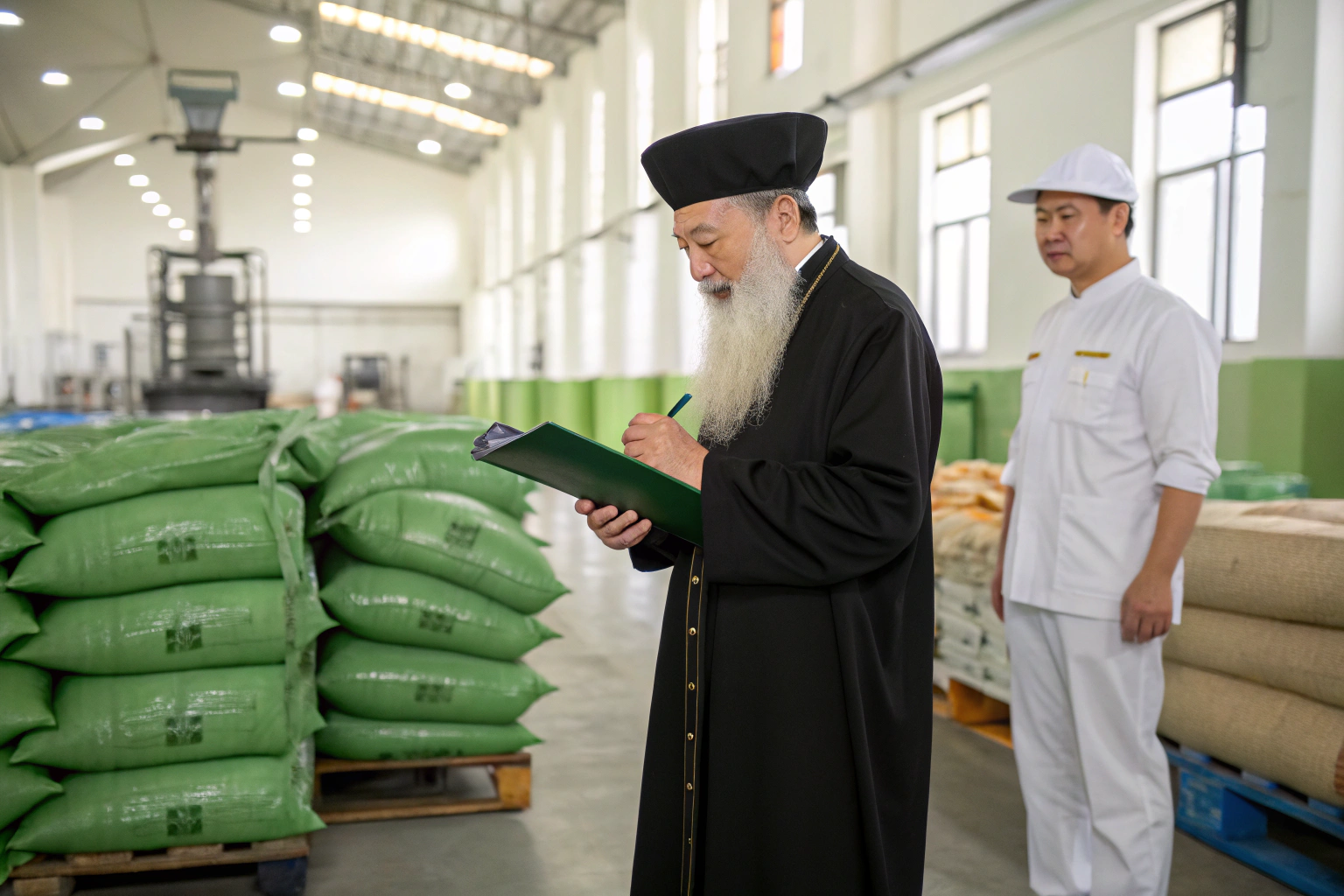
I still remember the email that started it all. It came from a distributor in New Jersey who had built his entire business around kosher-certified products. He had seen our Arabica listed on a B2B platform and was interested in a container load. But his first question was not about price or cup score. It was: "Do you have kosher certification?" I had to admit that I did not. I knew what kosher meant in a general sense, but I had never been through a kosher certification audit, did not know which agency to contact, and had no idea whether a coffee processing mill in rural Yunnan could even qualify. That email set me on a six-month journey through rabbinical inspections, ingredient reviews, and Passover production schedules. It was one of the steepest learning curves of my export career, but it opened a market segment I had previously thought was closed to a Chinese producer.
Sourcing kosher certified coffee beans from a Chinese factory requires engaging a recognized kosher certification agency with operational presence in China, such as OU Kosher, OK Kosher, or Star-K, preparing the facility for a thorough inspection of all equipment, ingredients, and processing aids that touch the coffee from cherry intake to export packaging, and implementing an ongoing compliance program that includes annual audits, approved supplier lists for any post-harvest inputs, and, for Passover-certified lots, a supervised production run that ensures absolutely no contact with chametz grains or their derivatives.
Kosher certification is not a quality grade. It is a religious dietary standard rooted in Jewish law, but its commercial significance extends far beyond the observant Jewish consumer market. Many consumers—Muslims who seek halal and accept kosher as a compatible standard, vegetarians and vegans who trust the ingredient scrutiny, and health-conscious buyers who view certification as an additional layer of quality assurance—actively seek out kosher-certified products. For a coffee producer, kosher certification is a door opener. It signals to a broad swath of importers, roasters, and retailers that the facility has been inspected by a rigorous third party and that the production process meets an internationally recognized standard of purity and traceability. In this article, I want to share the practical steps we took to achieve kosher certification for our Baoshan facility, the distinctions between everyday kosher and Passover kosher, the documentation trail that a buyer should expect, and how to verify that a Chinese supplier's kosher certificate is genuine.
What Does Kosher Certification Actually Mean for Green Coffee Production?
When I first approached the topic of kosher certification, I assumed it would be complicated. Coffee is a simple agricultural product, I reasoned. It is a seed inside a fruit. It goes through water, fermentation, and drying. There are no animal products, no dairy, no meat. What could possibly be non-kosher about a coffee bean? The answer, as my certifying rabbi patiently explained, is not about the bean itself. It is about everything that touches the bean during processing, every ingredient that is introduced, every piece of equipment that is shared with non-certified products, and every production run that occurs during a period when kosher rules require special supervision.
Kosher certification for green coffee confirms that the beans have been processed, stored, and handled entirely on equipment that has been approved by a rabbinical inspector, that no non-kosher additives—including certain processing aids, defoamers, or fermentation accelerators—have been introduced at any stage, that the facility can document a clean chain of custody from cherry to export bag, and that, for the highest level of certification, a rabbi has supervised the production run and affixed a kosher symbol to the documentation.
Unprocessed green coffee, in its pure form, is inherently kosher. It is a raw agricultural product that grows on a tree, has no contact with animal-derived substances, and is not subject to any of the major kosher prohibitions. The kosher certification challenge for a coffee mill is not the bean. It is the processing environment. The wet mill must be inspected to ensure that fermentation activators, if used, do not contain non-kosher ingredients such as enzyme preparations derived from animal sources. The dry mill must be inspected to ensure that the hulling, polishing, and grading equipment has not been used to process non-kosher grains or oilseeds that would leave a residue. The warehouse must be inspected to ensure that the coffee bags are stored separately from any non-certified products and that the fumigation agents used, if any, are approved. The entire chain of custody, from the cherry receiving station to the container loading bay, must be documented and shown to be free of cross-contamination with non-kosher products. Once a facility achieves certification, the kosher certifying agency issues an official certificate that lists the certified products, the facility location, the effective dates, and the certifying rabbi's signature. This certificate is the document that the buyer will request and that the buyer's own kosher certifier will rely on to confirm the coffee's status.
What specific equipment and processing aids must be kosher verified?
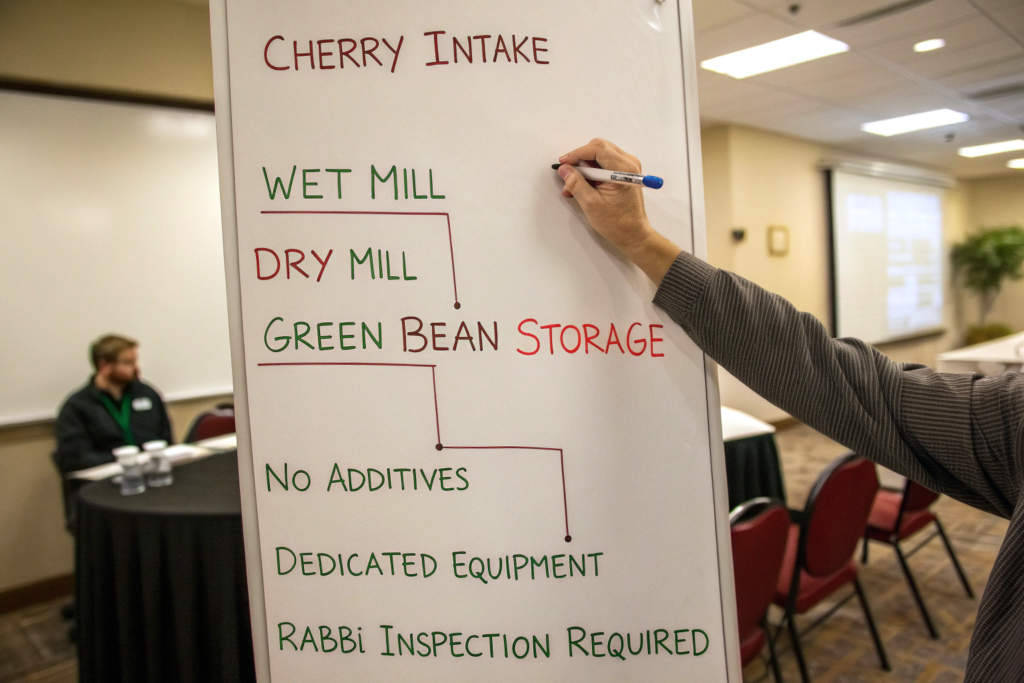
The equipment and processing aids that require kosher verification in a coffee mill fall into several categories. First, any ingredient intentionally added to the coffee during processing must be on the certifying agency's approved list. For most washed coffee production, this list is short: water and, in some cases, specific fermentation enzymes. If the mill uses pectinase enzymes to accelerate mucilage breakdown during fermentation, those enzymes must be certified kosher. Many commercial pectinase preparations are derived from fungal sources and are inherently kosher, but some are produced using animal-derived growth media or processing aids that render them non-kosher. The certifying rabbi will review the technical data sheet and the kosher certificate of each enzyme product used.
Second, the equipment that contacts the coffee must be evaluated for its previous use. A wet mill that processes only coffee presents few challenges, because the equipment is dedicated and the product is inherently kosher. The dry mill, however, may share equipment with other agricultural products. If the hulling machine was previously used to hull non-kosher grains—wheat, barley, spelt, oats, or rye—without a proper kosherization process, the coffee processed on that machine may be considered non-kosher. Kosherization, which involves a thorough cleaning and sometimes a heating or boiling process that the rabbi supervises, restores the equipment to kosher status. Our dry mill in Baoshan processes only coffee, so this was not an issue. But a facility that processes multiple commodities must address this carefully. Third, the packaging materials must be verified. The GrainPro bags, the jute sacks, and any plastic liners must be confirmed to contain no non-kosher coatings, lubricants, or slip agents. This is rarely a problem with modern food-grade packaging, but the certifier will review the packaging supplier's documentation. Fourth, any lubricants or greases used on processing machinery that could incidentally contact the coffee must be food-grade and kosher-approved. The rabbi will inspect the maintenance workshop and review the lubricant product data sheets.
How does kosher certification differ from organic or Fair Trade certification?
Kosher certification is fundamentally different from organic or Fair Trade certification in its legal basis, its audit focus, and its commercial meaning. Organic certification is a government-regulated agricultural standard that verifies the absence of synthetic pesticides and fertilizers. Fair Trade certification is a social and economic standard that verifies minimum pricing and labor conditions. Both are product and process standards enforced by accredited third-party certifiers. Kosher certification, by contrast, is a religious standard enforced by a rabbinical organization. Its legal authority derives not from government regulation but from the trust of the kosher-observant consumer community and, in some jurisdictions, from laws against fraudulent kosher labeling.
The audit focus differs sharply. An organic inspector will walk the farm, take soil samples, and review pesticide application records. A Fair Trade inspector will interview workers and review payment ledgers. A kosher inspector will walk the processing facility, open every equipment panel, review every ingredient's kosher certificate, and trace the path of the coffee through the mill to ensure no cross-contact. The kosher audit is intensely focused on the processing equipment and the ingredient inputs. It generally does not extend to the agricultural practices on the farm, because the raw agricultural product is considered inherently kosher. The commercial meaning also differs. Organic and Fair Trade are primarily consumer-facing labels that communicate a set of values and practices. Kosher certification is a religious compliance mark that serves a specific dietary requirement, but it also functions as a general quality signal. The kosher symbol on a product tells the consumer that a knowledgeable third party has inspected the production facility and verified the purity of the ingredients. This broader trust function explains why kosher-certified products have market reach far beyond the Jewish community. For a coffee producer, kosher certification is complementary to organic and Fair Trade certifications, not competitive. A green coffee lot can carry all three certifications simultaneously, and a buyer who wants all three is a buyer placing a premium order.
Which Kosher Certifying Agencies Operate in China, and How to Engage One?
The first practical step toward kosher certification is identifying a certifying agency that has an operational presence in China and is recognized by the kosher consumers and importers in your target market. Not all kosher symbols carry equal recognition. In the United States, the Orthodox Union symbol—a U inside a circle, commonly called the OU—is the most widely recognized and accepted kosher certification mark. The OK symbol, a K inside a circle, and the Star-K symbol are also major agencies with broad acceptance. For a Chinese coffee exporter targeting the U.S. kosher market, engaging one of these major agencies is the path of least resistance for buyer acceptance.
The major kosher certifying agencies operating in China include the Orthodox Union, which has a dedicated Asia-Pacific office and Mandarin-speaking rabbinical representatives, OK Kosher, which maintains a significant presence in Chinese food production, and Star-K, which has experience with Chinese agricultural processing facilities, with the engagement process beginning by submitting an online application through the agency's website, followed by a pre-assessment call, an on-site inspection by a rabbi who typically visits on a regional tour, and the issuance of a certification letter and the right to use the agency's kosher symbol on certified products.
Engaging an agency begins with an application. The application asks for a detailed description of the facility, the products to be certified, the ingredients and processing aids used, and the other products processed at the same facility. After the application is reviewed, the agency schedules an initial inspection. The inspection is critical, and it is the stage where many first-time applicants stumble. The rabbi will arrive at the facility and expect to see a clean, organized, and transparent operation. He will ask to see every ingredient storage area, every processing machine, every packaging material, and every cleaning chemical. He will ask about the source of the water, the fuel used in the dryers, and the sanitation schedule. The inspection is thorough but collegial. The rabbi is not looking to fail the facility. He is looking to understand the operation well enough to determine whether it can be certified and what ongoing supervisory protocols will be required.
After the initial inspection, the agency issues a certification agreement that lists the certified products, the conditions of certification, and the annual fee. The fee varies depending on the complexity of the facility, the number of certified products, and the frequency of required supervisory visits. For a coffee mill processing only its own beans with no shared equipment and no complex ingredients, the annual certification cost is relatively modest—typically a few thousand U.S. dollars. Once the agreement is signed and the fee is paid, the certification is active. The facility receives an official kosher certificate that lists the certified products by name. This certificate is the document that the buyer will request before placing an order.
What documentation does a certified coffee factory provide to buyers?
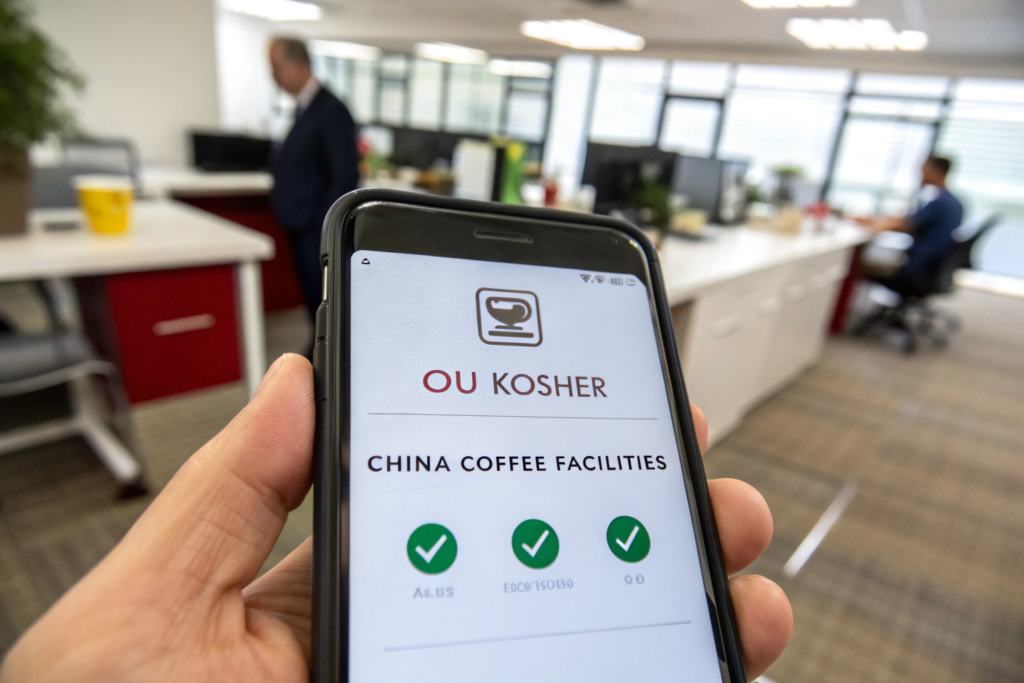
After certification is achieved, the factory must be able to provide a specific set of documents to any buyer who requests kosher verification. The primary document is the kosher certificate itself, often called a "kosher letter" or "letter of certification." This document, issued on the certifying agency's letterhead, states the name and address of the certified facility, the specific products that are certified, the effective and expiration dates of the certification, the name and signature of the certifying rabbi, and the kosher symbol that is authorized for use. The certificate is typically valid for one year and must be renewed after a follow-up inspection.
The second document is the product list. The kosher certificate may reference a list of certified products. For a coffee mill, this list should explicitly include "green coffee beans," or more specifically, "green Arabica coffee beans, washed" or "green Catimor coffee beans, natural," depending on the lots being sold. The product description on the kosher certificate must match the product description on the commercial invoice. A mismatch between the two can cause a buyer's own kosher certifier to reject the lot. The third document is the kosher status confirmation for the specific shipment. Some buyers request a "shipment-specific kosher letter" that ties the kosher certificate to a specific bill of lading, container number, or production lot. This letter confirms that the coffee in that specific shipment was produced during the certification period and under the certified conditions. The fourth document, for Passover-certified lots, is a separate Passover certification letter that states the coffee is "Kosher for Passover" and was produced under the special supervision that Passover certification requires. A buyer who is ordering for the Passover market will request this letter specifically. The documentation package should be ready before the buyer asks. I keep our current kosher certificate, our product list, and a template shipment-specific letter on file and can provide them within hours of a buyer's request.
How often are kosher inspections repeated, and what triggers a re-audit?
The standard kosher inspection cycle is annual. The certifying agency sends a rabbi to the facility once per year to conduct a full re-inspection. The re-inspection follows the same scope as the initial inspection: equipment review, ingredient audit, cleaning protocol verification, and chain of custody documentation. The annual inspection is not optional. If the facility fails to schedule and pass the annual re-inspection, the certification lapses, and the facility cannot legally label any product as kosher until the certification is reinstated.
Beyond the annual cycle, re-audits can be triggered by significant changes at the facility. If the mill introduces a new processing step, a new piece of equipment, or a new cleaning chemical, the certifying agency must be notified and may require a special inspection before the change can be incorporated into the certified production. If the mill begins processing a non-coffee product—such as soybeans, grains, or spices—on the same equipment, the kosher status of the coffee may be affected. The agency must approve the co-processing arrangement and may require dedicated equipment, a kosherization procedure between runs, or the discontinuation of the non-coffee product. A buyer who is sourcing from a Chinese coffee factory should ask when the last kosher inspection occurred and whether any facility changes have been made since that inspection. If the certificate is more than 12 months old, or if the supplier cannot answer the facility change question clearly, the buyer should request a renewed certificate before committing to a purchase.
What Is the Distinction Between Year-Round Kosher and Passover Kosher Coffee?
The distinction between year-round kosher and Passover kosher is the most important technical detail that a coffee buyer needs to understand. Year-round kosher certification confirms that the coffee complies with standard kosher dietary laws, which prohibit mixing meat and dairy, require the use of kosher-certified ingredients, and prohibit certain non-kosher species and processing aids. Passover kosher certification is an additional, much stricter standard that applies specifically to the eight-day Passover holiday period. During Passover, observant Jews are prohibited from consuming or owning chametz—leavened grain products made from wheat, barley, spelt, oats, or rye—as well as kitniyot, a category of legumes, rice, and seeds that Ashkenazi Jewish tradition also prohibits during the holiday.
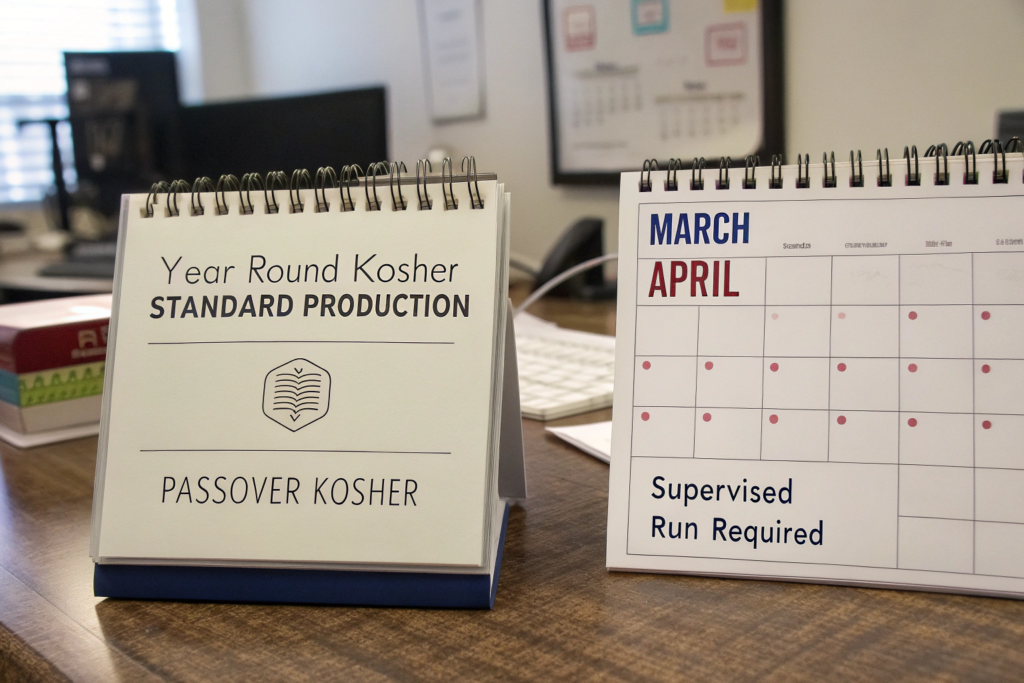
Year-round kosher coffee is certified as complying with standard kosher dietary laws, which for pure green coffee requires minimal ongoing supervision beyond annual equipment inspection, while Passover kosher coffee requires a special, rabbinically supervised production run conducted on equipment that has been thoroughly cleaned and kosherized specifically for Passover, with documented proof that no chametz grains or kitniyot materials were processed on the same equipment during the Passover production window, and a separate Passover certification letter issued for the resulting lot.
Unroasted coffee beans, in their pure form, are neither chametz nor kitniyot. They are a fruit seed. They are kosher for Passover in their natural state. The Passover concern is not the bean itself. It is the processing environment. If the coffee mill also processes grains—which many agricultural mills do—the coffee that runs on shared equipment during the Passover season may be considered contaminated with chametz and prohibited for Passover use. Even if the mill processes only coffee, certain processing aids, cleaning chemicals, or fumigation agents used during the Passover production window may contain grain-derived alcohol or other chametz derivatives. Passover certification therefore requires a specially supervised production run. The rabbi visits the facility immediately before the Passover run, verifies that the equipment has been cleaned and kosherized to Passover standards, approves the ingredients and processing aids that will be used, and supervises the production start. The coffee from that run is segregated, labeled as "Kosher for Passover," and documented with a separate Passover certification letter. The Passover certification generally costs extra, because of the additional rabbinical supervision time. For a coffee producer, offering Passover-certified lots is a value-added service that can command a premium from buyers who supply the Passover retail market.
Why does a coffee mill need a supervised production run for Passover certification?
A supervised production run for Passover certification is necessary because the standard of cleanliness and ingredient purity for Passover is far higher than for year-round kosher. During the year, trace cross-contamination from non-kosher sources that falls below a certain threshold—typically 1/60th of the total product volume—may be disregarded under the principle of nullification, or bitul. During Passover, however, the presence of chametz is not nullified in any amount. Even a microscopic trace of chametz renders a product non-kosher for Passover. This zero-tolerance standard means that the equipment must be not just cleaned but kosherized. Kosherization for Passover typically involves a thorough cleaning followed either by a 24-hour idle period and a boiling water flush, for equipment that contacts hot water, or by a rabbinically supervised dry cleaning, for equipment that processes dry materials such as green coffee beans.
The supervised run is the production batch that occurs on the kosherized equipment, with only Passover-approved inputs, under the direct observation of the rabbi. The rabbi's presence is not symbolic. He is there to verify that the cleaned equipment has not been compromised before the run starts, that the green coffee being loaded into the mill is from an approved lot, and that the packaging materials used for the finished coffee are Passover-certified. After the run is complete, the rabbi seals the lot with a tamper-evident seal or a signed label, and the coffee is stored in a segregated area of the warehouse. The supervised run requirement means that Passover coffee cannot simply be pulled from existing inventory, unless that inventory was specifically produced under Passover supervision. A buyer who waits until March to order Passover coffee for an April delivery will likely be disappointed. The supervised run must be planned months in advance, scheduled with the certifying agency, and coordinated with the rabbi's travel itinerary. Our mill schedules the Passover supervised run in January or early February, well before the Passover retail ordering window opens, to ensure the certified lot is bagged, cupped, sampled, and ready for shipment by March.
Which kosher symbols indicate Passover approval for a coffee shipment?
The presence of a kosher symbol alone on a certificate or a product label does not guarantee Passover approval. The standard OU symbol, for example, indicates year-round kosher certification. For a product to be certified for Passover, the symbol must be accompanied by the letter "P" adjacent to the symbol—often appearing as "OU-P"—or by the word "Pesach" or "Kosher for Passover" explicitly printed on the certificate. The same convention applies to other major certifying agencies: OK-P, Star-K-P, and KSA-P all indicate Passover certification. The absence of the "P" designation means the product is certified kosher for year-round use but is not certified for Passover. A buyer specifically sourcing for the Passover market must carefully check the certificate for the Passover indicator.
The kosher certificate itself should also state "Kosher for Passover" or "Certified for Passover use" in the product description line. If the certificate is ambiguous, the buyer should request a separate Passover certification letter that explicitly confirms the Passover status. A competent kosher-certified supplier will understand this distinction and provide the correct documentation without being asked. A supplier who appears confused about the difference between year-round and Passover certification, or who claims their year-round certificate "covers Passover too," is not managing their kosher program correctly. The buyer should escalate the documentation request to the certifying agency's local office to verify the Passover status independently. The cost of shipping a container of non-Passover coffee to a Passover retail buyer can be catastrophic to the buyer's own business, because the buyer's kosher certifier will reject the shipment the moment the documentation discrepancy is identified.
How Can a Coffee Buyer Verify a Chinese Supplier's Kosher Certificate Is Legitimate?
In the global food trade, fraudulent kosher certificates are a real problem. A supplier who lacks genuine certification may obtain a photocopy of a certificate from another company, alter the name and date, and present it as their own. Some suppliers purchase certificates from small, unrecognized certifying agencies that have no credibility with major kosher consumers or their certifiers. A buyer who unwittingly accepts a fraudulent certificate and sells the coffee as certified kosher faces the loss of their own kosher certification, product recalls, and severe reputational damage with their customer base. Verifying a supplier's kosher certificate is therefore not optional. It is a necessary step in the sourcing process.
A buyer can verify a Chinese supplier's kosher certificate by locating the certifying agency's name and logo on the certificate, visiting the agency's official website to use their online certificate verification tool or published certified facility directory, independently confirming that the facility name, address, and certified product list match the certificate exactly, and, if the standard organic coffee flow allows, directly emailing or calling the agency's Asia-Pacific office to confirm the certificate's validity and current status, a step that is especially important for first-time transactions with a new supplier.
The verification process takes less than 15 minutes. First, identify the certifying agency from the certificate. The major agencies—OU, OK, Star-K, KOF-K, CRC—all have distinctive logos and publicly available certification directories. Second, visit the agency's website and locate the "Certified Companies" or "Kosher Certificate Verification" section. The OU, for example, maintains a searchable online database called the OU Kosher Product Search. Type in the facility name as it appears on the certificate. If the facility is genuinely certified, it will appear in the search results with its current certification details. Third, compare the details in the database with the certificate in hand. The facility name, the facility address, the certified product names, and the expiration date must all match. A discrepancy in any field is a red flag that requires further investigation. Fourth, if the agency offers a certificate number verification tool, enter the certificate number. The system will confirm whether the certificate is genuine and current. If the certificate is not in the agency's database, or if the certificate number does not validate, the buyer should not proceed with the purchase until the supplier provides a verifiable certificate from a recognized agency. A supplier who genuinely holds certification will welcome this verification. A supplier who resists it, or who claims the verification system is "broken," is raising a serious warning signal.

Which online kosher databases can a buyer use for instant verification?
The major kosher certifying agencies each maintain an online product or facility search database that is free and publicly accessible. The OU Kosher database, accessible at the OU Kosher website under "Product Search," allows a buyer to search by company name, product name, or product category. The database returns the certified product list, the facility location, and the certification status. The OK Kosher database functions similarly, with a "Search for Certified Products" tool on the OK Kosher website. The Star-K database includes both a product search and a facility search, and the Star-K website also maintains a list of certified Passover products. The KOF-K and CRC databases are also reliable and searchable.
For a buyer verifying a Chinese coffee supplier, the process is straightforward. The supplier provides a kosher certificate. The buyer opens the certifying agency's website identified by the logo on that certificate. The buyer enters the supplier's company name exactly as it appears on the certificate into the database search field. If the supplier is certified, the database returns a result. The buyer compares the result with the certificate. The buyer prints or saves a PDF of the database result for their own compliance records. This database verification is the minimum due diligence that any kosher buyer should perform. It does not replace direct communication with the certifying agency for a high-value or suspicious transaction, but it quickly screens out the most obvious fraud. A supplier whose certificate cannot be verified in the agency's own public database is not certified, and no amount of explanation changes that fact.
What should a buyer do if a supplier's certificate is from an unrecognized agency?
The kosher certification market includes a wide range of certifying agencies, from internationally recognized organizations to small, local rabbinical boards with limited scope and recognition. A certificate from an unrecognized agency may be genuinely issued by a legitimate local rabbi, but if the agency is not recognized by the kosher consumers and certifiers in the buyer's market, the certificate has no commercial value. The buyer's own kosher certifier will not accept it as valid documentation for the buyer's production. The buyer faces a choice: reject the certificate and require the supplier to obtain certification from a recognized agency, or accept the certificate and risk their own certification status.
The prudent course is to require recognized certification. The buyer's contract with the supplier should specify the acceptable certifying agencies. A clause stating "All kosher-certified coffee supplied under this agreement must be certified by the Orthodox Union, OK Kosher, Star-K, or another agency pre-approved in writing by the Buyer" is simple, clear, and eliminates ambiguity. If the supplier proposes an agency not on the pre-approved list, the buyer can forward the agency's information to their own kosher certifier for an evaluation. In some cases, the buyer's certifier may accept a certificate from a lesser-known agency after verifying the agency's credentials and standards. In other cases, the buyer's certifier will reject it, and the buyer must either find a new supplier or help the existing supplier engage a recognized agency. The engagement of a recognized agency is not prohibitively difficult or expensive for a Chinese coffee mill, as discussed earlier. A supplier who is serious about serving the kosher market will obtain recognized certification. A supplier who refuses, insisting that their unknown agency is "just as good," is signaling that they do not understand or respect the buyer's compliance requirements. That is not a supplier with whom a prudent buyer builds a long-term kosher supply chain.
Conclusion
Sourcing kosher certified coffee beans from China is a structured process that rewards preparation and transparency. The coffee bean itself is inherently kosher, but the processing environment—the equipment, the ingredients, the storage, and the documentation—must meet the standards of a recognized rabbinical certifying agency. The engagement of an agency like the OU, OK, or Star-K provides the supplier with a verifiable certificate that opens the U.S. kosher market. The distinction between year-round kosher and Passover kosher requires the buyer to specify which standard they need and to verify that the supplier's documentation reflects it. The existence of online kosher verification databases allows a buyer to independently confirm a certificate's legitimacy in minutes. The entire system is designed for transparency. A supplier who is genuinely certified has nothing to hide, and a buyer who performs basic due diligence can enter the kosher coffee market with confidence.
For a Chinese coffee producer, kosher certification is not an exotic niche credential. It is a practical market access tool that signals rigorous third-party inspection and ingredient purity to a broad consumer base. The journey from that first confused email from New Jersey to a fully certified, annually audited kosher production line was not short, but it was worthwhile. The kosher-certified lots we ship today reach buyers who would not have considered a Chinese origin five years ago, and the certification has paid for itself many times over in contract premiums and expanded market access.
If you are a roaster, importer, or distributor interested in sourcing kosher-certified green coffee from our Yunnan plantation, our export team at BeanofCoffee is ready to provide our current OU kosher certificate, our certified product list, and our Passover lot availability and planning schedule. Contact our export compliance lead, Cathy Cai, at cathy@beanofcoffee.com. Let us add kosher-certified Chinese Arabica to your approved supplier list.