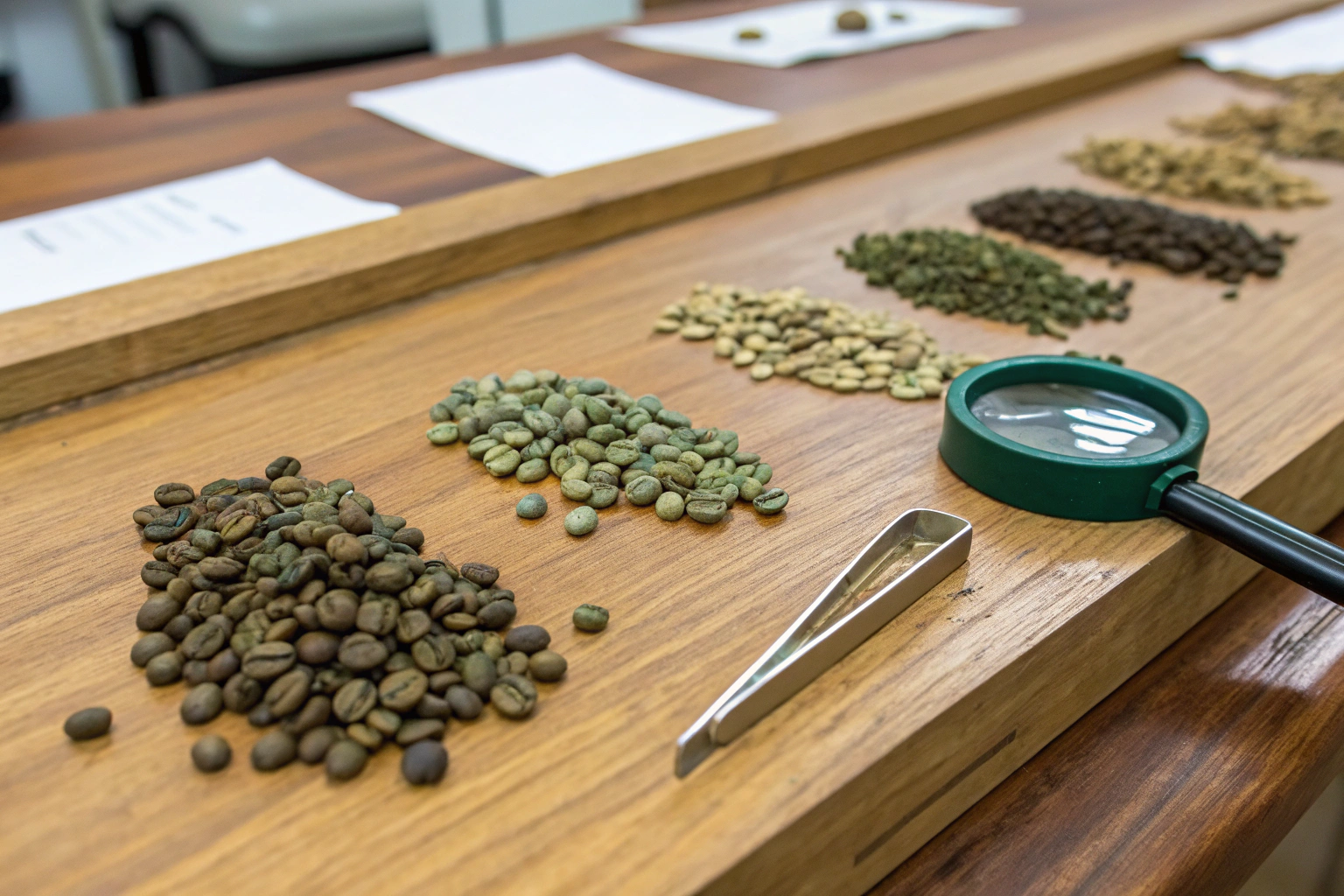
A few years ago, a broker offered me a "bargain." A container of Yunnan Arabica at $1.20 a kilo under market price. The photos looked fine. The moisture report was okay. But something felt off. I flew to the warehouse. I opened ten random bags. What did I find? Black beans. Sour beans. Broken bits. Shells. The lot wasn't specialty. It wasn't even good commercial. It was sweepings. The broker was trying to dump garbage on someone. If I hadn't looked with my own eyes, I would have shipped that mess to a roaster in Sydney and destroyed my reputation. The lesson is simple: you must know how to look at green beans and see the truth.
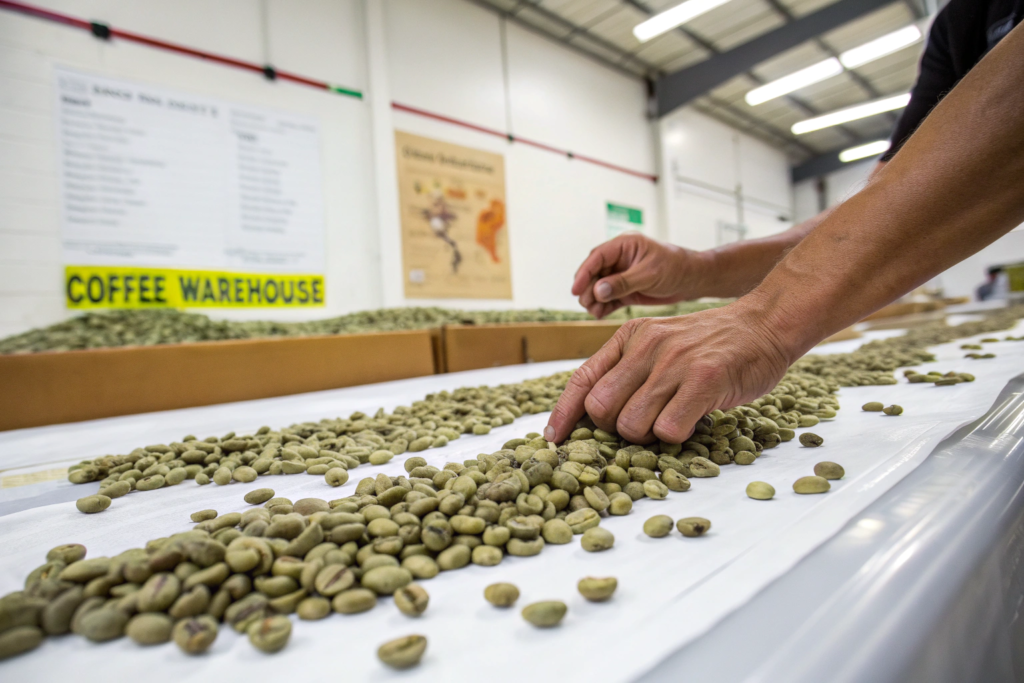
You spot low-quality Arabica immediately by conducting a simple visual and olfactory inspection focused on five specific defect categories: black beans, sour beans, insect damage, broken beans, and mold. Take a 350-gram sample. Spread it on a white sheet of paper in natural light. Your nose will catch musty mold before your eyes find it. Then, count the visual defects. A specialty-grade Arabica should have zero primary defects and fewer than five secondary defects per sample. If you see more than that, the coffee is below the 80-point threshold.
Green coffee doesn't hide its flaws. It wears them on its surface. But you have to know what you're looking at. You have to train your eyes. A black bean isn't just a "dark spot." It's a chemical time bomb that will ruin an entire roast batch. Let me walk you through exactly what to look for, what to smell for, and what each defect means for the cup quality of your shipment.
What Visual Defects Reveal Poor Processing Standards?
The green bean is a record of its own history. Every mistake made on the farm, at the wet mill, or in the warehouse leaves a physical mark. You don't need a fancy lab. You need a white surface, good daylight, and fifteen minutes of focus. The beans will tell you everything.
The most damning visual defects are full black beans, full sour beans, and severe insect damage. A full black bean is opaque, dark, and shriveled. It comes from a dead cherry, an over-ripe cherry, or a cherry that fermented on the ground. A full sour bean is mottled yellow-brown with a vinegar smell. It comes from over-fermentation in the washing tank. Both are primary defects according to the SCA Green Arabica Grading System. One primary defect in a 350-gram sample disqualifies the lot from specialty status.
What Does a Black Bean Mean for Roasting?
A black bean is the worst thing you can find. It's not just cosmetic. It's chemically toxic to the roast.
A black bean forms when the cherry is completely dead before processing. Maybe it fell on the ground and sat in the dirt. Maybe it was a floater that got caught in the machinery. The bean inside ferments and rots. The sugars turn to acetic acid. The proteins break down into foul-smelling compounds.
When you roast a batch that has even one black bean, that bean doesn't roast. It incinerates. It turns into a piece of charcoal. It fills the drum with an acrid, burnt-oil smoke that clings to all the other beans. The entire batch tastes dirty and ashy. Professional roasters at Roast Magazine have documented how a single black bean can drop a batch's cupping score by two or three points.
If I see a black bean in a sample, I don't negotiate. I reject the lot.
How Do You Identify a Sour Bean Versus a Good Bean?
Sour beans are trickier. They're not black. They're a sickly yellow, sometimes with a reddish-brown edge. They smell like vinegar or rotten fruit.
They come from over-fermentation. Maybe the cherry was pulped but then left sitting in a dirty tank for too long. Bacteria ate the sugars and produced acid. The acid cooked into the bean.
To spot them, you need contrast. Spread the sample on a pure white sheet. Look at each bean individually. A healthy Arabica is a consistent blue-green or jade-green. A sour bean looks dirty. It's faded. It's the color of old newspaper. Under a UV light, some roasters say sour beans fluoresce differently, but the simple eye test in good daylight works 95% of the time.
I train my sorters to look for "the color that doesn't belong." If the bean looks sick, it is sick. The Specialty Coffee Association green grading handbook has excellent reference photos for this specific defect.
Can You Detect Poor Quality by Smell Alone?
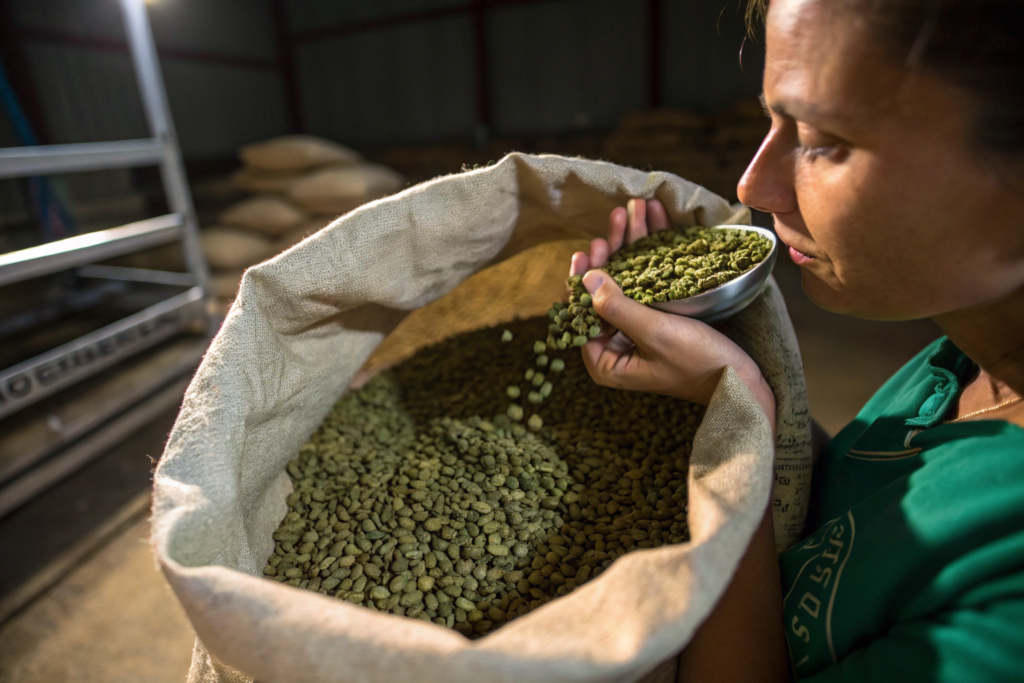
Your nose knows. Before you count a single defect, before you measure moisture, the smell of the bag will tell you 80% of the story. I've been doing this long enough that I can walk into a warehouse and know within seconds if there's a problem.
Low-quality Arabica often announces itself through off-odors: a musty basement smell, a fermented fruit smell, a smoky or burnt smell, or a chemical, gasoline-like note. Fresh, high-quality green coffee should smell clean, grassy, and slightly sweet. Any deviation from that clean profile indicates a biological or chemical problem. The nose is sensitive to compounds in the parts-per-billion range. It is a more sensitive instrument than any machine.
What Does "Musty" Actually Mean?
Musty means mold. Plain and simple. It's the smell of a damp towel left in a gym bag for a week. It's geosmin and other microbial metabolites.
If you open a GrainPro bag and get a whiff of must, the coffee has been wet at some point. Maybe the drying was incomplete. Maybe the container sweat caused condensation. The mold might not be visible yet—the hyphae might be inside the bean—but the smell is proof of biological activity.
Do not try to "roast out" musty coffee. You can't. The compounds that cause the musty smell are heat-stable. They survive roasting. They end up in the cup. A trained cupper will write "moldy" or "earthy" as a defect on the score sheet. The lot is only fit for disposal, or at best, low-grade instant extraction where the flavor can be chemically masked.
What Should Fresh Green Coffee Smell Like?
Fresh green coffee has a subtle but distinct aroma. It's vegetal. Like fresh-cut grass. Like green peas. There's a hint of sweetness, almost like hay drying in a field.
If the coffee is very fresh—just a few weeks from harvest—it can even have a slight fruity note from the dried mucilage. This is a good sign. It indicates careful honey processing.
If the coffee smells like nothing, that's also a warning. Old coffee, past-crop coffee, loses its aroma. The volatile compounds evaporate. A bag of two-year-old coffee smells like dust and paper. It's not defective, technically, but it's faded. It will brew a flat, boring cup. You should expect a clean, vibrant, green aroma. Anything less is a compromise you should be paying less for. At BeanofCoffee, our team cups every lot and also smells every single bag before it's loaded into a container.
What Are the Key Differences in Bean Size and Density?
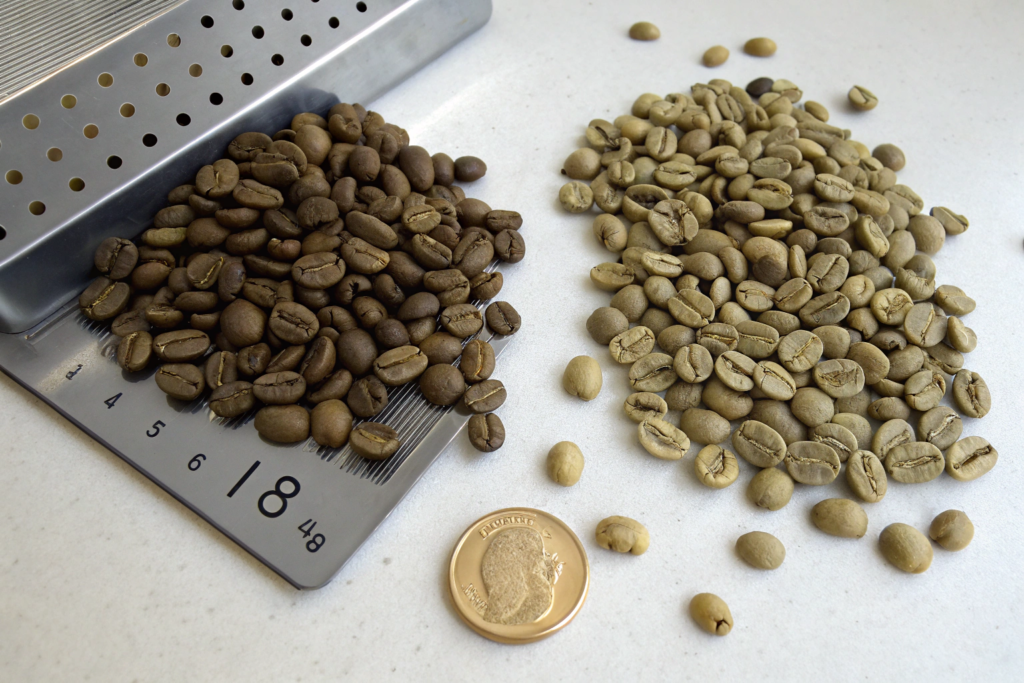
Size isn't just about looks. It's about the physics of roasting. If you put beans of wildly different sizes into the same drum, the small ones will scorch and the large ones will under-develop. The roast will be uneven. The cup will taste muddy—both baked and burnt at the same time. Size uniformity is a non-negotiable quality parameter.
Low-quality Arabica is often characterized by poor size uniformity and a high percentage of broken beans and shells. A well-graded specialty lot should be screened to a consistent size, with at least 70% of the beans retained on a single screen size, such as Screen 16 or Screen 18. A low-quality lot will show a chaotic mix of large flat beans, small round peaberries, and fragments. This visual chaos indicates that the producer did not invest in proper grading machinery or simply doesn't care about the roaster's experience.
What Do Broken Beans and Shells Indicate?
Broken beans are exactly what they sound like: fragments, chips, half beans. Shells are beans that formed with a cavity inside, often due to a genetic anomaly or drought stress.
A high percentage of broken beans means the dry mill was rough. The parchment was too dry when it was hulled, so the beans shattered. Or the machinery was old, badly calibrated, or the operator was careless. These sharp-edged fragments roast faster than whole beans. They catch fire easily. They create smoke and bitterness.
Shells are even worse. They are hollow. They roast to a black, carbonized crisp in the time it takes a whole bean to reach first crack. They fill the roaster with chaff and sparks. A good lot should have less than 2% broken beans and shells combined.
Does Bean Density Affect Quality?
Density is about altitude and maturation. Dense beans are hard. They feel heavy in your hand. They have a tightly closed center-cut that looks like a thin white line. Low-density beans are soft, lighter, and have an open, splayed center-cut.
High-density beans, grown slowly at altitude, are packed with sugars and flavor precursors. They conduct heat efficiently during roasting. They give the roaster control.
Low-density beans are spongy. Heat penetrates them slowly and unevenly. The outside scorches before the inside is cooked. They produce a woody, papery flavor. You can test density crudely by weighing a liter of green beans. A high-quality, high-grown Arabica weighs around 700 grams per liter. Lower-grown, softer beans weigh less. The coffee grading standards enforced in major producing countries use screen size and density as key sorting parameters.
How Do Harvesting Methods Affect Green Bean Appearance?
The way a cherry leaves the tree dictates the quality of the bean inside. You can have perfect soil, perfect altitude, perfect rain. But if the picking is sloppy, everything else is wasted. Hand-sorting at the mill cannot fully correct for bad harvesting. The damage is often internal and invisible until roasting.
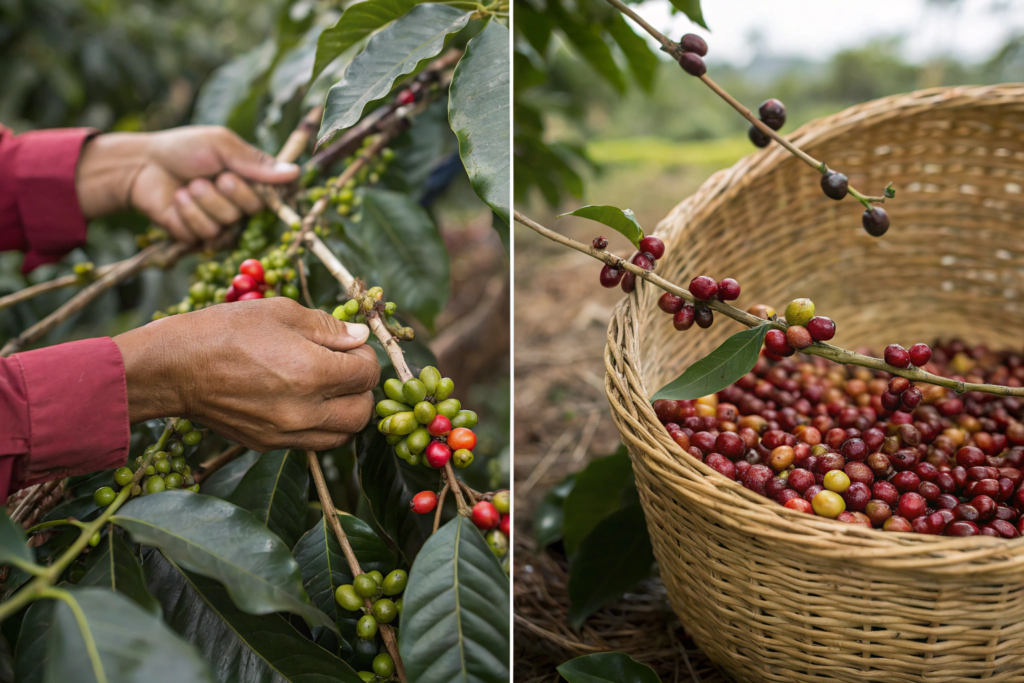
Strip-picking, where all cherries are pulled from the branch regardless of ripeness, is the hallmark of low-quality Arabica. It produces a mix of green, under-ripe cherries and black, over-ripe, raisin-like cherries. This inconsistency is baked into the lot. Selective hand-picking, where pickers make multiple passes through the farm and take only the fully red cherries, produces a uniform, high-quality lot. The visual result is beans of consistent color, size, and moisture, with no shriveled quakers or fermented black spots.
What Is the Signature of Strip-Picked Coffee?
Strip-picked coffee looks like a mess. In a single sample, you'll see a range of colors. Bright green from under-ripe cherries. Brownish-yellow from over-ripe. Dark spots from cherries that were already fermenting on the branch.
The under-ripe green cherries produce "quakers" after roasting—pale, under-developed beans that taste like peanuts and paper. The over-ripe cherries produce "ferment" notes, like rotten fruit or vinegar. Strip-picking guarantees that you will have both flavor defects in every bag.
You can spot strip-picked lots immediately by the color variation and the presence of dried cherry skins still stuck to the beans. This means the pulper couldn't handle the mix of soft over-ripe and hard unripe fruit.
Why Does Selective Hand-Picking Cost More?
Because it's slow. A skilled picker doing selective picking harvests maybe 80 to 100 kilos of cherry per day. A worker doing strip-picking can harvest 200 kilos or more. The labor cost per kilo is effectively double.
That extra cost is the single most important investment in quality. There is no machine that can match the human eye for ripeness selection. Selective picking is the foundation of the specialty coffee supply chain. When you see a lot that is uniformly blue-green, with zero quakers in the roast, you are looking at the result of a farmer paying for multiple passes through the same trees. That's what we do on our 10,000 acres. It's more expensive, but it's the only way to hit an 84+ cup score.
Conclusion
Spotting low-quality Arabica is not a talent. It's a skill that anyone can learn. You look at the color. You smell the bag. You check the size uniformity. You look for the signature marks of lazy picking and bad processing. Black beans, sour beans, musty smells, and wild size variations are the red flags. They are the beans telling you, "I was not treated well."
If you ignore these signs, you pay for them later. You pay in ruined roasts, disappointed customers, and damaged brand reputation. But if you train your eye and your nose, you can avoid the garbage lots before they ever reach your roastery.
The samples we send out are exactly what we would want to receive if the roles were reversed. Clean, uniform, traceable, fresh. I don't hide behind perfect photos. I send the coffee, and I let the beans speak.
If you want to practice your defect-spotting skills on a sample of our current Baoshan Arabica, I invite you to request one. See what a clean, well-processed lot looks like up close.
For sample requests, cupping protocols, or lot availability, reach out to Cathy Cai. She will prepare a 200-gram sample and ship it directly to your office.
Email: cathy@beanofcoffee.com. Train your eyes on the good stuff.