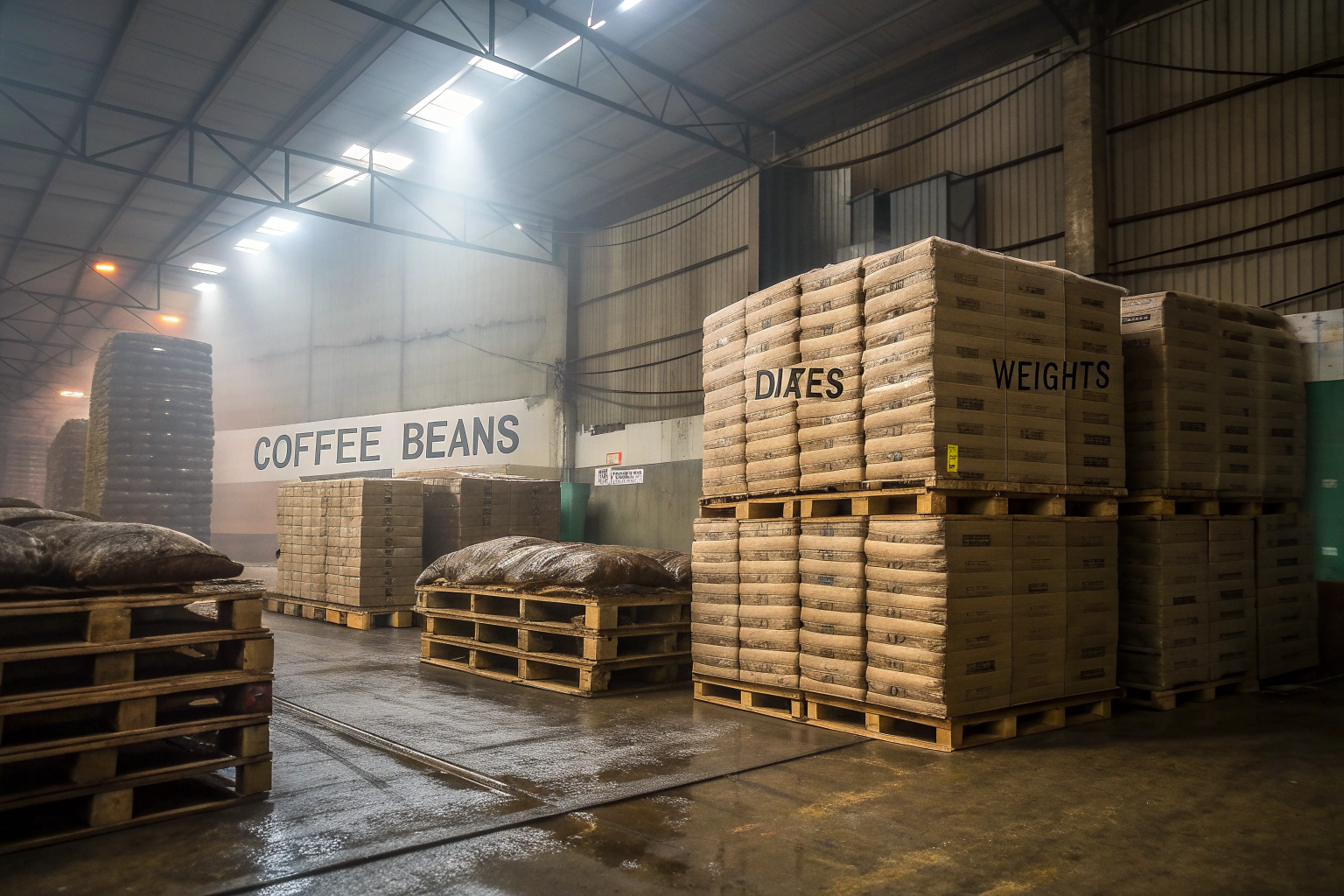
I learned a hard lesson about storage in 2016. We had a bumper harvest of washed Arabica. Beautiful beans. Cupping score over 85. We filled our warehouse to the ceiling, proud of the volume. Then the Yunnan rainy season hit. Not in the warehouse directly—the roof was fine—but the ambient humidity crept up and stayed there. We didn't catch it fast enough. Three pallets in the back corner, near the wall, developed the faint, musty smell of mold. That was a $12,000 loss. And it was entirely preventable. Here's what that loss taught me: growing great coffee is only half the battle. Keeping it great until it ships is the other half.
Safe storage of large-volume green coffee requires strict control of moisture, temperature, airflow, and pest access. The goal is to preserve the bean's water activity at a stable level—typically between 0.53 and 0.60 aW—while preventing the conditions that trigger mold, insect infestation, or flavor degradation. For commercial buyers, proper storage is not a warehouse expense; it is a quality insurance policy on a valuable asset.
If you're buying container loads from us here at BeanofCoffee, you probably think about storage from the moment the beans arrive in your country. But I think about it from the moment the beans finish drying on our raised beds in Baoshan. Let me walk you through the whole chain—what we do at origin, and what you should do when the coffee is sitting in your own facility.
What Are the Biggest Threats to Green Bean Quality During Warehousing?
You might think the biggest threat is a leaking roof or a forklift running into a pallet. Those are obvious. The real killers are invisible, silent, and slow. By the time you spot the damage, the coffee is already ruined. And here's a disturbing truth: most of the damage I've seen over two decades wasn't from a single catastrophic event. It accumulated quietly, day by day, in conditions the warehouse manager thought were "good enough."
The four biggest threats to green bean quality in storage are moisture migration due to humidity swings, insect infestation from inadequate pest control, temperature stratification that creates condensation pockets, and cross-contamination from storing coffee near strong-smelling materials or other agricultural products. Each of these can render a premium specialty lot unsellable.
How Does Moisture Migration Ruin Stored Coffee From the Inside Out?
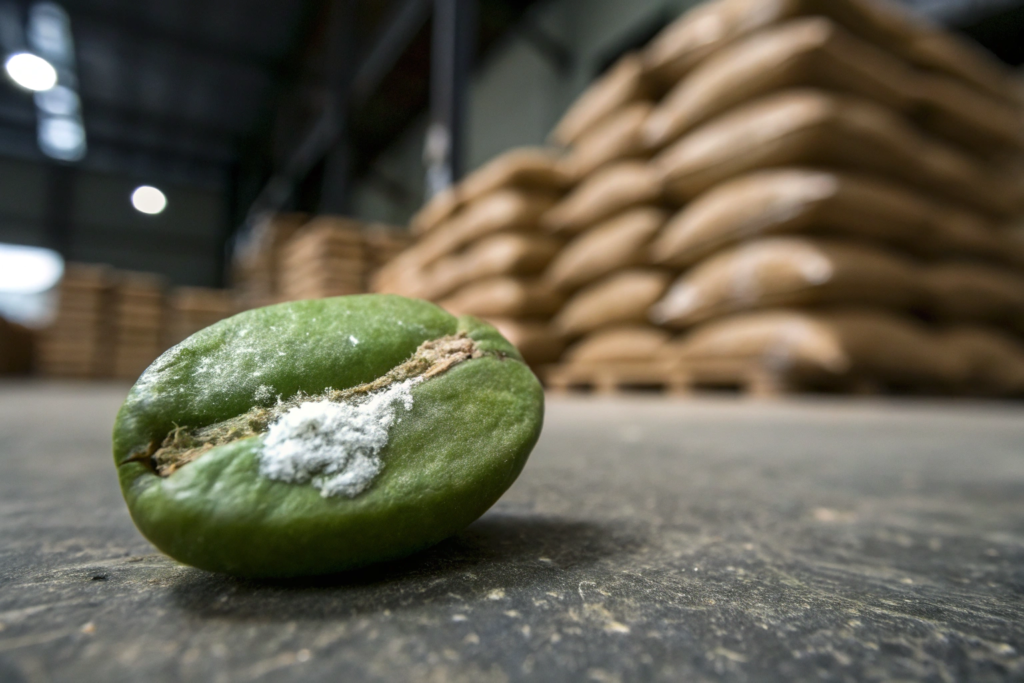
Moisture migration is a sneaky thief. It doesn't flood your warehouse. It just moves tiny amounts of water vapor through your coffee over weeks and months. Here's how it works. Green coffee is hygroscopic. It breathes. It absorbs moisture from the air around it and releases moisture back. The bean is always trying to balance with the environment.
The problem starts when one side of a bag is warmer than the other. In a warehouse, the sacks touching a cold concrete floor are cooler. The sacks on top of the stack near the ceiling are warmer. Moisture moves from the warm area to the cool area. The bottom sacks can become wetter and wetter, even though the room's average humidity reading looks fine. I've measured a 3% moisture difference between the top and bottom of a single pallet stack—just from temperature differences. That's enough to push the bottom bags into mold territory.
For large volumes, this isn't a theory. It's a constant battle. A big stack of 40 sacks acts like a thermal battery. It holds temperature differently than the air. If your warehouse temperature drops at night, the beans cool slower than the air. Condensation forms inside the bag. Not outside. Inside. You can't wipe it off. The moisture is already inside the grain sack, feeding fungi that are just waiting for a drink.
Why Are Pests a Persistent Risk Even in "Clean" Warehouses?
I've walked into spotless warehouses that had a weevil problem. The manager was shocked. "We sweep every day!" Sweeping cleans the floor. It doesn't kill the eggs already inside a coffee bean that arrived from another origin.
Coffee borer beetles and weevils are the worst. They can arrive in a shipment as invisible eggs inside the bean. They lie dormant in cool conditions. Then the warehouse warms up a few degrees, and suddenly you have a population explosion. The larvae burrow out, leaving tiny holes. The beans smell stale, woody, or downright sour.
Pest management isn't just about reacting. It's about isolation. I learned to quarantine every new lot that arrives at our storage facility in Baoshan for at least two weeks before integrating it into the main stock. During those two weeks, we use pheromone traps to see if anything hatches. It's an early warning system. For you, as an importer receiving beans from different origins, this isolation protocol is vital. Don't unload a new container of Yunnan Arabica right next to a six-month-old stock of Brazilian. If the Brazilian has a hidden infestation, it will migrate. The insects don't care about borders. They just see food.
What Are the Ideal Warehouse Conditions for Green Coffee?
So, we know the threats. Now, what's the target? I've had buyers ask me, "Is air conditioning necessary?" and "Can I just store them in my roastery back room?" The answers depend on your climate and your volume. But there are some hard, non-negotiable boundaries that I've settled on after managing millions of pounds of coffee.
The ideal storage environment for green coffee is a stable, cool, and moderately dry space that resists rapid fluctuations. The widely accepted target is a temperature between 60°F and 70°F (15°C–21°C) and a relative humidity between 55% and 65%. More important than the exact number is the stability—swings in either direction cause more damage than a stable condition slightly outside the ideal range.
What Temperature and Humidity Ranges Prevent Mold and Aging?
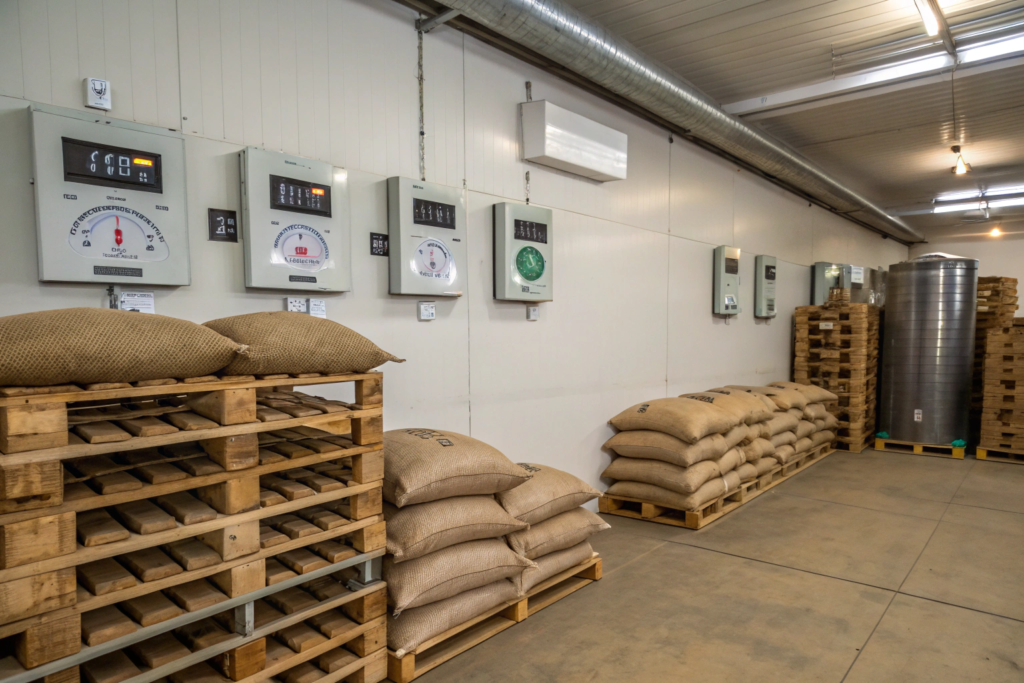
Let's start with the numbers. I keep our main warehouse in Baoshan at 60°F to 68°F. Relative humidity at 58% to 62%. This is the sweet spot I've found for preserving our washed Catimor and Arabica for 6 to 12 months without losing the bright, clean notes.
Why these numbers? Mold needs moisture. Most molds that attack green coffee need a water activity above 0.65. At 60% RH and 68°F, the equilibrium moisture content of the bean keeps the water activity safely below that threshold. It's a safety buffer.
Temperature drives the speed of chemical reactions. Higher heat accelerates aging. The volatile aromatic compounds that make our Baoshan Arabica special degrade faster at 80°F than at 65°F. Think of it like a loaf of bread. A day on the counter equals a week in the fridge. For coffee, a few degrees makes a real difference over months of storage. I store my specialty-grade parchment lots in a climate-controlled section, separate from the commercial-grade Robusta. The Robusta can handle a bit more temperature fluctuation. The high-altitude Arabica cannot.
Here's a quick reference I share with our wholesale partners:
| Storage Condition | Target Range | Risk If Exceeded |
|---|---|---|
| Temperature | 60°F – 70°F (15°C – 21°C) | Accelerated aging above; condensation risk if fluctuating |
| Relative Humidity | 55% – 65% | Mold above; excessive drying and weight loss below |
| Bean Moisture Content | 10% – 12% | Mold above 12.5%; brittle, faded flavor below 9% |
| Water Activity (aW) | 0.53 – 0.60 | Microbial growth above 0.65 |
| Daily Temperature Swing | < 5°F | Condensation inside bags |
Stability is the key word. A warehouse that swings from 50°F at night to 80°F by noon will ruin beans even if the daily average looks perfect on a spreadsheet. I've seen it happen.
How Does Airflow and Pallet Placement Prevent Hotspots?
Airflow is the unsung hero of large-volume storage. You can have the best air conditioner in the world, but if you pack your sacks tightly together with no room to breathe, you'll still get mold.
Air needs to move around the sacks. It carries away moisture and heat. I learned this from a mistake we made stacking pallets flush against the warehouse wall. The wall was cooler, moisture condensed, and the sacks touching it got damp. The air couldn't circulate behind them.
Now, we have strict rules. Every pallet is at least 8 inches from any wall. Aisles between pallet rows are a minimum of 18 inches wide. We never stack sacks directly on the floor, even if the floor looks dry. Concrete breathes moisture. Always use plastic or wooden pallets. And the pallets themselves should be in good condition—no splinters that tear sacks, no residual smell from previous cargo.
For high stacks, we use ventilation channels. Some large warehouses use perforated plastic tubes inserted into the stack to let air penetrate the center. We've also experimented with small, low-power circulation fans positioned to move air through the aisles, not directly at the sacks. The goal is gentle, consistent movement, not a wind tunnel that overly dries the outer layers of the bean. A well-ventilated warehouse should never smell stale or "warehouse-y." It should smell like clean coffee.
Which Storage Materials and Packaging Protect Bulk Coffee Best?
Choosing the right bag isn't just about cost. It's a strategic decision about how long you need to store the coffee and what you're protecting it from. Jute sacks have been around for centuries. Modern hermetic liners are newer. Both have a place. The problem is when buyers use the cheapest option without understanding the trade-offs.
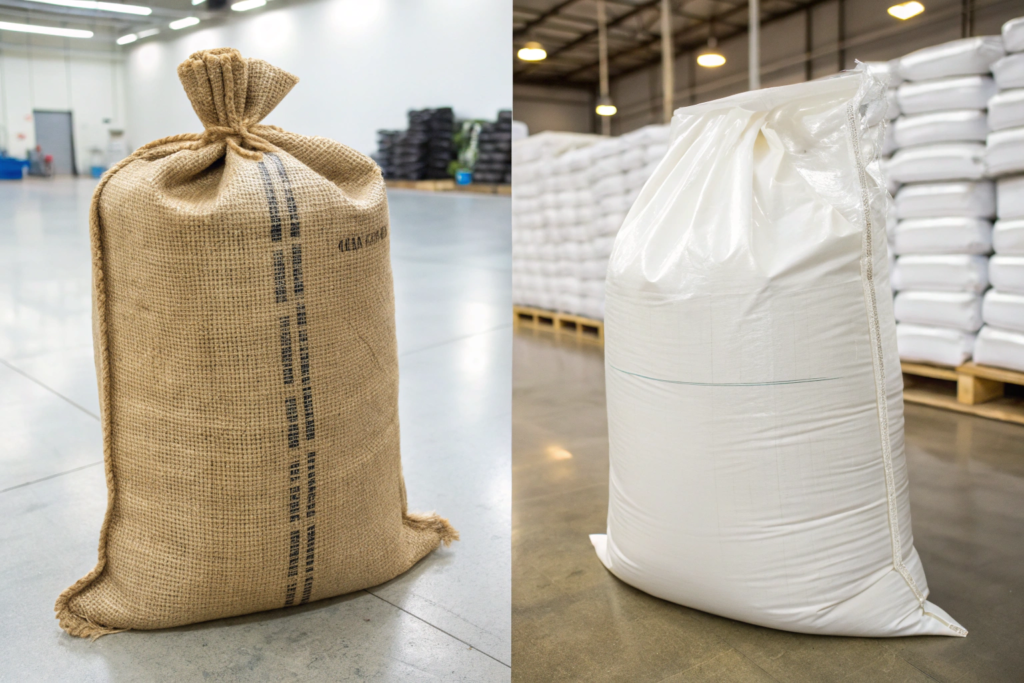
The choice of storage material—whether traditional jute, hermetic GrainPro liners, or vacuum-packed boxes—directly determines the shelf life and quality trajectory of green coffee. Jute allows the bean to breathe and is fine for short-term logistics but exposes the coffee to ambient humidity. Hermetic bags create a sealed microenvironment that locks in moisture content and prevents pest access, ideal for long-term storage of specialty lots.
Are GrainPro and Hermetic Bags Worth the Investment for Long-Term Holding?
For our specialty Arabica, the answer is a clear yes. GrainPro bags, and similar hermetic liners, are the standard for a reason. They work. A GrainPro bag is essentially a high-barrier plastic liner placed inside a traditional jute sack. You fill it, press out the excess air, and tie it off with a zip tie.
What does this actually do? It stops moisture exchange. If the sealed bag is loaded at 11% moisture and 65°F, it stays at 11% moisture—regardless of what the warehouse does. It also starves insects of oxygen. Any eggs that were in the bean cannot develop. It's a physical barrier that jute simply can't match.
The cost difference is real. GrainPro liners add about $1.50 to $2.00 per bag. For a container with 300 bags, that's an extra $600. A buyer focused only on upfront price might skip it. But if you're holding that specialty lot for eight months, waiting for the right roasting window, the liner pays for itself many times over by preventing quality fade. I ship all my premium, high-scoring lots in GrainPro now as a standard. It's not an upsell. It's a guarantee that the coffee you cup in my lab is the coffee you'll cup in your roastery.
When Is Traditional Jute the Right Choice for Your Supply Chain?
Don't get me wrong. Jute isn't obsolete. It's still the backbone of global coffee transport. For our commercial-grade Robusta and quick-turnaround Arabica shipments, jute is perfectly fine.
Jute's advantage is breathability and tradition. A newly processed coffee with a lot of volatile moisture can slowly stabilize inside a jute bag without trapping condensation. Hermetic bags, if sealed on a coffee that's too warm or too wet, can actually trap that moisture and create a mold incubator. Jute forgives small errors.
Jute is also cheaper and easier to source. If you're a large commercial buyer turning inventory every 30 to 60 days, the beans aren't sitting long enough for ambient humidity to cause deep-seated damage—assuming the warehouse is reasonable. The key with jute is to never stack it directly on concrete, keep the warehouse dry, and turn the inventory. Don't let those bottom bags sit for six months. Move them. Use the older stock first. Basic inventory rotation, honestly, solves half the problems people blame on bag material.
How Should You Conduct Quality Control Inspections on Stored Inventory?
You can build the perfect warehouse. You can buy the most expensive hermetic bags. But if you don't look inside the bags regularly, you're still flying blind. I say this from experience. An inspection schedule isn't busywork. It's the feedback loop that catches a small problem before it becomes a claim, a loss, or a ruined relationship.
Regular, documented quality control inspections on stored inventory are the final defense against silent degradation. A good protocol combines sensory checks—smell, visual inspection, and hand-feel—with instrumental readings like moisture content and water activity. The frequency should be risk-based: monthly for stable, cool conditions and bi-weekly for high-risk seasonal windows or older lots.
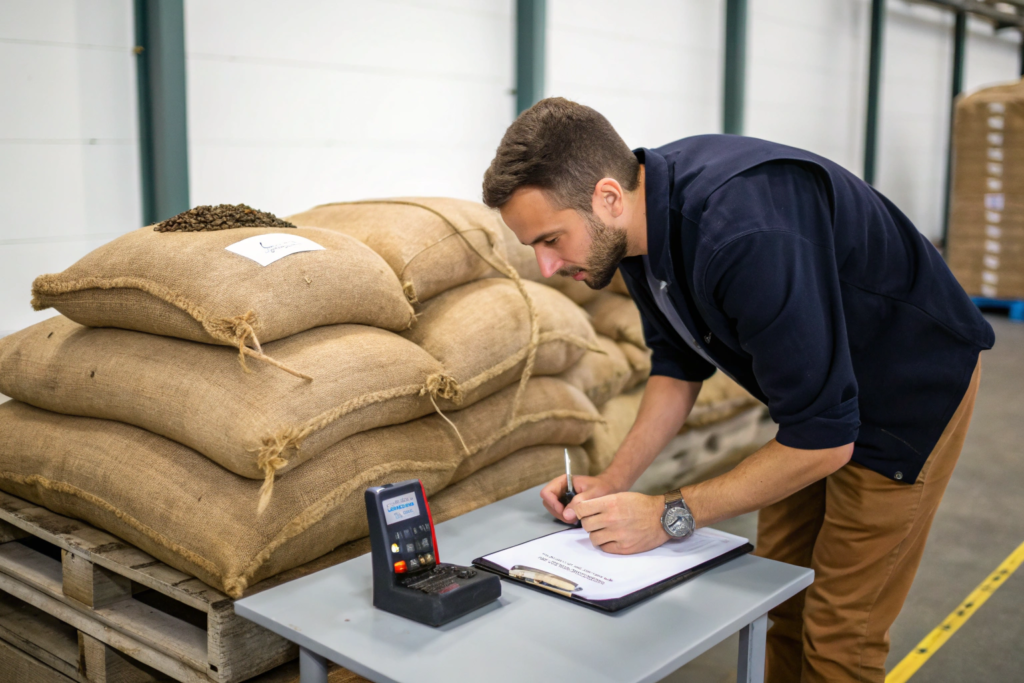
What Tools Do You Need for a Reliable Green Coffee Inspection?
You don't need a laboratory. You need a handful of reliable, calibrated tools that become an extension of your hand. Here's what I keep in my inspection kit at the Baoshan warehouse.
First, a sampling trier. This is the long, pointed brass tool you stick into a jute sack to pull a core sample from the center. The center of the bag is where problems hide. The outside beans might look perfect while the middle is heating up. Second, a portable moisture meter. I use a capacitive meter, calibrated for green coffee. It gives me a reading in seconds. Third, a water activity meter. It's more expensive than a moisture meter, but for long-term storage, water activity is the superior metric. It tells you if the water in the bean is actually available to microbes.
A small, powerful flashlight. A notebook or a tablet with a simple logging app. A digital probe thermometer—the type you stick into a pallet to check core temperature. I also keep a clean, airtight jar. If I pull a sample that smells even slightly "off," I seal it and bring it to the cupping lab. The nose knows a lot, but a controlled cupping confirms whether it's a real defect or just a warehouse smell that will air off.
How Do You Build an Effective Sampling Schedule for Large Volumes?
A full inventory check on 10,000 bags is a huge task. You can't do it every week. So you do it smart, not exhaustive. I use a risk-based approach that I borrowed from food safety protocols.
Every pallet in our warehouse gets a risk score. Age is the biggest factor. Coffee stored over six months is flagged as high-risk. Location is second. Pallet rows near exterior walls or dock doors get flagged because they see the most temperature fluctuation. I also flag any lot that arrived during the rainy season or had a known transit delay. That's an automatic bump up the inspection list.
For low-risk inventory—new crop, center warehouse, GrainPro bags—we sample 5% of the pallets monthly. For high-risk lots, we sample 20% bi-weekly. When we find a problem, even a small one, that entire row gets pulled and fully inspected. This targeted approach catches 90% of issues with 20% of the labor, compared to blind random sampling. For a buyer with a few containers in a US warehouse, the principle is the same. Don't just sample the pallet by the door because it's convenient. Sample the ones you're worried about. The ones in the back. The ones from that shipment that took an extra three weeks at sea.
Conclusion
Storing large volumes of green coffee safely is a discipline, not a destination. It's about knowing the invisible enemies—moisture migration, hidden pests, silent temperature swings—and building a system that accounts for them. It starts with a warehouse that breathes but doesn't swing wildly. It relies on choosing the right bag for the right purpose, whether that's a breathing jute sack for fast turnover or a sealed hermetic liner for the crown jewels. And it's sustained by a practical, risk-focused inspection routine that catches trouble before it stinks.
The beans that leave our farm in Baoshan carry the work of hundreds of hands. Watching that work get destroyed by a damp corner in a warehouse is heartbreaking—and entirely avoidable. If you're sourcing container loads and want to make sure your storage setup, from origin to your roastery door, is airtight, let's talk. At BeanofCoffee, we can guide you through the best packaging choices and share our full storage protocols openly. Reach out to Cathy Cai at cathy@beanofcoffee.com. She can arrange a video walkthrough of our facilities and help you design a storage plan that keeps your investment safe, stable, and ready to cup beautifully.