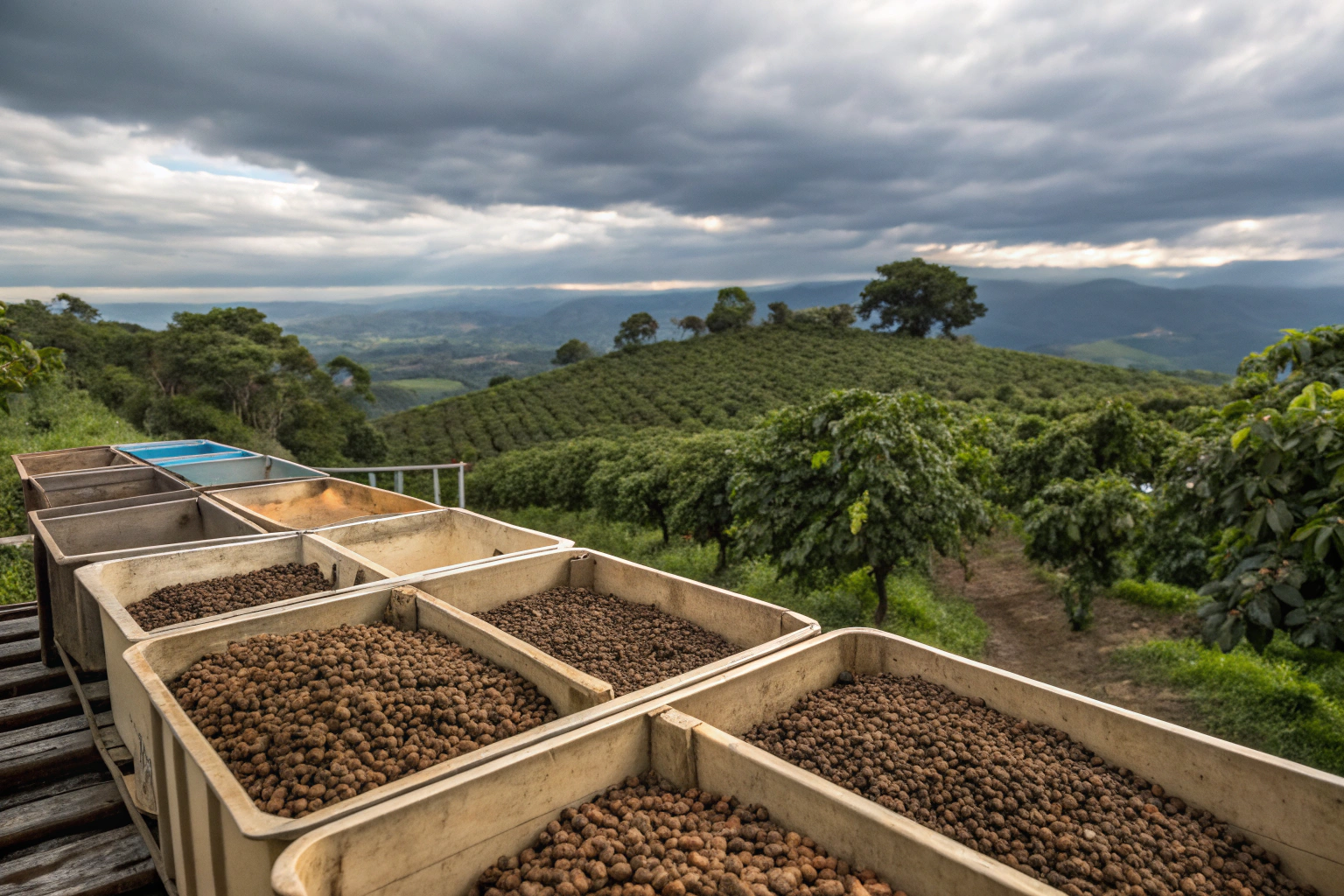
I used to think scale was the only story that mattered. Big farm, big volume, big contract. That was the model I had in my head when I started BeanofCoffee. But about five years ago, something shifted. I started getting calls from serious buyers—roasters in Melbourne, a distributor in Hamburg—not asking about our 10,000-acre main plantation. They were asking about the smallholder families in the next valley over. "Can you source from them? Can you aggregate? What's their story?" At first, I didn't get it. Now, I do. The big buyers aren't being charitable. They're being strategic.
Smallholder Yunnan farms are attracting major international coffee buyers because they offer a unique combination of traceable micro-lots, distinctive flavor profiles from high-altitude polyculture systems, and a compelling sustainability narrative that consumers increasingly demand. These farms represent not just a source of coffee, but a source of differentiation in a crowded market.
Here's the real shift I've witnessed from the ground in Baoshan. Commodity coffee is a race to the bottom on price. But a micro-lot from a named family, at a specific altitude, with a verified organic practice? That's not a commodity. That's a product with a face. And in today's market, a face sells better than a bulk bin. Let me show you why this matters for your sourcing strategy.
What Makes Yunnan Smallholder Coffee Genuinely Unique?
A buyer once asked me, "Why should I pay a premium for a half-bag lot from a farmer with two hectares?" It's a fair question. But it misses the point. The uniqueness isn't about the size of the farm. It's about the level of care and the micro-environment that a small plot forces a farmer to cultivate. A 1,000-hectare farm treats coffee like a factory input. A 1-hectare farm treats each tree like a family member. That sounds romantic, I know. But it shows up in the cup. Every single time.
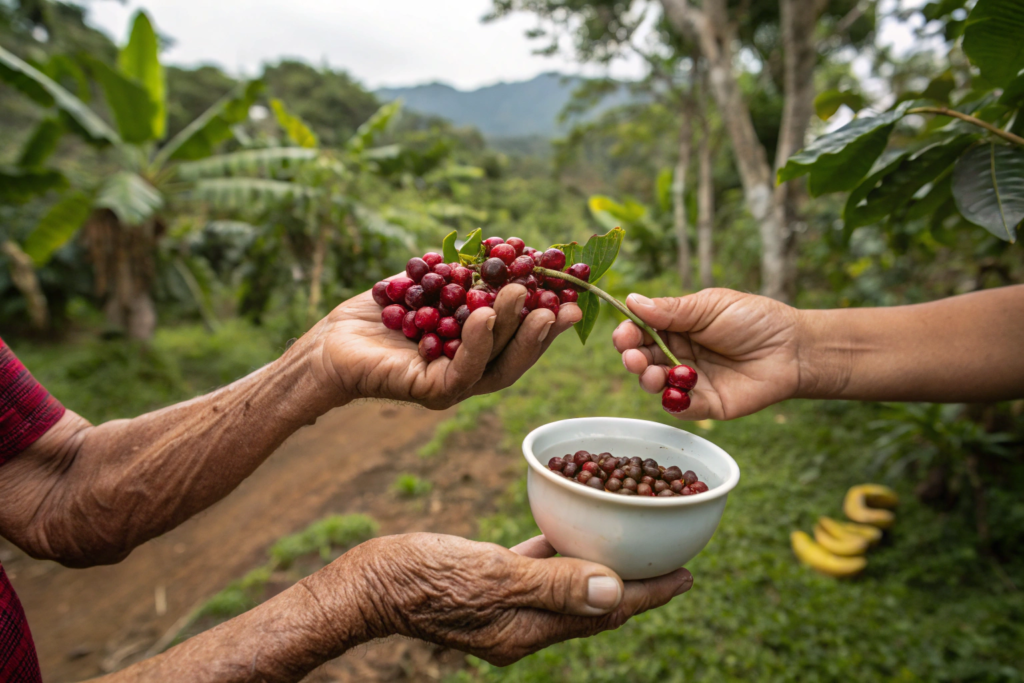
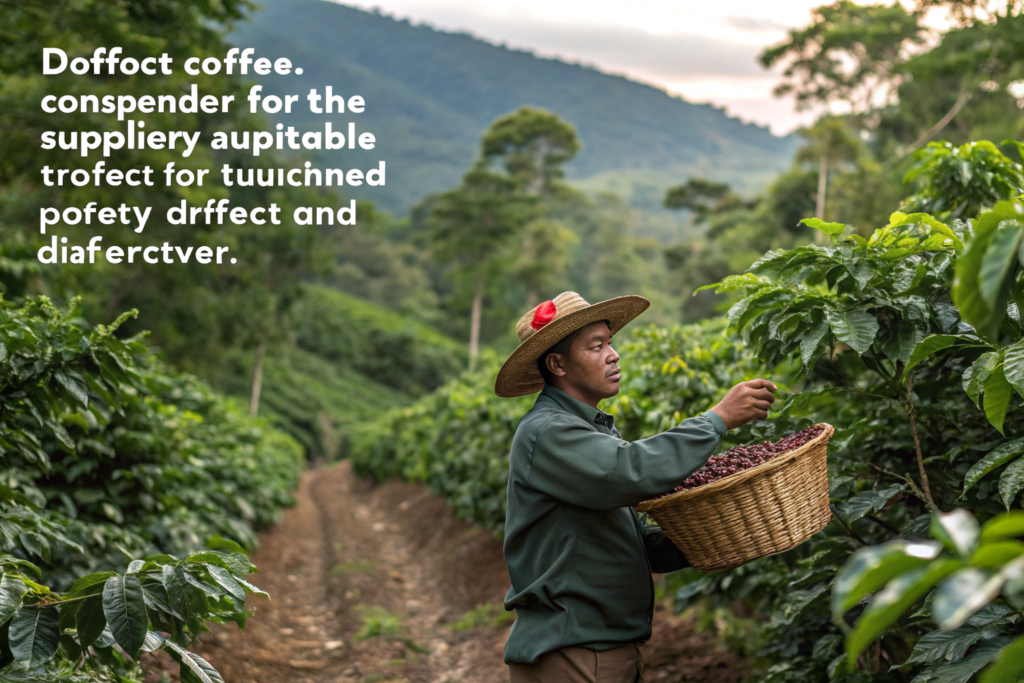
Yunnan smallholder coffee stands out because it is typically grown in biodiverse, high-altitude gardens where coffee is intercropped with fruit trees, nuts, and vegetables. This polyculture system, combined with meticulous hand-picking on steep slopes where mechanical harvesting is impossible, produces smaller volumes of beans with greater density, complexity, and a flavor signature that cannot be replicated by large-scale monoculture plantations.
How Does Yunnan's Terroir Differ From Other Asian Origins?
Terroir isn't just a wine word. It's the sum of soil, slope, sun, and rain that makes a bean from one hillside taste completely different from a bean grown just five miles away. Yunnan's terroir is special, and smallholder farms capture it in high definition.
Most of these small farms sit between 1,200 and 1,600 meters above sea level. The soil in Baoshan is volcanic in origin, rich in iron and organic matter. The temperature swings hard between day and night—we're talking a 20-degree Fahrenheit difference. The coffee cherry matures slowly under this stress. Slow maturation means more sugars develop in the mucilage. That translates to a cup with a syrupy body and a surprising sweetness you don't always get from other Asian origins like Vietnam.
Compare this to a lower-altitude, flat-land Robusta farm in another region. The difference is night and day. The Vietnamese coffee is efficient, high-yielding, but often one-dimensional—earthy, heavy, built for blending. Yunnan smallholder Arabica and Catimor, grown under shade canopies and harvested selectively, can express floral notes, stone fruit, and a malic acidity that's reminiscent of a crisp apple. I've cupped lots from a single household that scored 86 points. That's competitive with Central American specialty coffee. Big buyers are noticing this because it lets them offer an "Asia" origin that doesn't taste like the typical earthy Sumatra or heavy Vietnam.
Why Are Traditional Polyculture Practices Appealing to Modern Buyers?
Walk onto a smallholder farm in Baoshan, and you won't just see coffee. You'll see walnut trees, persimmons, soybeans, and maybe a vegetable patch. This is a traditional practice that, it turns out, is also the future of sustainable agriculture.
The coffee plants get dappled shade from the taller trees. The leaf litter from the walnuts and fruit trees creates a natural mulch, feeding the soil microbes. The vegetable crops feed the family and generate secondary income, reducing the financial pressure to push the coffee plants with chemical fertilizers just to squeeze out a few more kilos.
For a modern buyer, this is a storytelling goldmine. A roaster can put on their bag: "Grown under native walnut canopies in polyculture gardens by a third-generation family." That's a real sentence from one of our partner lots. It connects with a consumer who cares about biodiversity, soil health, and a landscape they can imagine. It's not a sanitized, monoculture grid that could be anywhere in the world. It's a specific, beautiful place. And honestly, the ecological function backs up the romance. These integrated farms have fewer pest outbreaks because the biodiversity keeps pests in check naturally. Less pesticide, healthier cup.
How Can Smallholder Aggregation Work Reliably for Volume Buyers?
Now, I hear the objection. "Stories are great, but I need 300 bags. How do I get consistency from 50 farmers with 2 hectares each?" This is the challenge. And it's exactly what I've spent years solving. Smallholder aggregation is hard. If done poorly, you get a jumbled mess of inconsistent quality. If done well, you get the best of both worlds: the volume of a plantation with the character of a micro-lot. The secret is in the infrastructure and the protocol at the collection point.
Reliable smallholder aggregation requires a centralized processing hub with strict quality protocols, a transparent traceability system that keeps family lots separated until a strategic blending decision, and a financial incentive structure that rewards quality over sheer weight. The aggregator acts as the bridge, translating the buyer's spec sheet into actionable, daily instructions for dozens of small farms.
What Quality Control Systems Are Needed at the Collection Point?
The collection point is the make-or-break moment. It's where cherries arrive on the back of a motorbike, in a basket, and decisions are made in seconds. I learned early on that you cannot fix bad cherry at the washing station. You can only prevent it from getting mixed in.
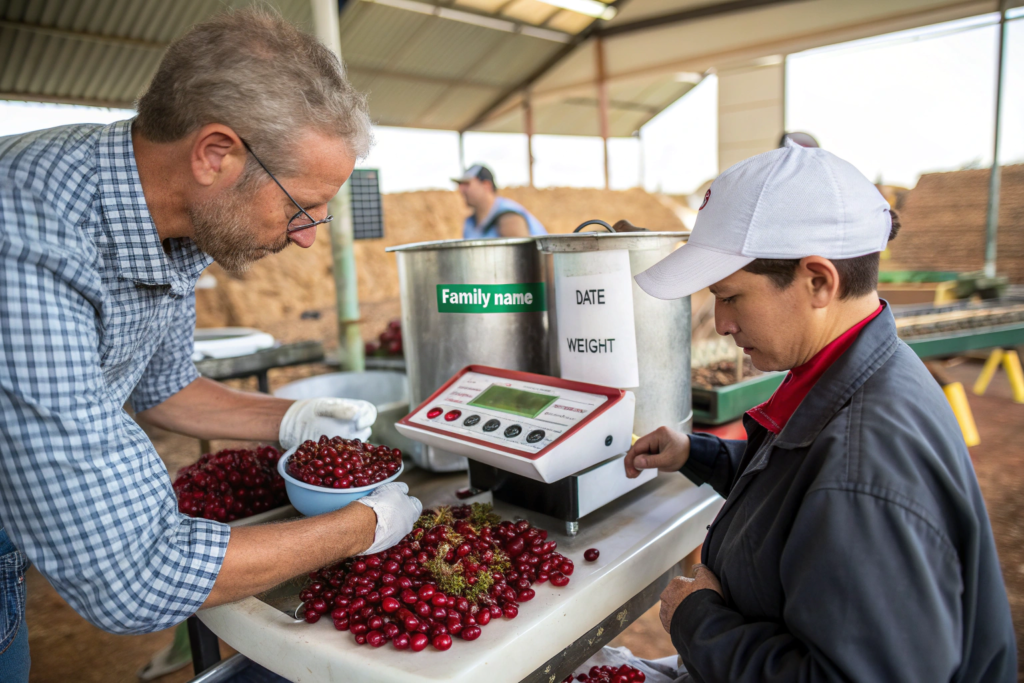
At our Baoshan hub, we use a simple, visual three-tray system for cherry evaluation before we accept a single kilo. When a smallholder brings their day's harvest, we pour a sample onto a black tray. The grader looks for uniformity. Is the cherry deep red, or are there greens and semi-ripes mixed in? We use a refractometer on a random sample to check the brix level—the sugar content. For our specialty lines, we set a minimum brix threshold of 18. If the cherry is under-ripe or mixed, the whole lot is rejected on the spot. Not negotiated. Rejected.
This sounds harsh. But it teaches fast. Farmers learn that quality, not just weight, determines their income. Accepted cherry is weighed on a calibrated digital scale. The lot gets a unique batch code right there. Family name, date, weight. That code follows the coffee through depulping, fermentation, drying, and milling. If a buyer wants a single-family micro-lot, we can pull it. If they want a community blend of five farms with a similar flavor profile, we can combine those specific codes. The data is the backbone. Without the batch codes, you have a story without proof. With them, you have a supply chain.
Can Smallholder Cooperatives Meet the Consistency Demands of Export?
Consistency across a cooperative is a training challenge, not a genetic challenge. The trees on these farms are often the same Catimor and Arabica varietals I grow on the main plantation. The variable is the human practice. So, we invest in training like it's a core business expense—because it is.
Before the harvest season, we run workshops. I bring in agronomists who teach pruning techniques that maximize airflow and reduce fungus. We teach selective hand-picking—stripe picking is forbidden for the specialty stream. We demonstrate the ideal fermentation time based on our altitude and the water temperature that day. These aren't lectures. They're hands-on sessions at the wet mill.
Then, during the harvest, we place a quality liaison in the village. This person is not a guard. They're a coach. They walk the picking rows, check the drying beds, and give immediate feedback. If a farmer's lot shows a fermentation defect in the first cupping, we sit down and trace it back together. Was the water too cold? Was the cherry stored too long before pulping? This closed-loop feedback, scaled across a group of 40 smallholders, creates a consistent output that can absolutely meet export standards. I've shipped a container of 86+ scoring community blend that was sourced entirely from smallholders. It cupped uniformly across 20 random samples. That's when I knew the system wasn't just feel-good; it was commercially viable.
What Certifications Are Easiest for Smallholders to Obtain and Leverage?
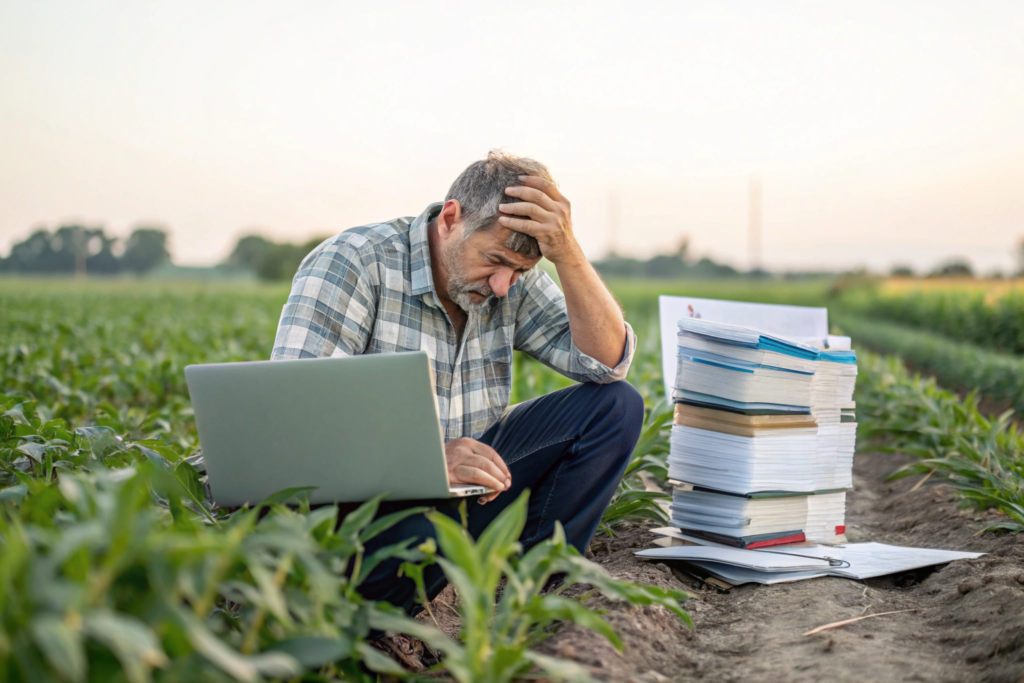
Certifications can feel like a paperwork nightmare. For a smallholder with a fourth-grade education and no computer, the audit process alone can be terrifying. I've sat through meetings where a farmer was so nervous about answering an inspector's question that he couldn't speak. That's not fair. The system shouldn't exclude the very people it claims to help. So, we've had to get practical about which certifications actually open doors for buyers without crushing the farmer in bureaucracy.
The most accessible and impactful certifications for Yunnan smallholders are Organic and Rainforest Alliance. Organic is the strongest price-driver but has a challenging 3-year transition period. Rainforest Alliance focuses on holistic farm management and biodiversity, aligning naturally with existing polyculture practices, making it easier for smallholders to adopt and pass the audit. Group certification models dramatically lower the per-farmer cost.
Is Organic Certification Realistic for Yunnan's Mountain Farmers?
The short answer is yes, but only with group support. Organic certification is the most recognized label in the world, and it commands a real premium. For a smallholder in Baoshan, the transition to organic can actually be a return to how their grandparents farmed, before cheap chemical fertilizer became available.
The biggest hurdle is the three-year transition period. For three years, the farmer must use organic practices, but they cannot sell the coffee as certified organic and get no premium. That's a long time to wait for a payout. The solution we've found is an internal support system. We, as the exporter, subsidize a portion of the organic compost and pest control during the transition. We guarantee a purchase at the end, provided the practices are maintained. It's a partnership, not a hands-off certification.
Another practical issue is contamination from neighboring conventional plots. A small farm in a valley might be organic, but if the farmer uphill uses chemical sprays that drift down, the organic test can fail. We've dealt with this by working with entire villages, not isolated farms. When a whole community transitions together, the risk of contamination drops. The auditing body also offers a "group certification" model, where an internal control system manages dozens of small farms under one certificate. The cost per farmer drops from perhaps $800 annually to less than $100. That makes it viable. For a big buyer, a certified organic Yunnan lot from a smallholder group is a rare and valuable asset.
How Does Rainforest Alliance Fit the Existing Yunnan Ecosystem?
Rainforest Alliance feels almost tailor-made for the traditional Yunnan smallholder. The standard emphasizes shade cover, biodiversity, soil health, and worker welfare. As I mentioned, these farmers already intercrop with walnuts and fruit trees. Their farms aren't barren monocultures. They're already halfway there just by continuing what they've always done.
The RA audit looks at things like: Are you protecting natural waterways from processing waste? Are you using integrated pest management before reaching for a spray? Are farm workers paid a fair wage and given protective equipment? These are practical, farm-level improvements.
For a buyer, Rainforest Alliance certification is a strong signal of ethical sourcing without the complexity and cost of the organic transition. It's also a stepping stone. I've seen smallholders get RA certified first, build their record-keeping skills, and then use that confidence to tackle the organic paperwork. From an exporter's perspective, RA-certified coffee moves well in the European market, where the standard is highly trusted. It allows a smaller farmer to access a global supply chain they'd be locked out of otherwise.
How Does a Direct Trade Relationship With Smallholders Reduce Sourcing Risk?
Risk in coffee sourcing isn't just about price volatility. A big part of it is counterparty risk. Will the coffee be there when you need it? Will the quality match the sample? In a purely transactional, anonymous market, you're always rolling the dice. Direct trade, especially with smallholders, rewires that dynamic. It turns a supplier into a partner. And a partner doesn't disappear when the market gets tough.
A direct trade relationship with smallholders reduces sourcing risk by creating mutual dependency and transparency. The buyer gains a committed supply of a differentiated product, direct visibility into farming practices, and a relationship that can absorb market shocks. The smallholder gains price stability, agronomic support, and a long-term market for their crop, which incentivizes consistent quality over opportunistic selling.
Why Does Farm-Gate Transparency Lower Your Quality Risk?
When you buy a container from a generic broker, you're buying a story written on a spec sheet. Moisture: 11.5%. Defect count: 8. Screen size: 16. Those numbers can be true. They can also be massaged. How do you know? You don't, really, until the container arrives.
Farm-gate transparency changes that. If you, as a buyer, have a direct line to the collection hub—or better yet, you've visited the farms—you've seen the drying beds with your own eyes. You know the fermentation tanks are clean. You've cupped the pre-shipment sample, and you know it was pulled from the specific lot code you bought. There's no gap for a middleman to slip in a cheaper, older lot.
This transparency isn't just philosophical. It's a hard risk-reduction tool. If a quality issue does arise, the feedback loop is instant. You don't go through three layers of traders. You tell me, I call the farm leader in the village, and we figure it out. Was it a drying issue? A picking issue? We fix it for the next lot. The relationship creates an accountability chain that an anonymous paper contract cannot replicate.
Can Long-Term Smallholder Partnerships Stabilize Your Supply Chain?
Supply chains break when the weakest link snaps under pressure. In a commodity market, when the C market spikes, a trader might sell your contracted coffee to someone else for a higher price. It happens. It's called default, and it's a constant fear.
A smallholder who has been selling to you for five years, whose child you helped send to school through a community fund, whose farm you helped get organic certified—that farmer doesn't default. Not because of a piece of paper. Because of the relationship. I've seen a smallholder walk away from a cash offer from a competitor that was 15% above our contracted price. Why? "They've never been here. You come every year." That's not a contract. That's loyalty. And it's the strongest supply chain insurance money can't buy.
For a big buyer, committing even 20% of your volume to a direct partnership with a smallholder group acts as a stabilizer. It's the part of your supply that won't vanish in a volatile market. It also provides a steady stream of the differentiated, story-rich coffee that your marketing team craves. It's a dual hedge: against supply disruption and against brand blandness.
Conclusion
The shift toward Yunnan's smallholder farms is not a passing trend or a feel-good marketing angle. It's a structural recalibration of what value means in the coffee supply chain. Big buyers aren't just looking for a cheap bean in a big bag anymore. They're looking for authenticity, traceability, and a flavor that can't be found on a spreadsheet. The smallholder farms in Baoshan, with their high-altitude polyculture gardens and meticulous hand-picking, deliver exactly that. And when the aggregation, the quality control, and the relationships are managed professionally, these tiny farms can feed some of the most demanding supply chains in the world.
At BeanofCoffee, we've built our smallholder network as a core part of what we offer, not a side project. We know these families, we know their lots, and we know how to turn their beautiful, hand-tended coffee into a reliable, export-ready container for you. If you want to explore what a smallholder-sourced lot from Yunnan can do for your coffee program, I'd love to start that conversation. Reach out to Cathy Cai at cathy@beanofcoffee.com. She can share lot profiles, farmer stories, and cupping scores that will, I think, surprise you. This is where the real flavor is. And the real future.