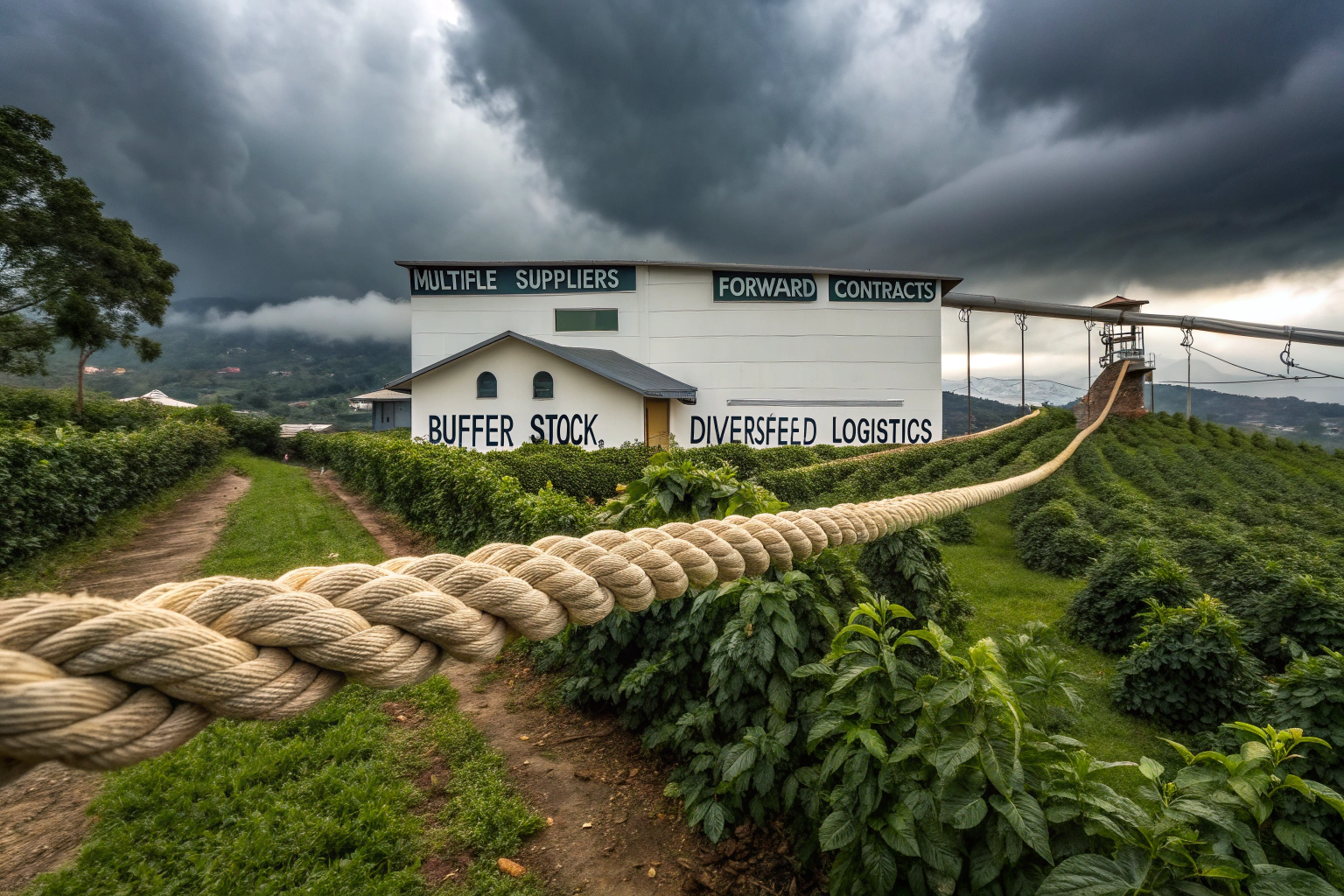
In April of 2022, I had a nightmare month. Within the span of three weeks, three things happened simultaneously. A lockdown in Shanghai froze the port just as I had two containers ready to ship. A drought report from Brazil sent the C-market price soaring, and my phone lit up with panicked buyers trying to lock in prices I could no longer honor. And a key processing machine at our dry mill broke down, with the replacement part stuck in the same Shanghai backlog. For about ten days, I wasn't sure if my business would survive. We made it through. But that month changed how I think about supply chains forever.
Strengthening your coffee supply chain stability means building redundancy, visibility, and flexibility into every link between the farm and the roastery. It requires diversifying your supplier base, your logistics routes, and your contract structures so that no single failure can halt your business. It requires investing in real-time data and transparent communication, so you see problems coming before they hit. And it requires building genuine, trust-based relationships with your supply partners, because in a crisis, a contract is a piece of paper, but a relationship is a lifeline. Stability is not about avoiding disruptions; it's about surviving them with minimal damage.
A fragile supply chain is cheap in good times and catastrophic in bad times. A resilient supply chain costs a little more to maintain but pays for itself ten times over when the storm hits. I learned this the hard way. Let me share what I've built since that terrible April, so you can strengthen your own sourcing strategy.
Why Is Supplier Diversification the First Line of Defense?
The most fragile supply chain is the one that depends on a single source. It's efficient. It's simple. It's also a disaster waiting to happen. If that one source fails—a crop failure, a political crisis, a bankruptcy—the entire business stops. Diversification is the oldest and most effective risk management strategy in the book.
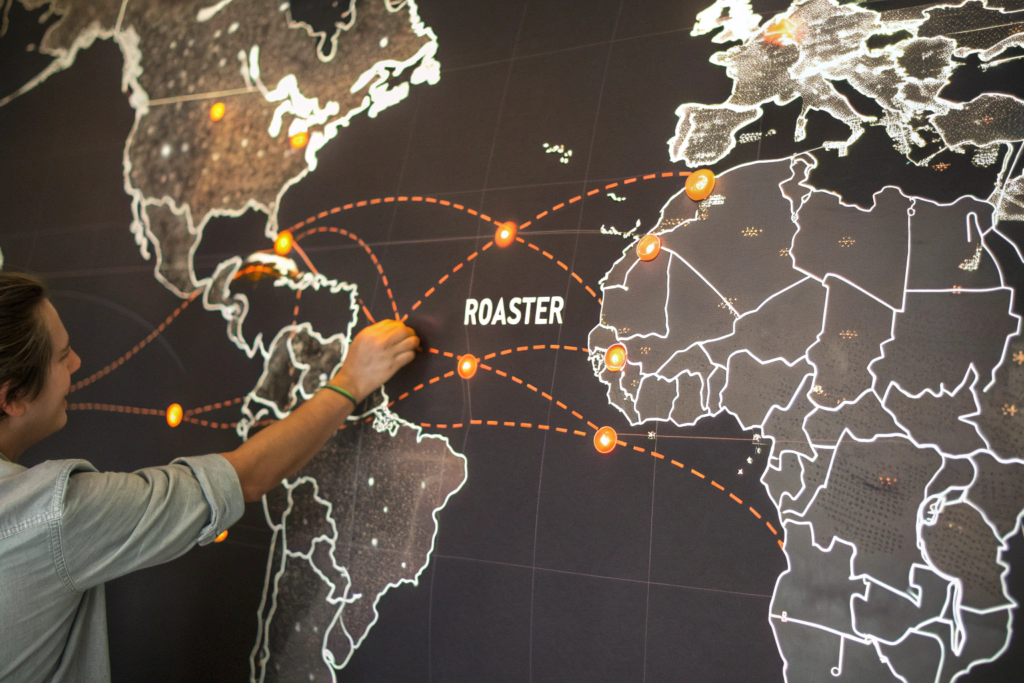
Supplier diversification is the first line of defense against supply chain disruption because it ensures that a failure at one origin does not cripple your entire operation. A roaster who sources 100% of their coffee from one farm, in one country, is completely exposed to the weather, the politics, and the economic conditions of that single location. A roaster who sources from three or more origins, across different continents, can absorb a shock at one origin by increasing volume from the others. The goal is not to replace a primary, trusted supplier. It is to build a portfolio of options that provides a safety net.
How Many Suppliers Is Enough?
There is no magic number, but a good rule of thumb is a minimum of three active supplier relationships, across at least two different coffee-growing continents.
If you're a US roaster buying most of your coffee from Central America, consider adding a relationship with a supplier in South America and another in Asia. The weather patterns, the harvest seasons, and the political risks are different in each region. A drought in Brazil will not affect a farm in Yunnan.
The goal is not to order equal volumes from all suppliers. It's to have established, tested relationships so that when your primary source has a problem, you can increase your orders from the secondary sources quickly and without having to do due diligence from scratch. At BeanofCoffee, we understand that we are often one part of a roaster's diversified portfolio, and we work to integrate seamlessly with their other supply lines.
What About Diversifying Within a Single Origin?
Diversification within an origin is also valuable. Even within Yunnan, conditions vary. A drought in Pu'er might not affect Baoshan. A processing problem at one mill doesn't affect another.
A smart sourcing strategy diversifies at multiple levels: continent, country, region, and supplier type. This layered approach creates a buffer at every level of the chain.
How Do Forward Contracts and Hedging Stabilize Costs?
A stable supply chain is not just about having coffee. It's about having coffee at a predictable cost. Price volatility is as destabilizing as physical shortage. A roaster who budgets $3.50 per pound and suddenly faces $5.00 per pound is in crisis, even if the coffee is physically available.
Forward contracts and hedging instruments stabilize costs by transferring price risk from the buyer to a counterparty willing to bear it. A forward contract with a fixed FOB or CIF price locks in the total cost for a future delivery, insulating the buyer from C-market fluctuations. A contract with a fixed differential and a floating C-market price allows the buyer to lock in the quality premium while timing the market for the base price. Hedging with futures and options on the ICE exchange provides a financial mechanism to cap or offset price increases. The right strategy depends on the buyer's risk tolerance, cash flow, and market view.

What Is the Difference Between a Fixed-Price and a Price-to-Be-Fixed Contract?
A fixed-price contract means the buyer and seller agree on a specific price per pound today, for delivery in six months. That price will not change, regardless of what happens to the C-market. The seller bears the market risk. This gives the buyer perfect budget certainty. The cost is a price premium built into the contract to compensate the seller for taking that risk.
A price-to-be-fixed, or PTBF, contract means the buyer and seller agree on a differential above the C-market. The final price is determined when the buyer instructs the seller to "fix" or "lock in" the C-market component. The buyer can wait for a dip in the market to fix. The risk is that the market rises and never comes back down.
We offer both structures to our buyers. A fixed-price contract is peace of mind. A PTBF contract is an active management tool.
How Do Buyers Use Futures and Options?
Larger, more sophisticated buyers use the ICE futures market directly to hedge their physical coffee positions.
A roaster who has committed to selling 10,000 pounds of roasted coffee to a supermarket chain in six months has a future obligation. To protect against a rise in green coffee prices, they can buy Arabica futures contracts today. If the C-market rises, the profit on the futures contract offsets the higher cost of the physical coffee.
Options are a form of insurance. A call option gives the buyer the right, but not the obligation, to buy futures at a specific price. If the market spikes, the option is exercised and the price is capped. If the market falls, the option expires and the buyer purchases cheaper coffee on the spot market.
These instruments require expertise and active management. Many smaller roasters prefer to let their exporter manage the hedging, through fixed-price contracts, rather than engaging with the futures market directly.
What Role Does Buffer Stock Play in Absorbing Shocks?
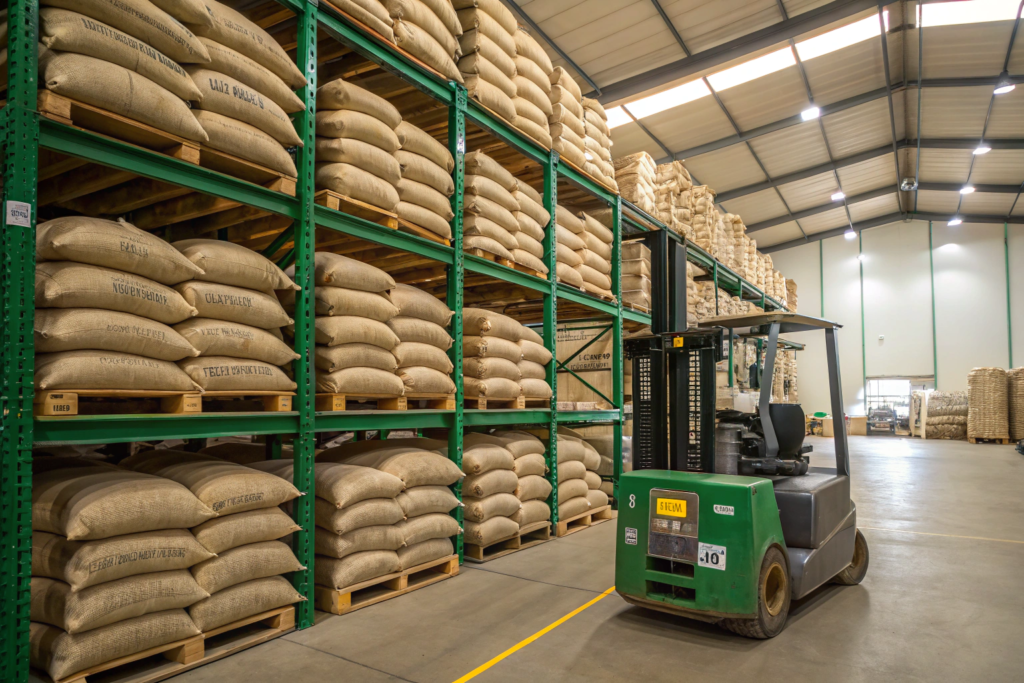
The physical buffer of coffee sitting in a warehouse is the simplest and most direct form of supply chain insurance. When a shipment is delayed, when a crop is short, when demand spikes unexpectedly, the buffer stock is what keeps the roastery running and the customers caffeinated.
Buffer stock absorbs supply chain shocks by providing a physical cushion of inventory that can be drawn down when the pipeline is disrupted. A roaster who holds eight weeks of green coffee inventory can survive a two-week shipping delay without missing a single production run. A roaster who practices just-in-time inventory with two weeks of stock will be forced to stop production, disappoint customers, and lose revenue if a container is delayed. Buffer stock costs money—warehousing, financing, the risk of quality degradation—but it buys operational continuity.
How Much Buffer Stock Is Enough?
The right level of buffer stock depends on the lead time, the volatility of the supply chain, and the cost of running out.
For a roaster importing from Yunnan to the US West Coast, the ocean transit is about 14 to 18 days. Add a week for customs clearance and inland trucking. The total lead time from vessel sailing to warehouse is about three to four weeks. A prudent buffer would be six to eight weeks of inventory. This covers one full lead time plus a buffer for delays.
The cost of carrying this inventory—warehousing, insurance, the opportunity cost of the capital tied up—must be weighed against the cost of a stockout. A stockout means lost sales, damaged customer relationships, and potentially lost accounts. For most businesses, the cost of a stockout far exceeds the cost of carrying buffer stock.
How Do You Manage Green Coffee Quality in Storage?
The concern with buffer stock is freshness. Green coffee ages. It fades. Past-crop coffee loses its vibrancy and develops woody, papery notes.
Good storage practices mitigate this. Coffee should be stored in a cool, dry, dark warehouse. GrainPro bags, hermetically sealed, dramatically extend the shelf life of green coffee. Coffee stored in GrainPro at stable temperature and humidity can maintain its quality for a year or more.
Rotation is critical. First in, first out. The oldest coffee is used first. The buffer stock is not static inventory; it's a revolving fund. We advise our buyers on proper storage protocols and shelf life management.
How Can Technology Improve Supply Chain Visibility?
In my nightmare month of April 2022, the worst part was the blindness. I didn't know the Shanghai port was locking down until my trucker called from the gate, turned away. I didn't know the machine part was stuck on a vessel that had been diverted. I was reacting to crises I couldn't see coming. Today, I have visibility.
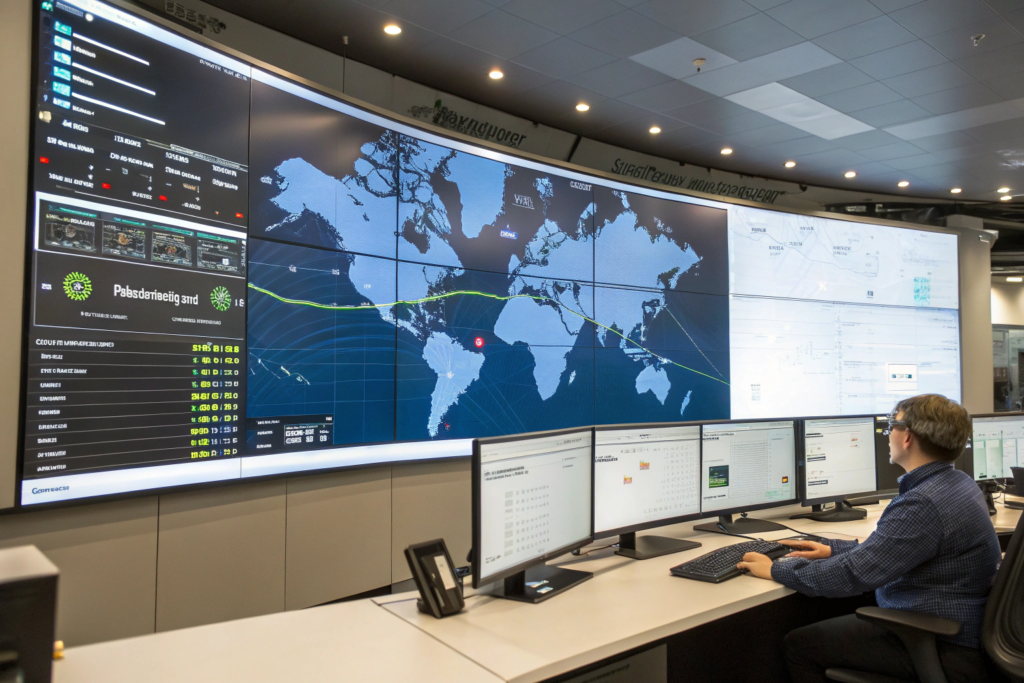
Technology improves supply chain visibility by providing real-time, shareable data at every stage of the coffee's journey. Vessel tracking platforms allow buyers to monitor their container's location and estimated arrival time. Cloud-based inventory systems allow real-time stock level monitoring at the roastery and at the origin warehouse. Digital quality logs, shared via platforms or simple cloud documents, allow the buyer to see the moisture readings, the defect counts, and the cupping scores before the coffee ships. Visibility turns supply chain management from a reactive scramble into a proactive discipline.
What Tools Provide Real-Time Shipment Tracking?
Most major shipping lines offer online container tracking. Enter the container number, and the system shows the vessel's current position, the last port called, and the estimated date of arrival.
Third-party platforms like MarineTraffic and VesselFinder aggregate data from multiple sources and provide more detailed vessel tracking, including speed, heading, and port congestion information. These tools are useful for monitoring whether a vessel is on schedule.
For a more integrated view, some freight forwarders offer dashboards that track all of a buyer's containers across multiple shipping lines. This is valuable for larger buyers with multiple shipments in transit simultaneously.
How Does Shared Quality Data Prevent Disputes?
Many quality disputes arise from information asymmetry. The exporter knows the coffee's quality before it ships. The buyer doesn't know until it arrives. If the arrival quality is different from what was expected, trust erodes.
Sharing the pre-shipment quality data—the full grading report, the moisture analysis, the cupping scores—before the coffee ships closes this information gap. The buyer knows exactly what to expect. Any deviation upon arrival is immediately identifiable and can be addressed with data, not accusations.
We share a complete quality data package with every shipment. It's part of our commitment to transparency and stability. The buyer never has to wonder what's in the container. They know.
Conclusion
Supply chain stability is not a static state. It's a dynamic capability. It's the capacity to absorb shocks and continue functioning. It's built through deliberate choices: diversifying suppliers, locking in predictable costs with forward contracts, holding adequate buffer stock, and investing in the technology that provides visibility.
The coffee industry will always be volatile. Weather will always be unpredictable. Ports will always occasionally close. Prices will always swing. The goal is not to eliminate volatility. The goal is to build a system that can withstand it.
I've rebuilt my own supply chain since that terrible April. It's more diverse, more transparent, and more resilient. I sleep better now. And my buyers sleep better too, because they know that our partnership is designed to survive whatever comes next.
If you're looking to strengthen your coffee supply chain, whether through diversifying into Yunnan as a new origin, setting up a forward contract structure that stabilizes your costs, or simply having a transparent, reliable partner on the other side of the ocean, we're here to help.
Reach out to Cathy Cai. She can walk you through our supply chain stability practices, our contract options, and our quality transparency tools.
Email: cathy@beanofcoffee.com. Let's build a supply chain that bends, but doesn't break.