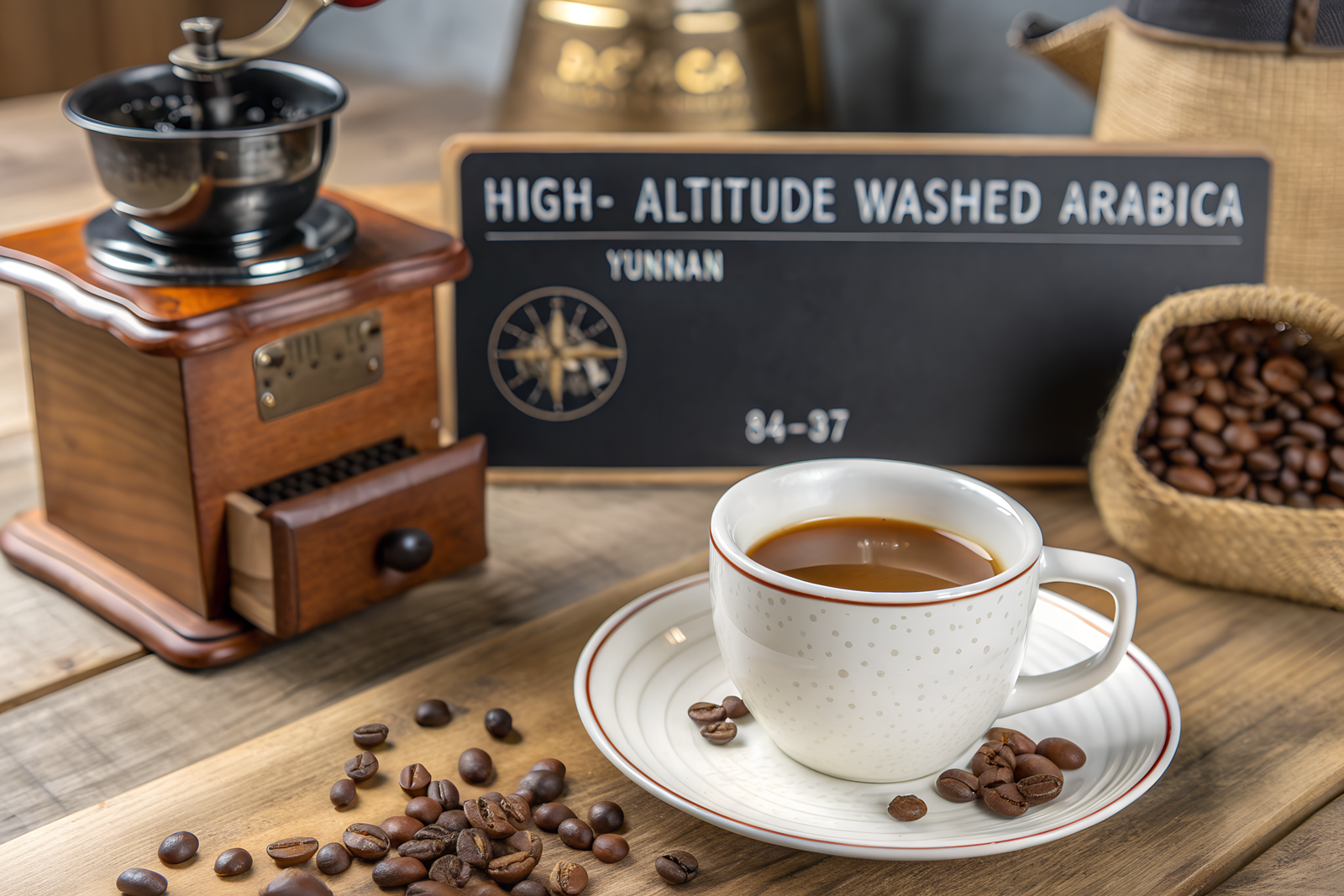
I was at a blending workshop in Portland last year. A roaster I respect—someone who's been sourcing for two decades—pulled me aside. He said, "I want to use your Yunnan in my house espresso, but I'm nervous about putting 'China' on my blend label. My customers still think Chinese coffee means instant." I understood his hesitation. It's the same hesitation I faced when I first started exporting. The perception lag is real. The quality, however, is already here.
Chinese coffee, specifically high-altitude washed Arabica from Yunnan, is now producing lots that cup at 84-87 points—fully competitive with specialty-grade coffees from Colombia, Guatemala, and Brazil. For blends, Yunnan Catimor offers a unique combination of bright malic acidity, clean brown sugar sweetness, a medium-full body, and a price point typically 15-25% below equivalent scoring Central American lots. It's not just "good enough." It's a strategic blending ingredient.
Why does this matter for your blend program? Because blends live and die by consistency, cost, and flavor balance. A great blend base needs to be clean enough not to introduce defects, complex enough to contribute positively, and priced to allow margin at your target retail. Yunnan Catimor hits all three. I own 10,000 acres in Baoshan. I've cupped our coffee against Colombian Supremo, Guatemalan SHB, and Brazilian Santos in blind panels with Q-graders. Our best lots consistently rank in the top half. The data is there. The perception just needs to catch up. Let me walk you through the evidence, so you can make a confident decision for your blend.
How Does Chinese Arabica Score in Professional Cupping Evaluations?
The only way to answer the quality question is with data, not stories. Cupping scores are the industry's standardized quality measurement. The Specialty Coffee Association protocol is rigorous: ten attributes scored on a 6-10 scale, defects deducted, final score out of 100. Any coffee scoring 80+ is specialty. 85+ is excellent. 90+ is outstanding. Where does Chinese Arabica fall on this scale?
Chinese Arabica, specifically washed Catimor grown above 1,400 meters in Baoshan and Pu'er, consistently scores 83-87 points in professional Q-grader evaluations. The best microlots push into the 87-89 range. This places Chinese specialty Arabica firmly in the same quality tier as mid-range Guatemalan and Colombian offerings, and above most Brazilian commercial-grade Arabica.
The cupping profile is distinct. The acidity is typically malic—green apple, crisp pear—rather than the citric acidity of a Kenyan or the phosphoric acidity of some Colombians. The body is medium to full, with a slightly creamy, tea-like texture that comes from the Catimor varietal's density. The sweetness is brown sugar and caramel, not the fruity, berry-like sweetness of an Ethiopian natural. The finish is clean and lingering, without the earthy or baggy defects that plagued Chinese coffee a decade ago. The uniformity is excellent. Because our farms in Yunnan are large, professionally managed estates rather than fragmented smallholder plots, the processing is consistent lot to lot. When I send a pre-shipment sample that cups 85, the arrival sample cups 85. That predictability is essential for a blend component. You can't build a blend around a coffee that varies by three points from shipment to shipment. The SCA cupping protocol is the standard we use. Our lots are cupped by licensed Q-graders, not just by our internal team. The scores are documented and shared with buyers.
How Has Yunnan Coffee Quality Evolved Over the Past Decade?
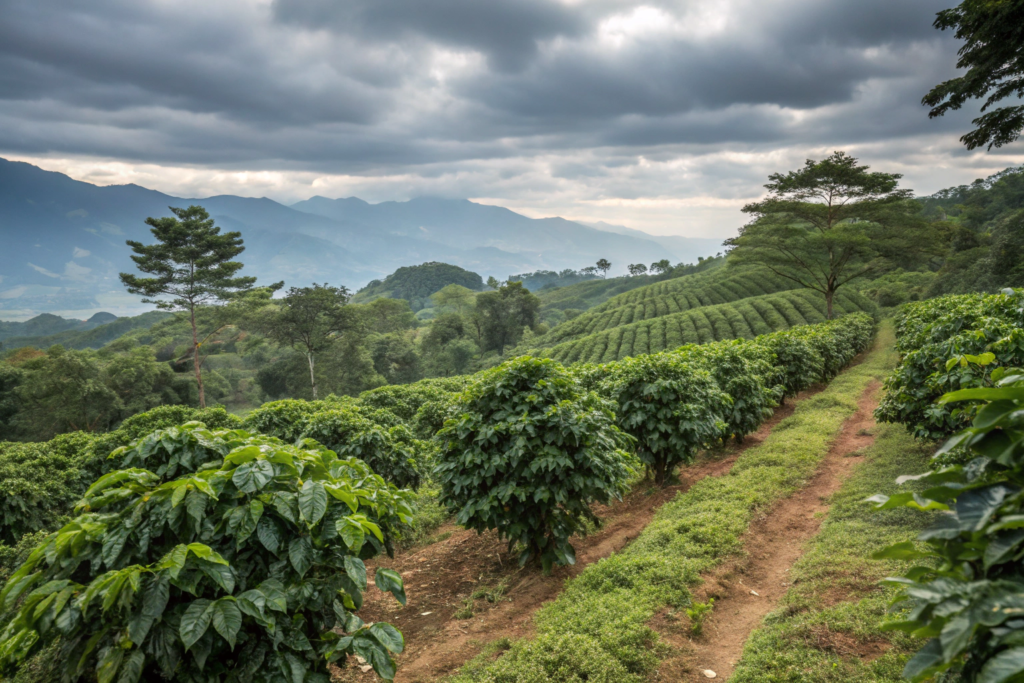
Ten years ago, Chinese coffee was mostly commodity-grade. It went into instant coffee and low-cost commercial blends. The processing was inconsistent. The picking was often strip-picked rather than selective. The drying was on concrete patios with minimal oversight. The cup had earthy, baggy, and sometimes moldy notes. That old reputation is what still lingers in some buyers' minds. But the industry has transformed.
The turning point came around 2015-2018. Several factors aligned. First, the Chinese government invested in agricultural modernization, including coffee. Subsidized loans allowed farms to build wet mills, buy optical sorters, and install raised bed drying systems. Second, international NGOs and specialty coffee buyers from Europe and Australia started partnering with Yunnan farms, bringing cupping training and processing expertise. Third, a new generation of Chinese coffee farmers—many educated abroad—took over family plantations and applied modern agronomy. At our farm, we started measuring Brix levels in the cherry before harvest. We implemented selective hand-picking with quality bonuses for pickers. We installed temperature-controlled fermentation tanks. We switched from patio drying to raised African beds. We hired Q-graders and built a cupping lab. The result: our average cup score increased from around 80 points in 2015 to 85-86 points today. This trajectory isn't unique to us. It's happening across the top Yunnan estates. The quality gap between Yunnan and Central America has narrowed to the point where it's no longer a meaningful differentiator. The World Coffee Research Yunnan trials document the varietal improvements and processing innovations that have driven this quality revolution.
What Do Blind Cuppings Reveal About Chinese vs. Colombian Coffee?
Blind cupping eliminates bias. The cupper doesn't know which coffee is which. They judge purely on the sensory experience. I've participated in dozens of blind cupping panels comparing Yunnan Catimor to Colombian Supremo, Guatemalan SHB, and Costa Rican Tarrazu.
The results are consistent: Yunnan Catimor from high-altitude estates places in the middle of the pack or higher. It doesn't win against a 90-point Geisha, but neither does a standard Colombian Supremo. Against an 84-85 point Colombian, a well-processed Yunnan often ties or slightly edges ahead. The cupping notes are different, not inferior. The Colombian might be more chocolate-forward with a nutty, round body. The Yunnan might be more apple-forward with a tea-like, structured body. Which is better? That depends on your blend goal. If you want a coffee to add brightness and lift to a dark-roasted base, the Yunnan's malic acidity is perfect. If you want a coffee to add heavy body and chocolate notes, a Brazilian might be a better fit. Neither is universally superior. The blind cupping evidence simply shows that Yunnan Arabica belongs in the same conversation. It's not a "cheap substitute." It's a distinct origin with a valid specialty profile. I've had buyers cup our Catimor blind against a $4.20/lb Guatemalan and choose the Catimor for their blend—not because it was cheaper, but because the flavor balance worked better with their other components. The SCA flavor wheel can help you map the specific attributes of different origins and see where Yunnan fits in your blend architecture.
What Flavor Profile Does Chinese Arabica Bring to a Blend?
A blend is an equation. Every component contributes something. One coffee provides the bass note. Another provides the melody. A third might add texture or crema. The art of blending is knowing what each origin brings to the equation, and Chinese Arabica brings a very specific and useful set of attributes.
Chinese Arabica, specifically high-altitude Yunnan Catimor, contributes bright malic acidity (green apple, pear), clean brown sugar sweetness, a medium to full tea-like body, and a neutral, clean finish that doesn't introduce earthy or fermented defects. In a blend, it functions as a "brightener" and "structure builder"—adding lift and complexity without dominating the cup or clashing with other components.
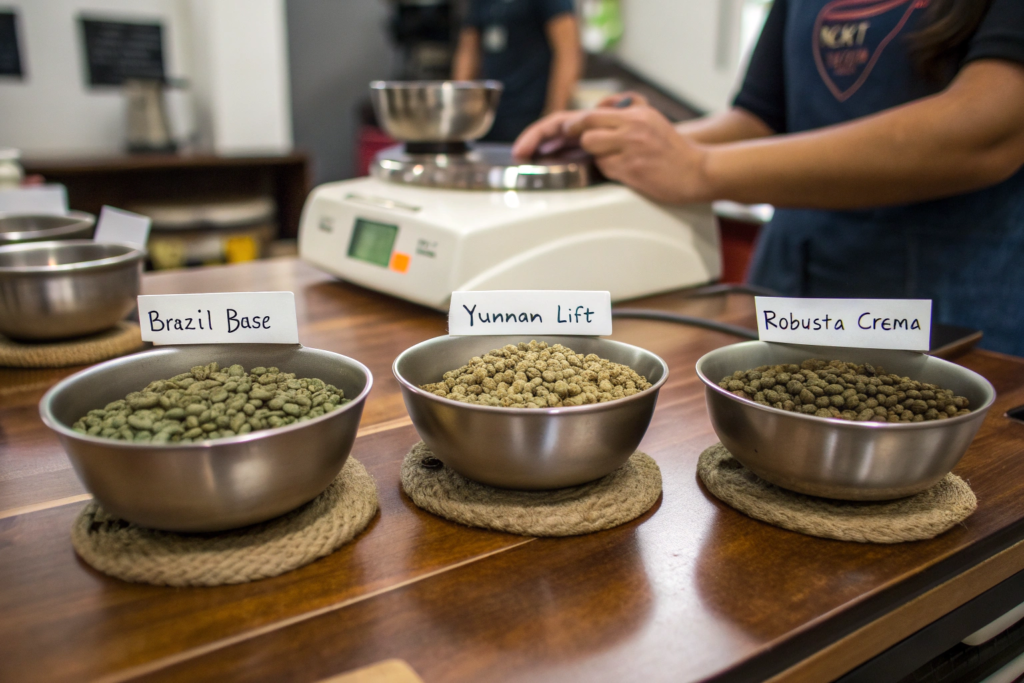
Think of blend components in terms of their function. A Brazilian natural provides heavy body, chocolate notes, and a low-acid base. It anchors the blend. A Colombian washed adds mild acidity, nutty sweetness, and balance. It rounds out the blend. An Ethiopian natural adds explosive fruit, floral aromatics, and complexity. It accents the blend. Yunnan washed Catimor adds a different kind of acidity—crisp, clean, apple-like—and a distinctive tea-like body texture that cuts through milk beautifully. In an espresso blend, it brightens the shot without making it sour. In a drip blend, it adds a refreshing quality that makes the coffee feel lighter and cleaner. It's also an excellent "blender coffee" in the sense that it plays well with others. It doesn't have the funky, fermented notes that can clash with other components. It doesn't have the earthy, heavy body that can weigh down a light roast. It's versatile. I have a client in Texas who uses our Catimor as 60% of his house blend, with 30% Brazilian and 10% Indian Robusta. He describes the Catimor as the "skeleton" of the blend—it provides the structure and the acidity, while the Brazilian adds flesh and the Robusta adds punch. That's a perfect functional description.
What Varietals Are Available from Yunnan for Blending?
Yunnan grows several Arabica varietals, but the dominant one—and the one most relevant for specialty blends—is Catimor. Catimor is a hybrid of Caturra (a natural mutation of Bourbon) and Timor Hybrid (a natural Arabica-Robusta cross). It was introduced to Yunnan in the 1990s because of its resistance to coffee leaf rust, which is a major problem in the humid subtropics.
Catimor has a complicated reputation. In some origins, it's known for producing harsh, vegetal, or peanut-skin flavors. But at high altitude in Yunnan—above 1,400 meters—that harshness disappears. The slow maturation at altitude gives the bean time to develop sugars and organic acids. The result is a clean, sweet, balanced cup that doesn't taste like the negative Catimor stereotype. There are several Catimor subtypes grown in Yunnan, including P3 and P4 selections, each with slightly different cup characteristics. P3 tends to be brighter and more acid-forward. P4 tends to be rounder and sweeter. We grow both and blend them to achieve a balanced profile. Beyond Catimor, there are small plantings of Bourbon, Typica, and even Geisha in Yunnan, but these are mostly experimental microlots, not commercially available in container volumes. For a blend program that requires consistency and volume, Catimor is the practical choice. It's disease-resistant, high-yielding, and at our altitude, it cups beautifully. I've had buyers ask for "100% Bourbon from Yunnan," and I have to explain that a container of Bourbon from Yunnan doesn't exist yet. The trees are too young and the plantings too small. Catimor is what Yunnan does at scale, and done right, it's a genuinely excellent coffee. The World Coffee Research Catimor profile documents the genetic background and cup potential of this varietal.
How Does Yunnan Arabica Perform as a Single-Origin vs. Blend Component?
Some coffees are soloists. They're so distinctive and complex that they shine brightest as a single-origin pour-over, where nothing else competes for attention. A natural Ethiopian with explosive blueberry notes is a soloist. A Geisha with jasmine and bergamot is a soloist. Yunnan Catimor is, in my honest assessment, more of an ensemble player.
As a single-origin, Yunnan Catimor is pleasant, clean, and balanced—but it doesn't have the wild, immediately recognizable character that makes a single-origin Ethiopian or Kenyan leap out of the cup. It's an excellent single-origin for a cafe that wants to feature an approachable, well-priced offering with a compelling origin story. "Coffee from China? Tell me more." That conversation happens at the counter, and it sells bags. But as a blend component, Yunnan Catimor truly excels. In an espresso blend, its malic acidity cuts through milk fat with a clarity that chocolatey Brazilians sometimes lack. The tea-like body gives the mouthfeel an elegance that heavy-bodied Robustas can't provide. In a drip blend, it adds a refreshing, apple-juice-like quality that makes the coffee drinkable all day. The versatility is the superpower. It doesn't impose itself on the blend. It integrates. It lifts the other components without shouting over them. A roaster I work with in Melbourne uses our Catimor as the "secret ingredient" in his award-winning house blend. He doesn't even tell his customers it's Chinese coffee—he just lets them taste the blend and judge for themselves. The blend wins on flavor. The origin is a bonus story, not the primary selling point. That's the right approach.
How Cost-Effective Is Chinese Arabica for Blend Programs?
Quality is the entry ticket. Cost is the decision-maker. You can love a coffee's flavor, but if it doesn't work financially in your blend, you can't use it. This is where Chinese Arabica makes its strongest case. The quality-to-price ratio is currently the best in the specialty coffee world.
Chinese Arabica offers a landed cost for 84-86 point coffee that is typically $0.60 to $1.00 per pound cheaper than equivalent scoring Colombian or Guatemalan lots. On an annual volume of 10,000 pounds, that's $6,000 to $10,000 in direct savings. For a blend that uses 50% Yunnan, the per-pound blend cost can drop by $0.30 to $0.50 without any reduction in cup quality or consumer experience.
Let's break down the numbers for a realistic blend scenario. Assume you produce a house espresso blend that's 50% Brazilian (82-83 points, $2.80/lb), 30% Colombian (84 points, $4.00/lb), and 20% Indian Robusta ($2.50/lb). Your weighted average green cost is about $3.40/lb. Now substitute the Colombian with an equivalent-scoring Yunnan Catimor at $3.20/lb. Your weighted average drops to $3.16/lb. On 20,000 pounds annually, that's a $4,800 saving. The blend cup quality remains in the 84-point range. The espresso still has brightness, body, and sweetness. Your customers don't notice the origin change. They just keep buying the blend. This is not about cheapening your product. It's about smart sourcing. You're buying an 85-point coffee at an 83-point price because the market hasn't fully priced in Yunnan's quality improvement. That arbitrage opportunity won't last. The Transparent Trade Coffee pricing data shows historical price trends by origin. Chinese Arabica differentials are rising as awareness grows. The window to lock in current pricing is open, but narrowing.
How to Calculate the Blend Cost Savings with Yunnan Arabica?
Let's make this concrete with a spreadsheet-style analysis you can replicate for your own blend program.
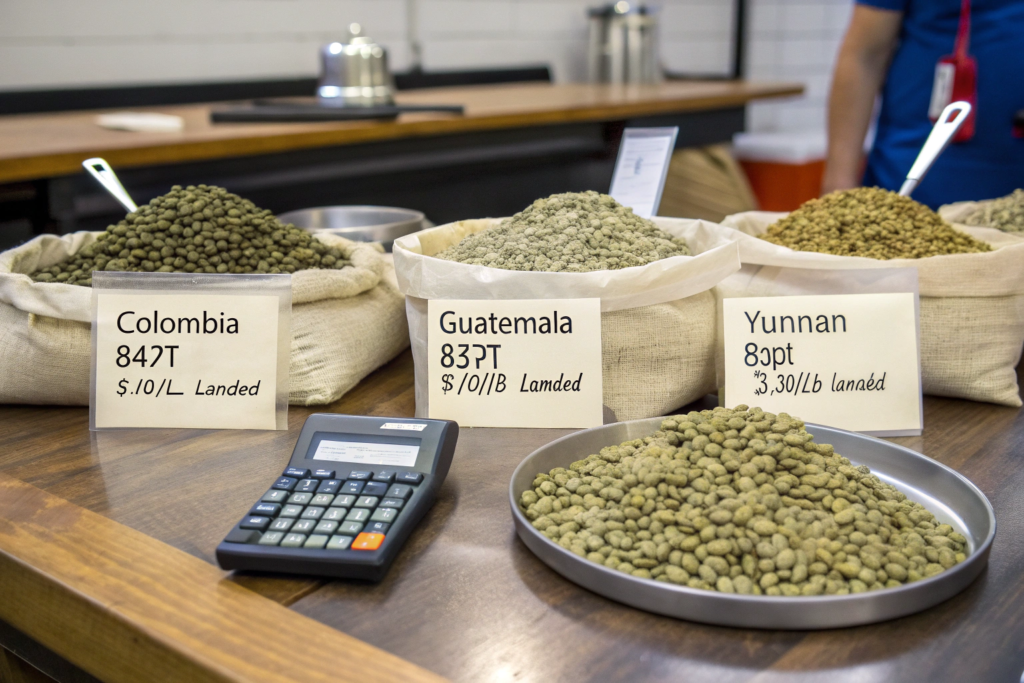
Take three common blend components and their approximate mid-2026 landed costs to a US West Coast port: Brazilian Santos 17/18 at $3.10/lb, Colombian Excelso 84-point at $4.10/lb, and Yunnan Catimor 85-point at $3.30/lb. Now build two hypothetical blends. Blend A: 60% Brazil, 30% Colombia, 10% Robusta. Weighted cost: $3.49/lb. Blend B: 60% Brazil, 30% Yunnan, 10% Robusta. Weighted cost: $3.25/lb. The Yunnan substitution saves $0.24 per pound. On a 40,000-pound annual blend volume, that's $9,600. Now, does Blend B taste worse than Blend A? In blind cupping, I'd argue it might taste better. The Yunnan's malic acidity is brighter and more defined than the Colombian's mild nuttiness. The blend has more lift, more clarity. You're saving money and potentially improving the cup. The key is to cup both blends side by side with your team. Run them through your espresso machine with milk. Do a triangle test with your best customers. Let the data—not the origin bias—guide the decision. If Blend B wins, or even ties, the financial case is closed. At BeanofCoffee, I'm happy to provide blend samples pre-mixed to your target ratios so you can test before you commit. The SCA blend development resources offer frameworks for systematic blend testing.
Does the Lower Price Reflect Lower Quality or Market Inefficiency?
This is the central question that every skeptical buyer asks. Is Chinese coffee cheaper because it's worse, or because the market is inefficient? The answer is: the market is inefficient. The quality is there. The price hasn't caught up.
Market inefficiency in coffee origins happens when a region's quality improves faster than its reputation. Buyers still associate the origin with old, lower-quality standards. They apply a mental discount. They offer lower prices than the cup quality warrants. The farmers, lacking alternative buyers, accept those prices. The cycle perpetuates itself—until enough adventurous roasters cup the coffee blind, discover the quality, and start paying fair prices. That's exactly the phase Yunnan is in right now. Five years ago, Vietnamese Arabica was in a similar position—improving quality, lagging reputation. Today, top Vietnamese Arabica commands prices much closer to its quality level. The window of underpricing is temporary. Yunnan's cost structure is genuinely lower than Colombia's in some respects—labor rates in rural China are moderate compared to some Latin American countries, and the efficiency of China's port and logistics infrastructure reduces hidden costs. But the primary driver of the price gap is not cost structure. It's reputation lag. The coffee cups at 85. It's priced like an 83. That's a market failure, not a quality failure. And it's an opportunity for buyers who cup with their palates, not their preconceptions. The ICO coffee market reports document the price differentials between origins. Yunnan's differentials are rising, but they remain below comparable origins.
How to Integrate Chinese Arabica into Your Existing Blend Portfolio?
Adding a new origin to your blend program isn't just a purchasing decision. It's a creative and operational decision. You need to integrate the new coffee into your existing blends in a way that maintains or improves cup quality, manages inventory, and, ideally, tells a story your customers will embrace.
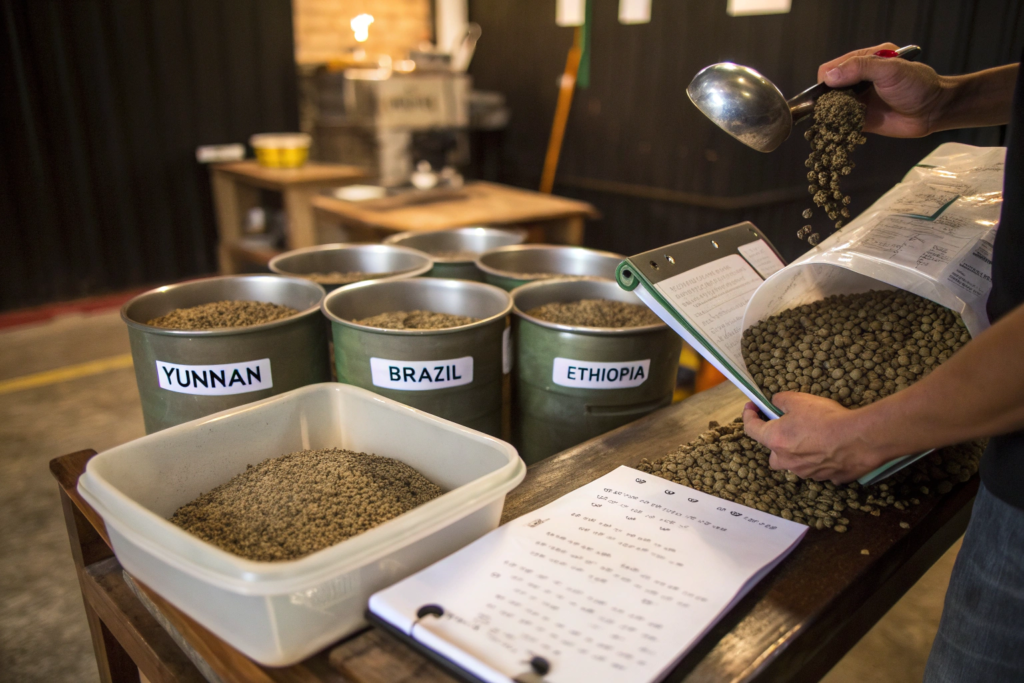
Integrating Chinese Arabica into your blend portfolio is best approached as a substitution, not an addition. Identify the blend component that Yunnan's flavor profile most closely matches—typically a washed Central American coffee providing acidity and structure. Replace 50-100% of that component with Yunnan Catimor. Run a blind cupping and espresso extraction comparison. Adjust the roast profile if needed. Then introduce the change to customers as an improvement, not a cost-cutting move.
Start small. Take your best-selling blend and order a sample quantity of Yunnan Catimor that matches the component you're considering replacing. Roast both versions of the blend on the same roast profile. Cup them side by side, blind. Pull espresso shots. Do milk tests. Let your staff taste without knowing which is which. If the Yunnan version ties or wins, you have a business case. If it loses, ask why. Is the acidity too bright? Could a slightly darker roast on the Yunnan component balance it? Is the body too light? Could you increase the Yunnan percentage and decrease a heavier-bodied component? The roast profile might need adjustment. Yunnan Catimor is denser than some Central American coffees. It may need a slightly higher charge temperature or a longer development time. Run a few roast experiments before finalizing. From a marketing perspective, introducing Yunnan as a blend component can be a story. "We've sourced a new origin for our house blend—Yunnan, China. This high-altitude Arabica adds a crisp, clean brightness we've been chasing for years." Frame it as an upgrade, not a cost reduction. Even though the cost reduction is a nice bonus, the customer should feel they're getting a better product, not a cheaper one. At BeanofCoffee, we support roasters through this transition with sample roasts, blend consultation, and marketing materials.
What Roast Adjustments Are Needed for Yunnan Catimor?
Catimor beans from high-altitude Yunnan have a specific density and moisture profile that affects how they behave in the roaster. Understanding these characteristics helps you get the best out of the bean and avoid common roasting pitfalls.
Yunnan Catimor is denser than a typical Brazilian Arabica and slightly denser than many Colombian lots. Higher density means the bean requires more thermal energy to heat through. The charge temperature should be slightly higher than you'd use for a lower-density coffee. The drying phase (yellowing) may take 30-60 seconds longer. Be patient. Don't rush the bean with high gas at the start, or you'll scorch the outside while the inside stays underdeveloped. The Maillard phase—the browning stage—is where Yunnan Catimor develops its brown sugar and caramel sweetness. Allow sufficient time here. A rushed Maillard phase produces a grassy, underdeveloped cup. A well-managed Maillard phase brings out the sweetness that balances the malic acidity. First crack tends to be slightly later and more vigorous than with a lower-density bean. The development time after first crack should be tailored to your target roast level. For a light roast single-origin, 60-90 seconds of development preserves the apple-like acidity. For a medium roast blend component, 90-120 seconds brings out more chocolate and caramel while retaining some brightness. For a dark roast, the Catimor takes the heat well and doesn't develop the ashy, carbonized notes that some coffees do when pushed. The bean size is uniform (Screen 17/18), which means even roasting. You won't see the small-bean scorch/large-bean underdevelopment problem that plagues less-sorted lots. The Roasters Guild resources provide detailed guidance on adjusting roast profiles for different bean densities and varietals.
How to Market a Blend Containing Chinese Coffee?
The marketing strategy for a Chinese coffee blend depends on your brand positioning and your customer base. There are generally three approaches: the transparent feature, the quiet substitution, and the discovery story.
The transparent feature works best for specialty roasters with an educated, curious customer base. You label the blend with its origin components, including "Yunnan, China." You train your baristas to tell the story: "Our house espresso includes a high-altitude Arabica from Yunnan, China—the same mountains that grow world-famous tea. It adds a crisp, apple-like brightness you won't find in a typical espresso blend." This approach turns the origin into an asset, a point of differentiation. The quiet substitution works for commercial roasters whose customers are more focused on taste consistency than origin stories. You swap the Colombian component for Yunnan, you keep the blend name and packaging, and you don't make a big announcement. The blend tastes the same or better. The customer doesn't know or care about the origin of each component. This is valid—you're not misleading anyone. You're just not leading with the origin change. The discovery story is a middle path. You introduce a limited-time "Yunnan Discovery Blend" as a seasonal offering. You build excitement around the new origin. You collect customer feedback. If it's positive, you roll it into your permanent lineup. This de-risks the transition and creates a marketing event. Whichever approach you choose, the key is to lead with taste. Never market Chinese coffee as "cheap" or "value." Market it as "crisp," "clean," "bright," "tea-like"—quality descriptors that position it as a premium choice. At BeanofCoffee, we provide origin photos, farm stories, and cupping notes that you can use in your marketing materials.
Conclusion
Chinese coffee is not just "good enough" for specialty blends. It's a strategic ingredient that can improve your cup quality, reduce your blend cost, and give your brand a unique story. High-altitude Yunnan Catimor cups at 84-87 points, matching the quality of mid-range Colombian and Guatemalan lots. Its flavor profile—bright malic acidity, brown sugar sweetness, tea-like body—adds lift and structure to blends without dominating. Its landed cost is $0.60 to $1.00 per pound cheaper than equivalent Central American coffees, not because it's worse, but because the market hasn't caught up to the quality. That gap is closing, but it's open now. The roasters who integrate Yunnan into their blend programs today will lock in a cost and quality advantage that their competitors will envy tomorrow.
At BeanofCoffee, we produce washed Catimor from 10,000 acres in Baoshan at 1,500 meters. Our lots are Q-graded, traceable to specific terraces, and shipped direct from our farm to your roastery. We offer pre-shipment samples, blend consultation, and consistent container-volume supply.
If you want to test Yunnan Catimor in your blends, contact my export director, Cathy Cai. She'll send you a sample kit with our current harvest and help you set up a blind cupping against your current components. Email her at: cathy@beanofcoffee.com.