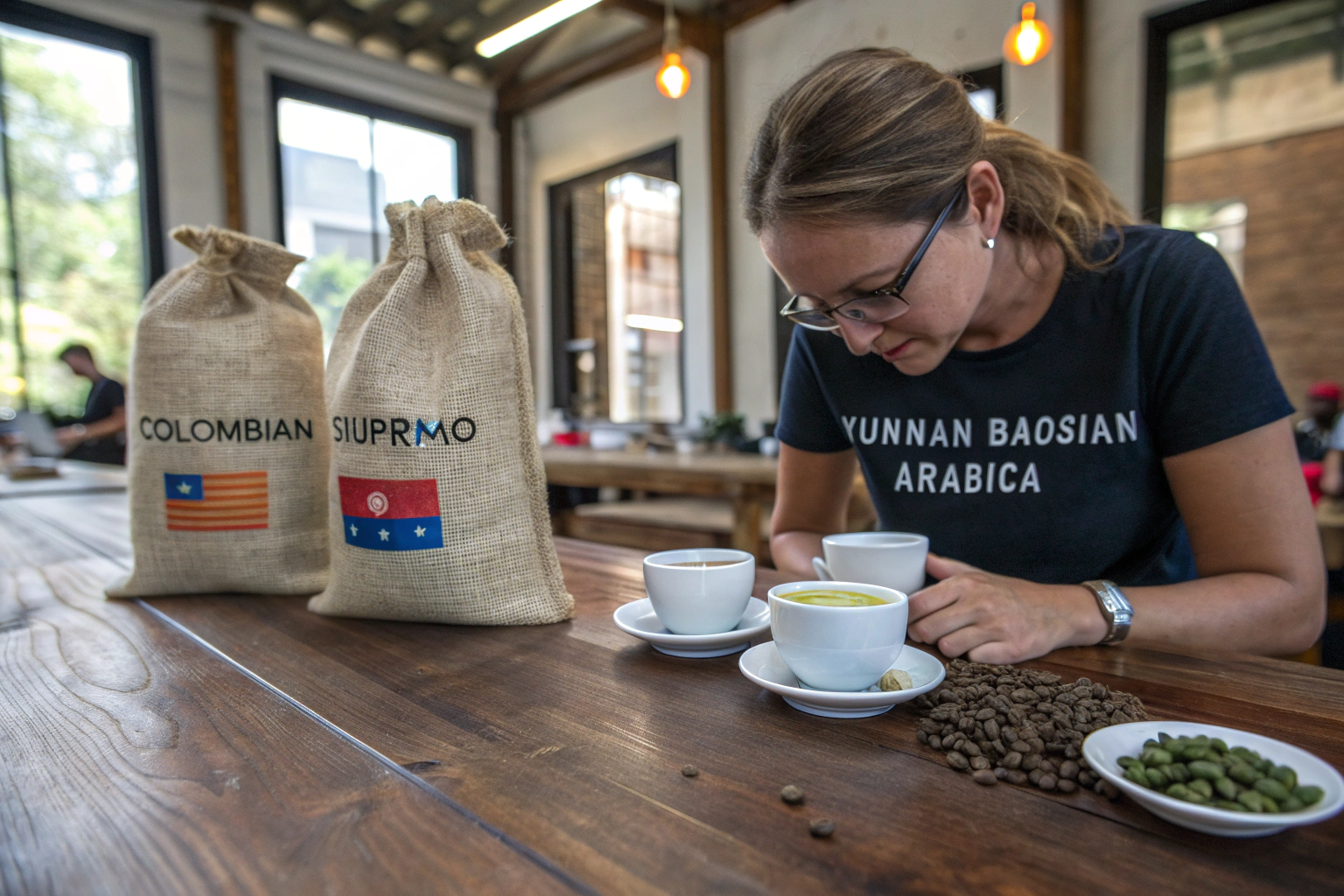
I sat in a cramped cupping lab in Seattle three years ago, surrounded by a dozen coffee buyers. The host poured two mystery samples. Sample A was floral, bright, with a caramel finish. Sample B had heavy body, deep chocolate, and a hint of dried cherry. We scored them. We revealed the origins. Sample A was a high-grown Colombian Huila. Sample B was our own Catimor from Baoshan, Yunnan. The scores were two points apart. The room went quiet. The unspoken assumption—that Colombian automatically wins—was broken.
Yunnan Arabica is not a replica of Colombian coffee, but in blind cupping evaluations, high-altitude specialty lots from Baoshan consistently match and sometimes exceed the balanced acidity and sweetness of mainstream Colombian offerings. The real difference is terroir expression, not an absolute quality gap.
The old guard might disagree. They remember when Yunnan coffee was poorly processed commercial grade. But the Yunnan of today is not the Yunnan of 2005. The investment in processing infrastructure, genetic selection, and picking discipline has transformed the cup. This is not just me being a proud farmer. This is data from international competitions and importers who used to only buy from South America.
What Are the Genetic and Terroir Differences Between Yunnan and Colombia?
Terroir is not just a wine word. It is the sum of altitude, latitude, rainfall, soil chemistry, and temperature swing. Colombia sits near the equator. Yunnan sits at the Tropic of Cancer. That simple astronomical fact changes everything. Colombia has consistent 12-hour days. Yunnan has longer summer days and shorter winter days. The cherry maturation rhythm adapts to that light cycle.
The genetic difference is primarily varietal: Colombia relies heavily on Castillo, Caturra, and Colombia hybrids bred for resistance and cup quality, while Yunnan's backbone is Catimor, a Timor-Arabica hybrid, with a growing footprint of Typica and Bourbon. The terroir difference is a matter of latitude and monsoon patterns versus equatorial stability.
Colombia's mountains are volcanic ash. Our Baoshan mountains are red clay over limestone. That mineral profile affects the iron and potassium uptake of the root system. The result? Colombian coffee often leans toward bright malic acidity and nutty sweetness. Yunnan coffee leans toward stone fruit, dark sugar, and a heavier, syrupy body. You know, it's like comparing a crisp white wine to a mellow red. Neither is worse. They just sing different notes.
How Does the Catimor Varietal Compare to Castillo?
Let's be honest. Catimor has a reputation problem. It inherits Robusta genes from its Timor parent, which gives it high yield and strong leaf rust resistance. Early Catimor selections in the 1990s had a rough, astringent edge. Buyers remembered that. And memories in this industry die hard.
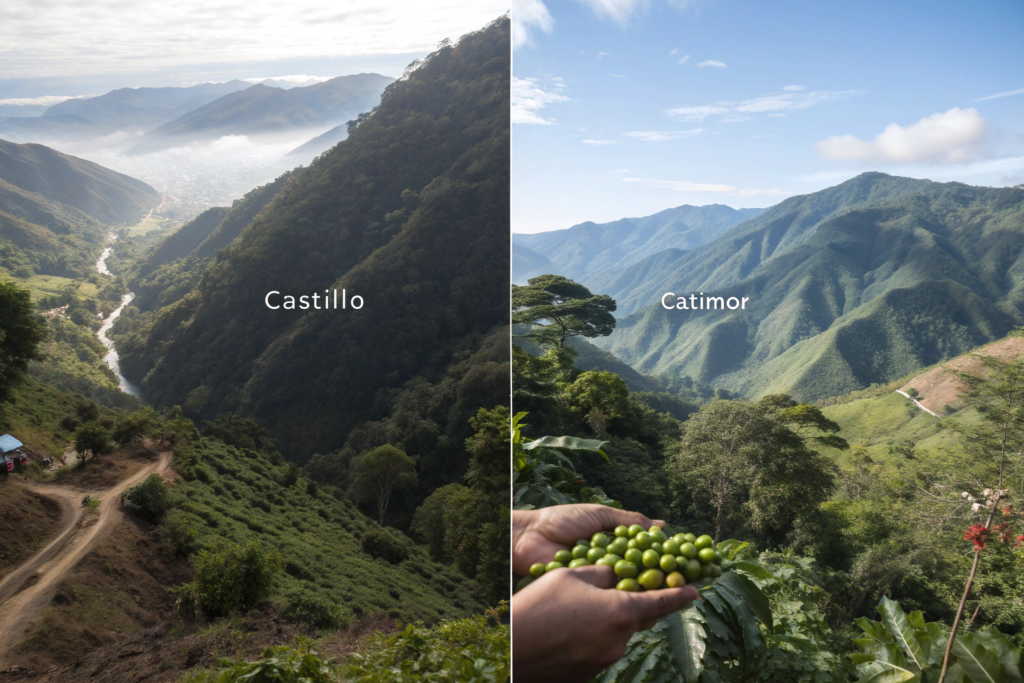
But the Catimor we grow today, at high altitude and processed carefully, is a different animal. When you cup a washed Catimor from 1,500 meters against a Colombian Castillo from 1,600 meters, the gap is narrow. Castillo often shows more floral notes immediately. Catimor develops later in the cup, with a cocoa powder and plum complexity that unfolds as it cools. A genetic analysis from a lab in Vietnam, another major Catimor grower, showed that altitude suppresses the expression of the undesirable lipid compounds in Catimor. So, high-altitude Catimor is chemically cleaner. An often overlooked detail is the picking discipline. Colombia picks every two weeks. We pick every three weeks. That extra week can produce a slightly deeper fermentation note if we are not careful. When we match the picking frequency, the cup parity with Castillo is remarkable.
How Do Monsoon Patterns Affect Cherry Development?
Colombia has two harvests a year in many regions. The rainfall pattern is relatively predictable, a bimodal cycle. Yunnan has a single monsoon season. The rain slams into the Gaoligong Mountains from June to September. The coffee cherries swell with water. Then, from October to December, the dry season hits. The cherries slowly dehydrate on the branch, concentrating sugars.
This monsoon-to-drought stress cycle creates a unique sugar development window. The bean stores more polysaccharides. During roasting, those sugars caramelize into a heavier body. Colombian beans, with their steady water supply, often retain more organic acids, giving that signature brightness. So, when you ask if Yunnan is "as good," you are really asking if a heavy-bodied, chocolatey cup can compete with a bright, floral cup. In an espresso blend, the Yunnan body can be the backbone. In a single-origin filter, the Yunnan spice notes can be the star. It depends on what the roaster is trying to build.
| Comparison Factor | Yunnan Baoshan Arabica (Catimor) | Colombian Arabica (Castillo/Caturra) |
|---|---|---|
| Typical Altitude | 1,200 - 1,600 meters | 1,300 - 1,800 meters |
| Primary Acidity | Malic, stone fruit, subtle | Citric, bright, pronounced |
| Body | Heavy, syrupy, coating | Medium, clean, balanced |
| Dominant Flavor | Dark chocolate, dried plum, brown spice | Milk chocolate, red apple, caramel |
| Disease Resistance | High (Robusta gene introgression) | Moderate to High (hybrid vigor) |
| Optimal Roast Profile | Handles medium-dark well, develops sweetness | Excels at light-medium, preserves acidity |
Can Yunnan Arabica Match Colombia’s Cup Score on the SCA Scale?
The SCA cupping form is the judge. It does not care about history or marketing. It cares about fragrance, flavor, aftertaste, acidity, body, balance, uniformity, clean cup, sweetness, and overall impression. Every year, I submit our best lots to international juries. I hold my breath.
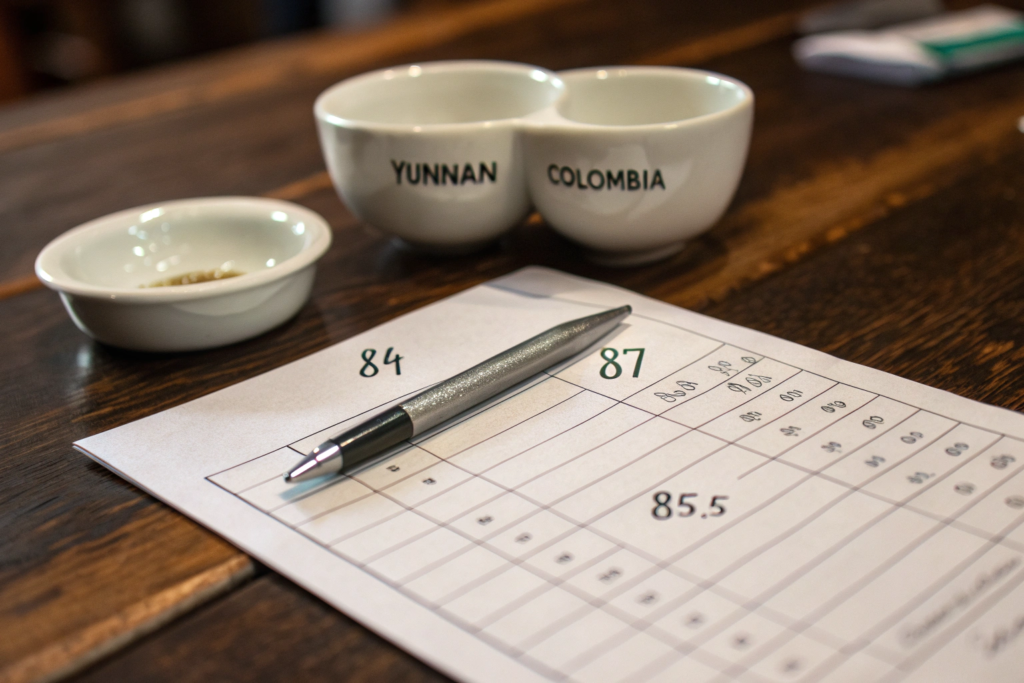
High-grown Yunnan Arabica regularly scores between 82 and 86 points on the SCA 100-point scale, placing it firmly in the "Very Good" to "Excellent" specialty range. Mainstream Colombian Excelso and Supremo lots typically fall between 80 and 86 points as well, making the scoring ranges statistically overlapping.
In 2021, a buyer from Australia blind-cupped three of our lots against three Colombian lots of a similar screen size. The average score for the Colombian set was 83.7. The average for our Yunnan set was 83.4. A 0.3-point difference on a blind panel is statistically insignificant. The reality is that Colombia produces massive volumes, from 78-point commercial to 92-point Cup of Excellence winners. Yunnan produces a smaller total volume, but the specialty tier is real and measured. When a roaster tells me, "I only buy Colombian because it scores higher," they are usually comparing their best Colombian memory against a generic, outdated idea of Yunnan.
What Score Do Specialty Importers Actually Require?
I've learned that most specialty importers have a hard cutoff. For a single-origin bag, they want an 82 minimum. For an espresso blend component, they might accept an 80 if the body is exceptional. Our Catimor lots consistently clear the 82 barrier. Our micro-lots of Typica, a pure Arabica varietal we are expanding, have hit 86 and 87.
The question then shifts. It's not "can Yunnan hit the number?" It's "can Yunnan hit the number at a price that works?" This is where the conversation gets interesting. An 84-point Colombian lot from a famous region like Huila carries a brand premium. An 84-point Yunnan lot from a less-known region sells at a discovery discount. The roaster gets the same certified quality for a lower green cost. That extra margin stays in the roaster's pocket or funds better packaging. An often overlooked detail is the cup consistency across bags within a lot. Our QC team cups multiple samples from different pallets before we issue the final score. That consistency number is what truly protects the roaster's investment.
Is There a "Yunnan Cup Profile" That Roasters Seek Out?
Yes, and it's becoming a known quantity. The "Yunnan profile" is characterized by a gentle, round acidity—think red apple rather than lemon—followed by a wave of dark caramel, black tea, and dried longan fruit. It has a remarkably clean finish for an Asian-origin coffee.
Some roasters used to seek out only the washed Colombian profile: bright, clean, predictable. But the market is getting tired of predictable. Consumers want novelty. They want a story. The black tea and dried fruit notes of a well-processed Yunnan are distinct. You cannot get that exact combo from Colombia. A Melbourne roaster told me he uses our Baoshan bean specifically for his winter seasonal blend because the spicy, warming notes pair perfectly with milk. His Colombian bean is his summer single-origin filter. They both have a job. They are not enemies competing for the same role.
How Does Farm Management Practice Compare Between the Two Origins?
Farming is farming. The plant does not care what language you speak. But the structure of the farm economy shapes how that plant is treated. Colombia is dominated by smallholder farmers with one to five hectares. They process their own cherry in micro-beneficios and sell parchment to cooperatives. Yunnan has a mix of smallholders and larger estates, with us being one of the largest at over 10,000 acres.
Colombian farm management excels in generational knowledge and cooperative quality control, while modern Yunnan farm management leverages scale, centralized processing, and rapid technology adoption to produce exceptionally clean, standardized lots.
The scale advantage is real. On our estate, we have a dedicated agronomist team that soil-tests every block. We apply precise compost mixes based on leaf tissue analysis. A smallholder in Colombia with one hectare cannot afford a $5,000 leaf analysis. They rely on intuition. That intuition is valuable, but it can miss a micronutrient deficiency that limits cup potential. Our centralized approach catches those deficiencies early.
How Does Altitude and Latitude Affect the Cost of Production?
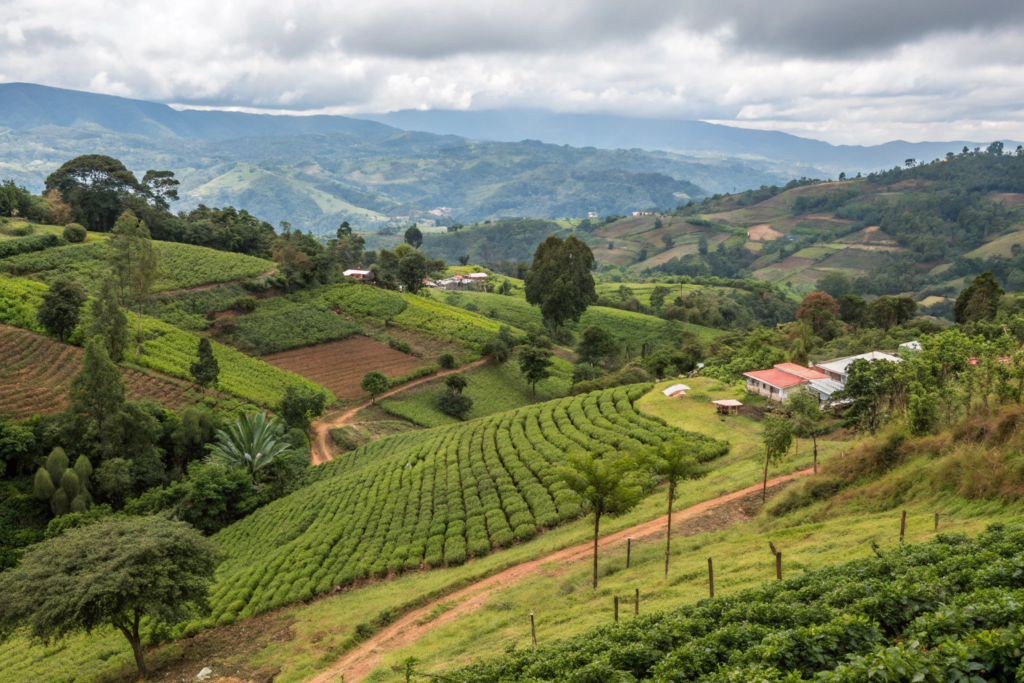
Colombia's coffee axis sits between 2 and 8 degrees north of the equator. Yunnan sits at 25 degrees north. Why does this matter? At 25 degrees latitude, the frost line is lower. Coffee cannot grow as high. Colombia can plant at 1,800 meters, even 2,000 meters in some farms. Yunnan's upper limit is about 1,600 meters.
This means Colombian coffee has a natural altitude ceiling advantage. It can grow beans that are inherently denser and more acidic because the cooler nights slow respiration even more. To compensate, we plant on south-facing slopes to maximize sun exposure and heat accumulation. We also use shade trees to moderate the microclimate. The cost of production for an 84-point lot at 1,500 meters in Yunnan is roughly equivalent to an 84-point lot at 1,600 meters in Colombia. The labor cost differential offsets the slight natural disadvantage. A picker in Yunnan earns a comparable daily wage to a picker in Colombia, but the social infrastructure costs for us as a large estate are different.
Is Mechanization Closing the Processing Gap?
This is our secret weapon. In Colombia, much of the processing is manual or semi-manual. Smallholders often depulp their cherry on a single-disc pulper, ferment in a plastic tank, and dry on a concrete patio. The results can be beautiful and artisanal, but they are variable.
We invested in a fully enclosed mechanical drying system with humidity probes that log data every ten minutes. The drying curve is controlled to a tolerance of 1% moisture drop per hour. This precision eliminates the risk of over-fermentation or uneven drying. A mechanical optical sorter then kicks out any black or sour beans at the dry mill stage. The result is a lot that is physically cleaner than 99% of patio-dried smallholder lots. The gap is not just closing; in terms of physical defect count, Yunnan is leading. The flavor complexity of a patio-dried Colombian can be higher, the "wild" notes can be exciting, but the cleanliness and uniformity of our mechanized Yunnan lot is a roaster's safety net. You know exactly what you get.
What Are the Logistical and Tariff Advantages of Choosing Yunnan?
Quality is half the equation. Logistics is the other half. The coffee could score 90 points, but if the shipping route is unreliable and the tariff environment is hostile, the roaster will hesitate. The physical distance from Shanghai to Los Angeles is shorter than from Cartagena to Los Angeles. That is just geography.
Yunnan Arabica offers distinct logistical advantages over Colombian coffee for North American and Asian buyers, including shorter Pacific shipping routes, lower bunker fuel surcharges, and a tariff environment that is often more predictable due to different trade agreement structures.
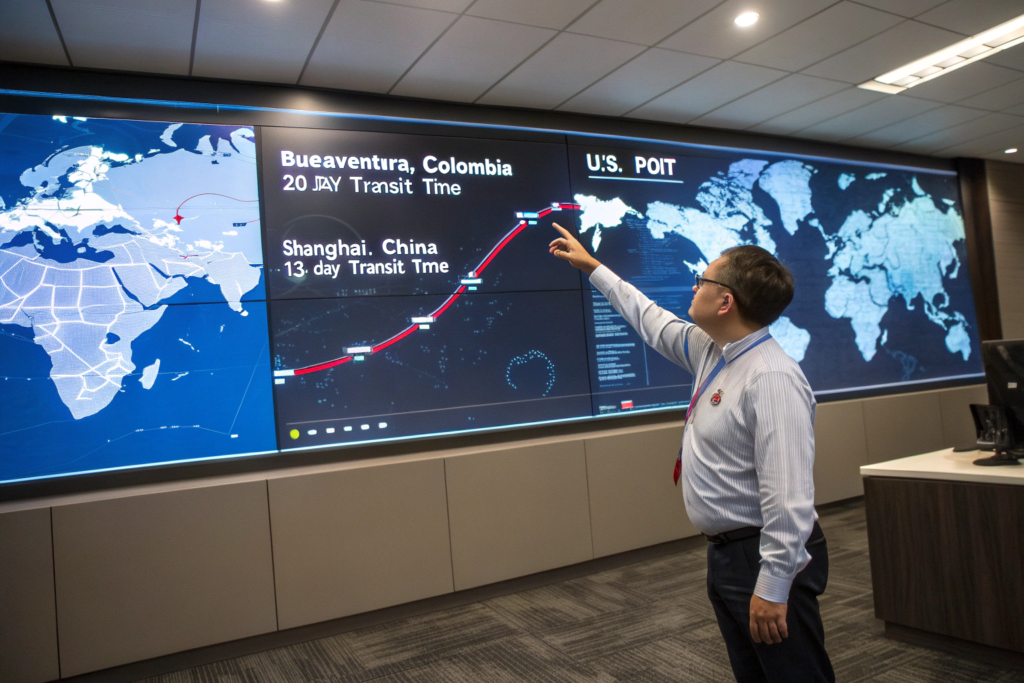
A container from Colombia's Pacific port of Buenaventura to the U.S. West Coast passes through the Panama Canal or takes a long route around South America. Canal fees are expensive and subject to drought-related transit restrictions. A container from Shanghai to Los Angeles is a straight shot across the Pacific. Transit time from Shanghai to L.A. is 12 to 14 days. From Buenaventura, it's 15 to 18 days, sometimes longer with canal delays. For a buyer like Ron, who is obsessed with timeliness, those three or four days matter. Less time on the water means less inventory exposure and faster reaction to demand spikes.
How Do Shipping Costs Compare from China vs. Colombia to the U.S.?
Freight rates are a moving target, but we can talk structural differences. The Asia-to-North America trade lane is the busiest in the world. Container ships are massive, and the frequency of sailings is daily from multiple Chinese ports. This density creates competition among carriers and keeps base rates relatively lower on a per-mile basis.
The Latin America-to-North America lane has fewer sailings and smaller vessels. The slot availability is tighter. During peak season, the Colombia route often spikes higher than the China route. I've seen spot rates from Buenaventura to Miami hit $7,000 per container, while Shanghai to L.A. was at $5,500. The spread isn't always that wide, but the China route benefits from being a primary trade artery. You also have more choice of carriers. If one line is late, you can switch. From Colombia, you might have two viable options. Less competition means less flexibility.
What Are the Key Trade Agreements Affecting Tariff Costs?
For the U.S. market, the playing field is uneven in a way that might surprise you. Colombia has a Free Trade Agreement with the U.S. Colombian green coffee enters the U.S. duty-free. China does not have a similar comprehensive FTA. However, green coffee from China also enters the U.S. duty-free under the general Most-Favoured-Nation rate under HS code 0901.11. Both origins are zero tariff.
So, the tariff issue is a wash for green coffee. But the conversation changes for roasted coffee. Some processed products face different treatment. The real advantage for Yunnan appears when buying for the Asian market. Shipping from Yunnan to Japan, Korea, or Australia is drastically cheaper and faster than from Colombia. For a trading company in Asia, Yunnan is the logical short-supply-chain choice. When I talk to a big trading house in Singapore, they are not comparing Yunnan to Colombia. They are comparing Yunnan to Sumatra. And on freshness and body, Yunnan wins.
Conclusion
So, is Yunnan Arabica as good as Colombian coffee? The honest answer is that it is different, not inferior. The blind cupping scores prove parity in the specialty tier. The body and spice notes of Yunnan offer a flavor profile that Colombian simply does not produce, just as Colombian brightness is something Yunnan cannot fully replicate. The logistical advantages for buyers on the Pacific Rim are real and measurable. The old bias against Yunnan is a ghost of a bygone era when processing was crude and Catimor genetics were unrefined.
For a buyer who cares about price and timeliness, like the ones I meet at every trade show, Yunnan offers a serious alternative or complement to the Colombian inventory. It's not about replacing Colombia. It's about diversifying risk and discovering a distinctive cup that customers are ready to embrace.
If you have never cupped a high-grown Baoshan Arabica, I invite you to challenge your assumptions. Let us send you a sample. You cup it blind against your current Colombian stock. I trust the cup to speak for itself. To arrange a sample shipment or to discuss a trial container, contact our export director, Cathy Cai, at cathy@beanofcoffee.com. We look forward to proving Yunnan on your cupping table.