I got a text from Ron last Tuesday. Just one line: "What's the real price right now? Not the C-market. The real price." He was staring at a spot offer from a Brazilian broker that seemed too high and a Vietnamese offer that seemed too low. He couldn't tell which one was the real market and which one was a trap. That's the frustration every roaster feels in 2026. The C-market is one number. Your actual invoice is a completely different number. The gap between them is where the confusion, and the cost, hides.
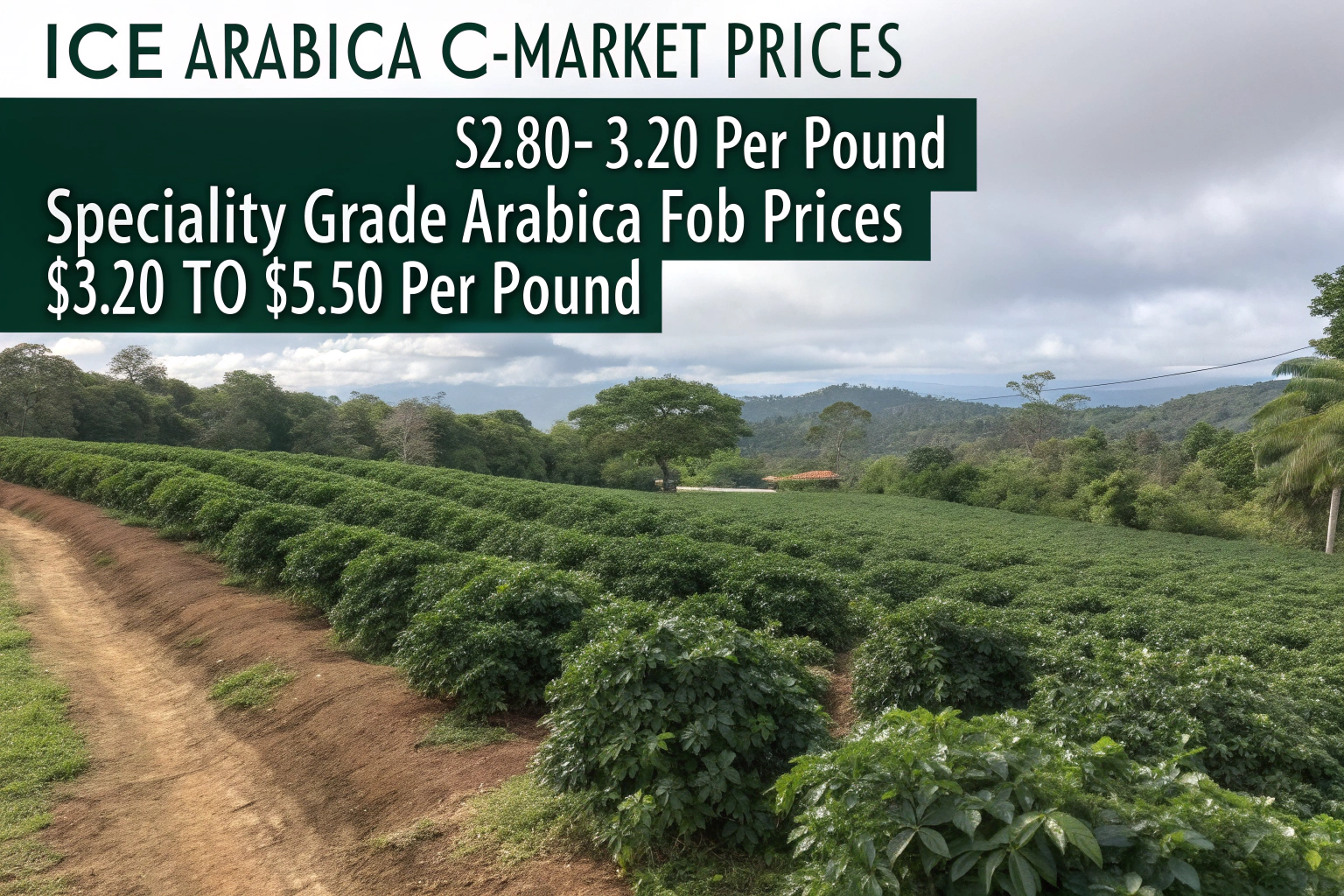
Current green coffee bean prices in mid-2026 are highly volatile, with the ICE Arabica C-market hovering around $2.80-$3.20 per pound, but actual FOB prices for specialty-grade Arabica from established origins range from $3.20 to $5.50 per pound depending on origin, cup score, and certifications. Robusta prices have surged to historically high levels, narrowing the traditional price gap with Arabica.
What do these numbers actually mean for your purchase order? They mean that the headline C-market price is just a starting point. The differential—the premium you pay above the C-price for quality, origin, and certification—has expanded significantly. A Colombian 84-point coffee might be C-plus-80-cents. A Guatemalan 86-point might be C-plus-$1.20. A Yunnan 85-point Catimor from our farm might be C-plus-40-cents. That differential is where your negotiation and your sourcing strategy matter most. I own 10,000 acres in Baoshan, Yunnan. I set prices based on my actual production cost, not on speculation. Let me walk you through the real price landscape so you can make offers with confidence and spot the deals versus the traps.
What Factors Are Influencing Green Coffee Prices in 2026?
The price you pay for green coffee in 2026 isn't driven by one factor. It's a collision of several forces, some natural, some financial, some logistical. If you only watch the C-market, you're missing most of the story. The C-market tells you what a generic, undifferentiated Arabica futures contract costs. Your coffee is not generic. It has an origin, a quality grade, a certification, and a shipping cost attached.
The main factors driving green coffee prices in 2026 are: a structural global supply deficit caused by adverse weather in Brazil and Vietnam, persistently high shipping costs due to Red Sea route disruptions, strong speculative fund activity on the ICE exchange, and rising differentials for certified and traceable lots as roasters scramble for quality supply.
Let's unpack the supply deficit first. Brazil, the world's largest Arabica producer, is in an "off-year" in its biennial production cycle. That's normal. What's not normal is the cumulative stress: a severe drought during flowering, followed by an unexpected frost scare that damaged young trees. The 2025/26 crop is significantly smaller than anticipated. Vietnam, the Robusta giant, had its own problems—too much rain during flowering, reducing cherry set, followed by a dry spell during fill. Robusta output dropped 15-20%. When both the Arabica and Robusta giants underproduce simultaneously, the global supply chain tightens dramatically. Now add shipping. Vessels are still diverting around the Cape of Good Hope to avoid the Red Sea, adding 10-14 days to transit times and consuming global container capacity. Freight rates remain elevated. Then add speculators. Hedge funds and commodity index funds have poured money into soft commodities, including coffee, as a hedge against inflation and currency volatility. Their buying pushes the C-market higher, which feeds into the physical price through the differential system. At BeanofCoffee, we're somewhat insulated from the C-market gyrations because we price on a production-cost-plus model, not strictly on the futures board. But we still compete in a global market, so these macro forces shape the negotiation. Understanding them helps you know when to lock a price and when to wait.
How Does the Brazilian Crop Cycle Affect Global Prices?
Brazil is the 800-pound gorilla of coffee. It produces roughly 40% of the world's Arabica. When Brazil has a big crop, prices fall. When Brazil has a small crop, prices rise. It's almost that simple, but the timing matters.
Coffee trees in Brazil follow a biennial cycle. One year they produce heavily. The next year, exhausted, they produce less. The "on-year" of the cycle typically depresses global prices. The "off-year" tightens supply. In 2026, we are in an off-year. But the cycle has been disrupted by climate stress. Trees that should have produced a decent off-year crop are producing even less because they didn't recover fully from the previous drought. The frost in some Arabica regions burned the leaves, reducing photosynthesis capacity. The result is that the 2026 Brazilian Arabica harvest is one of the smallest in recent years. This reverberates globally. Roasters who usually buy Brazilian Santos or Cerrado are forced to look for replacement volume from other origins—Colombia, Central America, and increasingly, Yunnan. That demand shift pushes up differentials everywhere. The Brazilian crop is so large that even in a bad year, it still fills a lot of containers. But the marginal volume that the market counted on to keep prices stable is missing. That marginal missing volume is what causes the price spikes. The USDA Foreign Agricultural Service coffee reports provide detailed production forecasts by country. Following these reports gives you a six-month lead on price trends.
Why Have Robusta Prices Spiked Alongside Arabica?
The traditional model is simple: when Arabica gets expensive, roasters blend in cheaper Robusta to manage costs. This substitution effect usually creates a price ceiling for Arabica and a floor for Robusta. In 2026, that model is broken. Robusta is expensive too.
The Vietnamese Robusta crop failure is the primary driver. Vietnam exports roughly 40% of the world's Robusta. A 15-20% production drop removes millions of bags from the global market. But demand for Robusta hasn't dropped. Instant coffee manufacturers, who are the largest Robusta buyers, still need volume. Large commercial roasters who use 30-40% Robusta in their blends still need volume. The result is a bidding war for the available Robusta. The London Robusta futures market has rallied to historic highs. The price gap between Arabica and Robusta has compressed to its narrowest level in decades. This matters for you even if you buy 100% Arabica. Why? Because the cheap Robusta escape hatch that Arabica roasters used to rely on is closed. You can't easily cut costs by adding Robusta to your blend. The Robusta you add would be expensive, and it would still be Robusta—bitter, earthy, one-dimensional. The other option is to find a cost-effective Arabica that delivers quality without the Colombian or Guatemalan premium. That's where our Yunnan Catimor comes into the conversation more and more frequently. It's a genuine Arabica, with specialty cup scores, at a price that's competitive with the blended landed cost of Arabica-plus-Robusta from other origins. The economics have shifted in our favor. The ICO Robusta price data tracks this historical price convergence.
What Is the Current Price Per Pound for Arabica by Origin?
The C-market is a benchmark for a generic, undifferentiated coffee. Your coffee is specific. It comes from a place. It has a score. It has certifications. The price you actually pay is the C-price plus a differential that reflects all of those specifics. Those differentials vary enormously by origin and by quality tier.
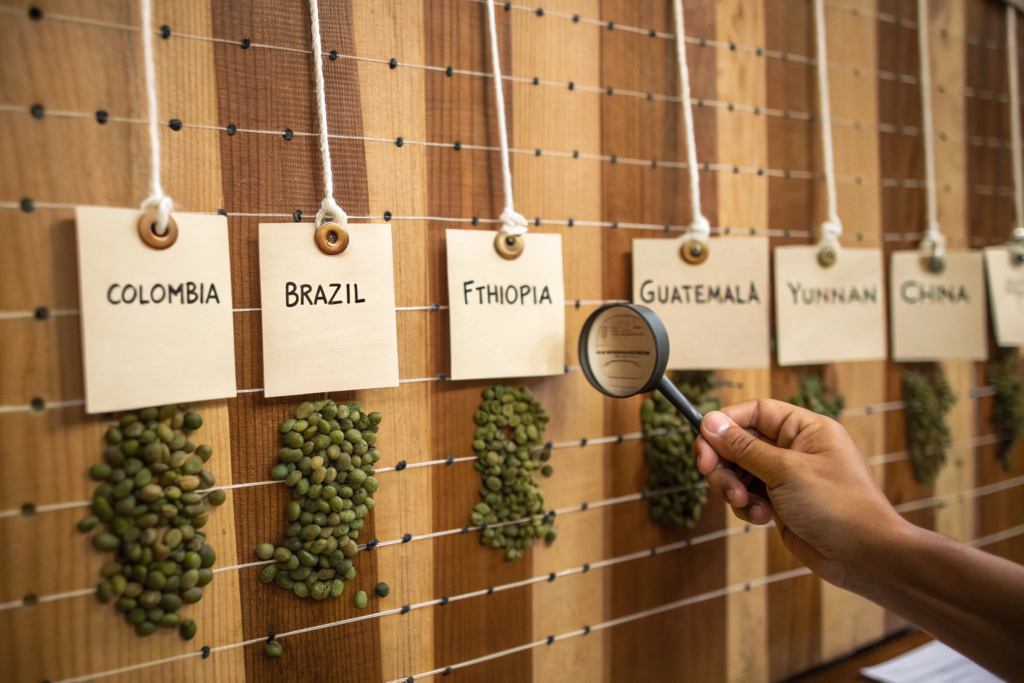
Current indicative FOB prices for washed Arabica by origin in mid-2026 are approximately: Colombian Supremo 84-point at $3.80-$4.20/lb, Guatemalan SHB 85-point at $3.60-$4.00/lb, Ethiopian Yirgacheffe Grade 1 at $3.50-$3.90/lb, Brazilian Santos 17/18 at $2.80-$3.20/lb, and Chinese Yunnan Catimor 85-point at $3.00-$3.40/lb. These are spot market ranges; contract prices can be lower.
Look at that spread. The difference between a Chinese 85-point Arabica and a Colombian 84-point Arabica is often $0.80 to $1.00 per pound. Multiply by a 42,000-pound container. That's $33,600 to $42,000 in savings. For a comparable or higher cup score. Why the gap? Colombia has a century of brand equity. Guatemala has a defined, protected origin reputation. Ethiopia has the "birthplace of coffee" narrative. China is the new entrant. The quality is there, but the brand premium hasn't been applied yet. That's the opportunity. The Brazilian price is the lowest for Arabica, but Brazilian Arabica is generally lower-altitude, softer, and less acidic. It's a blender, not a star. Our Yunnan Catimor is high-altitude, bright, and distinctive. It competes with Guatemalan and Colombian in the cup but prices closer to Brazilian. The Ethiopian price is interesting—Yirgacheffe Grade 1 is highly sought after, but Ethiopian supply chains can be fragmented and unreliable. You might pay $3.70 FOB and then wait six weeks for a container that was delayed by internal logistics issues. The true cost includes the reliability factor. At BeanofCoffee, our FOB price includes the coffee, the bagging, the container loading, and the documentation. No hidden fees. No last-minute surcharges. The price I quote is the price you pay.
What Are the Differentials for Certified Coffee (Organic, Fair Trade, Rainforest Alliance)?
Certifications add cost. They require annual audits, specialized inputs, segregated processing lines, and additional documentation. Those costs are passed through to the buyer. But certifications also add market value—consumers pay more for certified products, so roasters can justify the higher green cost.
For organic certified Arabica, the differential over conventional is typically $0.40 to $0.80 per pound, depending on origin. Organic Yunnan from our dedicated blocks carries a differential at the lower end of that range—around $0.40-$0.50 per pound. The reason is that our farm scale allows us to spread the certification cost over a larger volume. Fair Trade certification adds another $0.20-$0.30 per pound, which includes the Fair Trade minimum price and the social premium that goes directly to worker programs. Rainforest Alliance certification is generally $0.10-$0.20 per pound. If you want a triple-certified coffee—Organic, Fair Trade, Rainforest Alliance—the combined differential can be $0.80-$1.20 per pound above the conventional price. Is it worth it? For the right market, absolutely. A roaster selling to a premium supermarket chain that requires multiple certifications can pass the cost through. A cafe owner selling drip coffee to customers who don't ask about certifications probably doesn't need the triple stack. I always advise buyers to be strategic. Don't buy certifications you can't sell. Buy the certifications your customers demand and will pay for. The Fairtrade International minimum price table lists the current floor prices and premiums for each origin and product category.
How Does Screen Size and Grade Affect the Price?
Not all Arabica from a given origin is priced the same. Within a single farm's harvest, there are multiple grades and screen sizes, each with its own price tag. The larger the bean and the cleaner the grade, the higher the premium.
Screen size refers to the physical size of the green bean, measured by passing it through sieves with precisely drilled holes. A "Screen 18" bean is larger than a "Screen 16" bean. Large beans are rarer—they come from the healthiest trees and the best positions on the branch. They also roast more evenly. For these reasons, they command a premium. The jump from Screen 16 to Screen 18 can add $0.20-$0.40 per pound. The difference between a "Grade 1" and a "Grade 2" lot is about defect count. A Grade 1 Arabica allows zero primary defects in a 350-gram sample. A Grade 2 allows up to 5 full defects. The difference in cup quality between a Grade 1 and a Grade 2 from the same farm can be noticeable—a Grade 2 might have a slightly earthy or baggy note from a few sour beans or insect-damaged beans that slipped through. Grade 1 commands a premium of $0.15-$0.30 per pound over Grade 2. At BeanofCoffee, we sell primarily Grade 1, Screen 17/18 Arabica. It's our flagship export grade. We also offer an "Estate Blend" grade, which is a mix of screen sizes and allows a very low defect count. The Estate Blend scores 83-84 points versus the 85+ of our Reserve, and it's $0.40-$0.60 per pound cheaper. It's the same farm, same processing, just less rigorous sorting. For a house espresso blend, the Estate Blend is a value play that many of my customers prefer. The Green Coffee Association grading standards specify the exact defect tolerances for each grade.
Where Can You Find the Best Value Arabica in the Current Market?
Value doesn't mean cheap. Value means quality per dollar. A $3.00 per pound coffee that cups at 85 points is better value than a $2.50 coffee that cups at 80, because the cup quality difference is worth more than the $0.50 gap to the end consumer. Finding value means hunting for origins where the quality has improved faster than the market has noticed.
The best value Arabica in the current market is found in emerging origins and under-marketed regions of established origins. China's Yunnan province, producing high-altitude Catimor at 84-87 points, currently offers a 15-25% discount compared to equivalent scoring Central American coffees. This value gap exists because buyer awareness hasn't caught up to the quality improvements made over the past five years.
The value play in 2026 is specifically in origins where the infrastructure and quality systems are modern, but the brand cachet hasn't been built yet. Yunnan is the prime example. The farms are large, professionally managed, and export-ready. The processing is done to international specialty standards. The cupping scores are documented and third-party verified. But the "origin story" premium that adds $0.50-$1.00 to a Guatemalan or Colombian coffee hasn't been applied to China. That gap won't last forever. Five years ago, you could buy specialty-grade Brazilian coffee at a steep discount to Colombian because Brazil was seen as a "commodity" origin. That gap has narrowed as buyers realized that top Brazilian estates produce exceptional coffee. The same trajectory is happening with China. Another value origin to watch is India—specifically high-grown Arabica from the Western Ghats. But Indian supply chains can be less reliable than China's. The combination of quality, value, and logistics reliability is what makes Yunnan the standout value proposition in 2026.

How Do Landed Costs Compare: China vs. Colombia vs. Brazil?
FOB price is only one piece. The landed cost—what the coffee actually costs when it arrives at your roastery—includes ocean freight, insurance, port fees, customs brokerage, and trucking. These costs vary by origin because of distance, port infrastructure, and shipping lane demand.
Let's run a comparison for a 42,000-pound container to the US West Coast. Assume a Colombian 84-point coffee at $4.00/lb FOB. Ocean freight from Cartagena to Long Beach: $2,800-$3,500, adding about $0.07-$0.08/lb. Landed cost: approximately $4.10/lb. A Brazilian Santos at $3.00/lb FOB. Ocean freight from Santos to Long Beach: $3,000-$3,800, adding about $0.07-$0.09/lb. Landed cost: $3.09/lb. A Yunnan Catimor 85-point at $3.20/lb FOB. Ocean freight from Shenzhen to Long Beach: $2,500-$3,200, adding about $0.06-$0.08/lb. Landed cost: $3.28/lb. The Chinese coffee lands at roughly $0.80/lb cheaper than the Colombian and only $0.19/lb more than the Brazilian. But the Chinese coffee is 85 points, the Colombian is 84, the Brazilian is maybe 82. The quality-adjusted value clearly favors the Chinese lot. Now, if you're on the US East Coast, the math shifts slightly. Freight from Brazil to Newark is cheaper than from China. But the quality gap remains. The lesson: don't just compare FOB prices. Run the full landed cost calculation for your specific port. Factor in your expected cup quality. Then decide. At BeanofCoffee, I provide a landed cost estimate for your specific port as part of every quote. Transparency on costs builds trust.
Can Long-Term Contracts Secure Below-Market Pricing?
Yes, and this is one of the most powerful tools available to roasters who want price stability. A long-term contract isn't just a piece of paper. It's a partnership that aligns the interests of the farmer and the buyer over multiple harvest cycles. In a volatile market, this alignment is worth real money.
The structure I offer to long-term partners is a fixed differential contract with a price cap. The differential—the premium above the C-market—is fixed for the contract period, usually 12 months. If the C-market drops, your price drops. If the C-market spikes, your price is capped at a mutually agreed ceiling. In return, you commit to a minimum volume, say three containers over the year. This arrangement benefits both sides. I get guaranteed volume, which allows me to plan my planting, allocate specific blocks to specific buyers, and secure financing at better rates. You get price protection and a guaranteed supply of quality coffee, even when the spot market is chaotic and containers are scarce. A long-term contract partner gets allocation priority. When a frost hits Brazil and everyone rushes the spot market, my contract holders get their containers loaded first. The spot buyers might wait an extra three weeks or pay a higher price. The contract price is typically 5-10% below the prevailing spot differential because I factor in the value of the guaranteed relationship. You're not just buying coffee. You're buying security. And in a market as volatile as 2026, that security has a price tag—a price you avoid by contracting early. The Specialty Coffee Association contract templates provide guidance on structuring these agreements fairly.
How to Navigate Price Negotiations with Chinese Coffee Suppliers?
Negotiating with a Chinese coffee supplier isn't a bazaar haggling session. The old stereotypes of aggressive bargaining don't apply to the modern specialty coffee sector. Serious suppliers are looking for long-term, mutually profitable relationships. The negotiation is about finding the right price for the right volume over the right timeline. It's a conversation, not a confrontation.
Effective price negotiation with Chinese coffee suppliers requires leading with volume commitment and relationship intent, not with a demand for the lowest possible price. Be transparent about your budget and quality requirements. Ask for a fixed differential contract. Discuss payment terms. And always cup the sample before negotiating the final number—quality sets the price floor.
The biggest mistake a buyer can make is opening with "What's your best price?" without providing context. It signals that you're price-shopping and will likely leave after one container. A better opening is: "We're looking for a long-term partner for our house espresso blend. We need roughly three containers a year, 85-point minimum, delivered CIF to Oakland. What can you offer on a 12-month contract?" That tells me you're serious. You've thought about volume, quality, logistics, and timeline. I'll give you my sharpest number because the lifetime value of the relationship is high. The other key is to negotiate on the differential, not the absolute price. The C-market moves daily. Fixing an absolute price today for delivery in three months exposes both sides to market risk. Instead, agree on the differential: "We'll pay C-plus-35-cents, capped at a total price of $3.60/lb." That structure is fair in both rising and falling markets. At BeanofCoffee, I'm open to this structure because it aligns our incentives. If the market drops, you benefit. If it spikes, you're protected. I'm protected by the volume commitment. Payment terms are also negotiable. Standard is 30/70 T/T. For a strong buyer with a track record, I might offer 20/80 or even open account after a few successful transactions. The relationship evolves. The initial negotiation sets the tone. The subsequent transactions prove the trust.

What Is a Fair Differential for Yunnan Arabica in 2026?
The differential is the premium you pay above the C-market price for a specific coffee. It reflects quality, origin, processing, and certification. For Yunnan Arabica, the differential is still lower than for established specialty origins, but it's rising as awareness grows.
In 2026, a fair differential for a Grade 1, washed, Screen 17/18 Yunnan Catimor cupping at 84-85 points is roughly +35 to +50 cents over the C-market. For a premium microlot cupping at 86-87 points, the differential might be +60 to +80 cents. For certified organic, add another +40 to +50 cents. Compare this to a Colombian Excelso 84-point at +70 to +90 cents, or a Guatemalan SHB 85-point at +80 to +$1.10. The Yunnan differential is lower because the origin doesn't yet have the demand pull that Colombia or Guatemala have. Fewer buyers are competing for the lots. That lower competition translates to a lower price for you. The differential is also negotiable based on volume and contract length. A single container on spot might be +50. A three-container annual contract might be +40. A five-container contract with a 30% upfront payment might be +35. The more commitment you bring, the sharper the differential I can offer. I'm transparent about this math with my buyers. The C-market settlement price is public. The differential is our negotiation. A fair differential is one where I cover my production cost and earn a reasonable margin, and you get a quality coffee at a landed cost that works for your business. It's not zero-sum.
How to Verify That the Price Matches the Quality?
The sample is the ultimate verification. A price quote means nothing unless the coffee in the bag matches the spec on the paper. You need to cup the pre-shipment sample, and you need to check the physical characteristics of the green beans.
Before you agree to a price, ask for a representative sample. Not a "selected sample" of the best beans. A true composite sample drawn from the lot you would actually receive. Cupping it yourself is best. Hiring a third-party Q-grader is second best. The cupping score should match the supplier's claim. If you're paying for an 85-point coffee, the sample should cup at 85 points. If it cups at 83, either the price needs to drop, or you need a different lot. The physical check is equally important. Measure the moisture content. It should be 10-12%. Measure the water activity. It should be 0.53-0.60. Check the screen size. Are the beans uniform? Check the defect count. A Grade 1 should have zero primary defects in a 350-gram sample. If the physicals are off—if there are insect holes, sour beans, or moisture above 12%—the coffee won't hold up in transit or roast properly. The price might be low for a reason. Cheap coffee that arrives defective isn't cheap. It's a total loss. I encourage all my buyers to have the pre-shipment sample tested independently before making the final payment. It protects them and it protects my reputation. A good supplier welcomes this scrutiny. A supplier who resists it is hiding something. The CQI sample protocols provide a standardized methodology for drawing and testing samples.
Conclusion
The current green coffee price landscape in 2026 is defined by a structural supply deficit, high shipping costs, and volatile C-market speculation. Colombian and Guatemalan specialty Arabica have pushed past $4.00/lb FOB. Robusta, historically the cheap alternative, has spiked to record highs, closing the price gap with Arabica. In this environment, value is found not in chasing the lowest nominal price, but in identifying origins where quality is high and the brand premium is still low. Yunnan, China, is that origin. Our washed, high-altitude Catimor is cupping 84-87 points, with a differential 30-50% lower than equivalent Central American lots. The landed cost advantage is real, the logistics are reliable, and the quality is verified by third-party cuppers.
The window on this value gap will close as more roasters discover Yunnan. Prices will adjust as demand increases. That's how markets work. The buyers who contract now, at current differentials, will lock in a cost advantage that their competitors won't have.
If you want a specific quote for your target quality and volume, or if you want to receive a pre-shipment sample to cup yourself, contact my export director, Cathy Cai. She'll prepare a detailed offer including FOB and estimated landed cost for your port. Email her at: cathy@beanofcoffee.com.