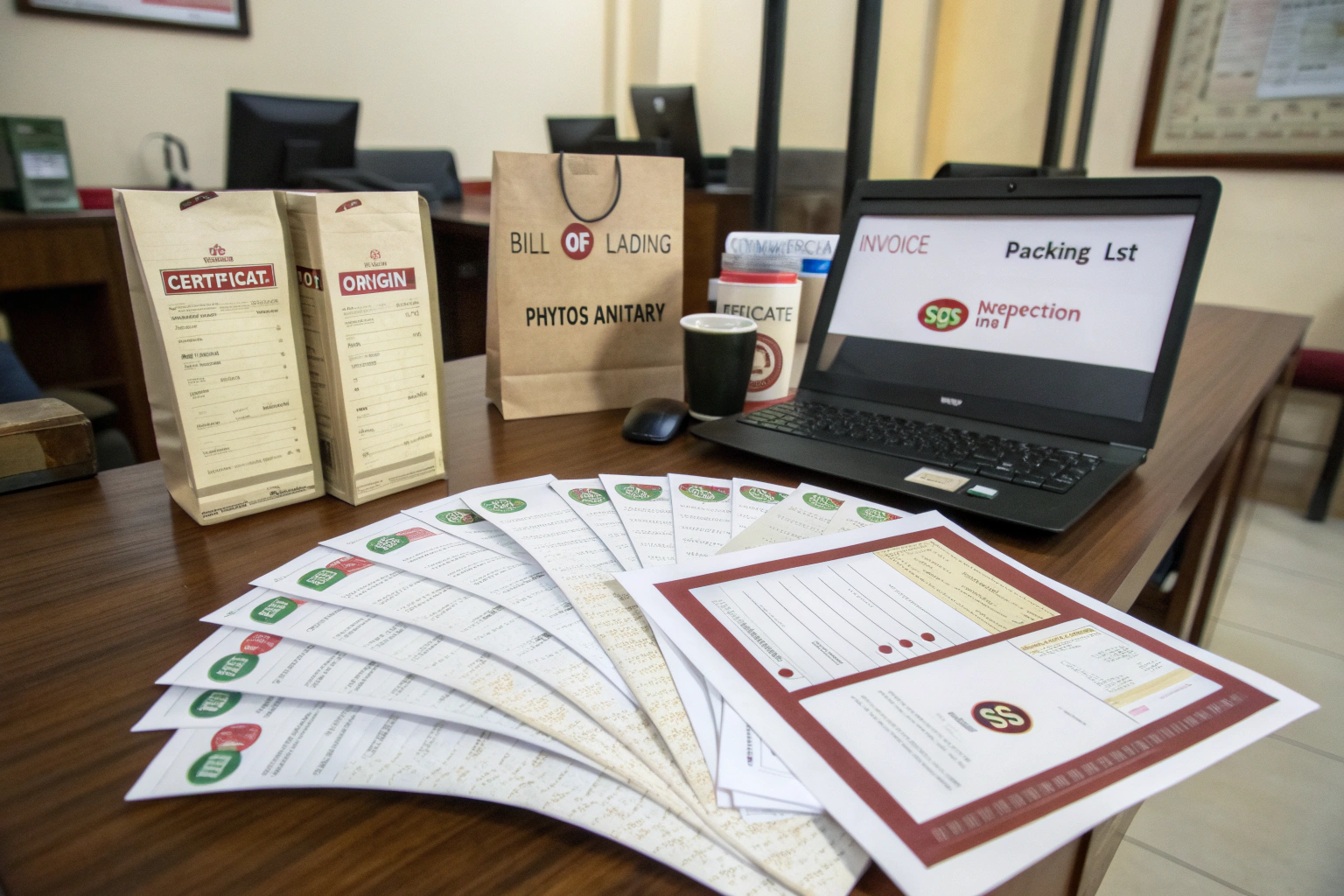
I received a frantic call from a buyer in Vancouver three years ago. His container of our Baoshan Arabica had arrived at the port of Vancouver, but customs would not release it. The reason? The phytosanitary certificate had a one-digit typo in the container number. One digit. The entire container sat in the port for five days while we scrambled to issue a corrected certificate and courier it to his customs broker. He paid $750 in demurrage fees. I paid the courier cost. We both learned a lesson. A single document error can cost more than the coffee profit on the shipment.
The key export documents for international coffee shipments are the Bill of Lading, which serves as the contract of carriage and proof of ownership, the Commercial Invoice and Packing List, which declare the value and contents of the shipment, the Certificate of Origin, which determines tariff treatment, the Phytosanitary Certificate, which confirms the coffee is free of pests and diseases, the Fumigation Certificate, which certifies pest treatment, and the Insurance Certificate, which covers loss or damage during transit.
Each document has a specific legal function. Each is checked by a different party in the supply chain. The shipping line checks the Bill of Lading. Customs checks the Commercial Invoice and Certificate of Origin. The food safety authority checks the Phytosanitary Certificate. The bank checks all of them if a Letter of Credit is involved. Missing or incorrect documents are not a paperwork inconvenience. They are a barrier to the coffee entering the destination country.
What Is the Bill of Lading and Why Is It the Most Critical Document?
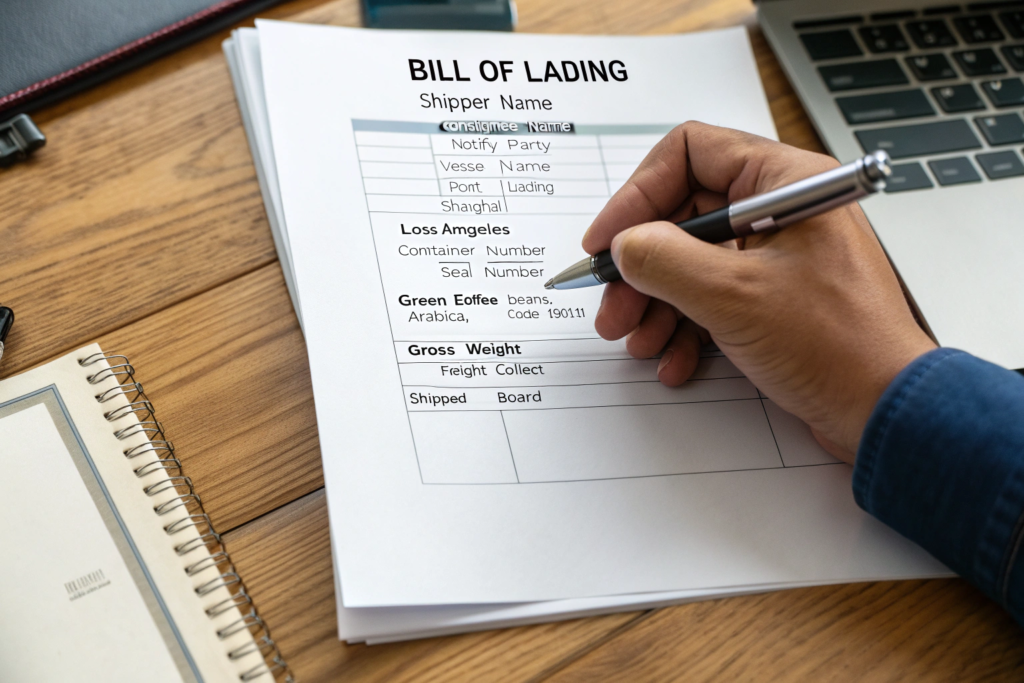
The Bill of Lading is the king of shipping documents. It performs three functions simultaneously. It is a receipt issued by the shipping line confirming that the cargo has been received in good condition. It is a contract of carriage, setting out the terms under which the goods will be transported. And most importantly, it is a document of title, meaning the legal owner of the original Bill of Lading is the legal owner of the goods.
The Bill of Lading is the most critical coffee export document because it is a negotiable document of title. Whoever holds the original, properly endorsed Bill of Lading owns the coffee. Without it, the buyer cannot take delivery of the container at the destination port. It must be accurately completed with the correct shipper, consignee, notify party, port of discharge, container number, seal number, and cargo description.
There are different types of Bills of Lading. A "Shipped On Board" Bill of Lading confirms the container is actually on the ship. A "Received for Shipment" Bill of Lading only confirms the container was received at the port. Banks financing coffee transactions typically require a Shipped On Board Bill of Lading. The Bill of Lading also indicates freight terms. "Freight Prepaid" means the shipper paid the ocean freight. "Freight Collect" means the consignee pays at destination. These terms must match the sales contract.
How Does the Bill of Lading Function as a Document of Title?
The document of title function is what makes the Bill of Lading powerful and dangerous. An original Bill of Lading is a negotiable instrument. Possession of the document is possession of the goods. When a coffee buyer pays for a shipment, the exporter endorses the original Bill of Lading and releases it to the buyer. The buyer then presents it to the shipping line at the destination to take delivery.
If the Bill of Lading is lost, the process of obtaining delivery becomes complex and expensive. The buyer must provide a bank guarantee to indemnify the shipping line against any future claim. This guarantee costs money and takes time. If the Bill of Lading is consigned "To Order," it can be bought and sold while the coffee is on the water. This is how coffee is traded during transit. The document of title function is the mechanism that enables trade finance and interim trading.
What Are the Key Data Fields That Must Be Accurate?
Every field on the Bill of Lading matters, but some matter more than others. The shipper field must match the exporter's legal name exactly as it appears on the export license. The consignee field determines who can take delivery. A mistake here diverts the container to the wrong party.
The notify party is the person or company the shipping line contacts when the cargo arrives. If this is wrong, the buyer does not receive the arrival notice and the container sits at the port accumulating demurrage. The container number and seal number must be exact. Customs systems match these numbers against the manifest. A mismatch triggers a hold. The cargo description must be consistent with the Commercial Invoice, the Packing List, and the Certificate of Origin. "Green Coffee Beans" on one document and "Coffee Beans, Not Roasted" on another is a discrepancy that can delay clearance.
What Commercial Documents Are Required for Customs Clearance?
Customs clearance is a documentary process. The customs officer in the destination country does not see or taste the coffee. They see the paperwork. If the paperwork is correct and consistent, the coffee clears. If the paperwork has errors or omissions, the coffee sits.
The essential commercial documents for coffee customs clearance are the Commercial Invoice, which declares the value of the goods and is the basis for customs valuation, the Packing List, which details the container's contents including bag counts, net weight, and gross weight, and the Certificate of Origin, which certifies where the coffee was grown and determines the applicable tariff rate under trade agreements or preferential programs.
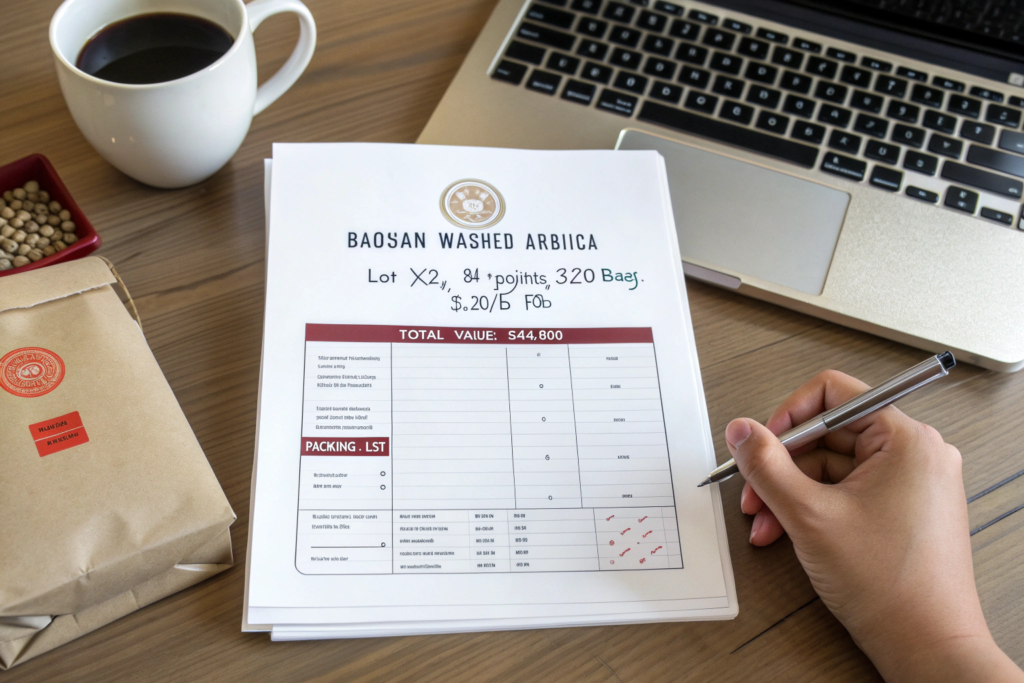
The Commercial Invoice is a legal document, not just a bill. It must include the seller's and buyer's full legal names and addresses, a detailed description of the goods including the HS code, the quantity, the unit price, the total value, the Incoterm, the country of origin, and the payment terms. The customs authority uses this to assess duties and taxes. Understating the value to reduce duty is customs fraud.
What Is the Difference Between a Commercial Invoice and a Packing List?
The Commercial Invoice is about value. The Packing List is about contents. They serve different functions, and both are required.
The Commercial Invoice states the price and the terms of sale. It is used by customs to determine the dutiable value. The Packing List provides the physical details of the shipment. It lists each pallet or bag, the type of packaging, the net weight per unit, the gross weight including packaging, and the dimensions if required. The customs inspector uses the Packing List to verify that the physical cargo matches the declared cargo. A container of coffee should have a Packing List that matches the actual bag count. A discrepancy triggers a physical examination.
How Does the Certificate of Origin Determine Tariff Treatment?
The Certificate of Origin is the document that says where the coffee was grown and processed. It is not a formality. It is the document that unlocks preferential tariff rates under free trade agreements and the Generalized System of Preferences.
For example, coffee exported from China to the United States enters duty-free under the Most Favored Nation tariff rate for HS code 0901.11, which is "Free." But the importer must still present a Certificate of Origin to claim that rate. Without it, customs may apply the general rate or delay clearance while origin is verified. For coffee entering the European Union, the Certificate of Origin is part of the EUDR compliance package. The certificate is typically issued by the local chamber of commerce or the entry-exit inspection and quarantine authority and must be stamped and signed.
What Sanitary and Phytosanitary Certificates Are Mandatory?
Coffee is a food product. When it crosses an international border, the destination country's food safety authority gets involved. They want to know that the coffee is free of pests, diseases, and chemical contaminants. The Phytosanitary Certificate and the Fumigation Certificate are the documents that answer these questions.
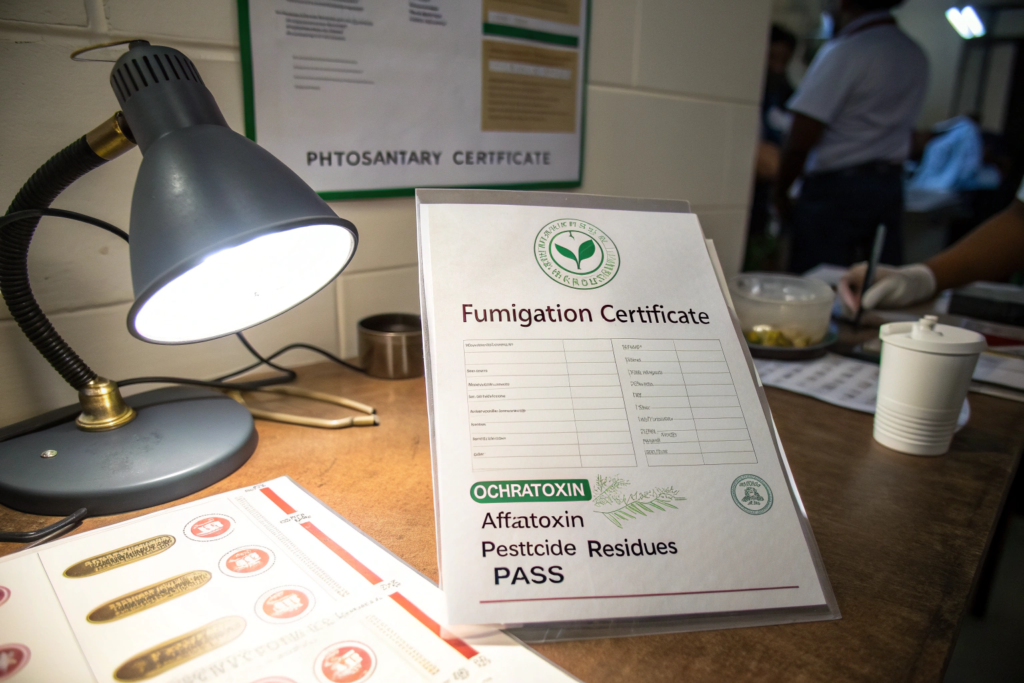
The Phytosanitary Certificate, issued by the national plant protection organization of the exporting country, certifies that the coffee shipment has been inspected and is free of quarantine pests and diseases. The Fumigation Certificate, issued by a licensed pest control operator, certifies that the coffee has been treated to eliminate any pests present. Both are mandatory for coffee import clearance in virtually all destination countries.
A container of coffee arriving without a Phytosanitary Certificate will not be released. It will be held at the port, and the importer will be ordered to either re-export the coffee at their own cost or have it destroyed. The Phytosanitary Certificate is non-negotiable.
What Information Must a Phytosanitary Certificate Contain?
The Phytosanitary Certificate follows an international format established by the International Plant Protection Convention. It must include the name and address of the exporter and the consignee, the place of origin of the coffee, the declared means of transport and the port of entry, a description of the consignment including the number of packages, the net weight, and the botanical name of the product, Coffea arabica or Coffea canephora, and the official declaration that the plants or plant products have been inspected and are considered free from quarantine pests.
The certificate is issued by the Entry-Exit Inspection and Quarantine bureau in China. It bears an official stamp and the signature of the authorized officer. The certificate number must be unique. The container number and seal number on the certificate must match the Bill of Lading. This is the detail that most commonly causes problems.
Is Fumigation Always Required for Coffee Shipments?
Fumigation requirements vary by destination country and sometimes by the specific port of entry. Some countries require fumigation as a blanket condition for all agricultural imports. Others require it only if the phytosanitary inspection reveals the presence of pests. Others accept the Phytosanitary Certificate alone as sufficient proof that the coffee is pest-free.
The exporter must know the specific requirements of the destination country. A shipment to Australia, with its strict biosecurity laws, will almost certainly require fumigation and specific treatment protocols. A shipment to the United States may not require fumigation unless pests are found. The prudent exporter fumigates as a standard practice unless the buyer instructs otherwise and accepts the risk. The fumigation certificate must detail the fumigant used, the dosage, the duration of exposure, and the temperature during treatment. Methyl bromide is being phased out globally due to its ozone-depleting properties. Alternatives like phosphine and controlled atmosphere treatment are increasingly used.
What Role Do Insurance and Inspection Certificates Play?
The ocean is a hostile environment for coffee. Containers are lost overboard. Storms cause moisture damage. Fires break out on ships. The buyer who receives a damaged container or no container at all needs financial protection. Insurance provides it. The buyer who wants independent verification that the coffee shipped matches the coffee ordered needs inspection. The Inspection Certificate provides it.
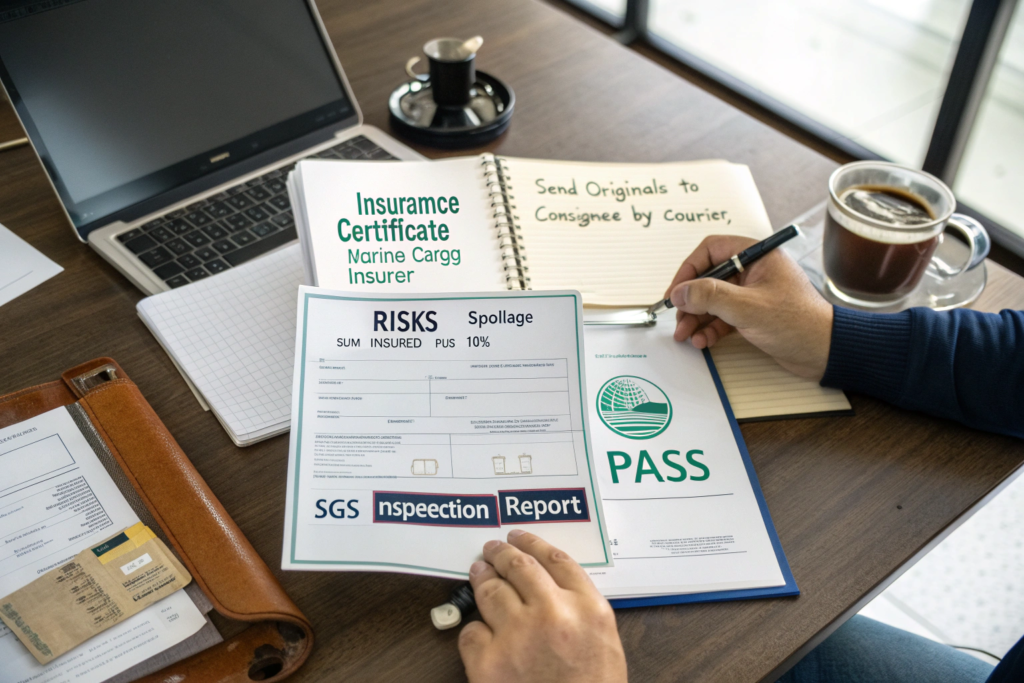
The Insurance Certificate provides financial protection against loss or damage to the coffee during transit, covering risks from the moment the coffee leaves the exporter's warehouse until it arrives at the buyer's warehouse. The Inspection Certificate, issued by an independent third party like SGS or Bureau Veritas, verifies that the coffee loaded into the container matches the approved pre-shipment sample in terms of quality, quantity, and packaging.
Insurance is often arranged by the buyer under FOB terms, or by the seller under CIF terms. The insurance certificate is a contract between the insured party and the insurance company. It specifies the risks covered, the sum insured, and the claims procedure. If a container is lost, the insurance certificate is the document that triggers the payout.
What Types of Marine Cargo Insurance Are Available for Coffee?
Marine cargo insurance comes in different levels of coverage. The most basic is "Free of Particular Average," which only covers total losses, such as the ship sinking with all cargo. This is cheap but inadequate for most coffee shipments.
"With Average" covers partial losses from specific perils like stranding, sinking, fire, or collision. "All Risks" is the broadest standard coverage. It covers all risks of physical loss or damage from any external cause, subject to specific exclusions like war, strikes, and inherent vice. For high-value specialty coffee shipments, All Risks coverage is the standard. The premium is a fraction of a percent of the cargo value. The sum insured should cover the CIF value of the goods plus 10% to account for the buyer's anticipated profit margin.
What Does a Pre-Shipment Inspection Report Verify?
A pre-shipment inspection report from an agency like SGS verifies the physical reality of the coffee before it is loaded. An SGS inspector visits the exporter's warehouse before the container stuffing date. The inspector pulls samples from randomly selected bags across the lot.
The inspection covers quantity, the number of bags, the net weight per bag, and the total consignment weight. It covers quality, the physical appearance of the beans, the screen size distribution, the moisture content, the water activity, and the defect count per the SCA grading system. It covers packaging, the type and condition of the bags, the marking and labeling, and the palletization. The report includes photographs and data tables. A pass result gives the buyer confidence that the coffee in the warehouse matches the approved sample. The final report is issued before the container is sealed.
Conclusion
Export documentation for coffee is not bureaucratic busywork. It is the legal and regulatory framework that enables international trade. Each document serves a specific function. The Bill of Lading proves ownership. The Commercial Invoice declares value. The Certificate of Origin determines duty. The Phytosanitary Certificate ensures food safety. The Insurance Certificate manages risk. The Inspection Certificate verifies quality.
A single error on any of these documents can delay a container, incur demurrage fees, and damage a buyer-supplier relationship. The exporter who treats documentation with the same rigor as coffee processing is the exporter who builds a reputation for reliability. The buyer who understands what each document is and why it matters can communicate requirements clearly and catch errors early.
At BeanofCoffee, we manage the full documentation package for every export shipment. Our team reviews every certificate for accuracy before the container sails. We provide pre-shipment copies to the buyer so their customs broker can review and flag any issues before the originals arrive. If you are planning an import and want to understand exactly what documents will be required for your specific destination, contact Cathy Cai at cathy@beanofcoffee.com. She will walk you through the checklist and provide sample documents for your broker's review. Let's make sure your coffee clears customs smoothly.