
You have negotiated the price. You have cupped the sample. You are ready to sign the contract for a full container of green coffee. The invoice arrives. The amount is substantial. Tens of thousands of dollars. Now comes the moment of truth. You must wire this money across the ocean to a supplier you have never met in person. A cold feeling settles in your stomach. What if the money disappears? What if the coffee never ships? What if this is all an elaborate scam? This fear is rational. Large international transactions are a high-stakes game. The payment method you choose is your shield. I have been on the receiving end of these wires for years. I understand the buyer's fear. I also understand the systems that protect both parties.
The most secure payment options for large coffee transactions are a Letter of Credit (LC), a bank-to-bank wire transfer with clear contract terms, and for ongoing relationships, a structured payment schedule with performance milestones. At BeanofCoffee, I work with buyers to find the payment structure that gives them the security they need while ensuring a smooth, efficient transaction.
The goal is not to make payment difficult. The goal is to make it safe for everyone. Let me walk you through the options, the risks, and the best practices for protecting your money.
Why Is a Letter of Credit the Gold Standard for First Transactions?
When you do not know a supplier, trust is thin. A Letter of Credit, or LC, replaces trust with a banking system. It is a document issued by your bank, guaranteeing payment to the supplier, but only when the supplier presents documents that exactly match the terms of the LC. This shifts the risk from a personal relationship to a financial institution.
A Letter of Credit is the gold standard because it protects both the buyer and the seller. The buyer knows the money will only be released when the supplier ships the correct coffee and presents the correct documents. The seller knows the payment is guaranteed by the buyer's bank. At BeanofCoffee, I accept LCs for large first-time orders. It is a signal that we are both serious, professional operators.
The LC is a bridge of trust. It allows two strangers to do business safely. The terms of the LC are critical. They must be precise and clear, because the bank will check the documents with ruthless accuracy.
What Documents Must a Supplier Present to Get Paid Under an LC?
The LC will specify a list of required documents. The typical set includes a commercial invoice, a packing list, a bill of lading showing the goods have been shipped, an insurance certificate, and a certificate of origin. For coffee, you might also require a phytosanitary certificate and a certificate of analysis. The supplier must present these documents to their bank, which forwards them to your bank. Your bank checks every detail. A misspelled word, a wrong date, a missing signature, any discrepancy can cause the bank to refuse payment. This is the security. It is also the potential headache. The documents must be perfect. A professional exporter knows how to produce perfect documents. At BeanofCoffee, my export documentation team is meticulous. We have never had an LC rejected for document discrepancies.
How Do LC Terms Protect the Buyer from Non-Shipment?
The LC protects the buyer by making payment conditional on proof of shipment. If the supplier never ships the coffee, they cannot obtain the bill of lading. If they cannot present the bill of lading, they cannot get paid. The money stays in your account. This is the fundamental protection. You are not paying for a promise. You are paying for evidence of performance. The LC also protects you from quality mismatches. You can specify in the LC that the certificate of analysis must show certain quality parameters, like a moisture content below 12% or a cupping score above 80. If the certificate shows a lower score, the bank will not pay. This puts the supplier under enormous pressure to ship exactly what was contracted. It is a powerful tool for the buyer.
How Does a T/T Wire Transfer Work Safely for Repeat Orders?
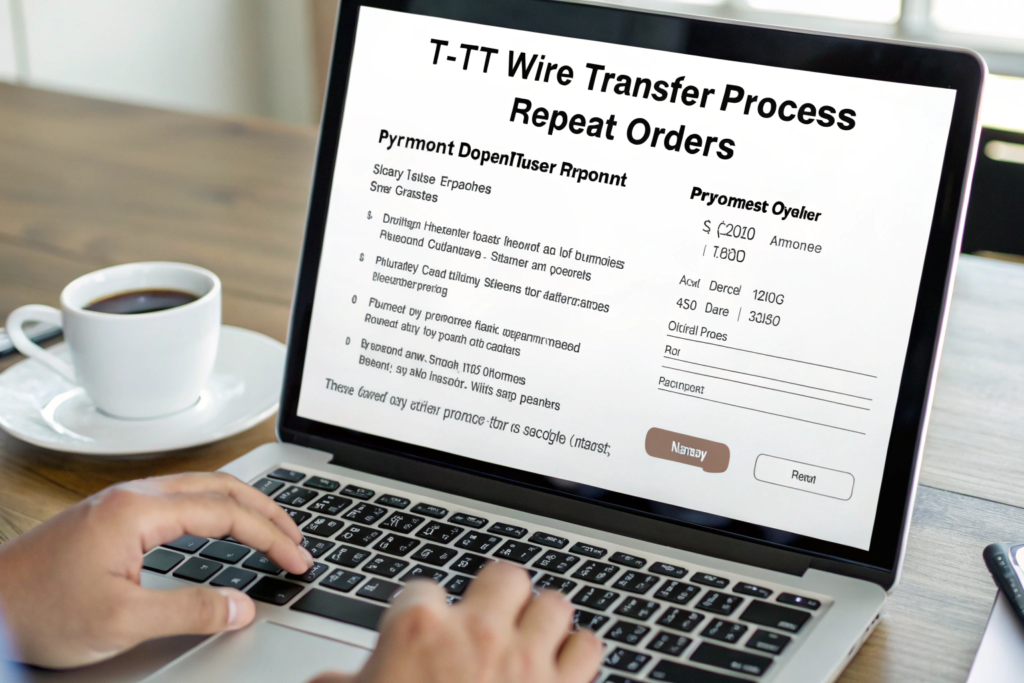
A Telegraphic Transfer, or T/T, is a direct bank-to-bank transfer of funds. It is the most common payment method in international trade. It is fast, simple, and relatively inexpensive. For a repeat order with a trusted supplier, it is the standard choice.
A T/T wire transfer is safe for repeat orders when you have an established relationship and a clear contract. The typical structure is a deposit upfront, followed by the balance against a copy of the shipping documents. At BeanofCoffee, I use this structure for my long-term clients. It balances the buyer's need for security with the seller's need for working capital.
The key is the payment schedule. It should be structured so that the risk is shared at every step.
What Is the Safest Deposit Percentage for a First-Time Wire Transfer?
The deposit is the buyer's risk capital. The higher the deposit, the more you are exposed if the supplier fails. For a first-time order, a common deposit is 30% of the contract value. This is enough to give the supplier the working capital to prepare the shipment, but not so much that a total default would be catastrophic for the buyer. Some suppliers might ask for 50%. You should negotiate. A 50% deposit for a first order from an unverified supplier is a high-risk gamble. At BeanofCoffee, I understand the buyer's perspective. I accept a 30% deposit for new relationships, with the balance paid when I present the copy of the bill of lading. This shows that I am confident in my ability to ship, and it gives my new client confidence in my integrity.
How Does Paying the Balance "Against Copy of Bill of Lading" Protect You?
The Bill of Lading is the document of title. It is the proof that the coffee has been loaded onto the vessel and is on its way to you. When the supplier asks for the balance payment "against copy of Bill of Lading," they are saying, "I have shipped the coffee. Here is the proof. Now please pay the balance." You, as the buyer, can verify this. You can check the vessel name, the sailing date, and the container number. You can confirm with the shipping line that the container is actually on the water. Only then do you release the payment. This structure ensures that you do not pay the full amount until you have tangible evidence that the coffee is moving. It is a fair and balanced approach. It is the standard practice for a healthy, ongoing trade relationship.
What Are the Hidden Risks of Using Online Payment Platforms for Coffee?
You might be tempted to use a platform like PayPal or Alibaba Trade Assurance. They seem convenient. They offer buyer protection. But for large coffee transactions, they have significant limitations. The fees are high. The dispute resolution process can be slow and biased. And the platform's terms may not align with the realities of the coffee trade.
Online payment platforms are not designed for high-value, bulk commodity transactions. The fees can eat into the already thin margins, and the buyer protection policies often do not account for the nuances of coffee quality and shipping. At BeanofCoffee, I prefer bank-to-bank transactions for large orders. They are cleaner, cheaper, and more professional.
The platform is a middleman. In a business where we are trying to cut out middlemen, adding a payment middleman is a step backward.
Why Are Platform Fees a Significant Cost on a Container Order?
Platform fees are a percentage of the transaction value. On a $50,000 container order, a 3% fee is $1,500. This is a significant amount of money. It is money that could be going toward better coffee, better logistics, or a better price. In the low-margin world of green coffee, $1,500 is not a rounding error. It is a competitive disadvantage. A bank wire transfer, by contrast, has a flat fee, often between $20 and $50, regardless of the amount. The difference is staggering. For a professional buyer, the platform fee is an unnecessary tax. It is a tax on convenience that is rarely worth paying.
How Can Platform Dispute Processes Fail for Specialty Coffee?
If a dispute arises, the platform's resolution process is a black box. It is often slow, taking weeks or months. The platform's staff are not coffee experts. They do not understand the difference between a 84-point and an 85-point coffee. They do not understand the impact of a slight delay on freshness. They are trained to process claims for consumer goods, like a broken phone or a fake handbag. A dispute about the quality of a green coffee lot, a nuanced, subjective, and highly technical argument, is beyond their capacity. The process is designed for a simple, provable problem. Coffee quality disputes are rarely simple. This is why the formal, legal framework of a bank LC is a superior protection. The documents are the evidence. The bank is the judge. The rules are clear.
How to Structure a Long-Term Payment Partnership That Benefits Both Sides?
The best payment security is a strong relationship. After years of working together, you and your supplier know each other. The trust is built. The payment terms can evolve to reflect this trust. This is the ultimate goal. It is a partnership, not a transaction.
A long-term payment partnership is built on a history of reliable performance. At BeanofCoffee, my most trusted clients enjoy flexible payment terms, including deferred payments and revolving credit. This is not an act of charity. It is a reward for their loyalty and a reflection of the mutual trust we have built.
The goal of secure payments is not to be suspicious forever. It is to build a foundation of trust that eventually makes the transaction smooth and effortless.

What Is a Revolving Credit Facility and How Does It Work in Coffee Trade?
A revolving credit facility is a form of short-term financing. Instead of paying for each container individually, the buyer and supplier agree on a credit limit. The supplier ships the coffee. The buyer makes a payment against the outstanding balance. The credit limit is drawn down and then replenished with each cycle. This is how large, established companies operate. It is efficient. It smooths out cash flow. It eliminates the administrative burden of individual wires. A supplier will only offer a revolving credit facility to a buyer they know and trust implicitly. It is a signal of a mature, stable relationship. It is the financial expression of a deep partnership.
How to Build Trust That Leads to Deferred Payment Terms?
Deferred payment terms, like "net 30" or "net 60," mean the buyer does not pay until 30 or 60 days after the coffee ships. This is a huge advantage for the buyer. It gives them time to receive, roast, and even sell the coffee before they have to pay for it. No supplier offers this to a stranger. It is earned. You earn it by paying on time, every time. You earn it by communicating openly. You earn it by being a reliable, professional partner. Over time, as the relationship deepens, the payment terms can loosen. This is the path from the rigidity of a Letter of Credit to the flexibility of a true business partnership. It is the destination. I have this kind of relationship with several of my long-term clients. It is how the coffee business should work.
Conclusion
The security of your payment is not a matter of paranoia. It is a matter of professional diligence. For a first transaction, the Letter of Credit is the gold standard. It wraps your money in the protective machinery of the banking system. For repeat orders, a structured T/T wire transfer, with a reasonable deposit and a balance against the bill of lading, is the industry standard. Online platforms, with their high fees and ill-suited dispute processes, are a poor fit for the bulk coffee trade. And finally, the ultimate security is the long-term partnership, built on a history of reliable performance, leading to flexible payment terms that benefit both sides. The choice of payment method is a signal. It tells the supplier what kind of buyer you are. Choose wisely.
Let's discuss the payment structure for your next order. Contact me, Cathy Cai, at cathy@beanofcoffee.com. I will walk you through the options, from a secure LC for a first shipment to a streamlined T/T for an ongoing partnership. We will find the structure that gives you the security you need and the efficiency you deserve. Your money is the fuel of our partnership. Let's protect it together.