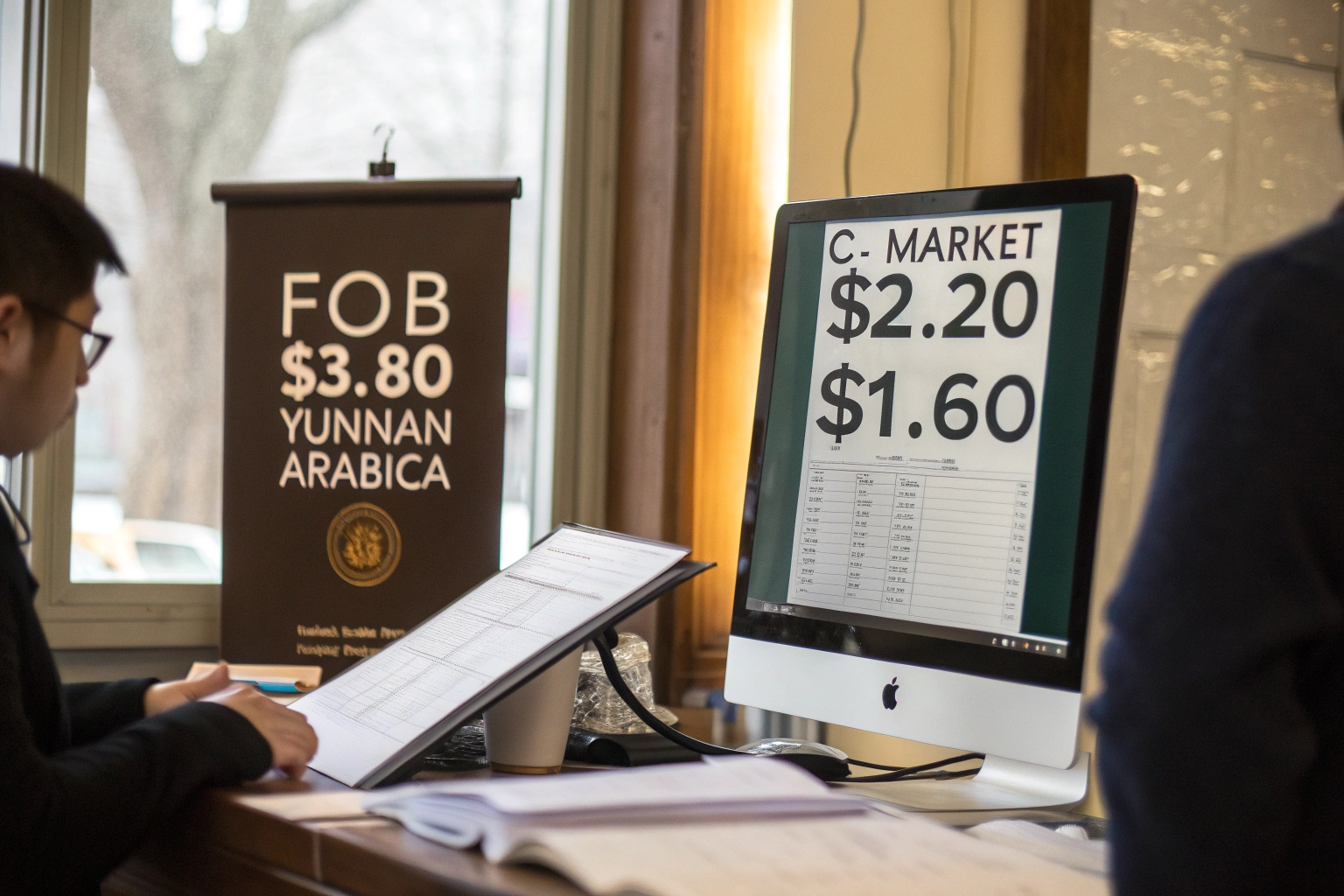
You see the FOB price on my offer sheet. $3.80 per pound for washed Yunnan Arabica. You check the C-market. It is hovering around $2.20. A gap of $1.60. Your mind does a quick, cynical calculation. "Cathy is making a killing." You imagine a margin of 40%, 50%, maybe more. You are ready to negotiate hard, to squeeze that price down because you assume there is a lot of fat. Let me stop you right there. The gap between the C-market price and the FOB price of a specialty, traceable, export-ready coffee is not pure profit. It is the cost of doing real agriculture at a quality level that meets your standards.
The net profit margin for a well-run, quality-focused wholesale coffee export operation is typically between 8% and 15%. The gross margin may look large, but it is consumed by the intense capital and labor costs of farming, processing, and certification. At BeanofCoffee, I operate on a transparent cost-plus model. My profit is a fair return on my land, my work, and my risk, not a speculative windfall.
I want to pull back the curtain on the economics of coffee exporting. Not the textbook version, but the real numbers from my operation in Baoshan. When you see where the money goes, you will understand why a "cheap" price is often the most expensive choice in the long run.
Why Is the C-Market Price Not a Reliable Benchmark for Cost?
The C-market, the ICE coffee futures contract, is a financial instrument. It trades paper, not physical coffee. It reflects the global supply and demand for commodity-grade Arabica from Brazil and Colombia. It does not reflect the cost of producing high-quality, traceable, single-estate coffee in Yunnan.
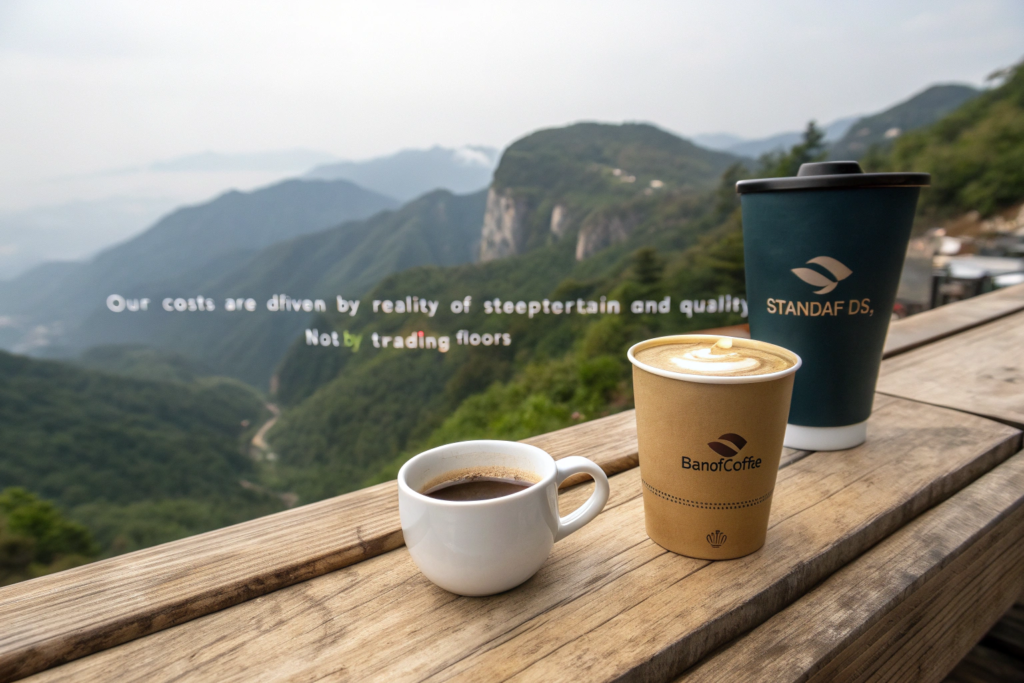
The C-market price is a global baseline for commercial grade coffee, not specialty. It ignores the specific costs of altitude farming, hand-picking, and meticulous processing. Our costs at BeanofCoffee are driven by the reality of our steep Baoshan terrain and our quality standards, not by a trading floor in New York.
If I sold my coffee at the C-market price, I would be bankrupt in one season. The price would not cover the cost of picking the cherries.
What Are the Real Production Costs Per Pound for Yunnan Arabica?
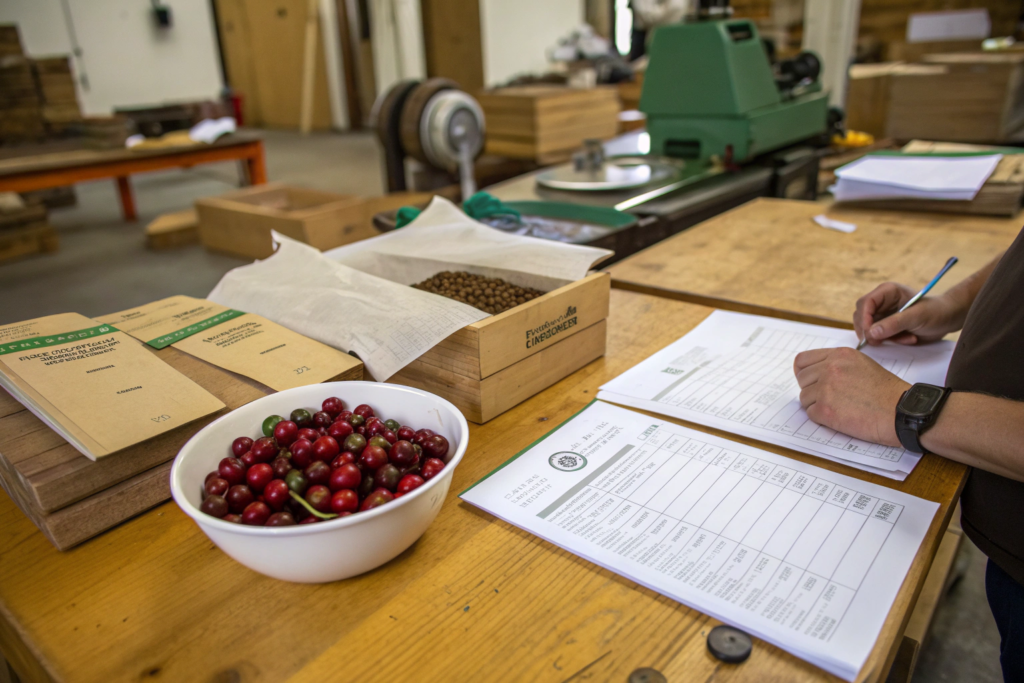
Let me break down the cost per pound of green export-ready coffee on my farm. This is an honest, rough average. The largest single cost is labor. Hand-picking ripe cherries on steep mountain slopes is slow, skilled work. A picker can harvest perhaps 50 to 80 kilos of cherry per day. The cherry-to-green ratio is roughly 6 to 1. So a day's picking yields maybe 10 to 13 pounds of green coffee. The daily wage, plus the cost of transport, meals, and insurance, is the baseline. Fertilization, both organic compost and some targeted mineral supplements, is a significant annual cost. Pest and disease management, even with our shade-based biological controls, requires labor and inputs. The amortized cost of the wet mill, the dry mill, the drying beds, and the mechanical dryer adds several cents per pound. Water, electricity, and fuel for the trucks are operational costs. Finally, the cost of the land itself, either as a mortgage or an opportunity cost on owned land, must be accounted for. Add all of this up, and the cost of production for one pound of export-ready green coffee on a quality-focused Yunnan farm can easily be between $2.50 and $3.20, depending on the harvest year and the specific lot's processing.
How Do Certification and Compliance Costs Reduce Net Margin?
Certification is not a one-time fee. It is an annual layer of cost. The organic certification I described requires the auditor's travel, the inspection days, the lab testing, and the transaction certificates. A food safety certification like ISO 22000 requires an initial implementation cost and annual surveillance audits. Rainforest Alliance has its own fee structure. Then there is the compliance cost. The optical sorter we use to remove defects is a major capital investment with ongoing maintenance. The third-party lab tests for ochratoxin A and pesticides are a per-lot cost. The GrainPro bags cost significantly more than plain jute. These quality and certification investments are not optional for selling into the US and EU specialty markets. They are the price of entry. They add up to several cents per pound. They are essential, but they do pinch the net margin.
How to Deconstruct a Wholesale Coffee FOB Price Offer?
An FOB price is not a single number pulled from the sky. It is the sum of several distinct cost layers, each with its own logic. Understanding these layers turns you from a passive price-taker into an informed negotiator.
A real FOB price includes the farm-gate cost of production, the milling and sorting cost, the packaging cost, the export documentation and logistics cost, and a margin for the exporter. At BeanofCoffee, I can walk you through each of these layers for any lot. A supplier who refuses to explain their price breakdown is hiding something.
A transparent price is a fair price. An opaque price is a guessing game where the house always wins.

What Is the Difference Between Farm-Gate Price and FOB Price?
The farm-gate price is the value of the coffee as it leaves the farm, often in parchment form. It covers the farmer's cost of growing and primary processing, plus the farmer's profit. The FOB price, which stands for Free On Board, is the price of the coffee delivered to the vessel at the export port. The difference between the farm-gate price and the FOB price is the "mill-to-ship" cost. This includes secondary processing at the dry mill, which means hulling the parchment, sorting by size and density, color-sorting, and hand-picking. It includes the cost of the bags, the GrainPro liners, and the palletization. It includes the transport from the dry mill in Baoshan to the port in Shanghai, roughly a three-day truck journey. It includes the export customs clearance, the port handling charges, and the documentation fees. When you buy FOB from a vertically integrated producer like me, these costs are internal transfers, not external markups. I own the mill and manage the logistics. The margin between my farm-gate cost and my FOB price is my operational return.
How Does Processing Complexity Affect the Final Price?
Not all coffee lots are created equal in cost. A washed Arabica is more expensive to produce than a natural Arabica. The washed process requires a pulping machine, a controlled fermentation tank, large volumes of clean water, and a mechanical dryer. Each step adds cost. A natural process, which involves simply drying the whole cherry, has lower processing costs but a much higher risk of defects and loss. A honey process sits in the middle. Within a process, the grade matters. A Grade 1 lot requires more intensive sorting, which means more labor hours and more beans rejected. A screen size 17/18 lot might command a premium over a 15/16 lot because the larger beans are rarer in the harvest. When you compare two FOB offers, you must compare the processing method and the grade, not just the dollar number.
What Are Typical Net Margins for Farmers, Millers, and Exporters?
The coffee chain is often described as a pie, and everyone wants a slice. But the size of the slice varies dramatically depending on where you sit in the chain and how much value you add. The farmer who only sells cherry has a tiny, precarious margin. The vertically integrated farmer-exporter has a larger, more stable margin, but also a larger capital base at risk.
A pure farmer selling cherry to a wet mill might see a net margin of 5% to 10%. A wet mill selling parchment might capture 10% to 15%. A vertically integrated exporter like BeanofCoffee combines the farmer, miller, and exporter margins into a single, more efficient return of 8% to 15%, depending on the market and the lot.
Vertical integration does not create a super-profit. It captures the efficiency of eliminating transaction costs between the stages.
Why Do Vertically Integrated Producers Like BeanofCoffee Have Different Margins?
I do not pay a middleman to sell my parchment. I do not pay a miller to toll-process my cherry. I do not pay an export broker to book my container. By owning the entire chain from the tree to the container, I eliminate the transaction costs that would normally be spread across three or four separate businesses. This gives me a cost advantage. I can choose to take that advantage as a slightly higher net margin, or I can pass some of it on to the buyer as a more competitive FOB price. I tend to do the latter. A stable, long-term partnership with a roaster is worth more to me than a one-time extra margin. My margin is a function of efficiency, not of exploitation of farmer poverty, which is the ugly reality in some less integrated supply chains.
How Much Do Intermediaries Mark Up Before the Coffee Reaches Your Port?
In a fragmented supply chain, the coffee passes through many hands. The local cherry collector marks up the price to the wet mill. The wet mill marks up the parchment to the dry mill. The dry mill marks up the green coffee to the exporter. The exporter marks up the FOB price to the importer. The importer marks up the CIF price to you, the roaster. Each markup can be 5% to 15%. A coffee that left the farmer at a farm-gate value of $2.00 per pound can easily land at your roastery at $4.00 or $4.50 per pound. Only a tiny fraction of that final price goes back to the farm. The rest is absorbed by the chain. This is the economic logic of direct trade. By cutting out the intermediaries, you are not "squeezing" the farmer. You are capturing the intermediary markups and sharing the benefit between the producer and the roaster.
How Can Long-Term Contracts Stabilize Margins for Both Sides?
A spot market transaction is a gamble for both sides. I gamble that I can sell my harvest at a price above my cost. You gamble that you can secure coffee at a price within your budget. A long-term contract transforms a gamble into a plan.
A long-term contract removes price volatility and allows both the producer and the roaster to plan their businesses. I offer 12-month forward contracts with a fixed price based on a transparent cost model. At BeanofCoffee, this contract stability allows me to invest confidently in the farm, knowing my margin is secured, and it allows you to budget your green coffee cost without fear of a market spike.
A contract is not a cage. It is a shared shield against the chaos of the commodity markets.

What Is a Cost-Plus Pricing Model and How Does It Work?
A cost-plus model is an open-book approach. I share my audited cost of production for a specific lot. We agree on a fair, fixed dollar margin per pound that I will earn on top of that cost. The final FOB price is the sum of the cost and the margin. If my costs go up due to a rise in the local labor rate, the price adjusts accordingly. If my costs go down due to an excellent harvest yield, the price adjusts downward. This model aligns our incentives. I am not trying to hide a windfall profit. You are not trying to squeeze me below my survival threshold. We are partners managing a shared cost structure. This is a deeply collaborative way to do business. It requires trust and transparency. But once established, it creates an unbreakable commercial bond.
How Do Forward Contracts Help You Hedge Against C-Market Volatility?
The C-market is not a cost indicator for my farm, but it does affect the broader market psychology and the price of substitute coffees. A forward contract with me decouples your green coffee cost from the C-market entirely. Our price is based on Yunnan reality, not Brazilian frost rumors. This is a powerful hedging tool for your business. If the C-market spikes to $3.50, my contract with you might still be at $3.80, which suddenly looks like a bargain compared to the commodity alternative. If the C-market crashes, I am protected because my price was never tied to that speculative index. We both get stability. This is the endgame of a mature, direct trade partnership. You are not buying coffee from a ticker. You are buying coffee from a farm, at a price that reflects the farm's real economy.
Conclusion
The profit margins in wholesale coffee export are not the hidden fortunes that some buyers imagine. They are modest, hard-earned returns on significant capital and risk. The C-market is a misleading benchmark. The real benchmark is the cost of producing quality in a specific place. My FOB price is built from the ground up, from the picker's daily wage to the optical sorter's electricity bill. My net margin, between 8% and 15%, is what allows me to reinvest, to pay my team fairly, and to keep the farm thriving year after year. The fragmented, multi-intermediary model generates a higher final price for the roaster, but very little of that extra money reaches the soil. The direct trade, vertically integrated model compresses the chain, delivering a better price to the producer and a better value to the roaster. A long-term, cost-plus contract turns this efficient model into a stable, predictable partnership.
Let's discuss the real economics of your next shipment. Contact me, Cathy Cai, at cathy@beanofcoffee.com. I will share a detailed cost breakdown for our current Baoshan washed Arabica lot. We can walk through the numbers together, line by line. I will show you exactly where every dollar of your FOB price goes. No smoke. No mirrors. Just the honest arithmetic of farming.