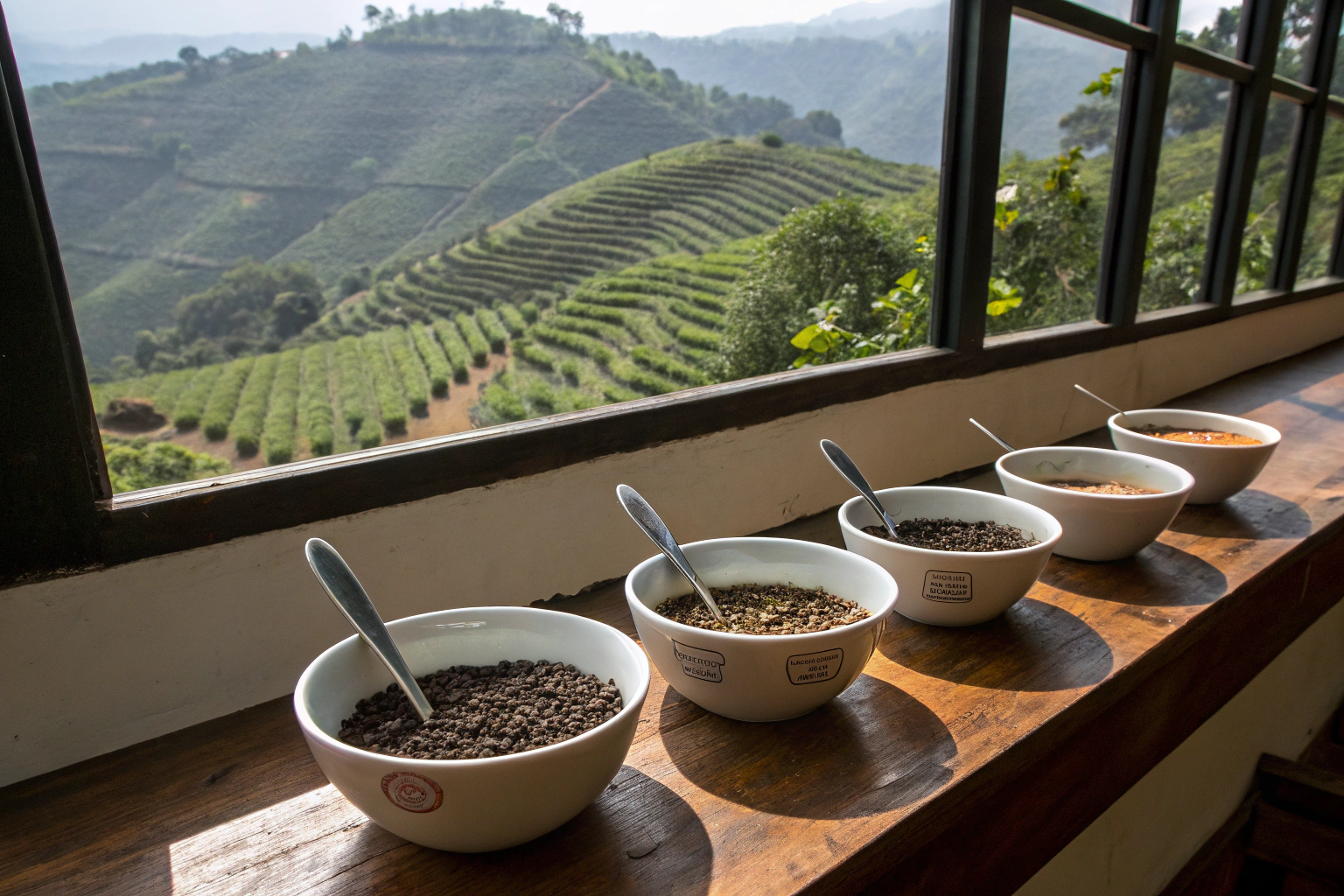
The first time I cupped three different lots from our own Baoshan farm side by side, I was confused. They were all Catimor. They were all washed. They were all grown within five kilometers of each other. But one tasted like black tea and brown sugar. One had a surprising lemon brightness. And one was deep, nutty, and chocolatey. The difference? One was from a plot at 1,200 meters. Another from 1,500 meters. The third was from a plot near a natural spring, shaded by walnut trees. That was the day I stopped talking about "Yunnan coffee" as a single thing.
The regional tasting notes of Yunnan Arabica vary significantly by sub-region, altitude, and micro-climate. Baoshan coffees, grown at higher elevations in western Yunnan, tend toward black tea, red apple, brown sugar, and malted grain notes with a clean, balanced body. Pu'er coffees, from the southern tea-growing mountains, often express more stone fruit, caramel sweetness, and a softer, rounder mouthfeel. Within both regions, specific micro-lots can surprise with citrus acidity, floral aromatics, and cocoa depth that challenge the outdated perception of Yunnan as a one-dimensional origin.
I've been farming in Baoshan for over a decade, and I've cupped Yunnan coffees from across the province. Here's a guide to the flavors of this rapidly evolving origin.
How Does Baoshan's Terroir Shape Its Coffee Flavor?
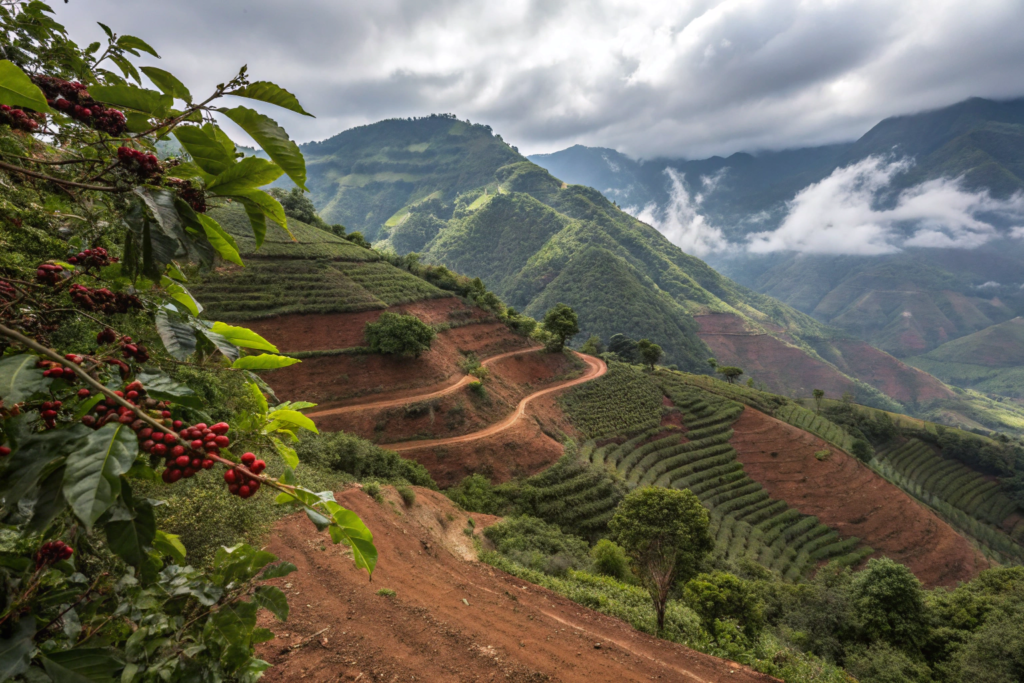
Baoshan is not just a dot on a map. It's a specific set of growing conditions that imprint themselves on every bean. The city sits in western Yunnan, near the border with Myanmar, along the historic Tea Horse Road. Coffee has been grown here for over a century, but the specialty movement is only a couple of decades old. The terroir is defined by high altitude, sharp diurnal temperature swings, volcanic soils, and a dry, sunny harvest season that allows for clean, consistent processing.
Baoshan's terroir produces Arabica coffees characterized by a clean, tea-like body, moderate to bright acidity, and flavor notes that lean toward red apple, black tea, toasted grain, and brown sugar. The high altitude and cool nights slow cherry maturation, concentrating sugars and developing a complex but balanced cup. The volcanic soils contribute mineral depth. Compared to Pu'er coffees, Baoshan lots are often described as more structured, with a defined acidity and a cleaner finish.
What Flavor Notes Come From Baoshan's High-Altitude Plots?
Altitude is the master variable in Baoshan. Our farms sit between 1,200 and 1,600 meters. The difference between the lower and upper plots is not subtle. It's the difference between a pleasant, simple coffee and a complex, memorable one.
At 1,400 to 1,600 meters, our Catimor develops a distinctive black tea note—think unsweetened Darjeeling, with a slight astringency that cleans the palate. There's often a red apple acidity, crisp and recognizable, not sharp. The sweetness is brown sugar or caramelized honey, not fruit sugar. The body is medium, clean, and smooth. The finish is the best part—lingering, slightly malty, like the aftertaste of a good whole-grain bread.
I've had cuppers compare our high-altitude Baoshan Arabica to a washed Guatemalan or a mild Colombian. The comparison makes sense in structure—balanced, clean, versatile—but the flavor profile is distinct. It doesn't taste like Central America. It tastes like Baoshan. The black tea and malt notes are signatures. Once you know them, you can identify a Baoshan coffee in a blind cupping with reasonable accuracy.
How Does the Dry Harvest Season Affect Processing and Taste?
Baoshan's harvest runs from October through January. These are the dry months. Rainfall is minimal. The sun is consistent but not brutal at altitude. The humidity is low. This climate is a gift to coffee processors.
Dry weather during harvest means cherries can be picked at optimal ripeness without the pressure of an approaching storm. It means washed processing can proceed without the risk of unexpected rain interrupting fermentation or drying. It means natural and honey processes can be executed with control, not panic.
The result is a region known for clean cups. Defects that plague origins with rainy harvest seasons—fermenty notes from delayed drying, mold from excessive moisture—are rare in well-managed Baoshan lots. The dry harvest climate allows the intrinsic flavor of the bean to express itself without processing interference. When you taste a Baoshan coffee, you're tasting the terroir and the varietal, not the struggle against the weather. That clarity is a regional signature.
What Makes Pu'er Coffee Different From Baoshan?
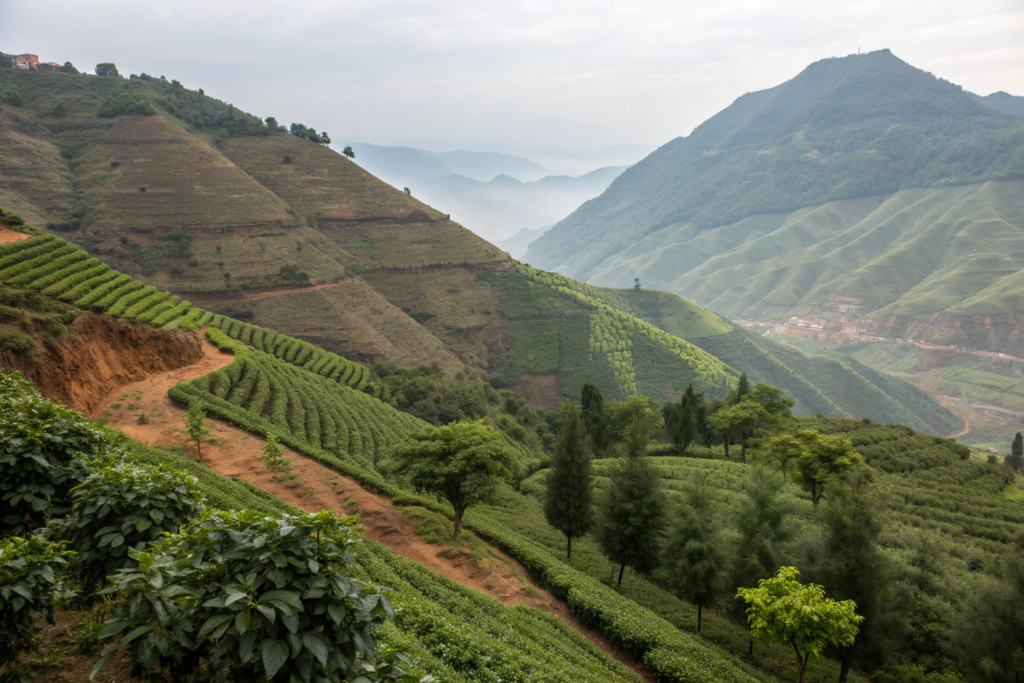
Pu'er is famous for tea. The name is synonymous with fermented pu'erh tea, a product with a global reputation and a deep cultural history. Coffee is the newer crop in Pu'er, but it has grown rapidly. The region's terroir is different from Baoshan's—lower average altitude, more rainfall, a more humid climate, and soils shaped by the same conditions that produce great tea. These differences produce a different cup.
Pu'er Arabica coffees tend to express a softer, rounder profile than Baoshan lots. The acidity is generally lower and more integrated. Flavor notes lean toward stone fruit—peach, plum—and caramel sweetness. The body is often fuller and more coating. Pu'er coffees can show a floral character, especially in washed lots from higher micro-climates, and a distinct tea-like complexity that may reflect the region's deep history with Camellia sinensis cultivation. The finish is typically smooth and sweet, with less of the structured astringency found in Baoshan.
How Do Pu'er's Lower Altitudes and More Humid Climate Affect the Cup?
Much of Pu'er's coffee grows between 900 and 1,300 meters. This is lower than Baoshan's prime coffee land. The lower altitude means warmer average temperatures, which accelerate cherry maturation. Faster maturation generally means less sugar accumulation, which can translate to a less complex cup. But it also means the plant experiences less of the cold stress that drives acidity in high-altitude beans.
The result is a coffee that is naturally lower in acidity and softer in structure. This is not a defect. It's a style. A well-processed Pu'er Arabica can be incredibly pleasant—smooth, sweet, approachable. It's a coffee that appeals to drinkers who find bright, acidic coffees challenging. For a blend, Pu'er adds body and sweetness without adding sharpness.
The more humid climate also affects processing. Pu'er's harvest season is not as reliably dry as Baoshan's. This makes washed processing more challenging and has encouraged wider adoption of honey and natural methods, which can be more forgiving in humid conditions. The processing style, in turn, influences the cup profile toward more fermented, fruit-forward notes. A Pu'er natural can show dried fruit, compote, and a creamy body that is quite different from a clean, washed Baoshan.
Are There Floral and Tea-Like Notes Unique to Pu'er?
Yes. And this is where the Pu'er story gets genuinely interesting. Several buyers I work with have noted a distinct floral character in Pu'er lots—jasmine, osmanthus, sometimes a lavender-like note in the aroma. This is not typical in Baoshan coffees.
Whether this is terroir, varietal, or processing is debated. Some argue that the tea-growing environment—the soil microbiome, the surrounding vegetation, the traditional agricultural practices—influences the coffee's aromatic profile. Others point to specific Catimor selections that thrive in Pu'er's conditions. Still others credit the honey and natural processing methods that are more common in Pu'er than in Baoshan.
The honest answer is that the research isn't settled. Yunnan specialty coffee is a young industry. We're still mapping the relationship between terroir, varietal, and cup character. What's clear is that Pu'er coffees can express a floral, tea-like aromatic complexity that is uncommon in other Asian origins and rare in Baoshan. For a roaster looking for a distinctive single-origin offering, a well-selected Pu'er lot with these characteristics is a point of difference.
Can Yunnan's Micro-Lots Surprise With Unexpected Flavor Profiles?
Here's the part of Yunnan coffee that excites me most. The averages—Baoshan is tea-like, Pu'er is soft and floral—are useful guides. But the outliers are where the real magic lives. A single plot, on a specific hillside, at a specific elevation, processed by a farmer who has been refining their technique for five years. That micro-lot can produce a cup that shatters the regional stereotype.
Yunnan's micro-lots are increasingly producing unexpected and world-class flavor profiles. Specific high-altitude plots in Baoshan have yielded washed Arabicas with pronounced citrus acidity reminiscent of lemon or even tangerine. Honey-processed lots from both regions have shown tropical fruit notes—pineapple, mango—and a syrupy body. A small number of anaerobic fermentation experiments have produced coffees with floral intensity and complexity that challenge comparisons with celebrated Ethiopian and Panamanian lots.

How Are Experimental Processing Methods Creating New Yunnan Flavors?
Processing is the frontier of flavor innovation in Yunnan. Five years ago, almost everything was washed. The specialty market demanded clean cups. Now, producers are experimenting—carefully, deliberately—with honey, natural, anaerobic, and even carbonic maceration processes. The results are rewriting what "Yunnan coffee" can taste like.
I've produced a small lot of anaerobic natural Catimor on our Baoshan farm for three seasons now. The coffee is fermented in sealed, oxygen-deprived tanks for 72 hours before drying. The result is a cup that doesn't taste like any traditional Yunnan profile. Intense strawberry and dark chocolate. A creamy, almost milkshake-like body. A finish that lingers for minutes. It's a polarizing coffee. Some buyers love it. Some find it too wild. But nobody calls it boring.
These experimental lots are tiny—a few dozen bags at most. They're not the core of our production. But they demonstrate the potential of Yunnan terroir when combined with innovative processing. The raw material is excellent. The processing knowledge is growing. The next few years will produce micro-lots that compete on the global stage. For a buyer willing to take a chance on small, unusual lots, Yunnan is a playground.
Are There Citrus-Forward and Brightly Acidic Lots Emerging?
The knock on Asian coffees has always been that they lack acidity. They're heavy, earthy, low-acid blending components. That stereotype was never entirely fair to Yunnan, and it's becoming less accurate every harvest.
Our highest Baoshan plots, above 1,500 meters, are producing washed Arabicas with a genuine citrus brightness. Not the aggressive, sour acidity of an under-developed roast, but a pleasant, integrated acidity—lemon zest, tangerine, sometimes a grapefruit-like bitterness that's actually quite appealing in the finish.
These lots require careful picking and precise processing. The window for producing this profile is narrow—the cherries must be picked at exactly the right ripeness, fermented cleanly, and dried slowly. But when everything aligns, the result is a Yunnan coffee that can stand next to a washed Central American in a cupping and hold its own on acidity. This is a relatively new development. It signals the maturation of Yunnan's specialty sector. The producers who can consistently deliver this profile will have a significant market advantage in the coming years.
How Should a Buyer Cup and Evaluate Yunnan Regional Samples?
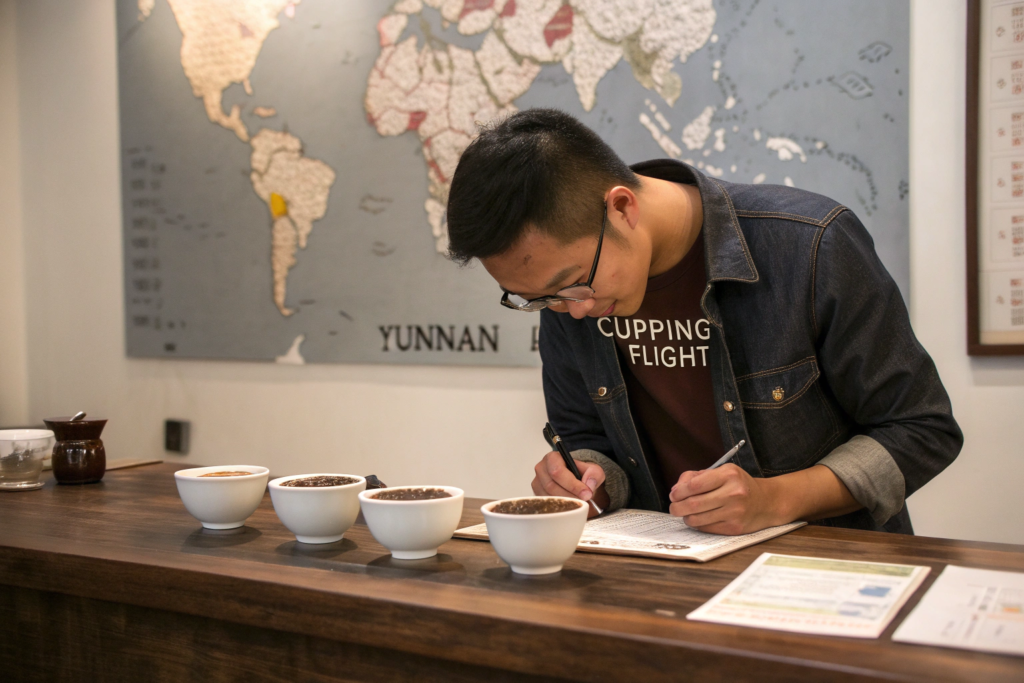
Cupping Yunnan coffees requires the same rigor as cupping any origin, with a few specific considerations. The range of quality within Yunnan is wide—from commodity-grade Catimor that tastes generically "coffee-ish" to specialty micro-lots that score 86+. The buyer's job is to place each sample within that range and to evaluate it on its own terms, not against a preconceived idea of what Yunnan coffee should taste like.
Evaluating Yunnan regional samples effectively requires cupping the coffee blind against reference samples from known origins, paying specific attention to cleanliness, body structure, and the quality of acidity. Yunnan's best lots are defined by what they lack—defects, harshness, astringency—as much as by what they express. The buyer should evaluate each sample for its intrinsic quality and its potential role in their portfolio, whether as a single-origin offering, a blend component, or an experimental micro-lot. Regional differences between Baoshan and Pu'er provide a starting point, but individual lot evaluation is essential.
How Do You Cup Yunnan Catimor Fairly Against Arabica From Other Origins?
Catimor has a reputation problem. It's a hybrid of Arabica and Robusta, developed for disease resistance. In many origins, it's associated with harsh, bitter, low-quality coffee. Yunnan's Catimor is different. Grown at altitude and processed carefully, it loses the harsh characteristics of its lowland relatives and expresses a clean, balanced profile. But cupping it next to a washed Ethiopian Yirgacheffe requires some mental adjustment.
The Ethiopian will likely be more aromatic, more brightly acidic, more floral. The Yunnan Catimor will likely be more restrained, more tea-like, with a quieter acidity. Judged by the Ethiopian's standards, the Catimor might seem dull. But that's the wrong comparison. The Catimor should be judged on its own merits—is it clean? Is the body pleasant? Is the flavor balanced and coherent? Does it have a distinct, enjoyable character?
A fair cupping evaluates each coffee for what it is trying to be, not for what it isn't. A Yunnan Catimor is not trying to be an Ethiopian. It's trying to be a clean, versatile, well-structured coffee with subtle complexity. At its best, it succeeds. Cup it alongside a mild Colombian or a washed Guatemalan for a more appropriate comparison. You'll find it holds its own.
What Should You Look for in a Pre-Shipment Sample From Yunnan?
The pre-shipment sample is the final exam for any coffee, but for a relatively new origin like Yunnan, it carries extra weight. The buyer needs to verify that the coffee in the container matches the offer sample they approved months earlier.
Consistency is the first check. Does the pre-shipment sample cup like the offer sample? Some variation is normal—coffee is an agricultural product. But the core character should be the same. If the offer sample showed red apple and black tea, the pre-shipment sample should show red apple and black tea, not fermented fruit or cardboard.
Cleanliness is the second check. Yunnan's dry harvest climate should produce clean cups. Any hint of ferment, mold, or phenol in a pre-shipment sample is a serious concern. It suggests a processing failure or a storage problem. Do not accept it.
The lot code is the third check. The pre-shipment sample should be clearly labeled with the lot code that appears on the contract and will appear on the shipping documents. Traceability is a core part of specialty coffee's value proposition. A supplier who can't or won't provide a lot-specific pre-shipment sample is not a specialty supplier.
At BeanofCoffee, every pre-shipment sample we send includes the lot code, the cupping score from our lab, the moisture and water activity readings, and the date the sample was drawn. We want the buyer to cup it and approve it with full information. That's what a professional supplier does.
Conclusion
The regional tasting notes of Yunnan Arabica tell a story of a young, fast-maturing coffee origin. Baoshan offers structure, black tea, red apple, and a clean, malty finish shaped by high altitude and volcanic soil. Pu'er offers softness, stone fruit, caramel, and occasional floral complexity shaped by a tea-growing terroir. Across both regions, micro-lots and experimental processing are pushing the boundaries, producing coffees with citrus acidity, tropical fruit, and floral aromatics that challenge old assumptions about what Asian coffee can be.
For a buyer, the opportunity is in the diversity. Yunnan is not one flavor. It's a palette. If you want to explore the range—from a classic washed Baoshan to an experimental Pu'er natural—reach out to Cathy Cai at cathy@beanofcoffee.com. She can arrange a regional sample set, with cupping notes and lot data, so you can taste the differences for yourself. Yunnan is writing its coffee story in real time. The best chapters are still being written.