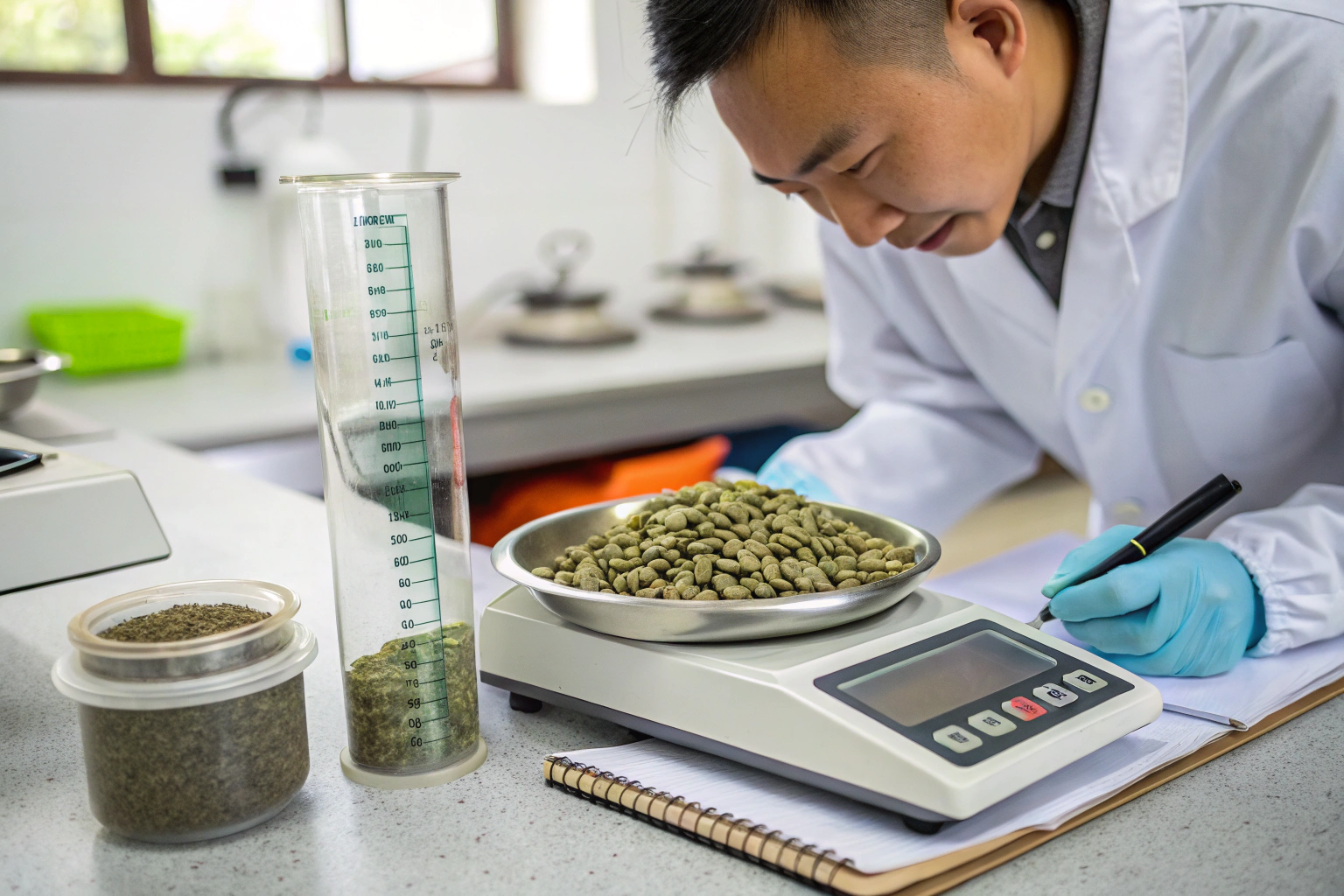
You buy Arabica from a new origin. The sample tastes good. The screen size is right. The moisture is fine. But when your roaster runs it, the roast goes sideways. The beans scorch on the outside and stay underdeveloped inside. You waste a batch. You lose a day. That is the problem. What you missed was density. And density starts with specific gravity.
The specific gravity of high-grown Arabica typically ranges from 1.14 to 1.40, with most specialty lots falling between 1.20 and 1.30. In bulk density terms, high-grown Arabica usually measures 680 to 780 grams per liter. Ethiopian and Kenyan highland coffees sit at 690 to 720 g/L and above. Brazilian low-grown naturals sit around 660 to 680 g/L. These numbers matter because denser beans need different roasting profiles and often score higher in cupping. At BeanofCoffee, we measure density on every Yunnan lot before we ship.
So, what do these numbers actually mean? And how do you use them? Let me break it down. I will share what I test and why.
What Is Specific Gravity in Green Coffee?
You may hear people use “density” and “specific gravity” like they mean the same thing. They are close, but not identical. Specific gravity is a ratio. Density is a measurement. Both tell you how much stuff is packed into a bean. Let me explain the difference.
Specific gravity is the ratio of a bean's mass to the mass of an equal volume of water. Density is the mass per unit volume, usually shown as grams per liter or grams per milliliter. In coffee trade, people use both. A specific gravity of 1.20 means the bean is 20% heavier than the same volume of water. Bulk density of 700 g/L means one liter of beans weighs 700 grams. Both numbers describe how compact the bean is.
I use bulk density more often because it is easier to measure in the warehouse. I fill a one-liter container with beans and weigh it. That gives me g/L. Specific gravity is more common in research papers. The Dabov Coffee density guide explains both methods clearly. So, what does this mean? It means you should pick one method and stick with it. Then compare your lots against each other. Consistency in measurement matters more than the unit.
| Term | What It Means | Common Unit |
|---|---|---|
| Specific gravity | Ratio to water mass | No unit |
| Bulk density | Mass per volume | g/L or g/mL |
| True density | Mass per volume, no air gaps | g/cm³ |
| Bean mass | Weight of 1,000 beans | grams |
How Do You Measure Specific Gravity?
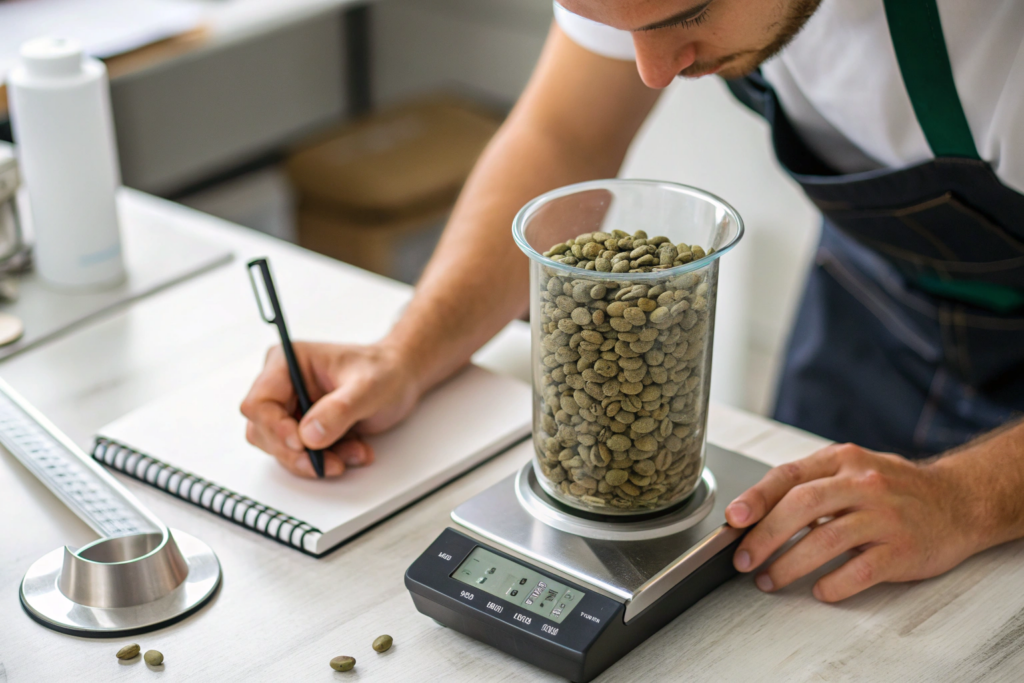
Specific gravity is measured by comparing the weight of a coffee sample to the weight of the same volume of water. A pycnometer or a specific gravity bottle works well for this. You fill the bottle with beans. You weigh it. Then you fill it with water. You weigh it again. The ratio gives you the specific gravity.
A study from the University of San Carlos in Guatemala found that Arabica specific gravity ranges from 1.14 to 1.40. Brazil averaged 1.20. Central America averaged 1.24. Colombia averaged 1.27. Robusta measured 1.18. That is a clear pattern. High-grown Arabica is denser than low-grown coffee. So, what does this mean? It means specific gravity is a quick way to check origin quality. A Colombian lot at 1.27 is denser than a Brazilian lot at 1.20. That tells you something about the bean before you even cup it.
What Is the Difference Between Specific Gravity and Bulk Density?
Specific gravity and bulk density measure different things. Specific gravity measures the true density of individual beans. Bulk density measures how much a pile of beans weighs in a given volume. Bulk density includes the air gaps between beans. The ISO 6669:1995 standard sets the method for measuring bulk density of whole green coffee.
I use bulk density for daily work because it is fast. Fill a one-liter cup. Weigh it. Done. The Royal Coffee analysis describes densities below 0.64 g/mL as low, around 0.67 g/mL as medium, and above 0.69 g/mL as high. That translates to 640, 670, and 690 g/L. So, a lot at 720 g/L is high density. A lot at 650 g/L is low density. That difference changes how you roast.
How Does Altitude Change Specific Gravity?
You may wonder why altitude matters so much. It is not about the height itself. It is about the temperature and water. At high altitude, the air is cooler. The soil drains faster. The cherries ripen slower. That slow ripening builds a denser bean. Let me explain the science.
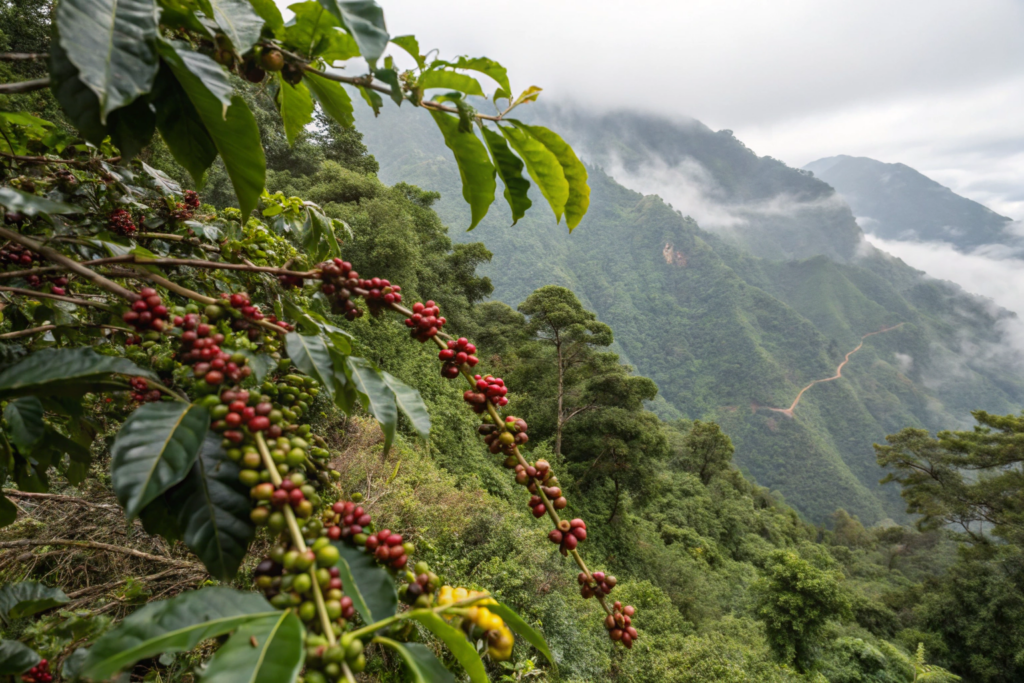
Altitude changes specific gravity because cooler temperatures slow cherry maturation. At 1,500 meters, temperatures drop about 9°C compared to sea level. Coffee cherries take 10 to 12 months to ripen instead of 7 to 8 months. That extra time lets the bean accumulate more sugars, more lipids, and more precursor compounds. The result is a denser, heavier bean with more flavor potential. Higher altitude almost always means higher specific gravity.
A study of coffee grown at different elevations in Nariño, Colombia found that bean mass and apparent density increased with altitude. Ethiopian and Kenyan coffees from 1,800 meters and above consistently measure 690 to 720 g/L or higher. Brazilian coffees from lower elevations typically measure 660 to 680 g/L. So, what does this mean? It means altitude is a reliable predictor of density. When a supplier tells you the farm is at 1,600 meters, you can expect a denser bean. That density translates to better roast control and often better cup quality.
What Specific Gravity Values Match Each Altitude Level?
Let me give you a simple table that links altitude to density and trade grade.
| Altitude | Trade Grade | Expected Bulk Density | Expected Specific Gravity |
|---|---|---|---|
| Below 600 m | Standard | 620-660 g/L | 1.10-1.18 |
| 600-900 m | High Grown (HG) | 650-690 g/L | 1.16-1.22 |
| 900-1,200 m | High Grown (HG) | 670-710 g/L | 1.20-1.26 |
| 1,200-1,500 m | Strictly High Grown (SHG) | 690-740 g/L | 1.22-1.30 |
| Above 1,500 m | Strictly High Grown (SHG) | 710-780 g/L | 1.25-1.35 |
The World Bank coffee grading document defines Strictly High Grown (SHG) as coffee grown above 1,200 meters. These beans have a closed fissure, high acidity, good body, and aroma. The dense structure comes from slow growth. So, when you see SHG on a bag, you know the density is higher. That is useful information.
Does Yunnan Arabica Match Other High-Grown Origins?
Yes, it does. Yunnan coffee grows at 1,200 to 1,700 meters in Baoshan and surrounding areas. That puts it in the SHG range. The dry season from November to April allows slow, even drying. The cool nights slow cherry development. The result is a dense bean with good sugar content.
I measure density on every Yunnan lot. Most lots from our farms in Baoshan measure 700 to 750 g/L. The best lots hit 760 or above. That puts them in the same range as Colombian and Kenyan high-grown coffees. The Keffa Coffee density reference lists Colombia high-altitude at 700-760 g/L and Ethiopia highland at 710-780 g/L. Yunnan sits right in that band. So, when buyers ask if Yunnan can compete on density, the answer is yes. The numbers prove it.
What Are the Density Grades in Coffee Trade?
You may see terms like “hard bean” and “soft bean” on coffee bags. These terms come from density. A hard bean is dense. A soft bean is light. The trade uses these grades to set prices. Let me show you how it works.
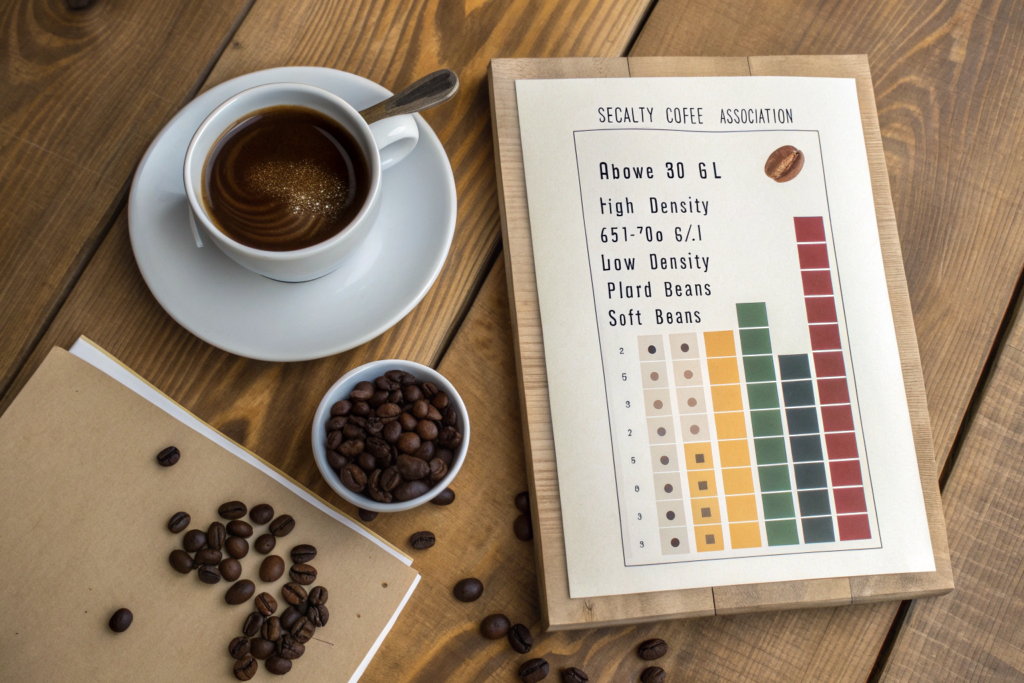
The coffee trade grades density into four main bands: very high density above 750 g/L, high density at 701-750 g/L, medium density at 651-700 g/L, and low density below 650 g/L. These bands come from the Specialty Coffee Association and are used by traders worldwide. Beans above 700 g/L are called hard beans. Beans below 700 g/L are called soft beans. Hard beans usually score higher in cupping and command premium prices.
The VINAHUGO density classification lists SCA grades clearly. Very high density is above 750 g/L. High density is 701-750 g/L. Medium is 651-700 g/L. Low is below 650 g/L. I use these bands when I evaluate lots. A lot at 720 g/L is high density. A lot at 660 g/L is medium. That difference tells me how to roast and how to price. So, what does this mean? It means density is not just a number. It is a trading tool. It helps you compare lots. It helps you set expectations. It helps you avoid surprises.
| Density Grade | Bulk Density (g/L) | Trade Term | Typical Origin |
|---|---|---|---|
| Very high | >750 | Strictly Hard Bean | Ethiopia, Kenya highlands |
| High | 701-750 | Hard Bean | Colombia, Guatemala, Yunnan |
| Medium | 651-700 | Semi-Hard Bean | Brazil, Honduras |
| Low | <650 | Soft Bean | Sumatra lowlands, Robusta |
What Makes a Coffee Bean Hard or Soft?
A hard bean is dense. It grew slowly at high altitude. It has compact cells and closed fissures. A soft bean is less dense. It grew fast at low altitude. It has more air pockets and open fissures. The Home-Barista forum discussion explains that higher and colder growing conditions produce denser beans. A Catuai variety will be denser than a Maragogype grown at the same altitude. Peaberry beans are denser than normal beans from the same plant. So, variety matters too. But altitude is the biggest factor. When you buy a hard bean, you are buying a bean that grew slowly and built more flavor compounds. That is why it costs more.
How Do You Use Density Grades for Buying Decisions?
Use density grades to set your roast profile before you even turn on the roaster. A high-density bean needs more heat at the start. It needs more development time after first crack. A low-density bean needs less heat. It develops faster. The Dabov density guide states that high-density beans resist heat transfer, reward patience, and work well with lighter roasts. Low-density beans caramelize quickly and suit heavier profiles.
I ask for density data before I buy. If the supplier cannot provide it, I measure it myself. It takes five minutes. It saves a ruined roast. So, make density a required spec on your purchase order. It is as important as moisture and screen size.
How Does Density Affect Roasting and Flavor?
You may not think about density when you roast. You just follow your usual profile. But density changes everything. A dense bean needs different heat. A light bean needs different airflow. If you ignore density, you get uneven roasts. Let me show you what happens.
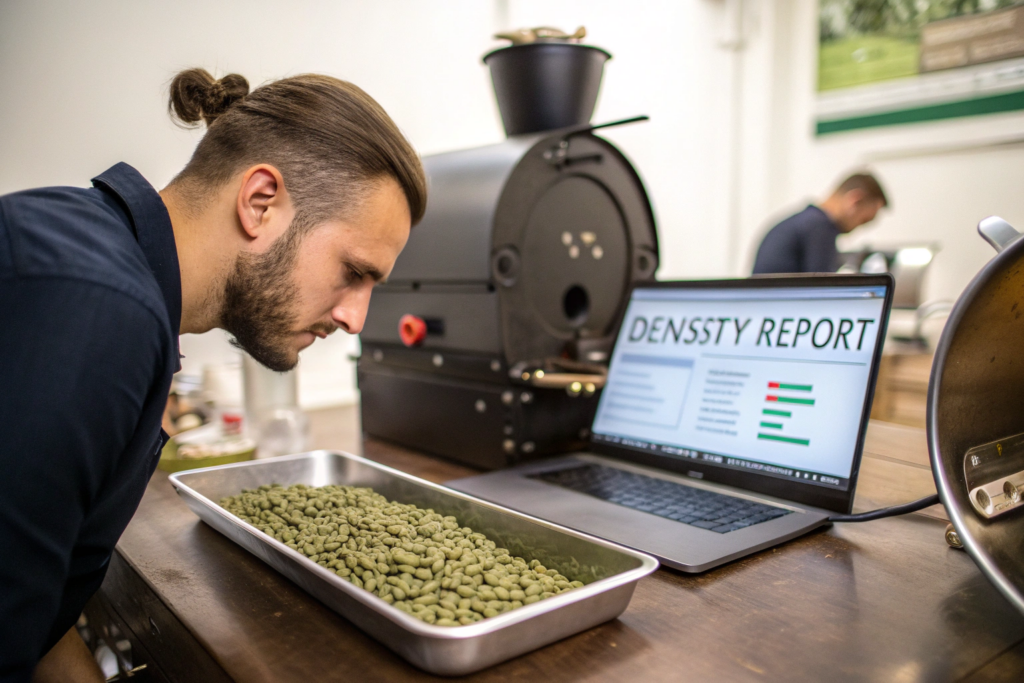
Density affects roasting because denser beans conduct heat more slowly. A high-density bean needs a higher charge temperature and more development time. A low-density bean needs a lower charge and less development time. If you use the same profile for both, the dense bean stays underdeveloped and the light bean scorches. Density also affects flavor. Dense beans often have more sweetness and acidity. Light beans often taste flatter and less complex.
The Keffa Coffee quality guide recommends charging 5 to 10°F higher for high-density coffees and using more aggressive airflow to prevent stalling. Development time may need to be longer. For low-density coffees, charge lower and watch for scorching. So, what does this mean? It means density is not just a buying spec. It is a roasting tool. It helps you dial in faster. It helps you get the best cup from every lot.
What Roast Profile Works for High-Density Beans?
High-density beans need a specific approach. Start with a higher charge temperature. Use more airflow early to push heat through the dense cell structure. Extend the development phase after first crack. This lets the sugars caramelize fully without burning the outside. The Royal Coffee density analysis notes that high-density coffee is more valuable because it weighs more and takes up less space. That value comes from flavor potential. If you roast it right, you taste it. If you roast it wrong, you waste it.
I roast high-density Yunnan lots with a slightly longer development phase. I also drop them at a slightly lighter roast level. That preserves the bright acidity and sweet finish. So, if you get a dense lot, do not rush it. Give it the time it needs.
How Does Density Correlate With Cupping Score?
Density correlates with cupping score, but not perfectly. A Korean study published in the Journal of the Korean Society of Food Science and Nutrition found that density decreased significantly as coffee grade dropped. NY2 grade beans measured 69.17 g/mL. NY4/5 grade beans measured 67.67 g/mL. The study also found that higher density green beans formed richer flavors.
But density alone does not guarantee a high score. Processing, variety, and storage all matter. A dense bean with poor processing can still taste flat. A less dense bean with great processing can taste excellent. So, use density as one data point. Combine it with cupping, moisture, and screen size. That is how you get the full picture.
Conclusion
Specific gravity and density are not just lab numbers. They tell you how a bean grew, how it will roast, and what it might taste like. High-grown Arabica typically measures 1.14 to 1.40 in specific gravity. In bulk density terms, that is 680 to 780 g/L. Yunnan Arabica from 1,200 to 1,700 meters fits right in that range. I measure every lot before shipment. I share those numbers with my buyers. That data helps them roast better and buy with confidence.
If you want density data with every order, contact us. BeanofCoffee owns over 10,000 acres in Baoshan, Yunnan. We export Catimor, Arabica, and Robusta to North America, Europe, and Australia. We measure moisture, density, and screen size on every lot. For orders or questions, email Cathy Cai at cathy@beanofcoffee.com. She will share the specs you need.