I used to think a "sustainable certification" was just a fancy sticker you put on a bag to charge a higher price. Honestly, that was my mindset fifteen years ago when we first started exporting from Baoshan. I saw the application forms, the auditor visits, the paperwork, and I thought it was all just a marketing tax. Then, a major buyer from Europe walked away from a full container deal. Not because of the price. Not because of the quality. He walked because we didn't have a single internationally recognized certification to prove our farm wasn't hurting the local water supply or our own workers. That stung. But it also woke me up. I realized that in the global market, a good story about sustainability is worthless without a verifiable standard to back it up.
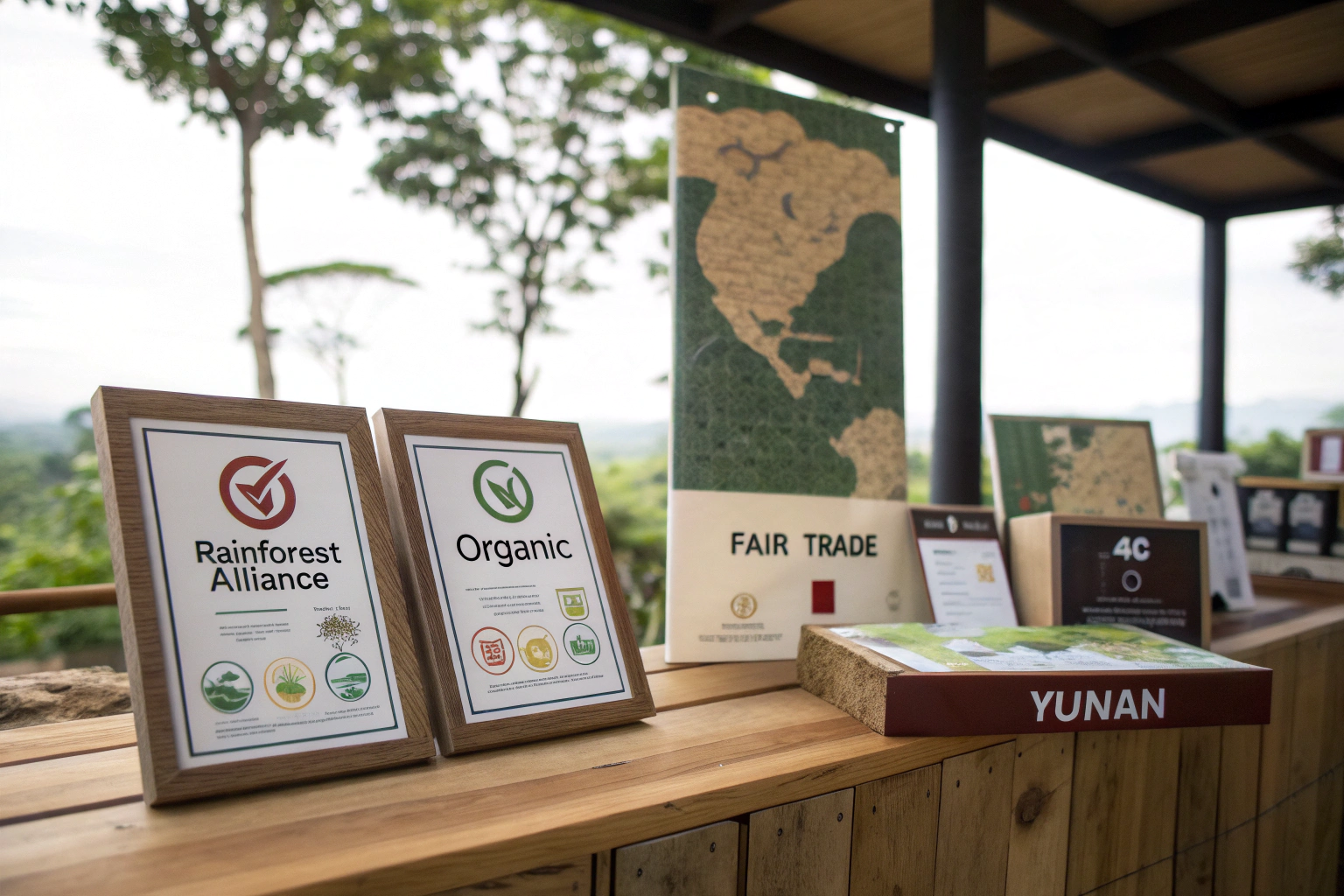
Sustainable certifications for coffee farms are third-party verified seals—such as Rainforest Alliance, Organic, Fair Trade, and 4C—that audit and guarantee specific environmental, social, and economic practices on a farm, giving importers and roasters a legally defensible way to prove their supply chain is ethical and safe. These aren't just logos. They're a risk management tool for a buyer like Ron, who cares deeply about security and quality. A certification means an independent inspector has already walked our fields, checked our water sources, and interviewed our pickers. It replaces your need to fly to Yunnan and do the audit yourself. It’s a pre-packaged trust signal.
What I want to do here is give you a real, unfiltered tour of the certifications we've actually lived with, paid for, and been audited against. Not the glossy marketing version, but the gritty reality of what it takes to get them, what they actually guarantee, and which one makes the most sense for your brand. Because picking the wrong certification for your market is just an expensive mistake. Let’s start with the one that most U.S. and European buyers ask about first, the one that has probably the most complex relationship with the word "organic."
Is Rainforest Alliance Certification Worth It for a Chinese Arabica Farm?
Getting Rainforest Alliance certified was, I won't lie, a headache in year one. The checklist is massive. It's not just about not spraying certain chemicals. It's about mapping every single water source on our 10,000 acres, proving we have buffer zones along the natural streams, and documenting that our seasonal pickers' kids have access to a school. It feels invasive. But over time, I realized this bureaucracy is exactly what creates the value. The standard forces you to become a better farm manager. It stops you from cutting corners when the harvest pressure is high and nobody is watching. For a Chinese Arabica farm, the certification is a signal to the world that we operate by a set of rules that a buyer in Germany or Australia can instantly recognize.
Yes, Rainforest Alliance certification is worth the investment for a Chinese Arabica farm because it unlocks premium market access in Europe and North America, where major retail chains and large coffee roasters often mandate this specific seal as a minimum entry requirement for their supply chain. The seal focuses heavily on ecosystem conservation and continuous improvement. It’s less about a fixed price premium and more about securing a long-term, stable buyer who won't abandon you for a cheaper, uncertified source next season. For a buyer like Ron, a Rainforest Alliance seal on our coffee means our farm has a deforestation-free, climate-smart plan, which protects his brand from environmental criticism.
But the worth is not just about market access. It’s about the farm’s resilience. The standard requires us to track our costs and yields meticulously. This data helps us reduce waste and, frankly, makes us more profitable in the long run. Let's look at what the seal specifically forces us to do with the water that runs through our land.
How Does the Rainforest Alliance Standard Protect Water Sources on a Farm?
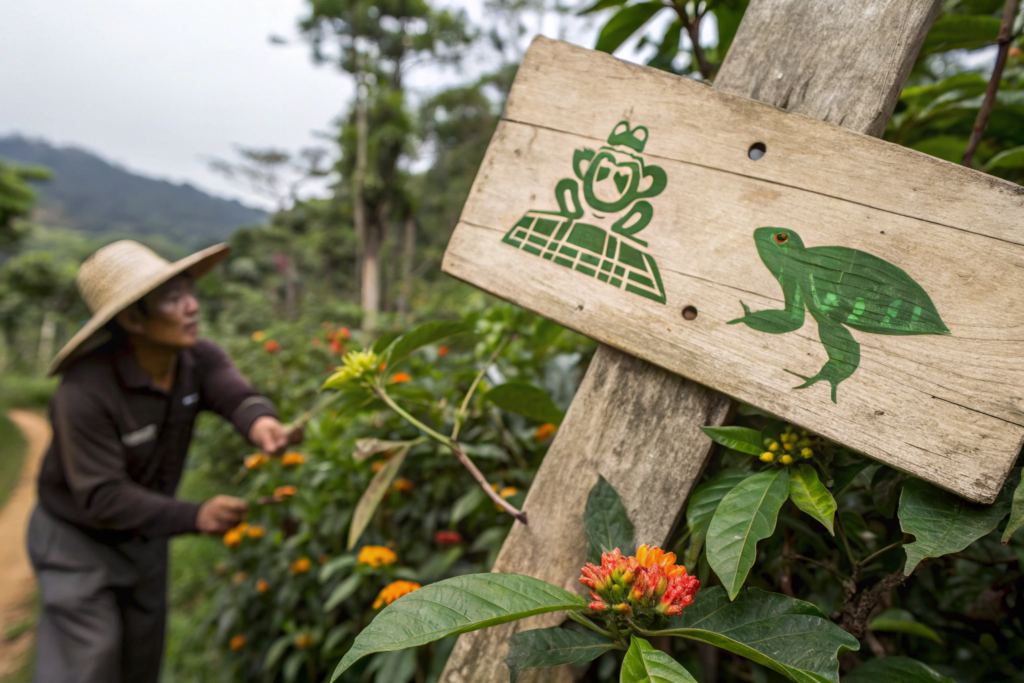
This is the part of the audit that surprised me most. The inspector didn't just look at a map. He walked every single creek. He checked if our processing wastewater—the sticky, sugary water from pulping the coffee cherries—was being filtered through a treatment lagoon or just dumped into the ground. Years ago, before the certification, we didn't have a proper system. The water just seeped away. That was normal practice in many places. The certification forced us to build a series of settling ponds with specific aquatic plants that clean the water naturally before it re-enters the watershed.
The standard is very specific: no raw wastewater can enter a natural waterway. We also had to document that our pesticide storage has a concrete, spill-proof floor, located far from any well or river. These are permanent structural changes that protect not just the environment, but our own drinking water. By adhering to these rigorous requirements, we ensure compliance with the standard's ecosystem conservation protocols. It's a system that proves our water management is sustainable and safe, which is also a core requirement for meeting certain broad environmental protection guidelines for agricultural imports.
Can This Certification Help a U.S. Roaster Avoid Greenwashing Accusations?
This is a real fear for your brand, isn't it? You put a little leaf symbol on your bag, or you call the coffee "sustainably sourced," and a customer digs into your website. If they find nothing but a pretty story, you're in trouble. The accusation of greenwashing can destroy a small roaster's reputation overnight. A Rainforest Alliance certification is your legal and marketing shield. It's a defensible, third-party claim that a specific, named organization has verified your supply chain.
You can use their logo on your packaging according to a strict contract. You're not just making a vague claim; you're pointing to a specific audit. For a roaster, this turns a liability into an asset. You are not the auditor. You are simply reporting a fact: this coffee comes from a certified farm. This layer of supply chain transparency is exactly what discerning wholesale clients are now demanding in their requests for proposals. They want to know the exact source and the validated proof, not just a marketing narrative.
But what if your market is less about the ecosystem and more about the purity of the bean itself? What if your customers care most about what is or isn't sprayed on the coffee? That leads to a different, and in many ways more legally complicated, certification. The one that governs the actual chemistry of the soil and the plants.
What Does a Certified Organic Coffee Label Guarantee for Importers?
When you buy an Organic-certified coffee from us, you're not buying a feeling. You're buying a chemical guarantee backed by a paper trail that goes back three years. This is the key difference. Organic isn't a snapshot of the farm today. It's a history. To get the certification, the soil on our specific plot in Baoshan had to be free of prohibited synthetic pesticides and fertilizers for 36 consecutive months before the first organic harvest. That's three years of managing weeds and pests with organic compost and manual labor, with zero premium return. It's a massive financial bet. We made that bet because we knew buyers like Ron, who prioritize safety and quality, would need absolute assurance that our "clean" coffee is genuinely clean.
A Certified Organic label guarantees the importer that the green coffee has been produced without synthetic pesticides, herbicides, or fertilizers, and that the entire supply chain from the farm's soil to the shipping container has been audited against a strict, legally defined chemical standard. For a U.S. buyer, this isn't just a preference. It's a direct link to the USDA's National Organic Program, which is a federal regulation. If a roaster wants to sell their roasted coffee as "USDA Organic" on the shelf, the green coffee they import must come from a farm certified to the same standard, and they themselves must hold an organic handling certificate.
This guarantee travels with the coffee in the form of an organic transaction certificate. Every single link in the chain—farmer, exporter, importer—must be certified. If one link breaks, the organic status is lost. It's a rigid, unforgiving system, which is why it has such high integrity. Let's look at how this system tracks the coffee from my drying patio all the way to your roastery door.
How Does the Organic Chain of Custody Prevent Fraud in Coffee Shipping?
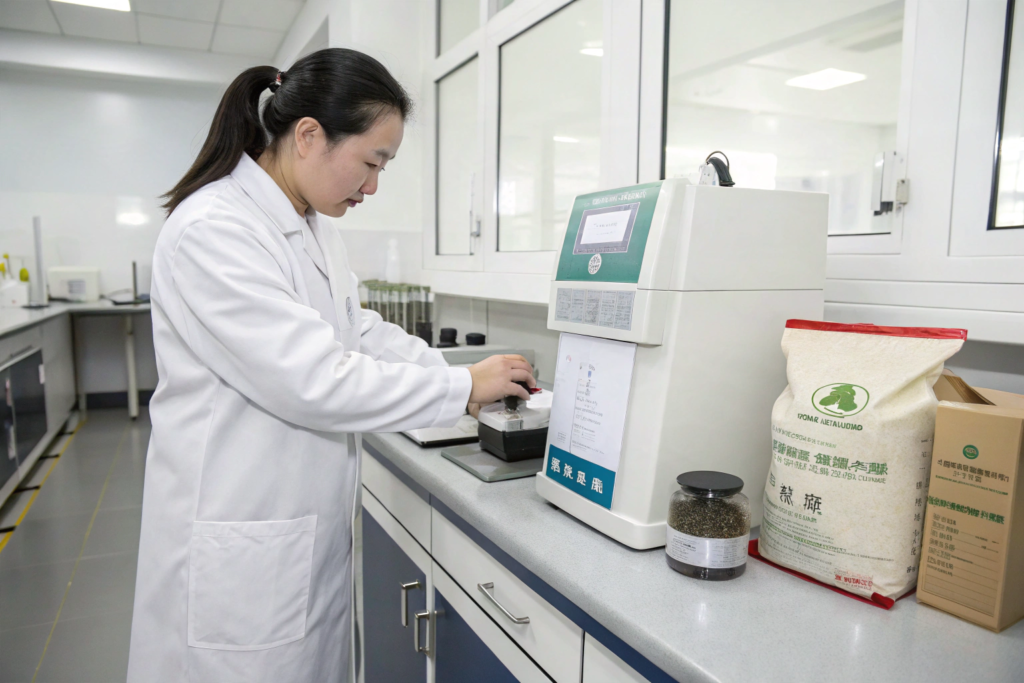
The paper is the product. In organic coffee, the transaction certificate is nearly as valuable as the beans. When we ship a container of organic Arabica to the U.S., we don't just send a commercial invoice. We issue an Organic Import Certificate that matches the exact lot number, the weight, and the vessel name. This document is generated through our certifier's online portal. When the coffee arrives, your own organic certifier checks the documents at your end to make sure the numbers match perfectly. A discrepancy, even a small one like a 100-kilo weight difference, can trigger a fraud investigation.
This chain of custody prevents a dishonest operator from buying one ton of organic beans and then blending it with ten tons of cheaper conventional beans while selling the whole lot as organic. The audit trail is too tight. Every single bag is tracked. This rigorous document flow is aligned with the strict USDA Organic regulations on import documentation. It's a process designed to give you, the importer, complete confidence that you're selling exactly what you paid for, a level of trust that's also fundamental to building a transparent direct trade relationship with a single farm.
Why Are Organic Green Coffee Beans Often More Expensive Than Conventional?
That 30% to 50% price premium you see on an organic FOB quote isn't arbitrary. It directly reflects our real, measurable costs. First, the yield on organic land is lower. Without synthetic nitrogen, our Catimor trees produce fewer cherries per branch. We have to farm more land to get the same volume. Second, the manual labor cost is immense. We can't spray herbicide, so we hire teams of workers to pull weeds by hand, multiple times during the rainy season. This labor cost, in a country with a developing rural economy, is significant.
Third, the annual certification audit fee itself costs thousands of dollars. So does the mandatory testing. Every organic shipment we send out is pulled and tested for a panel of over 200 prohibited pesticide residues by an independent lab before we even book the vessel. This is a cost we pay, and it's a cost that is part of your price. This annual audit ensures we are strictly compliant with the standards recognized under international food safety systems. You are not paying for a logo; you are paying for a guaranteed, chemically verified purity and a three-year soil transition period.
That purity and safety are cornerstones of a premium product. But a farm isn't just soil and plants. It's people. And the sustainability of our people—the pickers, the sorters, the truck drivers—is a whole other layer of security, and a whole other certification process, that some buyers, especially in Europe, consider non-negotiable.
How Does a Fair Trade License Impact Worker Welfare on a Plantation?
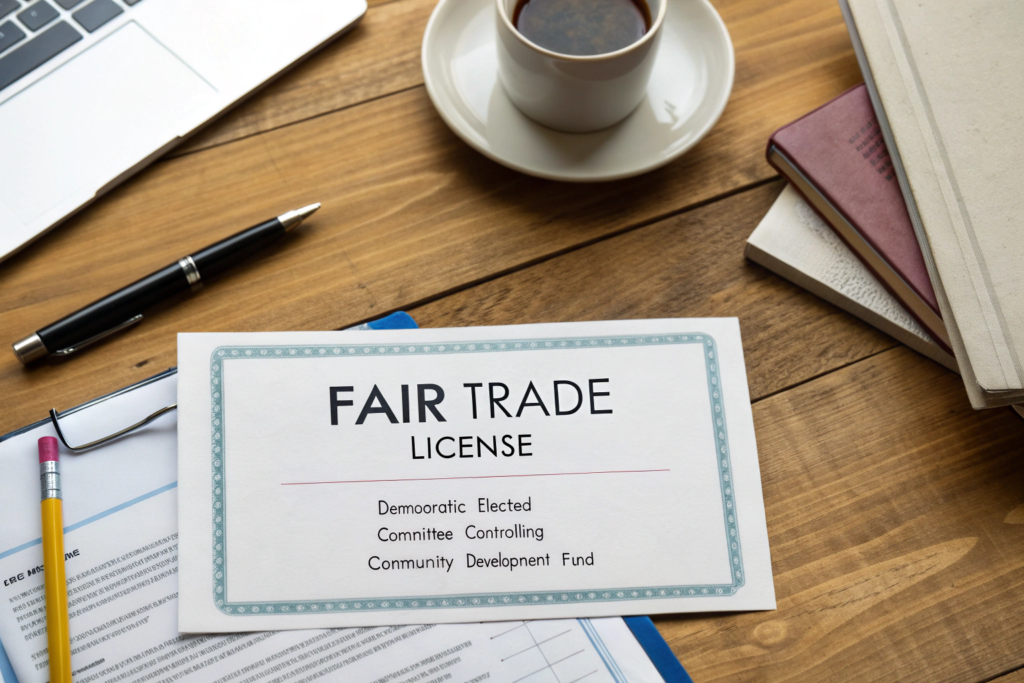
There's a common misunderstanding about Fair Trade. It's not just about a "fair price." Honestly, a market price for quality specialty coffee can often be higher than the Fair Trade minimum. The real impact of a Fair Trade license on a plantation like ours is the structure it forces around worker representation and community investment. When we applied for the license, we couldn't just claim we treated workers well. We had to prove we had a democratically elected worker committee. This committee, made up of pickers and processing staff, has real power. They decide how to spend the "Fair Trade Premium" money—an extra sum paid by the buyer on top of the contracted coffee price. This structure shifts the power dynamic from a top-down management decision to a collective, community-led choice.
A Fair Trade license directly impacts worker welfare by mandating a democratically elected committee that controls a separate community development fund, guaranteeing that a portion of the coffee's selling price is invested in projects chosen by the workers themselves, such as healthcare, education, or infrastructure. For an importer, this license provides a verifiable social standard. It answers the tough, awkward question: "Is my low coffee price causing poverty on this farm?" With a Fair Trade license, you have a documented, audited system that proves the workers have a collective bargaining tool and a direct cash fund for their own priorities. It’s a powerful layer of social security for your supply chain.
This isn't a perfect system; no system is. But it creates a formal channel where one didn't exist before. Let's look at the specific pot of money that makes this all work and how it's kept separate from our operational bank account.
What Exactly Is the Fair Trade Premium and How Is It Used?
The Premium is the engine of the whole system. For every pound of Fair Trade coffee we sell, the buyer pays an extra fixed sum, currently around 20 cents per pound. This money never touches our company's main bank account. It goes directly into a separate, transparent bank account controlled jointly by the worker committee and a management representative. I can't just write a check from this account for a new tractor. The committee votes on every single use.
Last year, our worker committee voted to use a large part of the premium to subsidize annual health check-ups for all the permanent workers' families. The year before, they invested in new energy-efficient cooking stoves for the worker dormitories. It's their decision. This direct, tangible benefit is what separates Fair Trade from a simple wage bonus. The system is audited annually by the certifier to ensure the money is spent according to the committee's democratically recorded decisions. This transparent structure aligns strongly with the core principles of ethical sourcing, a key component of modern sustainable agricultural value chains. It provides a tangible social return on investment that complements the environmental data.
Can a Fair Trade Certificate Stabilize Your Supply Chain During Price Spikes?
This is a strategic benefit that most price-focused buyers overlook. The C-market is volatile. When the global price of Arabica suddenly skyrockets due to a frost in Brazil, transaction-based buyers get hit with huge price increases overnight. Farmers and traders with loose, non-committed relationships often break contracts to sell to the highest bidder. This is a reality of the commodity world. A Fair Trade partnership adds a powerful incentive for loyalty. The Fair Trade minimum price acts as a safety net, but more importantly, the long-term contracts and the premium fund create a bond.
A farm is far less likely to "forget" a contract with a buyer who has been consistently paying the premium that funds their community's health clinic. There's a moral dimension and a relational stake that goes beyond the daily commodity ticker. This provides a sourcing stability that pure price negotiation can't replicate. This focus on long-term partnership directly helps secure a more predictable and ethically grounded supply chain, a point often explored in discussions on ethical coffee buying practices. It turns a simple purchase order into a relationship that can weather a volatile market spike without a breach.
These certifications—Rainforest Alliance, Organic, Fair Trade—are the heavy hitters. They're the ones with the big logos and the massive audit checklists. But the certification world is much more nuanced now. A recent, more pragmatic standard has emerged, especially for large-scale buyers who need a quick, verifiable baseline without the three-year wait and the premium price tag.
Is 4C Certification the Fastest Path to Verified Sustainable Sourcing?
Sometimes a buyer doesn't need the most expensive or the most famous certification. They need a credible baseline, and they need it fast. This is where the 4C certification comes in. Think of it as the entry door to the sustainable coffee world, not the penthouse suite. When a big European trading company approached us for a massive volume of our basic Arabica, they didn't ask for Organic. The volume they needed simply didn't exist in organic form. They asked if we were 4C verified. The standard is built around a risk assessment and a continuous improvement plan, not an absolute pass/fail on a hundred strict rules. It's designed to bring a huge volume of the world's coffee up to a minimum acceptable standard, eliminating the worst practices first.
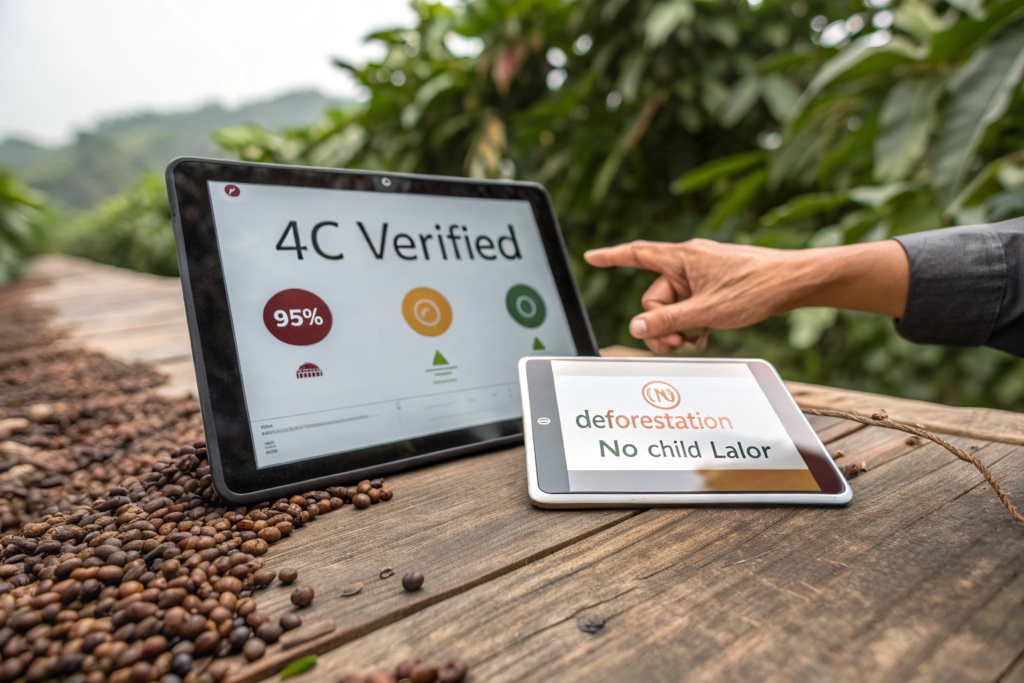
4C certification is the fastest, most scalable path to verified sustainable sourcing because it uses a traffic-light risk assessment system to eliminate unacceptable practices—like deforestation and forced labor—while allowing a farm to create a step-by-step improvement plan for other areas, making it achievable for entire landscapes in a single season. It's less of a marketing seal for a premium bag and more of a bulk verification tool for the supply chain. It allows a buyer to confidently source large, stable volumes of coffee with a guarantee that the absolute "red line" social and environmental violations are not present. For a buyer who needs to fill a lot of cups with a verified "responsible" bean without the huge organic premium, 4C is the practical tool.
This process is entirely different from the Organic or Rainforest Alliance audits. It's more collaborative at the start. It assesses the farm against a clear, universal code of conduct. Let's look at what that code specifically forbids.
What Are the 4C Code of Conduct's Red Light Elimination Criteria?
This is the core of the 4C system, and it's brutally simple. There are ten "Unacceptable Practices." If an auditor finds even one of them on our farm, we fail immediately. There is no improvement plan for these. It's a hard no. These red lines include child labor, forced labor, human trafficking, and clearing primary forest for new coffee planting after a specific cut-off date. The list also bans the use of the most toxic, World Health Organization-listed Class 1A and 1B pesticides. This is a clear, non-negotiable floor. As a farm owner, I appreciate this clarity. It's not ambiguous. You either meet these ten rules, or you don't get the certificate. This hard-line approach is detailed within the 4C Code of Conduct and ensures a universally accepted minimum standard.
How Does the Continuous Improvement Plan Work for Chinese Exporters?
If the ten red lines are the door, the continuous improvement plan is the path once you're inside. The auditor assesses us on dozens of other "yellow" criteria, covering things like water efficiency, soil conservation, and worker health and safety training. We get scored. We are then required to document, year by year, how we are going to move those yellow indicators toward green. It's a formalized, written promise to get better. It might mean installing drip irrigation to reduce water use by 10% in year one. Or implementing a formal PPE training for all processing staff. This is a practical, business-aligned approach. The standard is not just about labeling a product; it’s a management tool. It complements the general push towards sustainable agricultural practices that many global food buyers now require.
This model acknowledges that perfection is a journey. It gives a buyer a guarantee that the worst practices are gone and a plan for the rest. This honest, continuous-improvement mindset is the foundation of any real, lasting partnership.
Conclusion
Choosing a sustainable certification isn't about picking the one with the prettiest logo. It's a financial and strategic decision that aligns your sourcing with your customers' deepest values and your own risk tolerance. A Rainforest Alliance seal tells a story of thriving ecosystems and climate resilience, protecting your brand from environmental criticism. An Organic certificate is a rigid, legally defensible chemical guarantee that comes with a justifiable price premium. A Fair Trade license proves your supply chain has a beating heart of social equity, with a democratically controlled community fund that can stabilize your supply during chaotic market swings. And a 4C verification offers a fast, pragmatic baseline that cleans up the worst practices and establishes a documented path for improvement, especially for high-volume needs.
For us at BeanofCoffee, these certifications aren't wall decorations. They are the external audits that keep us honest and give a buyer like Ron the security he needs to trust a container of coffee shipped from Yunnan to his warehouse door. You don't have to guess about our water treatment, our pesticide logs, or how our workers' children are doing. You can look at the audit report. If you're ready to build a sourcing program around a specific certification, or if you need help navigating which one fits your market best, let's talk specifics. Reach out to our export partner, Cathy Cai, and she can provide our current certificate scans and the relevant lot availability. Write to her directly at cathy@beanofcoffee.com. Let's put a verifiable standard behind your next blend.