I was on a call with a new buyer from Oregon last week, and he sounded exhausted. He'd just spent three days buried in a maze of government websites, trade forums, and supplier claims, trying to figure out what paperwork he actually, legally needed to import a container of coffee in 2026 without getting fined or stuck in port. The anxiety in his voice was unmistakable. He wasn't just worried about the cost of a certificate; he was terrified of the hidden one—the "certificate" nobody told him about, the one that would hold up his entire shipment and trigger thousands of dollars in demurrage fees. That's the real pain. The unknown unknown.
For 2026, coffee importers need a tiered certification strategy covering baseline legal requirements like FDA facility registration, layered with market-driven proof of ethical and organic integrity like Rainforest Alliance or USDA Organic, and increasingly secured by emerging digital traceability technologies that satisfy the new European Union deforestation regulations.
It's not about collecting pretty logos. It's about building a legal shield for your business and a trust badge for your brand. And the rules are shifting faster now than they have in decades. A piece of paper that worked in 2024 might not satisfy a customs officer or an eco-conscious consumer in 2026. So, let's cut through the noise. Let's lay out exactly what you need, from the non-negotiable foundations that get your container through the door, to the ethical certifications that get your coffee on the shelf, to the digital future that's already knocking on our warehouse door.
What Are the Mandatory Food Safety Registrations for Coffee Imports?
You can have the best coffee on earth, but if you mess up the mandatory food safety paperwork, that coffee rots in a customs warehouse. I've heard the nightmare stories. A small roaster finds an incredible coffee, wires the money, and then the container hits the U.S. port. It gets flagged. He didn't file a Prior Notice. Now, he's scrambling, paying storage fees, and his organic certification doesn't matter one bit because the FDA won't even let him inspect the beans. The stress of a detained load is enough to kill a small business.
Mandatory food safety registration is the entry ticket. Without an active FDA Food Facility Registration and an accurate Prior Notice filed for every single shipment, your coffee is legally dead on arrival. These are not optional upgrades; they are the law.
Let's be crystal clear on this. The difference between a "nice-to-have" quality certificate and a "must-have" legal registration is the difference between a marketing tool and a jail key. You need to separate the two in your mind before you even place an order. The foundational requirement is a digital relationship with the FDA, and it has two very specific, sequential steps.
Why Is FDA Facility Registration a Non-Negotiable First Step?
This is step zero. Before a single bean ships, your company's physical address or your customs broker's bonded warehouse address must be registered with the U.S. Food and Drug Administration. The registration must be renewed every even-numbered year, so it's active for 2026. The process is done online through the FDA Industry Systems portal. You receive a unique 11-digit registration number. Why is this non-negotiable? Because no customs entry can be filed without it. It's not about the quality of the bean; it's about the existence of a responsible party on U.S. soil that the FDA can inspect. I once had a client who let his registration lapse by just two weeks. He didn't notice the reminder email. His container of our premium Yunnan Arabica sat untouched for ten days, racking up demurrage fees, until his broker could file an emergency amendment. The coffee was perfect, but the paperwork had a hole in it. An often-overlooked detail is that this registration isn't just for the importer. As the exporter, BeanofCoffee must also be registered with the FDA. We hold a valid U.S. Agent designation and a compliant Food Facility Registration number, which we provide directly on your shipping documents. Without it, we can't be the shipper. You can verify our status and learn more about your own registration requirements directly on the FDA website.
How Does a Prior Notice Protect Your Container at the U.S. Border?
The Prior Notice is the second, critical, real-time document. It's filed electronically for each individual shipment. It tells the FDA exactly what is coming, from whom, how much, and when it will arrive. The rule is simple: the notice must be filed and confirmed no less than two hours before the ship arrives by sea. If you fail to file it on time, your coffee is automatically flagged. This is the specific document that prevents a hold. A clever detail most new importers don't realize is that a Prior Notice confirmation number is cross-checked against the CBP entry. If the numbers don't match, the system rejects the release. This single document links your physical shipment to your digital registration. As your supplier, I make this seamless. Three days before the vessel departs, I send you the full packing list, the vessel name, and the ocean bill of lading number. My logistics team also inputs our FDA registration details onto the commercial invoice. You simply hand these to your customs broker. They can use the FDA Prior Notice System Interface to submit it in minutes. It's a simple, fast, digital handshake that turns a potential border crisis into a boring, predictable clearance. Don't overcomplicate it. Get the registration. File the notice. Clear your goods. That's the safety net.
Why Are Organic and Fair Trade Certifications Still Crucial?
A roaster I know once said, "My coffee tastes so good, it sells itself." That's a beautiful idea, and it's wrong. The consumer standing in a grocery aisle in 2026 is looking at fifty different bags. They can't taste them. They can only trust them. The frustration for a buyer is spending years building a supply chain on taste alone, only to be shut out of a major supermarket account because you lack a recognizable trust badge. You're not just selling beans anymore; you're selling peace of mind, and that requires proof.
Organic and Fair Trade certifications are not just a fading trend. In 2026, they are the definitive proof points that convert a skeptic browsing a shelf into a loyal customer paying a premium. They remain the most recognized symbols of ethical and chemical-free production.
But here's what has changed. It's no longer enough to have the logo. A smart importer in 2026 is digging one layer deeper. You need to know exactly what the supply chain audit trail looks like, because the consumer is starting to ask, "But how do you know it's fair?" Let's look at the two pillars.
What Does a USDA Organic Certificate Prove to a Roaster’s Customers?
A USDA Organic seal is a simple chemical promise. It says this coffee was grown without synthetic pesticides, herbicides, or fertilizers for three years. For a roaster's customers, it's a personal health reassurance. But for you, as the importer, the certificate is a legal shield against fraud claims. The value of a USDA cert is in its trace-back chain. My farm's organic certificate, issued by an accredited certifier, is linked to a specific lot number. When I ship you an organic container, you receive a Transaction Certificate, or TC. This is the critical document. It ties the lot number from my farm to your company. When you sell that coffee as organic, your roaster must have that TC on file. If an inspector audits them, the trail must lead back unbroken to my plantation. I had a client who was fined because he bought from a broker who claimed the coffee was "organically grown" but couldn't produce a TC. The beans were fine, but the paperwork was broken. A detail often overlooked is the NOP import certificate. We lodge this with the USDA AMS National Organic Program before shipment. It pre-clears the organic status at the border. This means your container doesn't just clear FDA; it clears organic verification too. You get a green light on both fronts, and you avoid the risk of having your premium organic beans treated as conventional if a paper is missing.
Is a Rainforest Alliance or Fair Trade Logo Worth the Audit Cost?
This is the ROI question you have to ask yourself. The audit cost is real, but so is the lost opportunity. Here's my direct experience. A large European buyer started placing orders with us five years ago. They initially bought our standard specialty lot. After we achieved Rainforest Alliance certification, the exact same bean, packaged with the green frog seal, was sold by them for a 15% premium into a university dining contract that mandated ethical sourcing. The certification unlocked a bid they couldn't even compete for before. That's the concrete value. The Fair Trade logo works similarly but focuses on the economic premium paid to the workers. In Yunnan, where I can show that a direct portion of the Fair Trade premium funded a new school roof, the logo becomes a tangible story. The benefit of Rainforest Alliance, and why I recommend it to my buyers, is its focus on holistic farm management—water, biodiversity, worker welfare. It's a more comprehensive, planet-first story. One of my clients launched an ad campaign specifically around the "Climate Smart" aspect of our Rainforest Alliance certified farm. The consumer engagement was measurable. You can check the specific impact data shared by the Rainforest Alliance on their site. The audit cost is a fixed line item. The premium you can charge, and the bids you can win, turn it from a cost into an investment. In 2026, as Gen Z's spending power grows, that logo isn't just "nice"; it's often the very first filter.
How Is EU Deforestation Regulation Shaping Coffee Import Rules?
This is the regulation that's causing more panic and confusion in the coffee world right now than anything else. The EU Deforestation Regulation, or EUDR. You might be a U.S. buyer thinking, "That's a European problem, not mine." That's a dangerous assumption. The pain point here is the tsunami of bad information. You have suppliers sending frantic emails, some guaranteeing compliance, some pretending the law doesn't exist. The fear for you is buying a container of perfectly good coffee, only to find it's unsellable to a third of the global market if you ever want to resell it, or if your own customers demand EUDR-compliant sourcing as their own corporate policy.
The EUDR is fundamentally reshaping coffee import rules by demanding digital, geo-located proof that every single bean shipped to Europe was not grown on land deforested after December 31, 2020. It's turning a moral obligation into a hard, trade-blocking data requirement.
This is the most significant shift in food trade compliance I've seen in my thirty years. It moves the industry from a paper-based "trust me" system to a data-driven "prove it" system. And even if you're not shipping to Hamburg, the standard is being adopted by major multinationals for all their sourcing globally. Let's break down what this data actually is.
What Is a Geo-Location Polygon and Why Does Your EU Buyer Need It?
A geo-location polygon is just a digital fence drawn on a map, but legally, it's your new certificate of origin. For every lot of coffee bound for the EU, the exporter must provide the GPS coordinates of the exact perimeter of the farm where it was grown. It cannot be a single central point. It must be a multi-sided polygon that encloses the specific, actual growing area. Why? To allow the EU's satellite monitoring system to check that polygon against historical deforestation data. I've already mapped the entire BeanofCoffee plantation—all 10,000 acres—into precise polygons using high-resolution GPS. I can pull up the polygon for the specific hillside where your lot was picked. This isn't a future plan; it's a current reality. I provide this data to my EU buyers as a direct shapefile they can upload to their own due diligence platform. A forward-thinking roaster in Portland, who sells 20% of his volume into Canada and the UK, now demands a polygon for every lot as part of his standard buying contract. He's not legally required to by the U.S., but he's future-proofing his brand. He uses a blockchain platform that integrates this data, viewable by his customers via a QR code. The polygon is the new gatekeeper. If a farm can't provide it, they cannot legally enter the EU market. It's a simple, brutal filter that massively benefits established, professional farms like ours and eliminates the opaque, anonymous middlemen. Learn more about the mapping requirements from the EU Observatory on Deforestation.
How Will Due Diligence Statements Change Your Supplier Relationships?
The Due Diligence Statement, or DDS, is the legally binding document that you, or your EU buyer, must file before placing the coffee on the market. It's a sworn statement that you have conducted a risk assessment and found zero non-compliance. This changes the exporter-importer relationship from arm's-length seller to joint risk manager. Why? Because if I, as the exporter, give you bad data, you are legally liable. The fines in the EU are massive, up to 4% of annual turnover. This means smart importers will only work with exporters who can provide not just a polygon, but a clean, traceable, auditable chain of custody from the drying bed to the container. I have already integrated a mass balance software in my dry mill. Every bag leaving my farm has a QR code that links back to the harvest date, the drying bed number, and the polygon ID. When I send you the DDS, it's not a guess. It's a summary of a digital, unbroken trail. I had a conversation with a nervous buyer in Spain. He was worried about the "legality" portion of the regulation—proving the farm had land-use rights. I sent him our official land tenure contract, translated and notarized, linked to the polygon. He submitted his first DDS last month without a single query from authorities. A supplier who can't walk you through the DDS line-by-line isn't a partner; they're a liability. This regulation is forcing transparency. For a buyer like you, Ron, this means you need to ask for a sample DDS with your first sample order. It's the 2026 version of a trust certificate.
What New Digital Traceability Tech Is Becoming a Standard?
Ten years ago, a paper certificate was enough. Today, it's a starting point, but a buyer's own customers are starting to demand a direct, unbroken digital link from their phone to the farm. The fear you should have is being left behind. You can have all the paper certs, but if a younger, tech-savvy competitor offers a QR code that tells the exact story of the coffee, your brand suddenly looks old and opaque. The pain is the slow erosion of trust not because you did something wrong, but because you didn't do enough to prove you did it right.
For 2026, digital traceability is not a gimmick. Technologies like blockchain-secured batch tracking and IoT-powered container monitors are rapidly becoming the standard expectation for any specialty coffee buyer who claims to offer "direct trade" transparency.
This is the area where I get genuinely excited. It's where the romance of a single-origin story meets the cold, hard proof of technology. We're not just telling you the coffee is good; we're letting you watch it travel. Two specific technologies are moving from the "experimental" column to the "standard equipment" column.
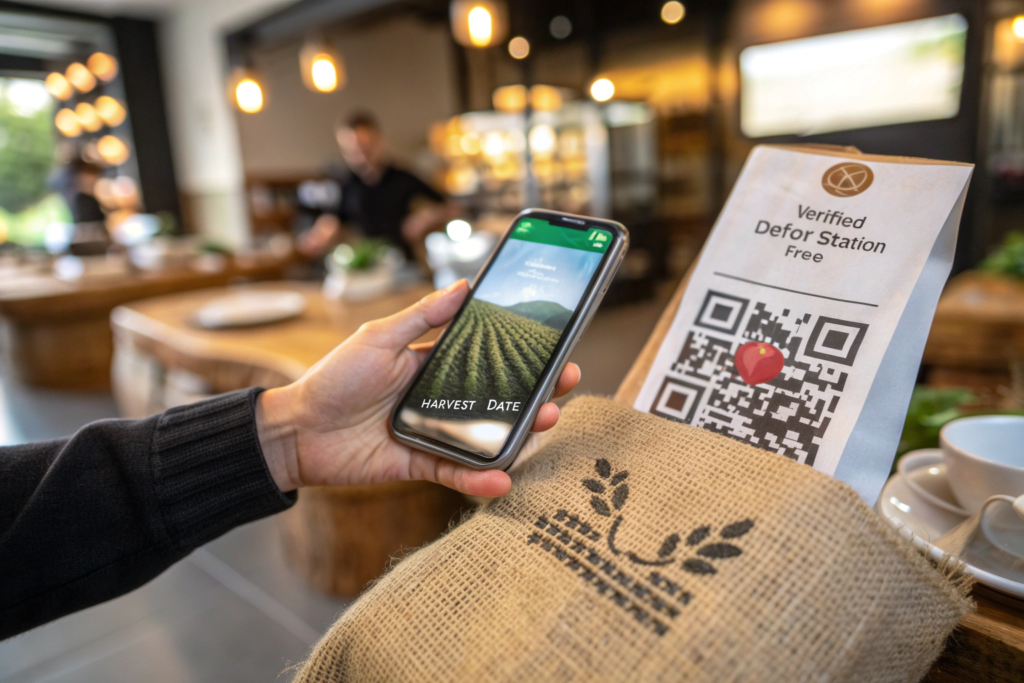
How Does Blockchain Traceability Work for a Single Coffee Lot?
Forget the hype about cryptocurrency. In coffee, blockchain is just a shared, tamper-proof digital notebook. For your single lot of Yunnan coffee, the data chain starts at harvest. We log the date, the GPS polygon, the cherry brix reading, and the picker's name into the platform. The data is hashed—fingerprinted—and written to a block. Then, we log the fermentation hours, the drying bed temperatures, the hulling date, and the final moisture reading. Each step is a new block. The final block is the bill of lading and container seal number. You, as the importer, get a read-only key to this notebook. You can see the immutable history. And we can provide a consumer-facing QR code that links to a beautiful visual representation of this chain. A roaster I supply in Texas uses this for their "Baoshan Blockchain Series." They print the QR code on the bag. The consumer scans it and sees a photo of my farm, the exact harvest date, and the truck's journey. It’s a powerful marketing tool. But for you, the importer, it's a quality control tool. If a roast tastes off, you don't guess. You check the digital log. Was the fermentation 16 hours or 18? Was there a temperature spike during drying? You have the data. Platforms are making this accessible. We use a system that integrates directly with the IBM Food Trust network, ensuring the data standards are globally recognized.
Can Real-Time Container Tracking Prevent Spoilage Claims?
I've seen it happen. A container arrives. The beans look dull. The buyer claims they were shipped wet. The shipping line blames the packer. It's a circular firing squad of blame, and usually, the buyer loses. Real-time container tracking kills that dispute with objective data. We are now placing small, non-lithium-battery IoT devices inside the sealed container. These record GPS location, temperature, and humidity every hour. I can give you a login to watch your container cross the Pacific. You can see the temp spike at the Panama Canal. You can see if the doors were opened. This is a game-changer for insurance and claims. I recall a shipment to Australia where the client noticed the internal container humidity jumped to 85% on day ten. We received an automatic alert. We radioed the shipping line, who found a vent malfunction at the next port and fixed it. The coffee arrived pristine. Without the tracker, we would have had a container full of moldy beans and a ruined relationship. The data proved it wasn't the bean's fault, and it wasn't my packaging. It was the carrier. We filed a successful claim using the IoT data log. This technology, once a luxury, is now something I provide as a standard service for full-container orders. It turns the voyage from a mysterious black hole into a monitored, managed process. It's the final piece of the "safe, reliable, and trustworthy" promise I make.
Conclusion
Navigating the certification landscape for a coffee importer in 2026 might feel like trying to solve a puzzle where the pieces keep changing shape. But when you strip away the panic and the acronyms, it's actually a very straightforward, tiered defense and growth strategy. We started with the absolute bedrock: the FDA registration and Prior Notice. Without these, you don't have a business. We moved up to the market-driven power of organic and ethical seals—the logos that don't just avoid fines, but actively command a premium and build a consumer trust that taste alone cannot. We then confronted the biggest regulatory earthquake, the EUDR, and saw how a simple GPS polygon and a due diligence statement are now as vital as a bill of lading. And finally, we glimpsed the immediate future that is already the present, where blockchain and live container tracking turn a one-time transaction into a transparent, verifiable journey.
This might seem like a lot, but from where I stand on my farm in Baoshan, it's actually a simplification. It's a clearing of the fog. All these certifications and technologies are converging on one single, powerful idea: radical, provable truth. They are tools that reward a professional, integrated operation that has nothing to hide. That's what we've built here.
You don't need to become a regulatory lawyer to import safely in 2026. You need a partner at origin who treats compliance not as a burden, but as a core product feature. That's the promise we make at BeanofCoffee. We don't just grow and process; we handle the documentation so it aligns perfectly with the physical product. If you want to build a supply chain on a foundation of unshakeable, certifiable trust, let's start a conversation. My colleague Cathy Cai manages our compliance documentation and can walk you through every certificate and data point we provide as standard. Reach out to her directly at cathy@beanofcoffee.com. Tell her your target market, and she'll email you a complete, sample documentation package that you can review with your own broker. Let's build a 2026 supply chain that's bulletproof from farm to cup.