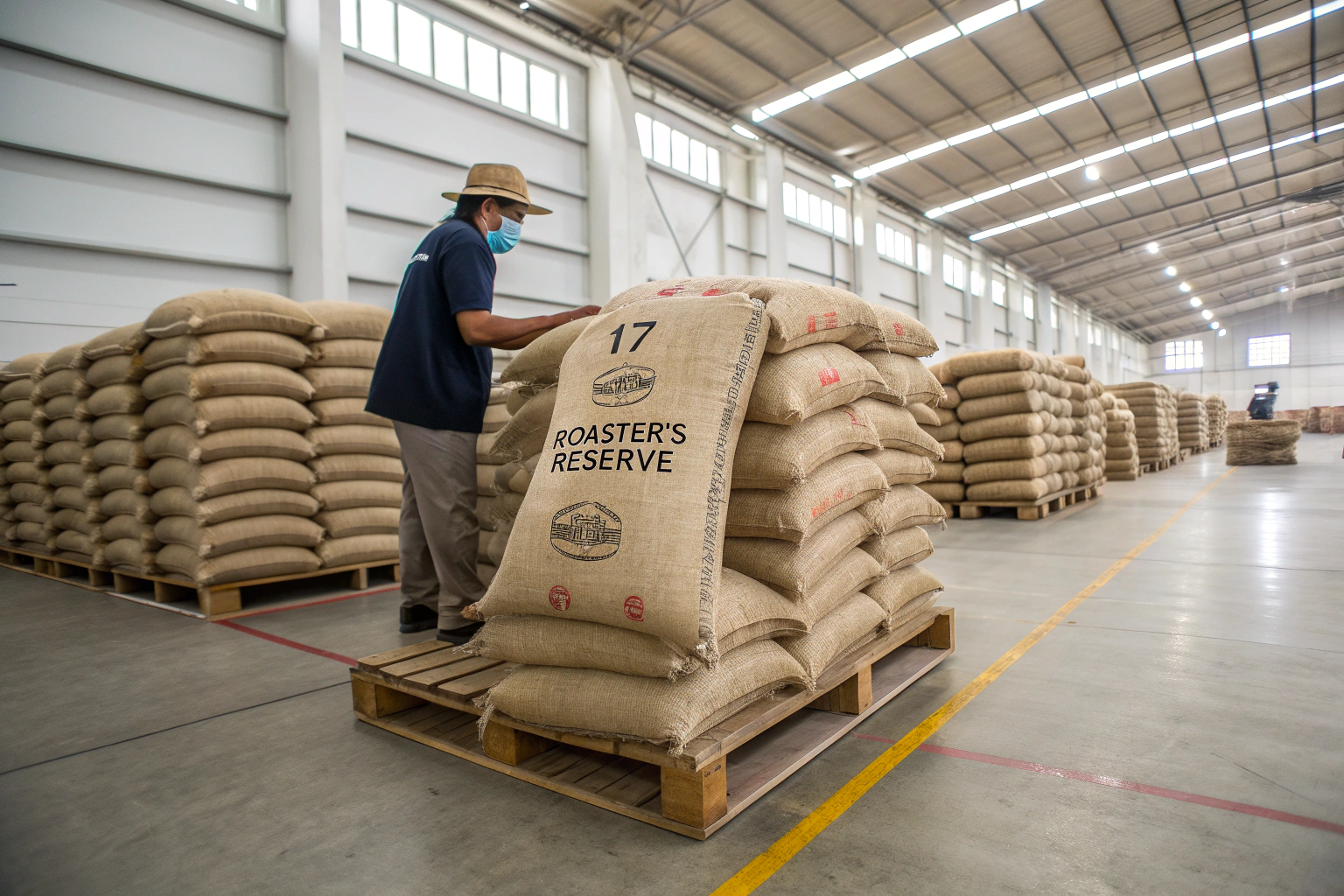
A new client recently asked me, "I know what a container is. But what does a smaller, 1,000kg order actually look like? Is it just a big pile of beans?" I laughed, but it was a fair question. We live in a world of container loads and metric tons, but for many specialty roasters just starting a private label program or testing a new single-origin, a full 19-ton container is a distant dream. The 1,000kg order is the gateway. It is the sweet spot between a sample and a full commitment. It is a real, manageable volume that allows you to launch a product, test a market, and experience our quality without overwhelming your warehouse or your cash flow.
A 1,000kg custom coffee bean order is exactly 17 bags of 60kg green coffee, typically stacked on a single standard pallet, and represents a deliberate, accessible volume that allows a roaster to produce approximately 2,800 retail bags of coffee, making it the ideal size for a controlled product launch, a seasonal offering, or a premium micro-lot program.
This is not a theoretical number. It is a physical, tangible thing. Let me walk you through exactly what this volume looks like from the moment it is milled to the moment it arrives at your door, and how we at Shanghai Fumao make it a seamless, turnkey experience. You can learn more about our smaller-volume offerings on our Private Label Program page.
How Is a 1,000kg Lot Physically Prepared and Packaged?
A 1,000kg order is processed with the same meticulous care and professional packaging as a 19,000kg container. It goes through the same mill, is sorted on the same gravity tables, and is packaged with the same protective materials. It receives no less attention to detail.
A 1,000kg lot is physically prepared by blending the custom components to a homogeneous mix, then precisely bagging the green coffee in 17 individual 60kg GrainPro-lined jute bags, which are then stacked and secured onto a single export-standard wooden pallet, creating a compact, protected, and easily manageable unit.
This is a professional, export-ready product. It is not a makeshift shipment. It is your coffee, protected for its journey.
What Does 17 Bags on One Pallet Look Like?
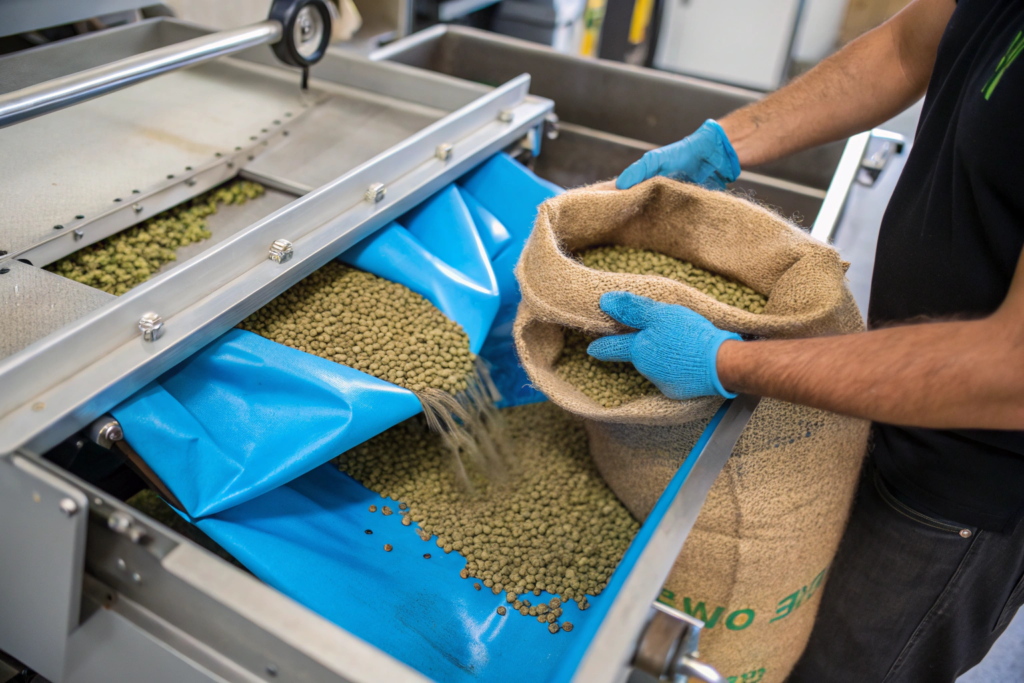
Let's make this tangible. A standard 60kg jute bag of green coffee, when filled, is a compact but substantial object. It is roughly the size and shape of a large, overstuffed duffel bag.
The Pallet Configuration:
- The Bags: You will receive 17 of these bags. They are uniform in size, weight, and appearance. Each one is clearly stenciled with the lot number, your custom blend name (if applicable), and the weight.
- The Pallet: These 17 bags are carefully stacked onto a single, heat-treated, export-standard wooden pallet. The stacking pattern is designed for stability: often a layer of 5 bags, then 5, then 4, with a final 3 on top, all interlocked.
- The Protection: The entire stack is then wrapped in multiple layers of thick, clear shrink-wrap plastic. This binds the bags tightly to the pallet, creating a single, stable unit. It protects the jute from dust, scuffing, and light moisture during handling.
- The Footprint: The finished pallet has a footprint of about 1.0 x 1.2 meters (standard pallet size) and a height of roughly 1.5 meters. It is designed to be safely lifted and moved by a standard pallet jack or forklift.
This single, secure pallet is your 1,000kg order. It is compact enough to fit in a corner of your warehouse and robust enough to travel safely via Less than Container Load (LCL) ocean freight. At Shanghai Fumao, we guarantee that this pallet will arrive in pristine condition, with every bag sealed and every GrainPro liner intact. We follow all palletization standards set by the International Plant Protection Convention (IPPC) for wood packaging material.
How Are the GrainPro Liners Sealed for a Small Pallet Shipment?
The protective packaging is identical, whether it is 17 bags or 320. There is no "downgrade" for a smaller order.
- The Process: Each of the 17 jute bags contains a GrainPro TranSafeliner. After the bag is filled with your custom blend on our automated line, the inner blue liner is immediately gathered and heat-sealed using a specialized pneumatic sealer. This creates a permanent, airtight hermetic closure.
- Then the Jute Bag is Closed: The outer jute bag is then folded over and closed with a machine-stitched seam. A tamper-evident, sequentially numbered security seal is often applied to the closure for an added layer of chain-of-custody security.
- Why It Matters for LCL: A pallet shipped via LCL will be handled multiple times. It will sit in consolidation warehouses and be moved between different trucks. The GrainPro liner is your coffee's armor. It locks in the precise 11% moisture content and protects the beans from the ambient humidity and odors of the various warehouses it may pass through. Just as with a full container, the hermetic seal is what guarantees the coffee arrives in the same fresh condition it left our mill. Our commitment to packaging is detailed on our Quality Control page.
How Is a 1,000kg Custom Blend Created and Verified?
You are not just ordering 1,000kg of a standard product off the shelf. You are commissioning your own unique blend. This requires an additional, meticulous step that happens before bagging: the blending and its verification.
A 1,000kg custom blend is created by precisely weighing each of your chosen components according to your agreed-upon recipe, loading them into our 5-ton industrial ribbon blender for a controlled mixing cycle that guarantees a perfectly homogeneous distribution of every bean, followed by a rigorous post-blend cupping protocol to verify that the mix is uniform from top to bottom.
We do not just mix and hope. We mix and then prove. This is what you pay for with a custom order.
What Is the Recipe Precision for a 1,000kg Blend?
Precision is the essence of a custom blend. You have designed a specific flavor profile, and we translate that into an exact, repeatable weight-based formula.
- The Digital Recipe: Your blend might be a 70/30 ratio of our washed Grade 1 Arabica and our natural process Catimor. For a 1,000kg order, this becomes a digital bill of materials in our production system: exactly 700 kg of component A and 300 kg of component B.
- The Weighing Process: The individual components are dispensed from sealed supersacks or hoppers onto a large, calibrated platform scale. The weight is recorded with precision. There is no estimating, no scooping by volume.
- Why It Matters for You: This precision means that the 1,000kg batch you receive in July will be identical in composition to the 1,000kg batch you order in November. The flavor profile you have built your brand on will be consistent, order after order. This is the manufacturing discipline that a professional estate can offer. Our Custom Blends Program page outlines this process in detail.
How Is "Homogeneity" Proven Through a Post-Blend Cupping?
Mixing the components in a blender is the physical act. "Homogeneity" is the proof that the mixing was successful. We verify this through a specific sensory test on every custom blend batch, regardless of size.
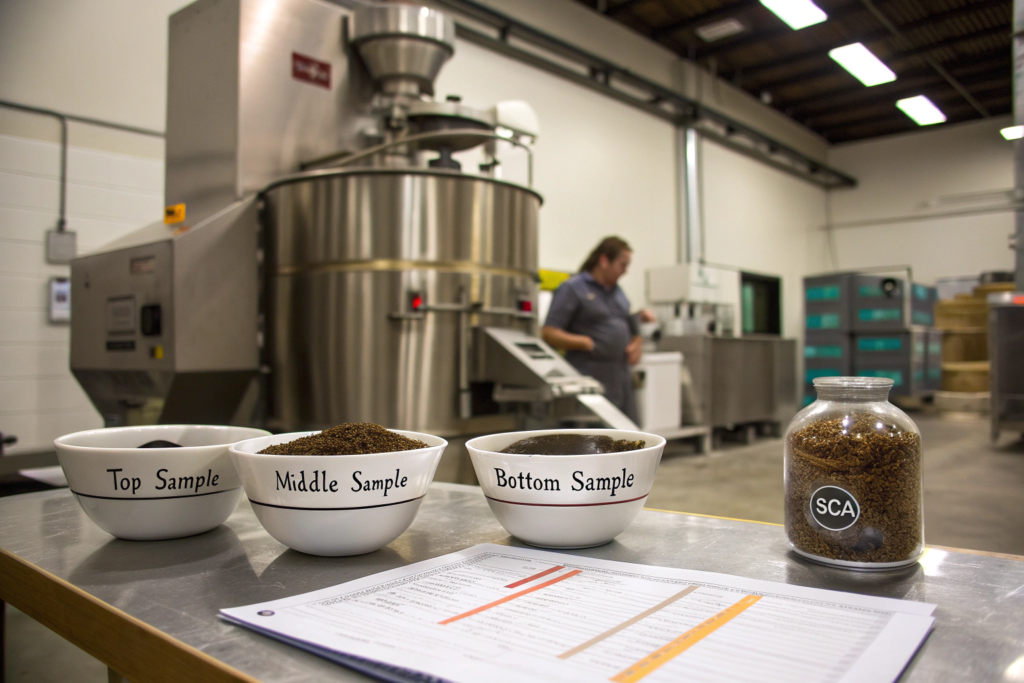
- The Sampling Protocol: After the blending cycle is complete, a trained technician uses a grain trier to pull samples not just from the top of the blender, but also from the middle and the bottom of the mix.
- The Triangulation Cupping: These three separate samples are then taken to the cupping lab. Our Q-Grader performs a blind triangulation. They are looking for any perceptible difference between the top, middle, and bottom samples.
- The "Pass" Mark: For the blend to be approved for bagging, the Q-Grader must confirm that all three samples are sensorially identical. If the top sample tastes slightly more of "Component A" than the bottom sample, the blending cycle is repeated until perfect uniformity is achieved.
This is the final quality gate. The sealed technical report, along with the signed cupping scoresheet, becomes part of the lot's traceability file. It is your guarantee that every single one of your 17 bags contains the exact same perfect expression of your unique recipe.
What Are the Shipping and Logistics Options for a 1000kg Pallet?
A single pallet of 1,000kg does not require a full 20-foot container. This opens up different, more flexible logistics options. You do not need to charter an entire container, but you must choose the shipping method that best balances your need for speed against your budget for freight.
The primary shipping options for a 1,000kg pallet are Less than Container Load (LCL) ocean freight, which is the most cost-effective for non-urgent shipments, or air freight, which is significantly more expensive but delivers the coffee within days, with the choice boiling down to a classic cost-versus-speed calculation.
We can arrange either option and provide you with a clear quote for both. At Shanghai Fumao, our logistics team manages the entire process, ensuring a seamless transition from our warehouse to yours.
What Is the Door-to-Door Cost and Transit Time for LCL vs. Air Freight?
Let's compare the two main options for a 1,000kg shipment from our door in Yunnan to a roastery on the U.S. West Coast. These are illustrative estimates; actual costs vary with fuel surcharges and market conditions.
| Feature | LCL Ocean Freight (Recommended) | Air Freight (Expedited) |
|---|---|---|
| Estimated Transit Time | 5-7 weeks (door-to-door) | 7-14 days (door-to-door) |
| Cost Estimate (1,000kg) | $400 - $700 USD | $2,500 - $4,500+ USD |
| Logistics Profile | Pallet is trucked to Shanghai, consolidated into a shared container, shipped to a U.S. port, de-consolidated at a Container Freight Station (CFS), and then trucked to you. | Pallet is trucked to a major airport (e.g., Shanghai Pudong), flown to a U.S. hub, clears customs, and is trucked to you. |
| Best For | Planned launches, inventory replenishment, cost-sensitive orders. | Urgent needs, filling a sudden stock-out, high-value micro-lots where the cost is justified. |
The vast majority of our commercial clients choose LCL. It is the workhorse of international small-batch trade. As we discuss in our guide on How to Plan Your Coffee Buying Calendar to Avoid Missing Selling Seasons?, planning ahead makes the cost-effective LCL option the clear winner. You can also get real-time freight estimates on platforms like Freightos.
How Is a Single Pallet Handled in an LCL Consolidation Warehouse?
If you are new to LCL, it is helpful to understand the journey your single pallet takes. It is not loaded directly onto a ship. It goes through a consolidation process.
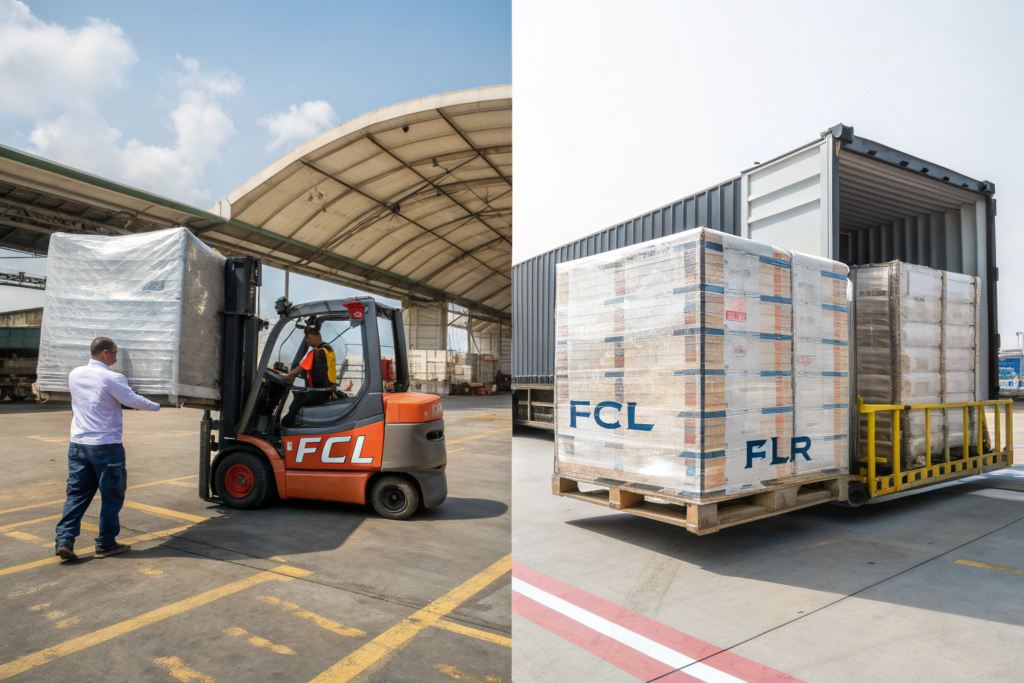
- Origin CFS (Shanghai): Our truck delivers your pallet to a secure Container Freight Station near the port. Here, it is unloaded and staged. A professional cargo consolidator then carefully loads your pallet into a shared 20ft or 40ft container, packed alongside pallets of other goods—textiles, electronics, machinery parts. The key is that your coffee is sealed in its GrainPro liner and thick shrink-wrap, protecting it from any odor or moisture transfer from the co-loaded cargo.
- Ocean Transit: The shared container makes the ocean crossing on the booked vessel.
- Destination CFS (e.g., Oakland): Upon arrival at the U.S. port, the container is trucked to a destination CFS. Here, the container is "de-vanned" (unloaded), and the individual pallets are separated by consignee. Your single, brightly shrink-wrapped pallet is easily identified by its markings.
- Final Delivery: A local trucking company, arranged by us or your customs broker, picks up your pallet from the CFS and delivers it directly to your roastery door.
Throughout this entire multi-step process, your coffee remains in its original, protective packaging. The GrainPro liner and the pallet wrap act as its mobile clean room, ensuring it arrives in the exact condition it left our mill. For more on LCL logistics, resources from the Council of Supply Chain Management Professionals (CSCMP) are excellent.
Conclusion
A 1,000kg custom coffee bean order is not an abstract entry on a purchase order. It is a tangible, meticulously crafted product that arrives at your door as a single, secure, professional pallet. It is the physical embodiment of your blend recipe, tested for homogeneity and packaged to survive its journey across the world.
This volume represents an accessible, low-risk entry point for a serious product launch. It is enough coffee to make a real impact in your market, but not so much that it overburdens your storage or balance sheet. And whether you choose the cost-effective LCL sea route or the expedited air option, the quality and care that goes into the bag is identical.
At Shanghai Fumao, we specialize in making this scale of custom order not just possible, but easy. We manage the blending, the packaging, the logistics, and the documentation, so you can focus on roasting and selling.
If you have a custom blend in mind and want to see what your own 1,000kg pallet would look like, let's start the conversation. Email Cathy Cai. Tell her your blend idea, and she can provide a quote for both LCL and air freight delivery right to your door. Contact Cathy at: cathy@beanofcoffee.com