I want to share a story that still keeps me up at night. Early in my career, we sent a small, promising lot of our best Yunnan Arabica to a potential buyer in Germany. We were incredibly proud of it. The beans had notes of jasmine and honey; they were truly special. Weeks later, the buyer's email arrived. The verdict? "Flat, woody, tastes like cardboard." I was devastated. It wasn't a bad crop; it was a catastrophic failure of packaging. Our beautiful coffee had died a slow death from oxygen exposure somewhere over the ocean.
The best packaging to prevent oxidation in transit is a high-barrier, multi-layer foil pouch equipped with a one-way degassing valve, which is then flushed with an inert gas like nitrogen before being hermetically sealed. This combination creates a near-zero oxygen environment, actively removing post-roast gasses while blocking any new oxygen from entering, thus preserving the coffee's delicate aromatic compounds from farm to roastery. This isn't just a preference; it's a scientific necessity for protecting the quality and value of specialty coffee.
That painful experience taught me a crucial lesson: as a coffee exporter, my job doesn't end when the beans leave the roaster. My responsibility extends all the way to the buyer's door. Protecting the coffee from its greatest invisible enemy—oxidation—is one of the most critical services we provide. For a buyer like Ron, whose business depends on the quality of the beans he receives, this isn't a small detail; it's everything. Let's dive into the science of why this specific packaging solution is the only real answer.
Why Is Oxygen the Ultimate Enemy of Coffee?
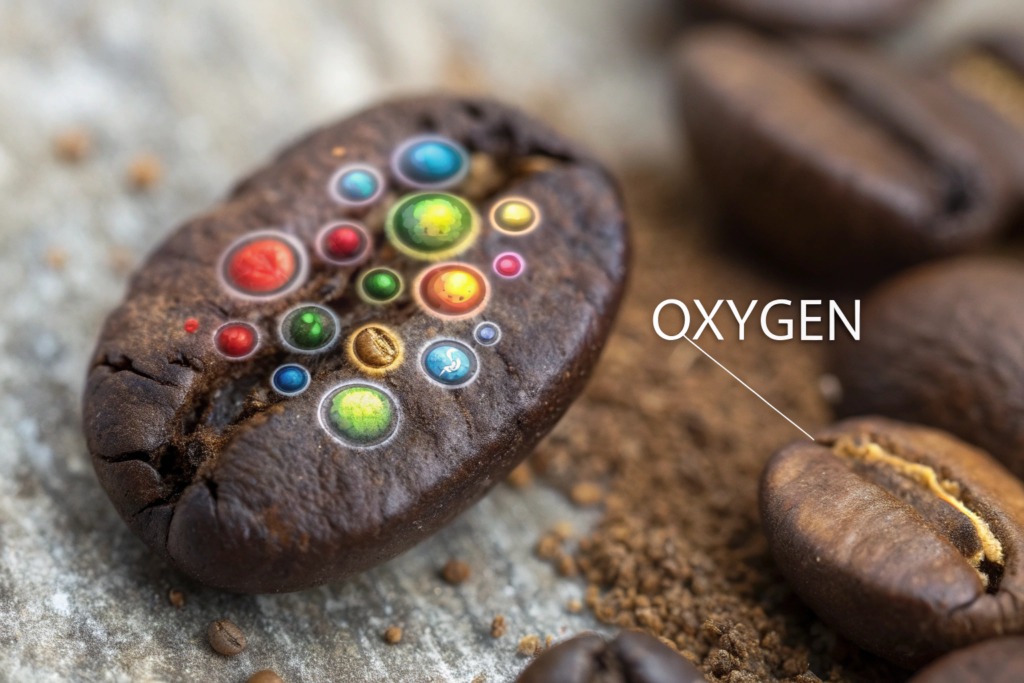
You can't see it, taste it, or smell it, but oxygen is relentlessly attacking your coffee from the moment it finishes roasting. It's a chemical process, slow and silent, but utterly destructive. The complex, volatile aromatic oils and fatty acids that give a coffee its beautiful flavor and aroma are extremely fragile. When they come into contact with oxygen, they begin to break down in a process called oxidation. This is the same process that makes an apple turn brown or cooking oil go rancid.
The result? Stale coffee. The bright, floral notes disappear first, replaced by a generic, flat taste. The sweetness fades, and a distinct, unpleasant bitterness takes over. For a buyer who has just paid a premium for a high-quality lot, receiving oxidized coffee is not just a disappointment; it's a financial loss. It's a product that is essentially unusable for the specialty market. This is why preventing oxidation isn't just a "nice to have"; it's the central goal of any professional coffee packaging.
Understanding this threat is the first step to defeating it. It’s not about finding a "good enough" solution; it's about creating an impenetrable fortress against this invisible enemy. It’s a core component of the quality control that buyers demand and that serious suppliers like Shanghai Fumao must provide.
What Exactly Happens During Oxidation?
When oxygen molecules interact with the oils and soluble compounds in roasted coffee, they trigger a chain reaction. The aromatic compounds, which are highly volatile, are transformed into new, less pleasant compounds. The fats and lipids become rancid, creating sour or bitter off-flavors. Essentially, all the wonderful, complex notes that the farmer worked so hard to create and the roaster worked so hard to develop are systematically dismantled. This process starts immediately after roasting and accelerates over time. You can learn more about the chemistry from resources like the Coffee Quality Institute (CQI).
How Quickly Does Coffee Go Stale?
The speed of staling depends on several factors, but the primary one is exposure to oxygen. Whole bean coffee stored in an open-air bin can lose a significant portion of its character in just 7-10 days. Ground coffee, which has a much larger surface area exposed to oxygen, can go stale in a matter of hours. During international transit, which can take several weeks, coffee packaged without proper oxygen barriers is almost guaranteed to arrive stale. This is a critical consideration for any import/export business.
What Is a High-Barrier Foil Pouch?
So, if oxygen is the enemy, the packaging must be the shield. But not all shields are created equal. A simple plastic bag or a paper pouch offers about as much protection as a screen door on a submarine. To truly stop oxygen, you need a material specifically engineered for the job. This is where high-barrier packaging comes in.
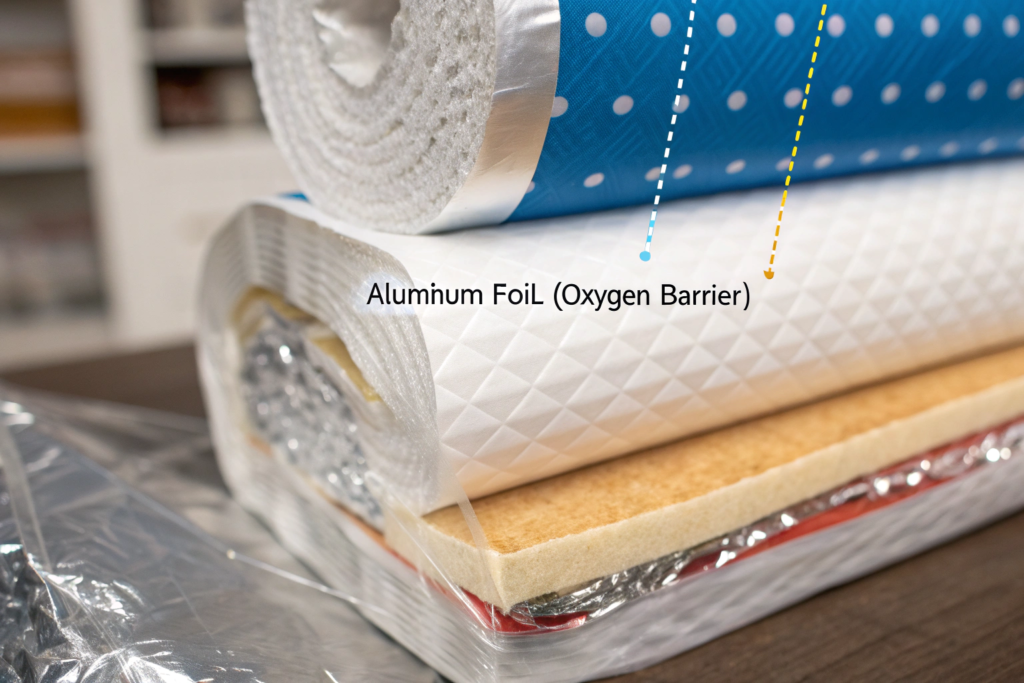
The gold standard for high-barrier coffee packaging is a multi-layer pouch that includes a layer of aluminum foil. While other materials like metallized polyester (the shiny stuff you see in chip bags) offer some resistance, nothing provides a more complete barrier to oxygen and moisture than a true foil layer. It's the difference between "slowing down" oxidation and "stopping" it almost completely.
When a buyer receives a sample or a bulk order in a true foil-lined bag, it sends a powerful message. It says that the supplier understands the science of coffee preservation and has invested in the proper materials to protect their product, and by extension, the buyer's investment. It’s a tangible sign of professionalism and a commitment to quality.
Why Is Aluminum Foil the Best Barrier?
Aluminum foil, when used as a layer in packaging, creates what is known as a "hermetic" or airtight seal. Its molecular structure is so dense that it is virtually impermeable to oxygen, moisture, UV light, and other environmental contaminants. While materials like EVOH (Ethylene Vinyl Alcohol) are also used as oxygen barriers in plastic films, they don't offer the same absolute, multi-faceted protection as foil. For a high-value, sensitive product like specialty coffee on a long journey, foil is the only truly reliable choice.
How Can You Tell a Real Foil Bag?
This is a pro tip for buyers: tear the bag. A bag with a metallized film layer (VMPET) will tear easily and will look like plastic on the inside. A bag with a true aluminum foil layer will be much tougher to tear. When you do tear it, you will see the distinct, crinkly, metallic edge of the foil layer inside. It feels different because it is different. Another way is to hold it up to a bright light; a true foil bag will block 100% of the light, while a metallized bag may show some light passing through. Knowing this helps you verify the quality of the packaging materials your supplier is using.
What Is the Role of the Degassing Valve?
Here's a paradox that every coffee roaster faces: freshly roasted coffee needs to be protected from oxygen immediately, but it also produces its own gas, carbon dioxide (CO2), for several days after roasting. If you seal fresh coffee in a completely airtight bag with no valve, the bag will inflate and likely burst. If you wait for the coffee to finish degassing before you pack it, it will be exposed to oxygen for days and will already be stale. It's a classic catch-22.
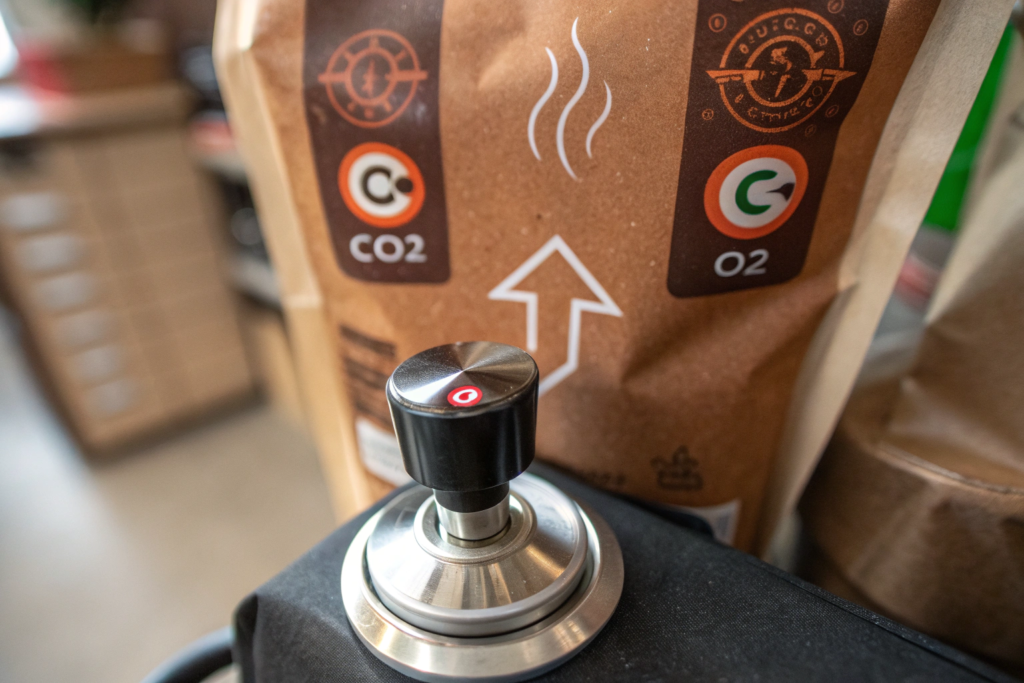
The solution is a small but ingenious piece of technology: the one-way degassing valve. This valve is a simple pressure-activated vent that is heat-sealed onto the coffee bag. When the pressure from the CO2 builds up inside the bag, it pushes the valve open just enough to let the CO2 escape. Once the pressure equalizes, the valve closes, forming a tight seal that prevents any oxygen from getting back in.
This tiny valve is absolutely non-negotiable for any serious coffee packaging. It allows us to pack our coffee at the peak of its freshness, just after roasting, ensuring it is protected from oxygen from day one. For a buyer, the presence of a degassing valve is an instant indicator that the supplier understands the fundamentals of coffee science and is committed to delivering a fresh product.
How Does the Valve Work?
Most one-way valves consist of a simple diaphragm or membrane. The pressure from the CO2 inside the bag is strong enough to push it open. However, the atmospheric pressure outside the bag is not strong enough to push it open from the other direction. It's a simple, elegant piece of fluid dynamics that solves a critical problem in coffee preservation.
What Happens If There's No Valve?
Without a valve, a supplier has two bad options. Option one: they pack the coffee fresh and the bag inflates, looking unprofessional and risking a burst during transit. Option two (the more common and worse option): they let the coffee sit out in the open air for several days to degas before packing. This "pre-staled" coffee is then sealed in a bag and sent to the buyer. The buyer receives a product that was already past its prime before it even began its journey.
Why Is Nitrogen Flushing the Final Step?
You've got the perfect high-barrier foil bag and the essential one-way valve. You've put your freshly roasted coffee inside. But what else is in the bag with the coffee? Air. And air is about 21% oxygen. Simply sealing the bag traps that residual oxygen inside, where it will immediately begin to degrade the coffee. This is the final, often-overlooked hurdle to achieving a truly oxygen-free environment.
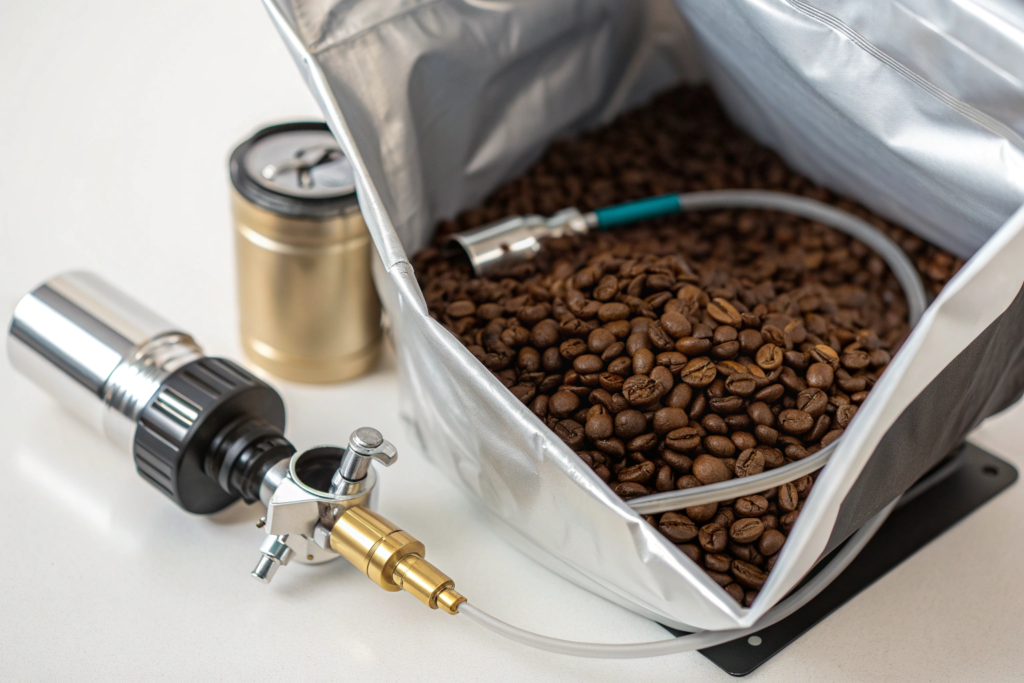
The ultimate solution, and the standard practice for any top-tier coffee exporter, is gas flushing, also known as Modified Atmosphere Packaging (MAP). Just before the bag is sealed, a nozzle flushes the inside of the bag with an inert gas, almost always nitrogen. Nitrogen is a harmless, odorless, and tasteless gas that makes up 78% of the air we breathe. It is heavier than oxygen, so it displaces the oxygen, pushing it out of the bag. The bag is then immediately heat-sealed.
The result is a pouch where the internal atmosphere is almost entirely nitrogen, with residual oxygen levels below 1%. This effectively "pauses" the oxidation process, preserving the coffee in a state of suspended animation. For a buyer receiving coffee that has been nitrogen flushed, it's the closest they can get to tasting the coffee the day it was roasted. It's the final, definitive step in professional coffee packaging.
Is Nitrogen Safe for Coffee?
Yes, completely. Nitrogen is an inert gas, which means it does not react with other elements. It will not affect the flavor or aroma of the coffee in any way. Its only job is to take up the space that oxygen would otherwise occupy. This technique is widely used throughout the food industry to preserve the freshness of products like potato chips, salads, and fresh pasta. It's a proven and safe method of food preservation.
Is This Process Expensive?
While it requires an investment in specialized equipment, the cost per bag is minimal, especially when weighed against the cost of losing a client due to stale coffee. For us at Shanghai Fumao, it's not a question of expense; it's a mandatory part of our quality assurance protocol. Any supplier who is serious about exporting high-quality roasted coffee must be willing to make this investment to guarantee the integrity of their product.
Conclusion
Preventing oxidation during transit is not a matter of opinion; it's a matter of science. The destructive power of oxygen is relentless, and combating it requires a multi-pronged defense system. A simple bag is not enough. The only truly effective solution is the combination of a high-barrier foil pouch to block oxygen from entering, a one-way degassing valve to release CO2, and nitrogen flushing to remove residual oxygen from inside the bag.
This three-part system is the promise we make to our clients. It's the guarantee that the coffee you receive from us will be as fresh, vibrant, and aromatic as it was the moment it left our facility. It’s how we turn a painful lesson from our past into a powerful asset for your business.
If you are tired of receiving coffee that has lost its character in transit and are looking for a partner who obsesses over preservation as much as you do over flavor, then we are ready to talk. Please contact our head of client relations, Cathy Cai, at cathy@beanofcoffee.com, and let us send you a sample packaged the right way.