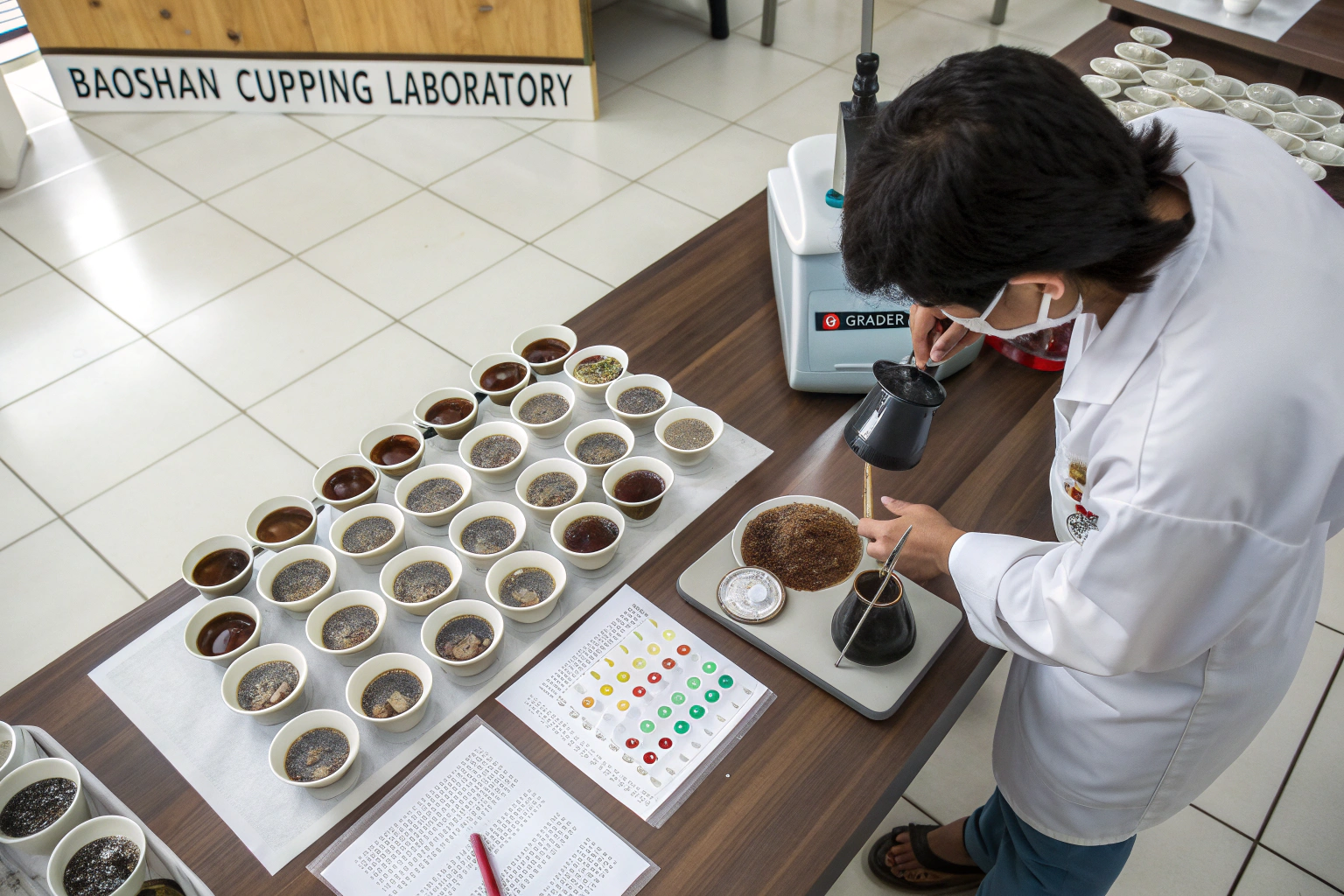
I remember a buyer asking me once, "How do you decide if a lot is good enough to ship to me?" I told him, "It does not leave the warehouse unless it passes our cupping table." He was surprised. He thought we just looked at the beans and put them in a bag. Many exporters do. But at BeanofCoffee, the cupping protocol is the heartbeat of our quality control. It is the final, non-negotiable gate that every single export lot must pass through. It is where the science of our farming meets the art of sensory evaluation.
The cupping protocol at BeanofCoffee for export approval is a rigorous, multi-stage process based on the Specialty Coffee Association (SCA) standards, conducted by our certified in-house Q-Grader, which evaluates every finished export lot for physical cleanliness, green bean defects, and sensory attributes including fragrance, aroma, flavor, aftertaste, acidity, body, and balance, with a strict minimum score requirement before shipment authorization.
This is not a casual tasting. It is a standardized, documented, and repeatable scientific evaluation. Let me walk you through the exact steps we take to ensure that the coffee you receive matches the quality we promise. You can also learn more about our overall quality philosophy on our Quality Control page.
What Are the Physical Grading Steps Before the Cupping Begins?
The sensory evaluation does not begin with tasting. It begins with looking and measuring. Before any water touches the grounds, we conduct a rigorous physical analysis of the green coffee. This is a pass/fail exam. If the coffee does not look right or the moisture is off, the lot is flagged before we even turn on the sample roaster.
The physical grading steps are a prerequisite that involve a standardized green grading analysis for screen size and defect count according to SCA protocols, and a precise measurement of moisture content and water activity, ensuring the lot meets our strict physical specifications for the intended grade.
This phase is all about objectivity and measurement. It removes the risk of a visually flawed or unstable coffee making it to the cupping table.
How Is a Green Grading Analysis Performed for Defect Count?
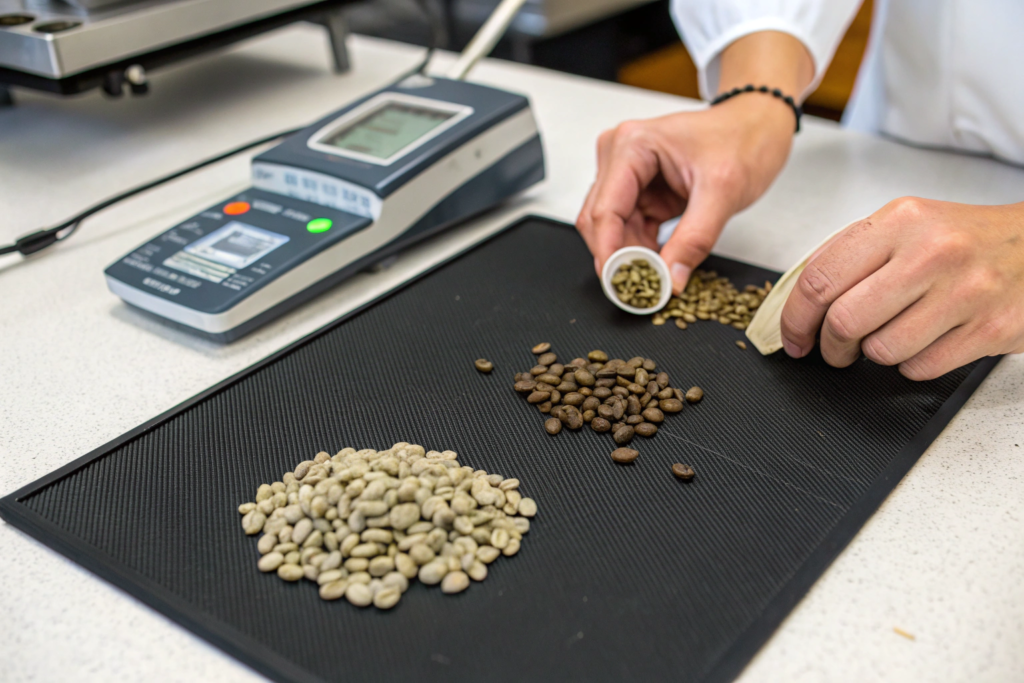
This is the most critical physical test. It is a quantitative measure of the coffee's cleanliness and sorting quality. We follow the official Specialty Coffee Association Green Coffee Grading Standards to the letter.
The Procedure:
- Sample Size: A 350-gram sample is drawn from the composite lot sample.
- Preparation: The sample is spread evenly on a black grading mat under bright, color-corrected light. Any foreign matter (stones, sticks, husks) is immediately removed and noted.
- Defect Identification: Our trained quality technician meticulously scans the entire sample, bean by bean. They identify and categorize every imperfection using the SCA Defect Handbook.
- Defect Categorization:
- Category 1 (Primary) Defects: These are severe flaws. A single full black bean or full sour bean counts as 1 full defect. The presence of even 1 Category 1 defect disqualifies a lot from being "Specialty Grade."
- Category 2 (Secondary) Defects: These are minor flaws like partial sours, parchment, broken beans, or slight insect damage. A few of these are allowed within strict tolerances. For our Grade 1, we allow a maximum of 5 secondary defects.
- Calculation: The total "Full Defect Equivalent" is calculated.
This is a painstaking process, but it is the only way to be sure. If a lot fails this visual inspection, it cannot be approved. For more on how this protects you, read our article on How to Ensure Your Coffee Supplier Isn't Mixing Lower Grade Beans. You can also learn about the SCA protocols directly from the Coffee Quality Institute.
Why Is Moisture and Water Activity Testing Crucial Here?
Even if the beans look perfect, they can be biologically unstable. The physical grading stage is where we verify the coffee's safety and shelf life using precision instruments.
The Dual Measurement:
- Moisture Content: We use a calibrated capacitance moisture meter to measure the total water percentage. We take readings from multiple parts of the sample. The lot must fall within our strict range of 10.5% to 11.5% . Coffee above 12.5% is at high risk for mold. Coffee below 9.5% is faded and dead.
- Water Activity (aw): This is the more critical measurement. We use a bench-top water activity meter. It measures the "free" water available for mold and bacteria. We enforce a hard internal limit of less than 0.60 aw. Coffee with an aw of 0.55-0.58 is perfectly stable. Coffee with an aw of 0.62 is a ticking time bomb, even if the moisture content looks fine.
No lot is approved for specialty export without passing these physical checks. The readings are logged on the lot's permanent record. At Shanghai Fumao, our internal moisture and water activity specifications are even tighter than the general industry standard, ensuring the coffee we ship is safe, stable, and will arrive in perfect condition. You can read more about the science in our deep-dive on Why Is Water Activity in Green Coffee Just as Important as Moisture?. The U.S. Food and Drug Administration also provides guidance on water activity in low-moisture foods.
How Is the Standardized Sample Roast Prepared for Cupping?
You cannot evaluate a green bean. You must roast it. But how you roast it changes everything. A dark roast can mask origin character and burn away defects. A cupping roast is a specific, scientific protocol designed for transparency.
The standardized sample roast is prepared using a dedicated laboratory roaster, targeting a precise SCA-standard cupping color of Agtron 58/63, followed by a strict resting period, to ensure that every sample is evaluated on a level playing field that reveals its true origin character and any hidden defects.
This ensures that the sensory differences we taste are from the bean, not from an inconsistent roast.
What Is Our Target Agtron Number and Roast Profile?
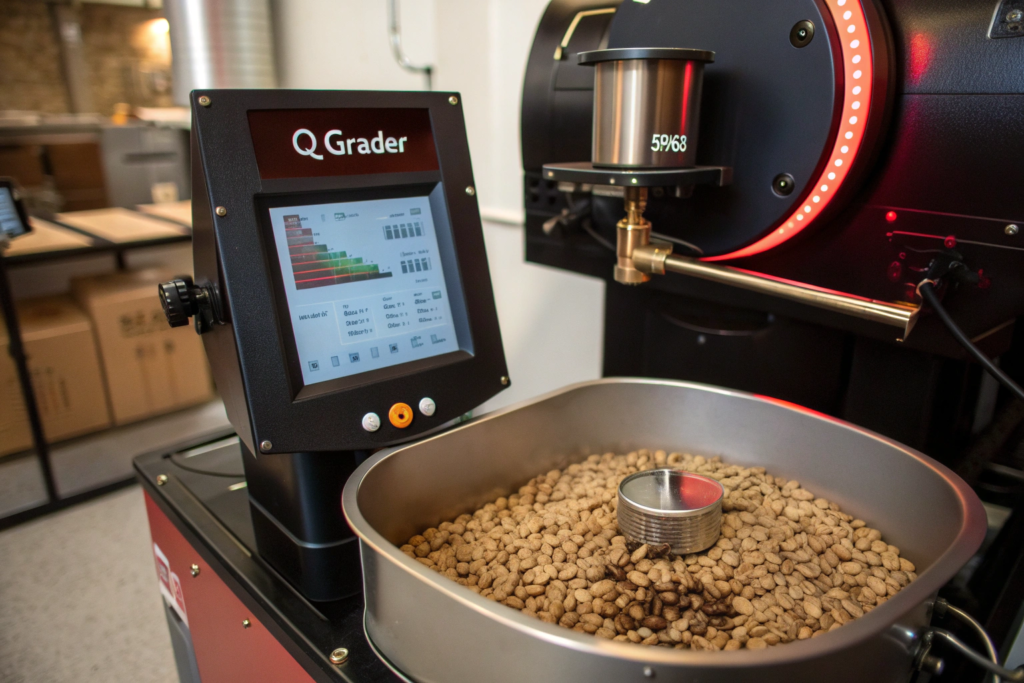
We do not roast "light" by guesswork. We use a digital Agtron color meter to measure the roast degree objectively. This is the only way to be consistent and to be calibrated with your lab.
Our Cupping Roast Specification:
- Target Color: We target an Agtron "Gourmet" scale reading of 58 for the whole bean and 63 for the ground coffee. This is the gold standard for the SCA cupping protocol.
- The Profile: This is a light roast. The total roast time is typically 8-10 minutes. The development time after first crack is kept short to preserve origin character. The goal is to caramelize the sugars enough for sweetness but not to introduce any roasty, bittersweet flavors that would obscure the bean's inherent profile.
- Why This Roast? This specific light roast is the best tool for a Q-Grader. It maximizes the expression of the terroir and the processing method. More importantly, it makes defects—like ferment, phenol, or earthy notes—glaringly obvious. A darker roast would mask these flaws.
Consistency is key. Our Q-Grader logs the roast curve for every single cupping session. If the roast is off-target by even a small margin, the batch is discarded and re-roasted. We only cup samples that meet our exacting roast specification. For more on Agtron scales and roast color, Roast Magazine is an excellent technical resource.
Why Is a Resting Period Essential Before the Tasting?
Freshly roasted coffee is a turbulent chemical soup. It is degassing large amounts of CO2. The volatile aromatic compounds have not settled. Cupping it immediately after roasting would be a mistake.
The Degassing and Resting Protocol:
- Minimum Rest: We rest the roasted sample for a minimum of 8 hours , but not more than 24 hours.
- Why Rest? Immediately after roasting, the grounds will bloom violently with hot water, and the cup will taste harsh, gassy, and ashy. Resting allows the excess CO2 to escape gently, revealing the true aroma and flavor.
- Why Not More Than 24 Hours? After about a day, the volatile aromatics begin to fade and oxidize. The cup starts to taste flat and stale. We cup within the "sweet spot" window of 8-24 hours post-roast.
The rested beans are ground immediately before cupping using a Mahlkönig EK43 grinder with dedicated cupping burrs, calibrated to a precise particle size. This ensures the extraction is consistent and the flavors are fully expressed. You can learn about the ideal cupping grind from the Specialty Coffee Association cupping protocols.
What Is the Standardized Tasting and Scoring Procedure?
The coffee is roasted and rested. Now comes the art and the science of the tasting itself. This is not a casual "sip and chat." It is a disciplined, silent, and methodical sensory evaluation that follows a strict timeline.
The standardized tasting procedure involves setting up multiple bowls per lot with an exact water-to-coffee ratio of 8.25g per 150ml of filtered, 93°C water, followed by a sequential evaluation of the dry fragrance, the wet crust aroma, and the coffee's flavor, body, and acidity as it cools from hot to room temperature.
Every step is choreographed to ensure consistency and repeatability across all cuppings, every day of the year.
How Is the Cupping "Brew" Prepared and the Crust Assessed?
This initial stage is as much about ritual as it is about science. The preparation sets the stage for the entire evaluation.
The Preparation:
- Ratio: For each bowl, we use 8.25 grams of freshly ground coffee and add 150 milliliters of filtered water heated to exactly 93°C (200°F) . This is the SCA Golden Cup ratio.
- Water Quality: This detail is often overlooked. We use reverse osmosis water that is then remineralized to the SCA standard for Total Dissolved Solids (TDS). Water chemistry dramatically affects extraction and flavor. Our water is neutral and optimized for coffee.
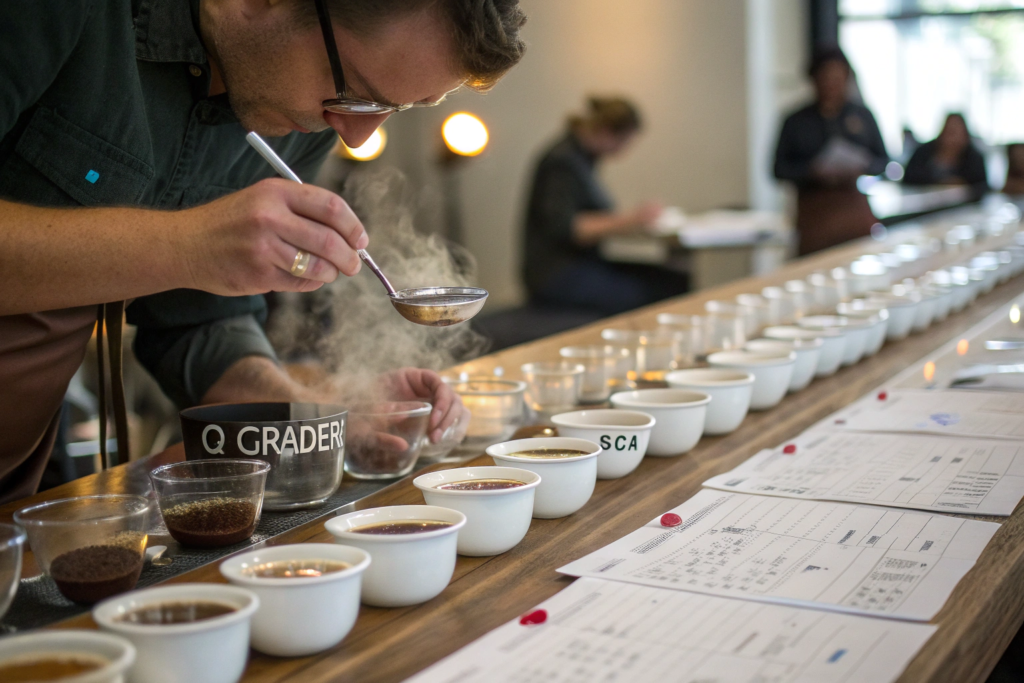
- The Pour and Wait: We pour the water aggressively in a spiral motion, ensuring all the grounds are evenly saturated. The coffee steeps, untouched, for a timed 4 minutes. A thick crust of grounds forms on the surface.
The Crust Break:
At exactly 4 minutes, the Q-Grader leans over the bowl and uses a cupping spoon to gently break the crust of grounds, pushing them to the back of the bowl. This is a moment of intense sensory input. The trapped aromas burst forth. The Q-Grader deeply inhales and evaluates the "Crust Aroma." Common descriptors for our Baoshan Arabica are dark chocolate, roasted nuts, and black tea. Any hint of musty earth, ferment, or phenol is a major red flag.
After all bowls have been assessed, the Q-Grader skims the remaining foam and floating particles from the surface, preparing the liquid for the first taste. Our protocol ensures that the extraction is consistent with the methods taught by the Coffee Quality Institute.
How Are Flavor, Body, and Acidity Scored Across Temperature?
The coffee is now ready to taste. But a single taste is not enough. Flavor is a moving target that changes dramatically as the coffee cools.
The Tasting Process:
- Hot Evaluation (Approx. 70°C / 160°F): We begin tasting as soon as the coffee is cool enough to sip without scalding our palate. We use a deep, vigorous slurp from the cupping spoon to aspirate the coffee across the entire tongue. The initial evaluation focuses on the Flavor profile (Is it as expected? Dark chocolate? Stone fruit?) and the Body (mouthfeel). Our Baoshan lots are expected to have a heavy, syrupy body at this stage.
- Warm Evaluation (Approx. 40-50°C / 100-120°F): As the coffee cools, the Acidity becomes more apparent. We evaluate its quality (Malic? Citric?), intensity, and integration. We also assess Balance.
- Cool Evaluation (Room Temperature): This is the moment of truth. As the coffee reaches room temperature, any latent defects become undeniable. A coffee that tasted clean when hot might reveal a hidden ferment, astringency, or papery flatness when cold. We taste continuously until the cups are cold.
The final scores for each attribute are not given until the coffee has been tasted across this full temperature spectrum. The Q-Grader fills out the SCA scoresheet, assigning a numerical score from 6.25 to 9.75 for each of the ten attributes. The total score is the final, objective measure of the lot's quality. For this process, we follow the exacting standards outlined by the World Coffee Research Sensory Lexicon.
What Is Our Internal Scoring, Calibration, and Approval Matrix?
The tasting is complete. The scores are in. Now we must translate that sensory data into a business decision. This is where our internal approval matrix comes into play. We have specific, non-negotiable thresholds that a lot must meet to be sold under a specific Shanghai Fumao grade.
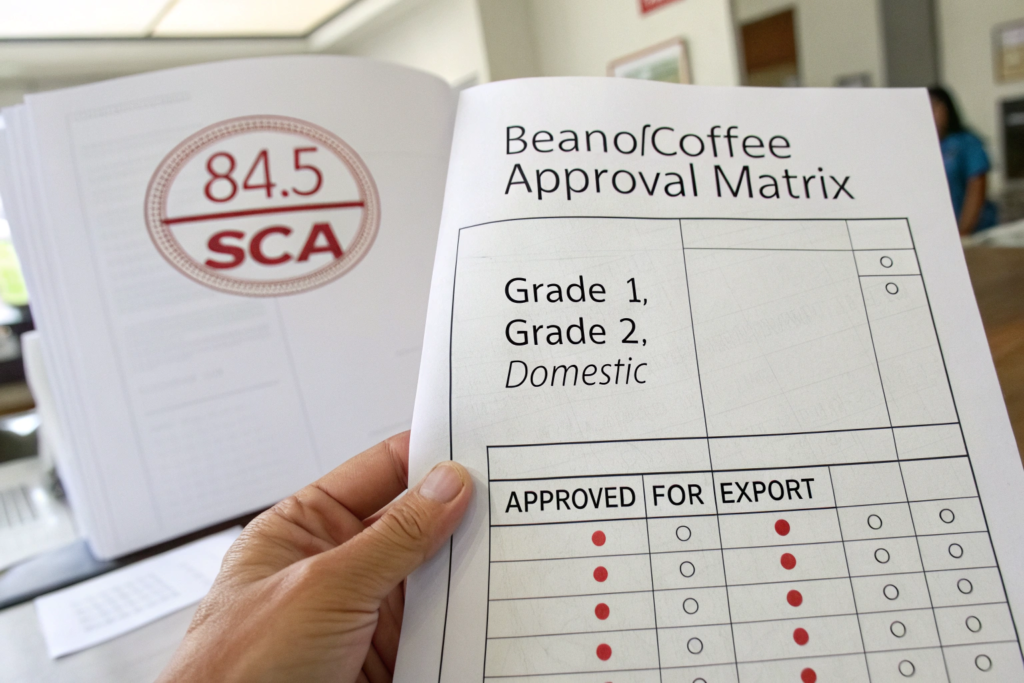
Our internal scoring and approval matrix mandates a minimum SCA total score of 83 points for our Grade 1 Arabica export status, with no single attribute scoring below 7.5, and we use a continuous calibration process with our long-term clients to ensure our sensory language and scoring align with their own quality expectations.
This matrix removes any ambiguity. The scores determine the grade. The grade determines the price and the market. It is a fair and transparent system.
What Is the Minimum SCA Score for a "Grade 1" BeanofCoffee Export?
We hold ourselves to a higher standard than the baseline specialty market. Our reputation depends on the consistency of our top grade.
The BeanofCoffee Grade 1 Approval Matrix:
- SCA Total Score: Minimum 83 points. (The SCA baseline for "Specialty" is 80 points. We add a 3-point buffer).
- Individual Attribute Score: No single attribute below 7.5. This prevents a "barbell" effect where a high score in one area masks a weakness in another.
- Defect Count: Zero Category 1 defects. Zero to five Category 2 defects.
- Moisture/Water Activity: Must be within our specifications.
If a lot scores an 84.5, it is approved as Grade 1. If a lot scores an 81.5, or scores an 83 but has a "Uniformity" score of 7.0, it is automatically downgraded. It might be offered as a high-quality Grade 2 commercial lot, but it will not be sold under our premium Grade 1 label. This is an automatic, rules-based decision. There is no "rounding up" or making exceptions. This is the integrity of our grading system. Learn more about our available grades on our Green Coffee Specifications page.
How Do We Calibrate Our Palates with Long-Term Clients?
A cupping score is only valuable if it is reliable and shared. If we score a coffee 84.5 and you score it 82, we have a calibration problem. We actively work to prevent this with our contract clients.
Our Calibration Protocol:
- The PSS as a Shared Benchmark: The Pre-Shipment Sample (PSS) is our primary calibration tool. You receive the coffee, roast it to the same specification, and cup it. Your score and your notes become the shared reference point.
- Sharing Scoresheets: We provide our internal cupping scoresheet with every PSS. You can see the individual attribute scores our Q-Grader assigned. This invites a direct comparison.
- Mutual Feedback: If there is a persistent gap between our scores and yours, we want to know. We might arrange a video call where we cup the same lot "live" together, discussing the notes in real-time. Sometimes the difference is simply a matter of the water chemistry in your lab. We work to identify and resolve the discrepancy.
- Annual Calibration Sessions: For our largest clients, we offer an annual calibration set. We ship a selection of coded samples representing different quality levels and flavor profiles. Both our Q-Grader and yours cup the set independently and then compare scores. This is the gold standard for building long-term sensory alignment.
This deep commitment to calibration is what allows our clients to buy with confidence. It is a service that goes far beyond just selling coffee. For independent verification of our quality systems, our processes are aligned with the standards of the Global Food Safety Initiative.
Conclusion
The cupping protocol at BeanofCoffee for export approval is the definitive, quality-guaranteeing heartbeat of our entire operation. It is a chain of rigorous, objective evidence that begins with a physical grading of the green bean and ends with a detailed sensory scoresheet, passing through a precise, standardized roast and a disciplined tasting procedure.
By enforcing a strict internal approval matrix that exceeds the industry standard, and by actively calibrating our palates with those of our long-term partners, we ensure that every container of Grade 1 Yunnan Arabica that leaves our warehouse delivers on our promise of quality, consistency, and flavor. This is not just how we taste coffee. It is how we build trust.
If you would like to experience our cupping protocol firsthand by receiving a PSS of our current Grade 1 offering, complete with our internal scoresheet, we can arrange that. Email Cathy Cai. Ask for the "Approved Export Sample and Scoresheet." Contact Cathy at: cathy@beanofcoffee.com