I once had a buyer who was embarrassed to ask. He had been sourcing coffee for years, but he never asked for a pesticide report. He thought it would be offensive, like questioning the supplier's integrity. He was worried about damaging the relationship. So he stayed quiet. Then one day, his largest grocery account asked him for the pesticide residue analysis for the coffee on his shelf. He did not have it. He came to me, apologetic. I told him the truth: asking for a current pesticide residue report is not an accusation. It is a standard, professional, and expected part of modern coffee sourcing, especially for organic and specialty lots. Any reputable supplier will have the report ready.
To ask a coffee supplier for their latest pesticide residue report, you should frame the request as a standard part of your quality assurance and food safety due diligence, specifically ask for a Certificate of Analysis (CoA) from an ISO 17025 accredited laboratory that covers a multi-residue panel including all pesticides relevant to the origin, and ask for the report to be tied to the specific lot number you are purchasing.
This is about protecting your brand and your customers. It is a question of food safety, not a question of trust. Let me explain exactly what to ask for, how to interpret the report, and what a comprehensive testing program looks like from a supplier like us.
What Specific Test Should You Request for Pesticide Analysis?
Not all "pesticide tests" are created equal. A simple, cheap test might only screen for a handful of common chemicals. A comprehensive test screens for hundreds. If you are going to ask the question, you need to ask for the right test.
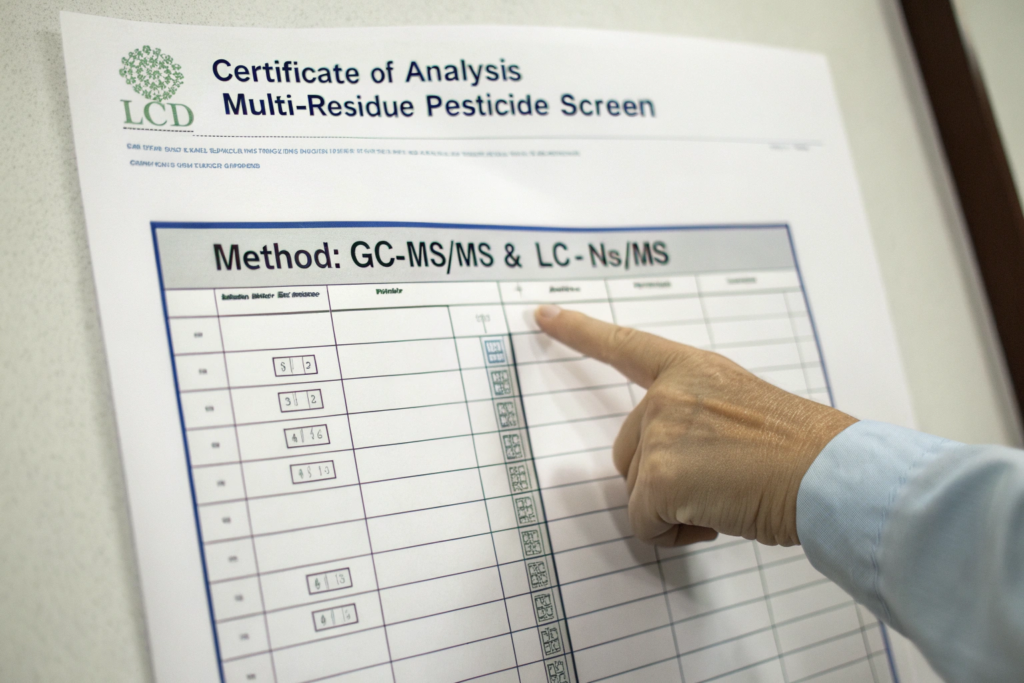
The specific test you should request is a "multi-residue pesticide analysis" performed using liquid and gas chromatography with mass spectrometry (LC-MS/MS and GC-MS/MS), which can simultaneously screen for 400-500+ individual pesticide compounds at extremely low detection limits, typically down to 0.01 mg/kg (10 parts per billion), in accordance with EU or NOP organic standards.
This is the gold standard. It is the type of test that a professional, quality-focused exporter should be conducting on their coffee. Do not accept a vague letter. Ask for the lab report with the specific chemical compounds listed.
What Is a "Multi-Residue Panel" and Why Is It Necessary?
A multi-residue panel is not a single test. It is an extremely broad screening that looks for the chemical fingerprint of a vast range of pesticides, herbicides, fungicides, and their breakdown metabolites, all in one analysis.
- Why It Is Needed: A coffee farm or its neighbors might use any number of agrochemicals. These include organophosphates, organochlorines (like DDT, which persists in the environment for decades), pyrethroids, neonicotinoids, and triazole fungicides. Testing for only one or two, or testing only for "organophosphates," is insufficient.
- The Technology: The LC-MS/MS and GC-MS/MS methods are capable of detecting these hundreds of compounds simultaneously at parts-per-billion (ppb) levels. This is equivalent to finding a single drop of a substance in an Olympic-sized swimming pool.
- Targeted vs. Non-Targeted: A good panel will be tailored to the origin, including pesticides known to be used in coffee farming in that region, as well as globally banned persistent organic pollutants (POPs).
At Shanghai Fumao, our annual pesticide surveillance testing uses a comprehensive multi-residue panel. We specifically test for the pesticides commonly used in Yunnan and those on the EU's list of prohibited substances. This is part of our commitment to transparency, and it supports the claims we make on our Sustainability page. You can learn more about the analytical methods from organizations like the AOAC International.
What Detection Limits Should a Trustworthy Report Guarantee?
A report that just says "Not Detected" is meaningless without knowing the detection limit. A poor test might have a detection limit of 0.5 mg/kg, missing a residue present at a lower, but still significant, level. A high-quality test has much lower limits.
Key Detection Limits to Look For:
- General Limit of Quantification (LOQ): A trustworthy lab will aim for an LOQ of 0.01 mg/kg (10 ppb) for most pesticides in a green coffee matrix. This is the default standard for EU pesticide regulations.
- Specific Residues: For certain highly toxic or strictly regulated compounds, the required detection limit may be even lower. For example, you might look for an LOQ of 0.005 mg/kg for substances like Endosulfan.
When you request a report, ask the supplier for the full report that lists the LOQ for each individual compound tested. This proves the test was sensitive enough. A supplier who understands these analytical nuances is a supplier who is serious about food safety. At Shanghai Fumao, our Certificates of Analysis always include the analytical method used and the LOQ for each compound. We are transparent because we have nothing to hide. Our internal standards are aligned with the strict residue limits set by the European Commission.
How Is the Sample Collected for a Valid Residue Analysis?
A multi-million dollar lab instrument is useless if the sample it analyzes was carelessly collected. The result is only as good as the sample. A professional supplier will follow a documented sampling protocol to ensure the tiny amount of coffee in the lab vial truly represents the entire lot.
A valid residue analysis depends on a statistically representative sample drawn from across the entire lot using sterile equipment, which is then securely sealed, labeled, and tracked with a Chain of Custody form to the laboratory, preventing any contamination or mix-up that could invalidate the results.
You should look for a supplier who can describe this process. It is a sign of a mature food safety system.
What Is the Standard Protocol for Collecting a Representative Lot Sample?
This is the same rigorous sampling protocol we use for mycotoxin and quality testing. It is a standardized process to ensure the sample is a true miniature version of the 19,000 kg lot.
The Representative Sampling Protocol:
- Lot Definition: The sample must be drawn from the specific, homogeneous lot you are purchasing. The lot number is recorded.
- Number of Increments: A single scoop from the top bag is not a sample. A representative sample is a composite sample, made up of many smaller "increments" or "core samples" taken with a sterile bag trier.
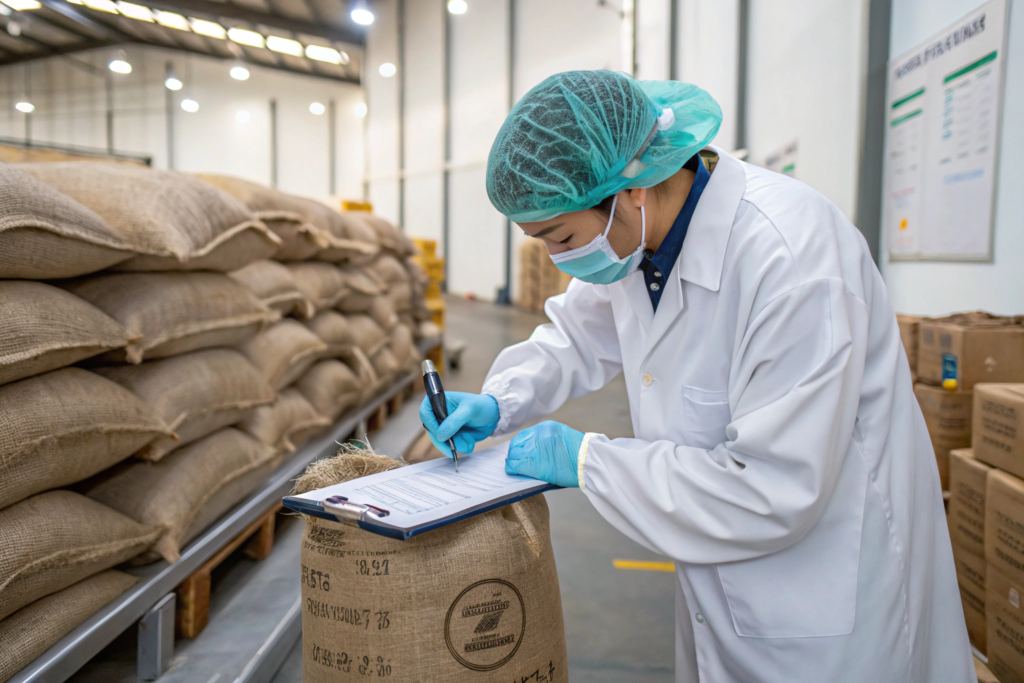
- The Procedure: Our trained QC staff probes a minimum of 10% of the bags in the lot, taking cores from the top, middle, and bottom of the pallets to ensure all parts of the lot are represented. All the cores are combined in a clean, food-grade container and thoroughly mixed.
- Quartering: This large composite is then reduced using a sample divider or the "quartering" method to a final laboratory sample of about 500 grams.
This process ensures the 15 grams the lab eventually grinds up is statistically representative of every single bag in the container. At Shanghai Fumao, this is our Standard Operating Procedure. You can be confident that the clean lab report you see reflects the coffee you will receive.
Why Is a "Chain of Custody" Document Important for the Sample?
The chain of custody (CoC) is the paper trail that proves the sample analyzed by the lab is the exact sample taken from your lot, and that it was not tampered with or contaminated along the way.
What a CoC Document Records:
- Sample ID: The unique identifier linking the sample to the lot.
- Sampling Details: The date, time, and location of sampling. The name and signature of the person who collected the sample.
- Custody Transfers: Every time the sample changes hands (from the QC technician to the courier, from the courier to the lab technician), the date and signatures of both the person relinquishing and the person receiving the sample are recorded.
- Seal Integrity: The CoC will often include a space to verify that the tamper-evident seal on the sample bag was intact upon arrival at the lab.
The CoC makes the analytical result legally defensible. It turns a lab report into an auditable record. When you ask a supplier for a pesticide report, you can also ask, "Do you maintain a Chain of Custody record for the sampling process?" This is a mark of a truly professional operation. The standards for this are often derived from guidelines by the International Organization for Standardization, such as ISO 17025 for laboratory competence.
How Does Organic Certification Simplify the Pesticide Question?
Requesting a pesticide residue report is essential for conventional coffee. But there is a higher level of assurance that simplifies the entire conversation: certified organic. An organic certification is not a pesticide test; it is a farming system verification that makes pesticide contamination extremely unlikely.
Organic certification simplifies the pesticide question by providing a government-backed, annually audited guarantee that the coffee was produced without the use of synthetic pesticides, herbicides, or fertilizers, effectively rendering a positive pesticide residue test a near impossibility and a sign of an audit failure.
For many specialty roasters, sourcing certified organic coffee is the most robust and efficient way to meet their customers' demands for clean, pesticide-free products. It eliminates the need to be a forensic chemist and replaces it with trust in a regulated system.
What Is the Difference Between a Pesticide Test and an Organic "System" Audit?
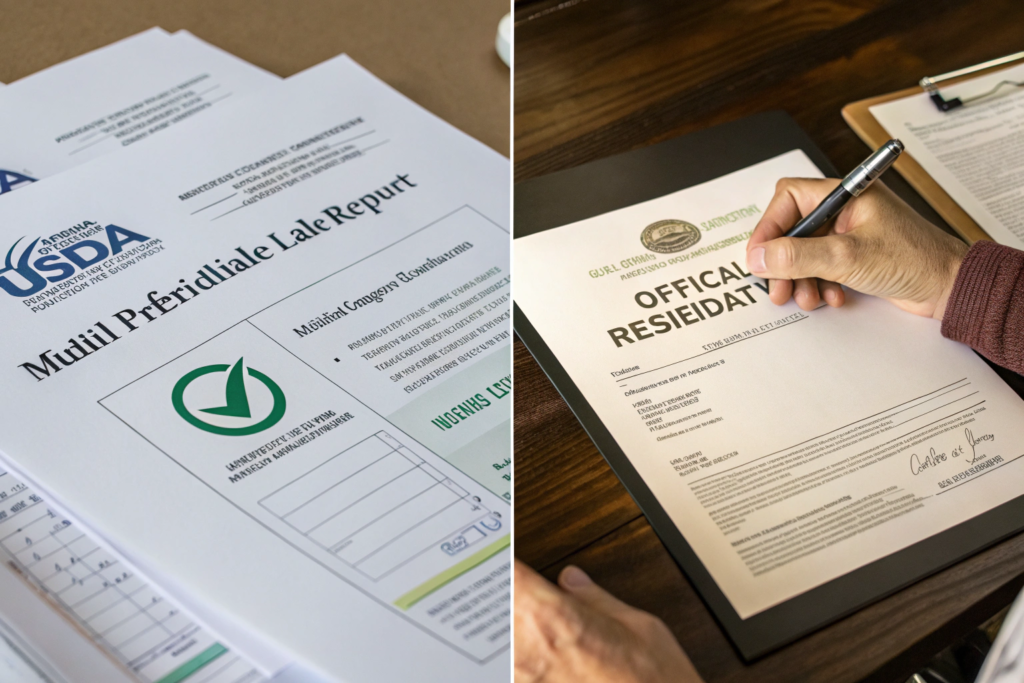
This is a crucial distinction. A pesticide test tells you if a residue is present in a specific sample at a specific moment. An organic audit tells you that the entire agricultural system is designed to prevent that residue from ever being there.
- Pesticide Test (A Snapshot): It is a reactive measurement. It tells you the coffee is clean today.
- Organic Certification (A System Audit): It is a proactive verification. The annual audit by a certifier like OFDC (for Chinese CNOP certification) or Oregon Tilth (for USDA NOP) verifies:
- Input Records: The certifier reviews years of purchase records for fertilizers, pest control products, and seeds, verifying that only approved organic inputs were used.
- Field History: The certifier verifies that the land has been free of prohibited substances for the required transition period (usually 3 years).
- Buffer Zones: The certifier inspects the farm to ensure adequate buffer zones separate organic plots from any potential contamination from neighboring conventional farms.
- Neighbor Notification: The certifier verifies that neighbors have been notified of the organic certification to prevent accidental spray drift.
This systemic approach is why organic certification is so powerful. It makes a positive pesticide test an anomaly that would trigger a full investigation and decertification. When you buy our USDA Organic Grade 1 Arabica, you are buying the output of this rigorously audited system. More details are on our Certifications page.
Can a Supplier Provide Both an Organic Certificate and a Lab Report?
Yes, and this is the "belt and suspenders" approach that provides the ultimate peace of mind. A supplier who is truly committed to quality will offer both.
Why Both?
- The Organic Certificate: This is the proof of the process. It demonstrates a systemic commitment.
- The Lab Report: This is the proof of the product. It is a direct, analytical verification of that specific lot.
At Shanghai Fumao, for our certified organic lots, we maintain a dual-layer documentation approach. We provide you with our valid Organic Product Certification Certificate and the shipment-specific NOP Import Certificate. And, as part of our standard food safety program, we also conduct periodic multi-residue pesticide screens on our organic production as a surveillance measure to verify the integrity of our organic system.
Any client who requests it can receive both sets of documents. This is not an either/or choice. It is a comprehensive display of our commitment to delivering a truly clean, verified product. For more resources on organic equivalency, the Organic Trade Association is a valuable industry group.
Conclusion
Asking your coffee supplier for their latest pesticide residue report is a simple, professional act that separates serious, transparent producers from the rest. It should never be an awkward conversation. It should be a routine part of your supplier qualification process, just like asking for a sample or a price quote.
By requesting a comprehensive multi-residue panel from an ISO 17025 lab, inquiring about their sampling and chain of custody protocols, and ideally, sourcing certified organic coffee that provides a system-level guarantee, you build an unassailable defense for your brand. You demonstrate to your customers that their health and safety are your top priority.
At Shanghai Fumao, we welcome these questions. Our food safety program is built on this transparency. Whether you need our latest surveillance test results for conventional lots or the full organic documentation package, it is ready for you.
If you would like to receive a sample of our documentation—including a recent third-party lab report and our organic certification—let's start that conversation. Email Cathy Cai. Ask for the "Food Safety & Pesticide Documentation Pack." Contact Cathy at: cathy@beanofcoffee.com