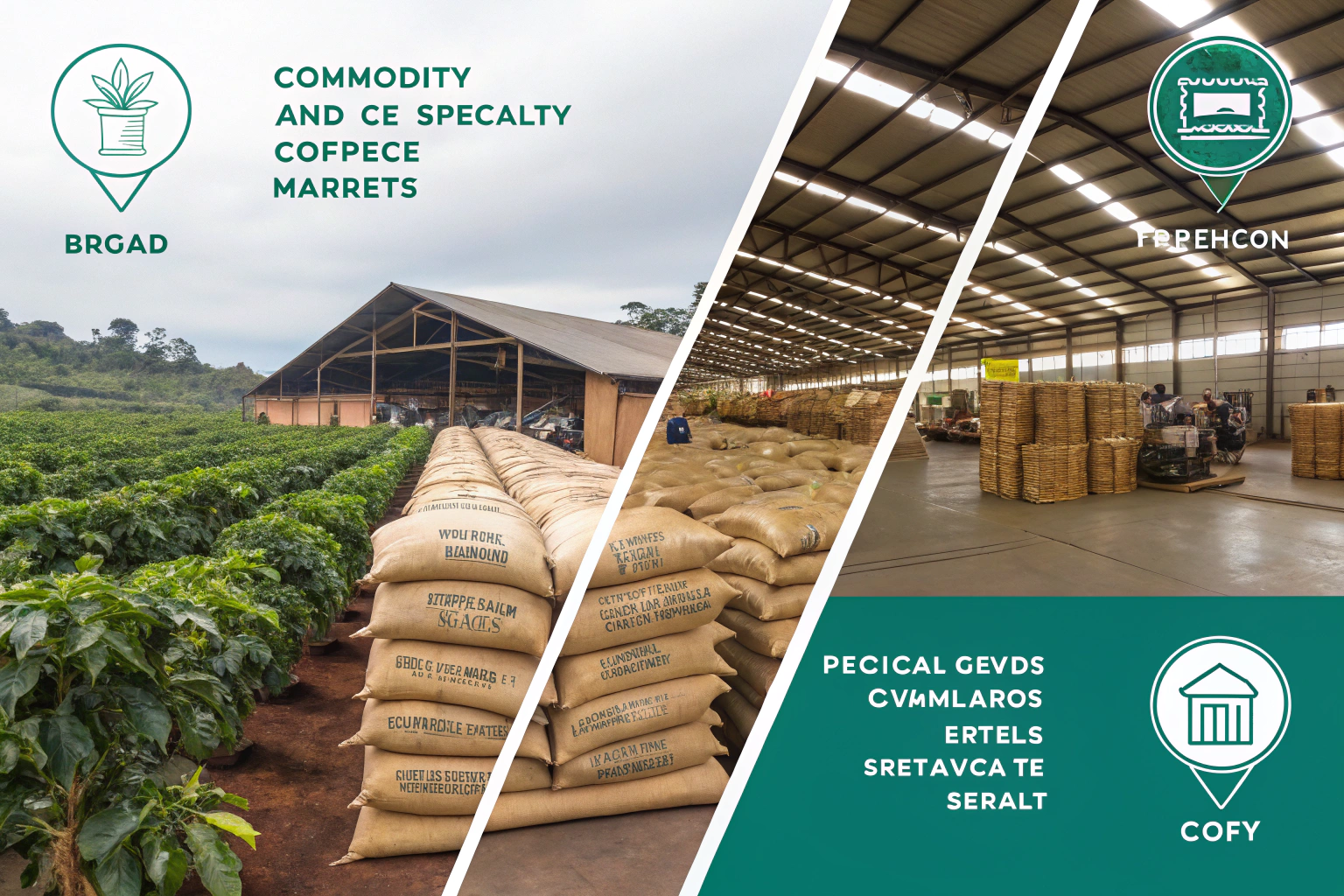
You're building a coffee business. You hear "commodity" and "specialty" thrown around, often with the latter spoken in reverent tones. But what does it actually mean for your sourcing, pricing, and risk? The gap between these two markets isn't just about quality—it's about fundamentally different economic systems, relationships, and business philosophies. Choosing the wrong path can lock you into a price war you can't win or alienate a customer base you don't understand.
The core difference lies in valuation basis: the commodity market prices coffee as a uniform, interchangeable bulk agricultural product based on futures contracts and broad physical grade standards. The specialty market prices coffee as a unique, graded agricultural craft product based on its measurable sensory quality, origin story, and sustainable practices.
Think of it like buying wheat for bread versus buying heirloom wheat from a specific farm for artisan sourdough. Both are wheat, but they operate in different worlds. Let's dissect these worlds.
How are prices determined in each market?
This is where the divergence is starkest. Your cost and your risk exposure change completely depending on which market you participate in.
In the commodity market, price is set by the "C" price—the ICE Futures US benchmark for Arabica—plus a small differential. In the specialty market, price is primarily set by quality score (e.g., SCA cupping score), origin rarity, and direct relationship, often bearing little relation to the volatile "C" price. Your business's predictability hinges on this mechanism.
What drives the volatile "C" price in commodity coffee?
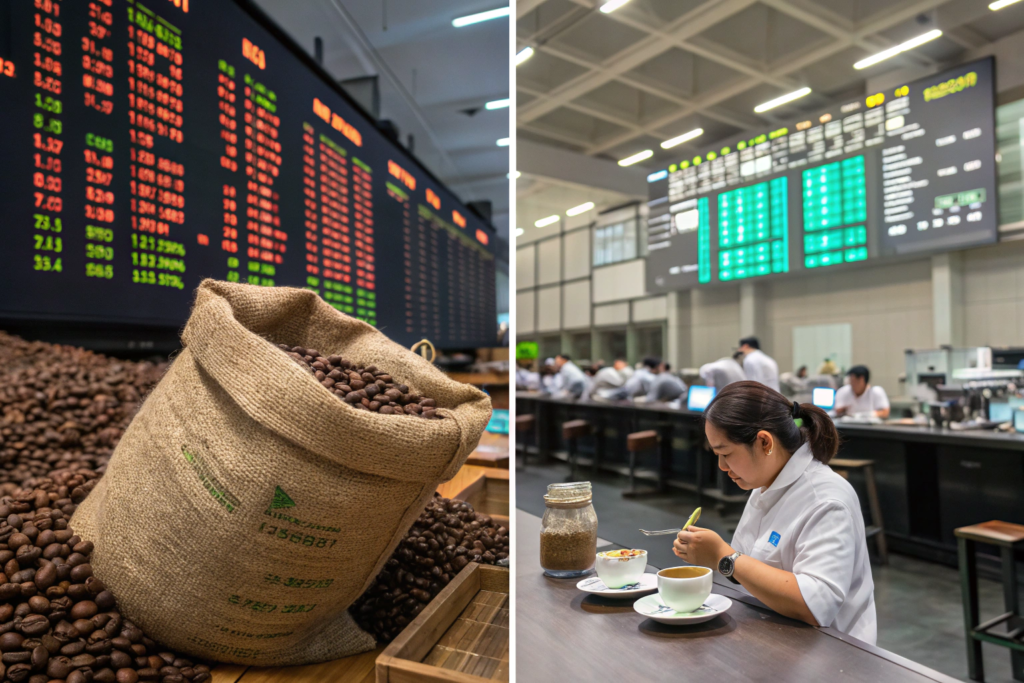
The ICE Futures "C" contract is the global reference. It's a bet on the future supply and demand of generic, deliverable-grade Arabica. Its price swings are driven by macro forces far removed from your farm or roastery: weather forecasts in Brazil, currency fluctuations in producer countries, speculative trading by hedge funds, and global inventory reports. For a buyer, this means your input cost can swing wildly due to a frost you'll never feel or a financial event you can't control. You are buying a fungible product. A bag of "Brazilian Naturals, Grade 4" from one supplier is meant to be identical to the same grade from another. The price is the market's. The risk is yours.
How do cupping scores and direct trade create specialty pricing?
Specialty coffee flips the model. The starting point is a professional quality assessment, typically using the Specialty Coffee Association (SCA) scale where a score of 80+ points defines "specialty grade." A 84-point coffee commands a higher price than an 81-point coffee. A 90+ point "exceptional" coffee enters auction territory. This price is negotiated directly between buyer and seller (farmer, co-op, or exporter like us). While the "C" price might be a reference point, the final price is a premium over it, determined by quality, lot size, and relationship. This is relationship coffee. We at Shanghai Fumao discuss with roasters what flavor profile they need, then match them with specific lots from our Yunnan estate, with a price based on its cupping score and our costs to produce that quality. The "C" price's daily gyrations are background noise.
What are the quality standards and certification processes?
You can't manage what you can't measure. The two markets measure value in completely different ways, using different tools and vocabularies.
Commodity coffee is graded on physical defects and basic attributes (bean size, moisture). Specialty coffee is graded primarily on sensory quality (flavor, aroma, aftertaste) via standardized cupping, with physical grading as a secondary, stricter check. The inspection process tells you everything about market priorities.
How does defect counting work in commodity grading?
The New York Green Coffee Contract defines the standard for deliverable "Exchange Grade" coffee. It's a defect-based system. Graders count the number of imperfections in a 350g sample: black beans, sour beans, stones, sticks, etc. A certain number of "quakers" (underdeveloped beans) or broken pieces is allowed. The goal is to establish a minimum acceptable standard for mass blending. It asks: "Is this coffee free from obvious faults?" It does not ask: "Does this coffee taste excellent?" The process is fast, visual, and tactile. Flavor is assumed to be "standard" if it passes the defect count. This is why commodity coffee is often described as "clean but bland" — it meets the basic spec but lacks distinction.
What is the SCA cupping protocol and why is it the specialty benchmark?
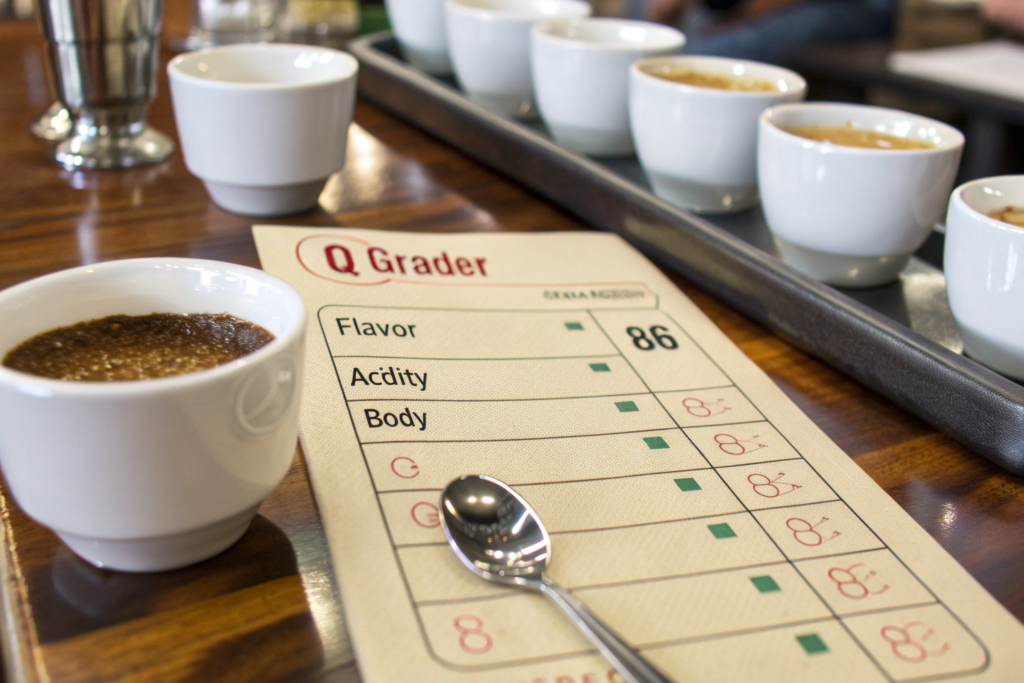
The SCA Cupping Protocol is the industry's standardized sensory evaluation tool. It is meticulous and human-centric. Roasted samples from a single lot are ground, smelled, and brewed. Certified Q Graders score across 10 attributes: Fragrance/Aroma, Flavor, Aftertaste, Acidity, Body, Balance, Sweetness, Uniformity, Clean Cup, and Overall. Each is scored on a scale, totaling 100. The key is that Flavor and Aftertaste carry the most weight. This system actively seeks out and quantifies positive attributes. A coffee scoring 85 has been judged to have clear, pleasurable, complex flavors with no defects. The score sheet from an impartial lab or a seller like us provides an objective quality passport for the beans. This data sheet is what a specialty roaster buys, not just a promise.
How do supply chain relationships differ?
The journey from farm to cup reveals the human and operational contrast between the two models. One is a chain of anonymous transactions; the other is a chain of interconnected partnerships.
The commodity supply chain is long, fragmented, and transactional, with multiple intermediaries (local traders, export houses, importers, brokers) between farmer and roaster. The specialty supply chain is shorter, more transparent, and relationship-based, often connecting the roaster directly to the producer or a dedicated exporter.
What is the typical path of a commodity coffee bean?
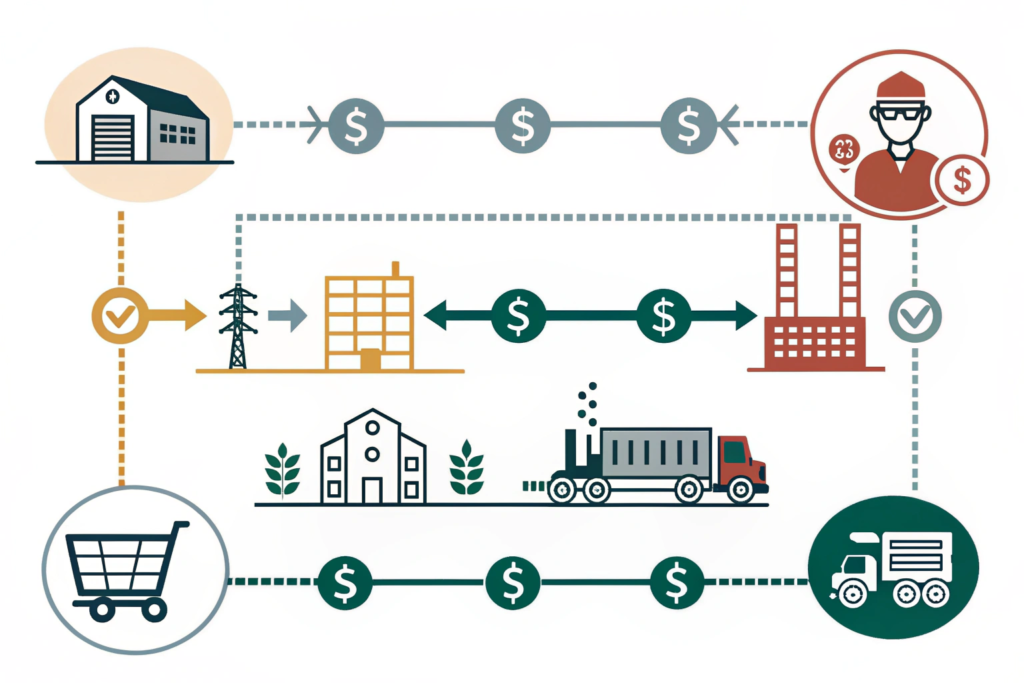
A smallholder's coffee often goes on a long journey: Farmer → Local Collector → Regional Trader → Central Mill/Exporter → International Broker → Importer → Large Roaster (e.g., for instant coffee or supermarket blends). At each step, the coffee is bulked with beans from hundreds or thousands of other farms to meet volume contracts. Origin identity is lost. The roaster knows they bought "Colombian Excelso" from an importer, but has no idea which farm, region, or even specific year it's from. The focus is on volume and meeting a minimum physical spec at the lowest cost. Price is the sole connector.
How does direct trade or relationship coffee work?
In specialty, models like Direct Trade aim to shorten the chain. A roaster may buy directly from a specific farm or cooperative, often visiting in person. More commonly, roasters work with an exporter-importer who acts as a dedicated sourcer and quality guarantor for specific farms. In our case, as Shanghai Fumao, we are that direct link for our Yunnan coffee. We know each plot on our estate. We can tell a roaster the harvest date, processing method, and cupping notes for Lot #BSC-23-105. The roaster buys that specific lot. Communication flows both ways: the roaster gives feedback, and the farm can adjust practices. Premiums paid go directly to sustaining that quality system. The relationship is about mutual success, not just a one-off transaction.
What are the end uses and consumer perceptions?
The market split ultimately reflects a split in consumer demand. One market feeds a need for a consistent, affordable, daily caffeine source. The other feeds a growing desire for an experiential, ethical, and flavorful product.
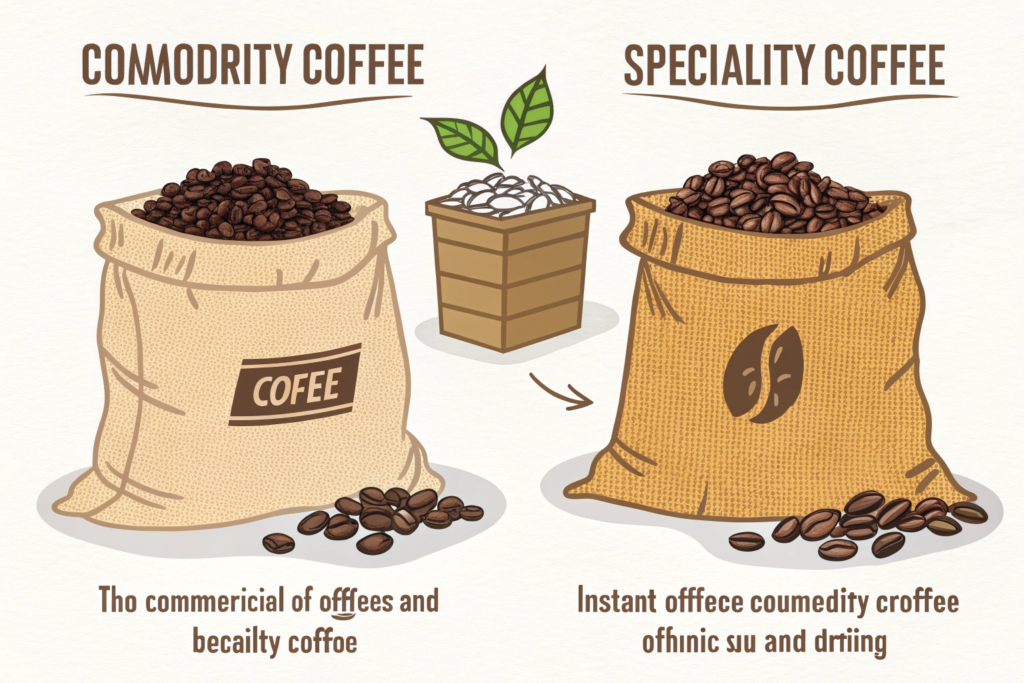
Commodity coffee is primarily destined for large-scale commercial products: instant coffee, mainstream supermarket blends, and private-label brands where consistency and low cost are paramount. Specialty coffee is destined for third-wave cafes, boutique roasteries, and conscious consumers who value origin story, unique flavor, and ethical sourcing.
How do large roasters use commodity beans?
Major roasters producing billions of servings annually rely on commodity beans. Their skill is in blending to create a uniform flavor profile year-round, despite the inherent variability of the raw material. They use advanced technology to roast consistently and blend away defects. The brand (e.g., a national supermarket brand) is everything; the origin is irrelevant or used as a vague marketing term ("Mountain Grown"). The product is shelf-stable for months and designed to taste the same everywhere. Success is measured in market share and cost-per-cup.
What does a specialty coffee consumer actually buy?
A specialty consumer buys a story and an experience. The bag will prominently feature: the country, region, and often the specific farm or cooperative; the varietal (e.g., Bourbon, Gesha); the processing method (Washed, Natural, Honey); the roast date (not just a best-by date); and tasting notes (e.g., "Jasmine, Peach, Brown Sugar"). They are buying transparency. They may also be buying a value: "Direct Trade," "Organic," "Fair Trade," which assures them of ethical sourcing. The roaster's role is to be a curator and translator, preserving and highlighting the unique attributes the farmer and exporter worked to create. The end use is often manual brewing (pour-over, AeroPress) or craft espresso, where nuances can be appreciated.
Conclusion
The difference between commodity and specialty coffee is a chasm between two paradigms. Commodity is a volume-driven, price-based system that values consistency and efficiency, treating coffee as a homogenized global commodity. Specialty is a value-driven, quality-based system that celebrates diversity, traceability, and craftsmanship, treating coffee as an artisanal product.
For a business, the choice isn't about which is "better," but about which model aligns with your capabilities, values, and customer base. You cannot compete in the commodity market without massive scale and cost control. You cannot succeed in the specialty market without a commitment to quality, education, and relationship building.
At Shanghai Fumao, we operate firmly in the specialty sphere, offering traceable, high-scoring lots from our Yunnan estate. We provide the data, the story, and the direct partnership that this market demands. If you are a roaster or brand looking to move beyond anonymous commodity sourcing and build a unique, quality-focused supply chain, let's talk. Contact our Export Manager, Cathy Cai, to explore our specialty grade Arabica and Catimor profiles: cathy@beanofcoffee.com. Let's build a relationship, not just a transaction.