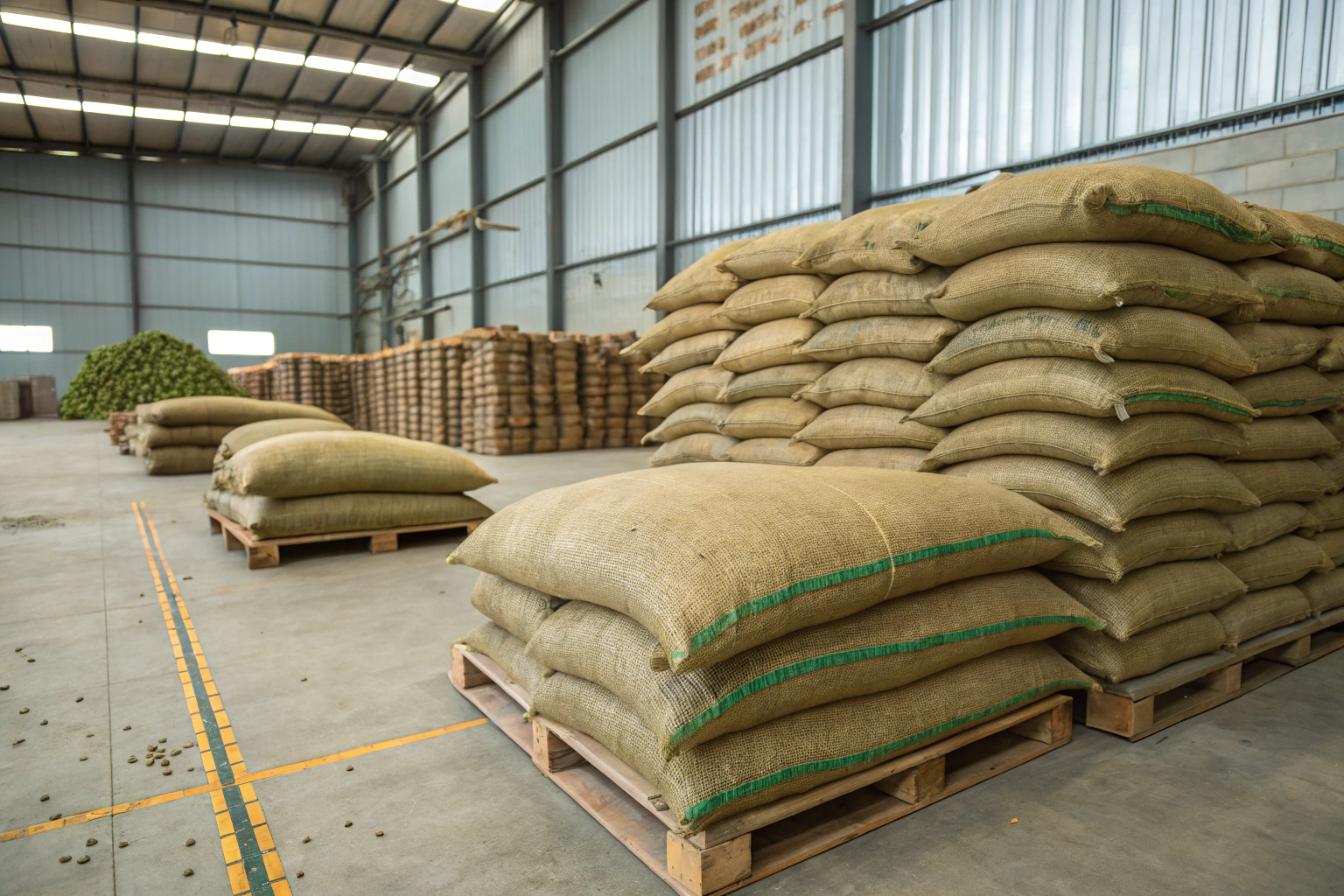
The container arrives. Your crew unloads 275 bags of beautiful, pale green Yunnan Arabica. You stack them neatly on pallets in the corner of your warehouse. You feel a sense of accomplishment. A month later, you pull a bag for roasting. You open it. The smell is... different. A little flat. Maybe a hint of paper or dry wood. You roast it. The cup is muted. The vibrant chocolate note you loved in the sample is gone. You realize: you protected the coffee all the way from China, and then you let it fade in your own building. You're asking: What did I do wrong? How do I store this valuable inventory so it stays as fresh as the day it arrived?
Storing green coffee beans in a warehouse to maintain freshness requires controlling four environmental enemies: heat, moisture, light, and odor. The ideal storage environment is cool (60-70°F / 15-21°C), dry (50-60% relative humidity), dark, and free from strong smells. Bags must be stored on pallets, away from concrete floors and exterior walls. The use of hermetic barrier bags (like GrainPro) inside the jute sack significantly extends the shelf life of high-quality coffee. Proper storage is not passive warehousing; it is the final, critical act of quality preservation before roasting.
I manage a warehouse full of coffee at Shanghai Fumao. I've seen the damage that poor storage can inflict on an exceptional lot. Let me walk you through the essential principles and practical steps to ensure the coffee you paid for stays in peak condition until the moment it hits your roaster.
What Are the Ideal Temperature and Humidity Conditions for Green Coffee?
Green coffee is a hygroscopic seed. It constantly interacts with the air around it, absorbing or releasing moisture until it reaches equilibrium with the ambient environment. Your goal is to make that environment stable and safe.
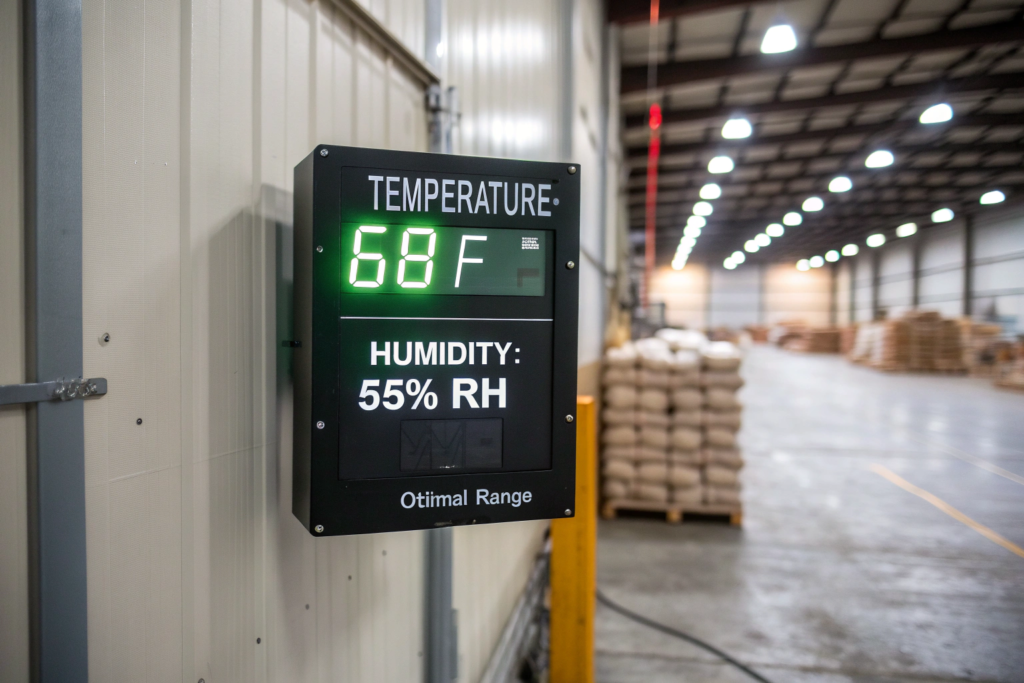
The universally recommended storage conditions for green coffee are a stable temperature between 60°F and 70°F (15°C - 21°C) and a relative humidity (RH) between 50% and 60%. These conditions maintain the coffee's internal moisture content in the ideal 10-12% range and keep water activity (Aw) safely below 0.55, preventing both mold growth and excessive drying. Fluctuations in temperature and humidity are more damaging than slightly sub-optimal but stable conditions, as they cause the bean to repeatedly expand and contract, accelerating the loss of volatile aromatics.
What Happens If My Warehouse Is Too Hot and Humid?
This is the classic "bad storage" scenario and the fastest way to destroy coffee quality.
- Mold and Fungus: Relative humidity consistently above 65% creates a high risk of mold growth on the jute bags and the beans themselves. This leads to musty, earthy, and phenolic off-flavors and is a potential food safety hazard (Ochratoxin A).
- Accelerated Aging: Heat is a catalyst for chemical reactions. High temperatures accelerate the oxidation of lipids (fats) in the bean, leading to the rapid development of "past-crop" flavors—woody, papery, and flat notes. The coffee loses its vibrancy and acidity much faster.
- Condensation: If warm, humid air hits a cold surface (like a concrete floor or a cold exterior wall), moisture condenses. This liquid water can soak into the bottom bags, causing localized mold and rot. This is why pallets are essential.
If your warehouse is naturally hot and humid (e.g., a non-air-conditioned space in the summer), you must consider climate control or drastically reduce your inventory holding time.
Is a Warehouse That Is Too Dry a Problem?
Yes. While the risk of mold is lower, a very dry environment presents its own set of quality issues.
- Moisture Loss: Relative humidity consistently below 40% will slowly pull moisture out of the green bean. The bean's moisture content can drop below 9%.
- Fading and Fragility: As the bean loses its internal moisture, it loses the volatile aromatic compounds that are held in that moisture matrix. The coffee will taste flat, hollow, and lifeless. The bean also becomes brittle and prone to shattering and chipping during handling and roasting.
- Roasting Difficulty: Over-dried beans are less dense and have lower thermal momentum. They roast faster and are more prone to scorching and tipping.
The ideal is a balanced, stable environment. If you are in a very dry climate (like a heated warehouse in a northern winter), you may want to consider keeping the coffee in its GrainPro liners sealed for as long as possible to prevent moisture loss.
What Is the Best Way to Stack and Palletize Green Coffee Bags?
How you physically arrange the coffee in your warehouse is just as important as the ambient conditions. Poor stacking can create micro-environments that trap moisture, restrict airflow, and damage the beans.
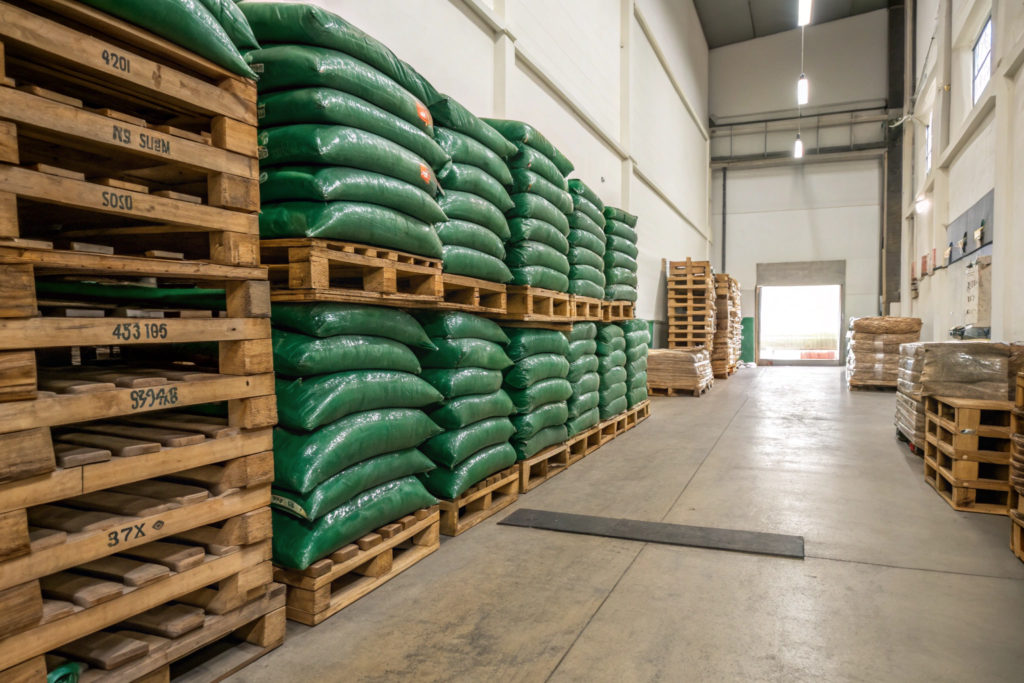
Best practices for stacking and palletizing green coffee bags are: (1) Always use pallets. Never place bags directly on a concrete floor. (2) Maintain an air gap between the pallets and the walls to allow for air circulation and prevent moisture wicking. (3) Stack bags in a stable, interlocking pattern to prevent collapse. (4) Do not stack pallets of coffee bags on top of each other unless the lower pallet is specifically designed to bear the load without crushing the bags beneath. (5) Ensure the warehouse has adequate ventilation or gentle air circulation to prevent stagnant pockets of humidity.
Why Is "Never on Concrete" the First Commandment of Coffee Storage?
Concrete floors are the enemy of stored agricultural products. They are porous and act as a thermal mass.
Concrete wicks moisture from the ground. If you place a jute bag of coffee directly on the concrete, the bag will absorb that ground moisture. The beans at the bottom of the bag will become damp. This creates a perfect micro-environment for mold. Even if the ambient humidity in the room is 55%, the humidity inside that bottom bag can be 80% or higher. Concrete is also often colder than the ambient air. If warm, humid air circulates in the warehouse, it can condense on the cold concrete floor, creating liquid water that soaks into any bag in contact with it. A standard wooden or plastic pallet provides an essential air gap and a moisture barrier. This is non-negotiable.
How Do GrainPro and Other Hermetic Bags Change the Storage Rules?
This is a game-changer. A GrainPro bag is a multi-layer, high-barrier plastic liner that is placed inside the traditional jute sack. It is sealed, creating a hermetic (airtight) environment.
GrainPro bags fundamentally change the storage equation by decoupling the coffee from the ambient warehouse environment. Once sealed, the coffee's moisture content and Aw are locked in. The external humidity can fluctuate wildly, and it will not affect the beans inside the GrainPro liner. The bag also provides a significant barrier against oxygen, slowing oxidation and preserving volatile aromatics. It protects the coffee from absorbing ambient odors. Coffee stored in sealed GrainPro bags in a non-climate-controlled but clean and dry warehouse will maintain its quality significantly longer than coffee in traditional jute. At Shanghai Fumao, we strongly recommend and use GrainPro bags for all of our specialty-grade exports. It is the single most effective tool for extending the shelf life of green coffee during transit and storage.
What Are the Biggest Odor and Pest Risks in Coffee Warehousing?
Green coffee is an olfactory sponge. Its porous cell structure readily absorbs volatile compounds from its surroundings. And it is a food product that can attract pests. Protecting it from these threats is essential.
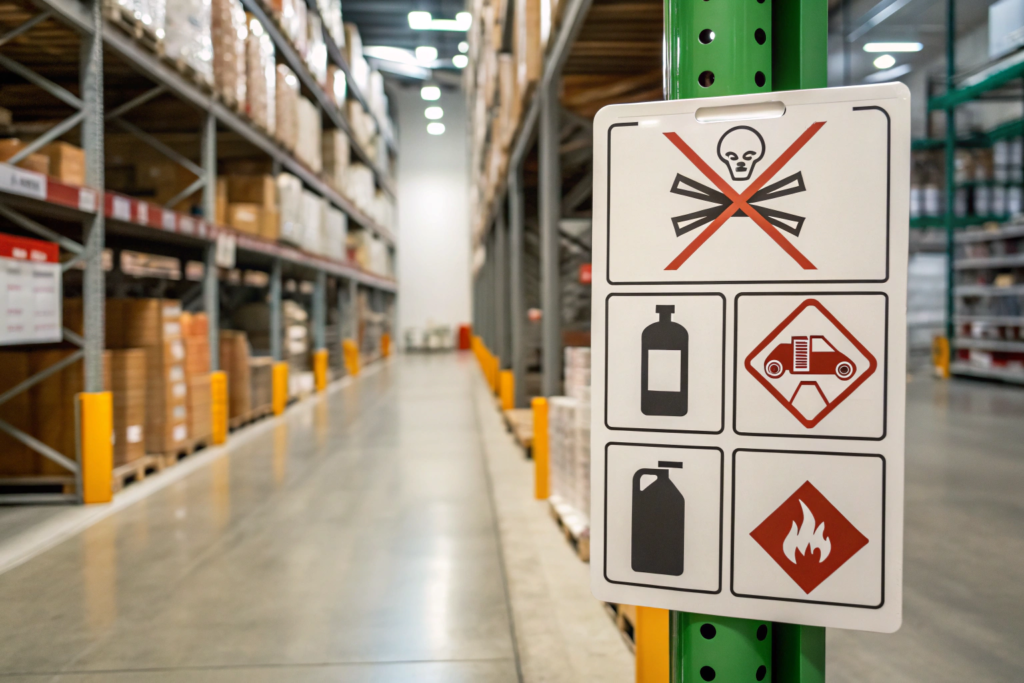
The primary odor risks for green coffee are volatile organic compounds (VOCs) from fuels (gasoline, diesel, propane), industrial solvents, paints, cleaning chemicals, and even strong-smelling foods or spices. Never store green coffee in a space shared with vehicles, chemicals, or strong-smelling products. Pest risks include rodents (attracted to the jute and the beans) and insects (like the coffee berry borer, though less common in storage). A rigorous Integrated Pest Management (IPM) program focused on prevention—sealing entry points, maintaining impeccable cleanliness, and using monitoring traps—is required.
Why Does Coffee Absorb the Smell of Fuel or Paint So Easily?
This is due to the bean's lipid (fat) content. Many volatile organic compounds from fuels and solvents are fat-soluble. They readily dissolve into the coffee's oils.
Once absorbed, these off-odors are incredibly difficult to remove. They will persist through roasting and end up in the cup, producing distinct and unpleasant "petrochemical" or "solventy" notes. This is a catastrophic and irreversible defect. The rule is absolute: No green coffee should ever be stored in a space that is, or ever has been, used for storing gasoline, diesel, propane, paints, varnishes, or industrial cleaning agents. The risk of cross-contamination is too high. A dedicated, clean, food-grade storage area is essential.
How Do I Implement a Basic Pest Prevention Program?
Prevention is far more effective and safer than reactive spraying of pesticides around your coffee.
A basic IPM program for a coffee warehouse includes:
- Exclusion: Seal all cracks, gaps, and potential entry points in the building's walls, doors, and roof. Install door sweeps.
- Sanitation: Keep the warehouse meticulously clean. Immediately sweep up any spilled beans. Remove all clutter that could provide harborage for pests.
- Monitoring: Place rodent bait stations outside the building perimeter. Place insect glue boards or pheromone traps inside the warehouse, along the walls, to monitor for pest activity. Check these traps regularly and log the findings.
- Distance: Keep the coffee pallets away from the walls to create an inspection aisle and reduce pest access.
- No Food or Drink: Enforce a strict policy of no food or drink consumption in the coffee storage area.
At Shanghai Fumao, our warehouse operates under a strict IPM protocol to ensure our coffee leaves our facility pest-free and odor-free.
How Often Should I Inspect and Cup My Stored Green Coffee Inventory?
Green coffee is a dynamic, living product. It is slowly changing, even under ideal conditions. "Set it and forget it" is not a viable strategy for quality-focused roasters. Regular, documented inspection is essential.
A professional green coffee inventory management program includes: (1) Visual inspection of the storage environment and the bag exteriors on a weekly basis. (2) Using a trier to pull a representative sample from long-term storage lots (6+ months) every 60-90 days for moisture testing and sensory evaluation (cupping). (3) Practicing strict FIFO (First-In, First-Out) inventory rotation to ensure older coffee is used before newer arrivals. (4) Keeping a detailed log for each lot, noting arrival date, initial moisture/Aw, and the results of subsequent inspections and cuppings.
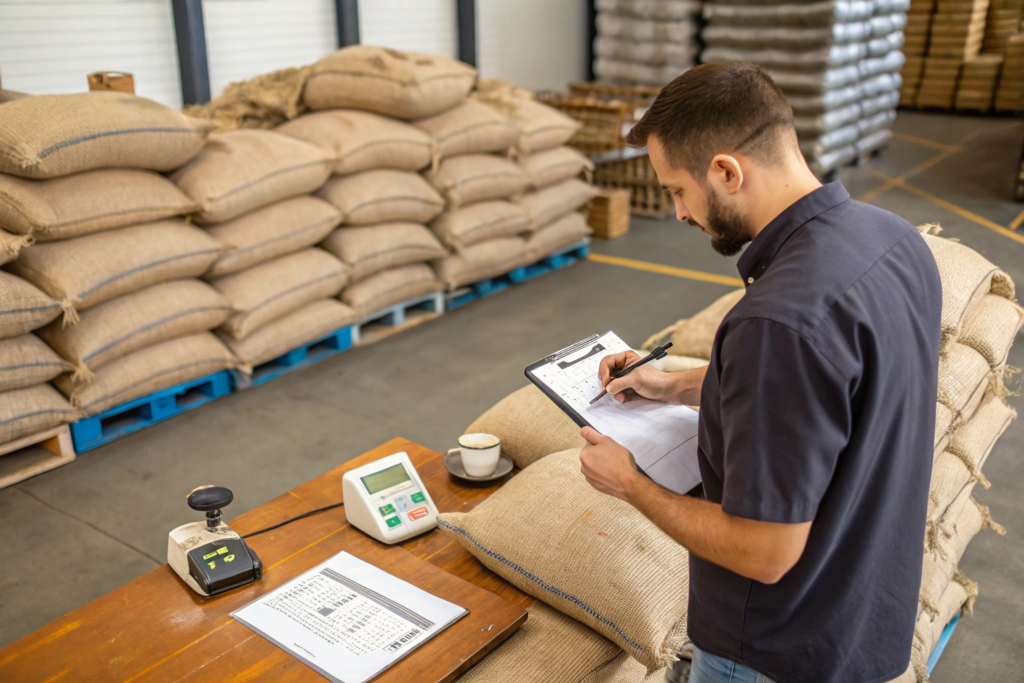
How Do I Properly Pull a Sample from a Stored Bag?
Don't just grab a handful from the top of an open bag. That sample is not representative of the entire bag or the pallet.
Use a bag trier. This is a pointed, hollow metal tube with an opening along its length. You insert the trier into the side of the bag, give it a twist, and withdraw a core sample of beans from the interior. For a single pallet of the same lot, you should pull trier samples from 3-5 different bags—some from the top tier, some from the middle, some from the bottom. Combine these cores into a single composite sample for that lot. This composite sample gives you a much more accurate picture of the overall condition of the coffee than a single scoop from one bag.
What Am I Looking for When I Cup an Aged Green Coffee Sample?
You are not expecting it to taste exactly like it did on day one. Some mellowing is normal and expected. You are looking for signs of negative aging or spoilage.
- First, smell the green beans. Do they smell sweet and grassy? Or is there a hint of must, damp, or paper?
- Roast a small sample. Use your standard profile.
- Cup the roasted sample, ideally side-by-side with your original arrival sample (if you saved one).
- Look for off-flavors: Woody, papery, cardboard, musty, moldy, baggy, or flat.
- Evaluate Acidity: Has the acidity softened? That's normal. Has it become sour or vinegary? That's a defect.
If the coffee cups clean and sweet, with just a slight mellowing of acidity, it's still perfectly good to use. You may just want to use it in a blend or as a base for a darker roast. If you detect must, mold, or strong papery notes, the coffee has degraded and should be evaluated carefully before use.
Conclusion
Storing green coffee is not a passive activity. It is the final, critical link in the quality chain that stretches from a farm in Yunnan to your roastery. The investment you made in sourcing a great coffee can be preserved or squandered by your storage practices.
The principles are clear and achievable: control the environment, keep the coffee off the floor, use hermetic bags, protect it from odors and pests, and inspect your inventory regularly. By implementing these practices, you ensure that the vibrant, complex flavors you paid for are still there, waiting to be unlocked by your roaster, when you need them.
If you have specific questions about the storage and handling of our Yunnan coffees, or about the GrainPro packaging we use, I'm happy to share our detailed protocols. My email is cathy@beanofcoffee.com.