I was on a farm inspection in Baoshan in early 2020 when my logistics coordinator called. "The port is closed," she said. "No containers in or out. No estimated reopening date." I remember standing there, phone in hand, staring at a warehouse full of coffee that was supposed to be on a vessel to Los Angeles in four days. That coffee sat in our warehouse for six weeks. The client in California, a roaster who depended on our Yunnan Arabica for his flagship blend, nearly ran out of inventory. He was calling me every other day, his voice getting tighter. We survived that crisis, barely, because we scrambled. We found alternative routing through a different port, paid a premium for trucking, and got the coffee to him just before his last bag ran out. But I made a promise to myself after that: never again would we scramble. We would plan.
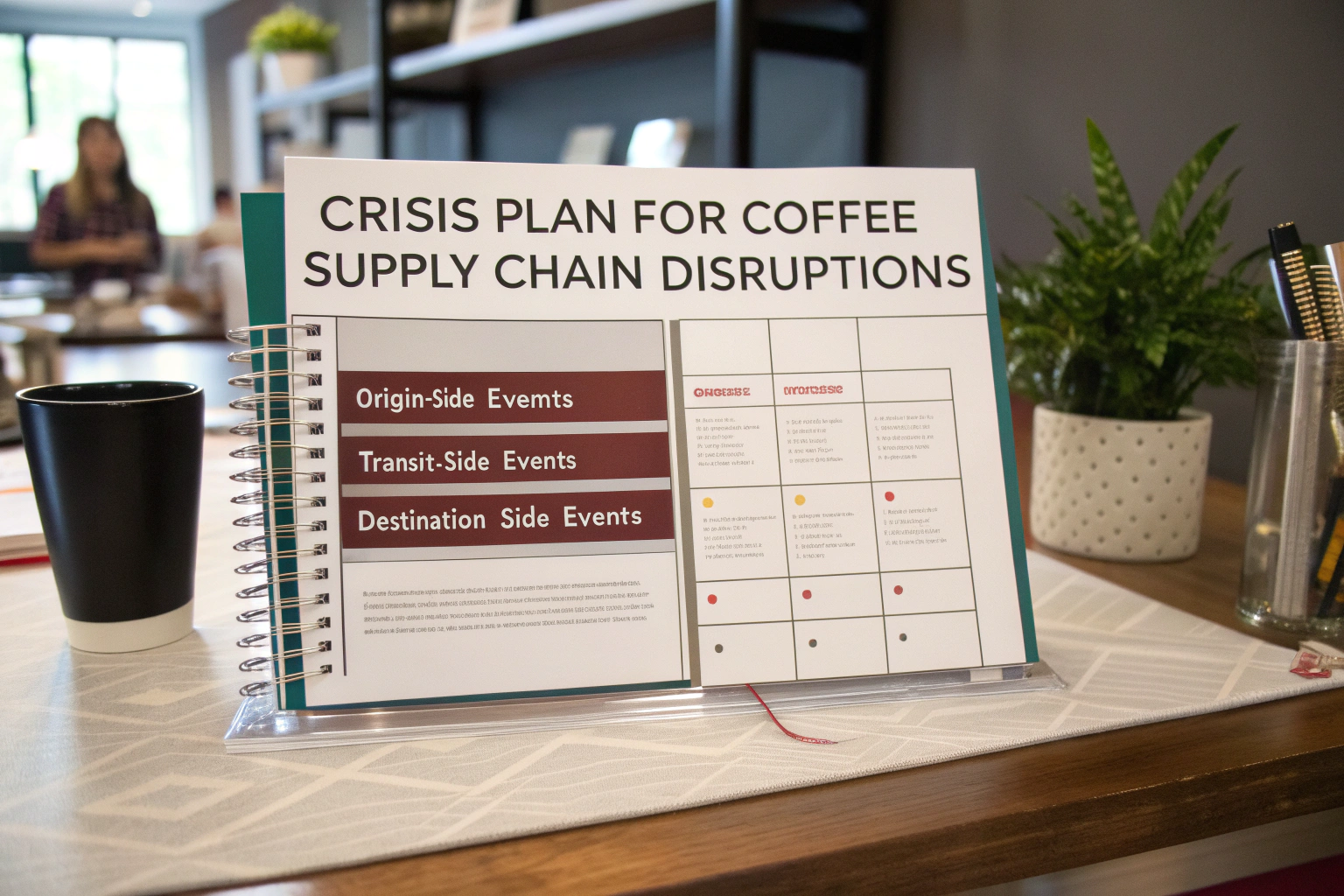
A crisis plan for coffee supply chain disruptions is a structured, pre-written playbook that identifies the most probable disruption scenarios, defines trigger points for activating the plan, assigns specific roles and communication responsibilities, and documents alternative sourcing, routing, and logistics options that can be executed immediately when a crisis hits. The plan must cover three categories of disruption: origin-side events like crop failure, processing delays, and port closures; transit-side events like vessel delays, container shortages, and canal blockages; and destination-side events like port congestion, customs holds, and warehouse capacity issues. A plan that covers all three categories, with current contact information and pre-negotiated backup options, transforms a crisis from an existential threat into an operational challenge with a known resolution path.
What I learned from that 2020 port closure, and from the frost that hit our high-altitude block two years ago, and from the global container shortage that followed the pandemic, is that crises are not exceptions. They are the normal operating environment for international coffee trade. The suppliers and buyers who treat them as such—who build systems, not just reactions—are the ones who survive and strengthen relationships during disruptions. Here is how to build that system.
What Are the Most Common Supply Chain Disruptions in Specialty Coffee Imports?
Before you can plan for a crisis, you need to know what crises actually look like. They are not all dramatic, sudden events. Some are slow, creeping problems that erode reliability over weeks or months before they become critical. Understanding the landscape of disruptions is the first step to building a plan that addresses the ones most likely to affect your specific supply chain.
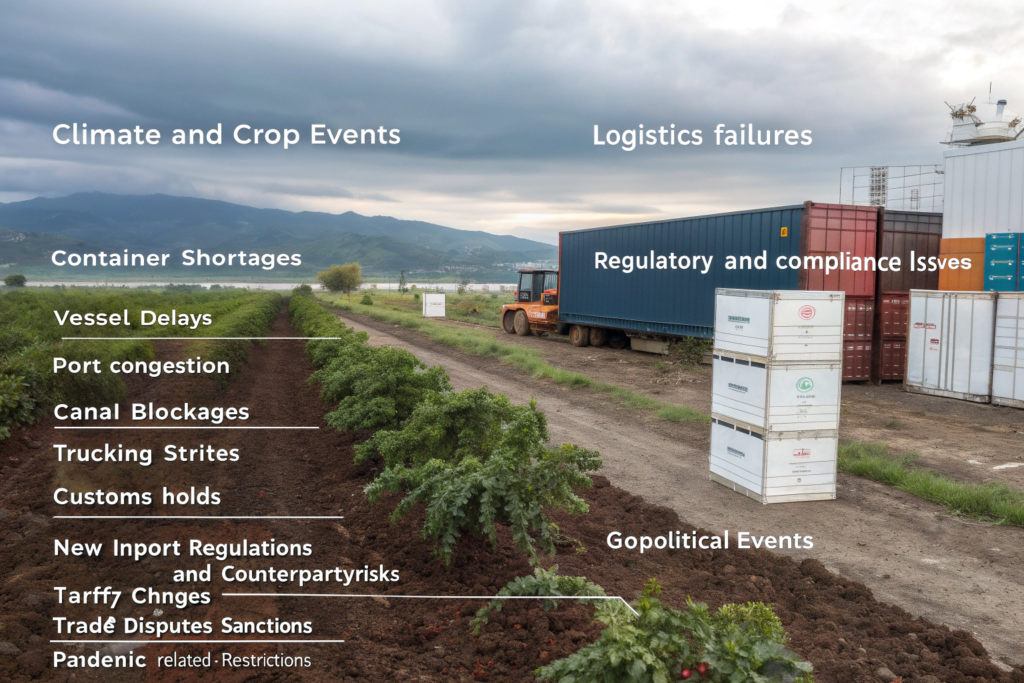
The most common disruptions in specialty coffee imports fall into five categories. Climate and crop events: frost, drought, excessive rain during harvest, pest outbreaks, and general yield fluctuations that reduce available volume or degrade quality. Logistics failures: container shortages, vessel delays, port congestion, canal blockages, and trucking strikes. Regulatory and compliance issues: customs holds, new import regulations, tariff changes, and documentation errors. Financial and counterparty risks: supplier insolvency, payment disputes, and contract defaults. And geopolitical events: trade disputes, sanctions, and pandemic-related restrictions. Each category requires a different response strategy, and a comprehensive crisis plan addresses all five.
I keep a running list of every disruption we have experienced or observed in the industry over the past fifteen years. The list is long. But patterns emerge. Container availability issues have become more frequent. Climate events are becoming more intense and less predictable. Customs enforcement in major importing countries is tightening. The specific crisis that hits next will probably be one we have seen before in some form. That is the value of a plan: it captures the lessons of past crises before the next one arrives. The World Coffee Research climate risk tools provide data on the probability of climate-related disruptions by region, and the International Chamber of Commerce's trade disruption resources offer guidance on managing logistics and regulatory risks in global supply chains.
How do you distinguish between a temporary delay and a supply-threatening crisis?
A temporary delay is a vessel that arrives five days late. The coffee still arrives. The quality is unaffected. The client is mildly inconvenienced but can manage with existing inventory. A supply-threatening crisis is a situation where the coffee may not arrive at all, or may arrive with significantly degraded quality, or may arrive so late that the client runs out of inventory and cannot fulfill their own commitments. The distinction is not academic. It determines the level of response. A temporary delay requires a status update and a revised delivery estimate. A crisis requires activation of the full crisis plan, including alternative sourcing, emergency logistics, and direct communication with the client's leadership. The trigger for crisis activation should be defined in the plan in objective terms.
What is the single most underappreciated risk in coffee supply chains?
In my experience, it is the concentration risk of relying on a single logistics route or a single port. Many roasters source from multiple origins but route all of their coffee through a single port of entry, often on the West Coast of the United States. A labor dispute, a port closure, or a severe congestion event at that single port can halt their entire supply chain, regardless of how diversified their origin portfolio is. A crisis plan must include alternative routing options—East Coast ports, Gulf Coast ports, Canadian ports with cross-border trucking—and the pre-negotiated relationships with freight forwarders and customs brokers to activate those alternatives quickly.
How Do You Map Your Coffee Supply Chain to Identify and Prioritize Vulnerabilities?
You cannot protect what you cannot see. A supply chain map is not a theoretical exercise. It is a visual, documented trace of every step your coffee takes from the farm to your roastery, with the vulnerabilities at each step identified and ranked. I built our first supply chain map on a whiteboard after the 2020 port closure, and the act of drawing it revealed risks I had never consciously considered.
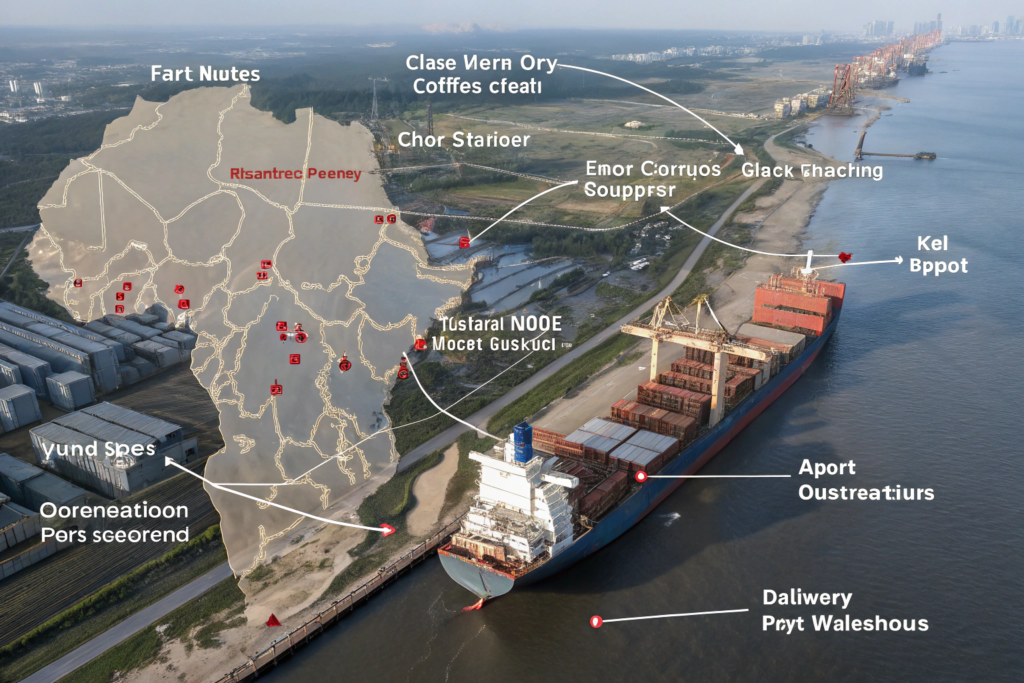
Supply chain vulnerability mapping involves documenting every node and link in the chain—farm, wet mill, dry mill, warehouse, trucking route, export port, ocean carrier, import port, customs broker, destination warehouse, final delivery—and then assessing each for two factors: the probability of disruption and the severity of impact if disrupted. The nodes with high probability and high severity are the priorities for contingency planning. For a typical Baoshan-to-US coffee supply chain, the highest-risk nodes are often the dry mill, where a mechanical failure can halt processing; the export port, where congestion or closures can delay multiple containers; and the destination port, where customs holds or labor issues can cause unpredictable delays. The map makes these risks visible and actionable.
When I mapped our chain, I discovered a vulnerability I had overlooked: our dry mill had a single critical piece of equipment, a density table, with no backup and a lead time of several months for a replacement part. If that table failed during the export season, we could not finish processing coffee to specification. We bought a backup unit within the month. That investment has already paid for itself by preventing a bottleneck during our busiest processing period. The Supply Chain Resilience Hub resources offer frameworks for mapping and risk assessment, and the Global Logistics Network design principles provide examples of how major logistics companies structure their contingency planning.
What does a supply chain map for a Yunnan coffee export actually look like?
It starts at the farm block with a GPS coordinate. Cherry moves to the wet mill, typically on the same farm or within a few kilometers. Parchment moves to the dry mill for hulling, grading, and sorting. Green coffee moves to a conditioning warehouse for stabilization. From the warehouse, it trucks approximately 500 kilometers on the Hangrui Expressway to Kunming, then transfers to rail or continues by truck to Shanghai port, a journey of roughly 2,500 kilometers total from Baoshan. At Shanghai, the container is stuffed and loaded onto a vessel. Transit to Los Angeles is typically 14 to 18 days. At the destination port, the container is unloaded, clears customs, and is trucked or railed to the buyer's warehouse. Each arrow on that map is a potential point of failure.
How do you rank vulnerabilities once they are mapped?
Use a simple matrix. On one axis, rate the probability of disruption from 1 (very unlikely) to 5 (very likely). On the other axis, rate the impact if disrupted from 1 (minor delay, easily absorbed) to 5 (catastrophic, supply chain halt). Multiply the scores. The nodes with the highest combined scores are the priorities. For most coffee supply chains, export port congestion, container availability, and destination port customs holds score high on both probability and impact. A mechanical failure at the dry mill scores lower on probability but very high on impact, making it a high-priority contingency despite being a rare event.
What Contingency Stock, Supplier, and Route Planning Should a Crisis-Ready Roaster Have?
A crisis plan is not complete until it answers the most basic question: if the primary supply chain fails, where does the coffee come from? A roaster who has only one supplier for a core blend, with no backup inventory and no qualified alternative supplier, does not have a crisis plan. They have a hope. Hope is not a strategy.
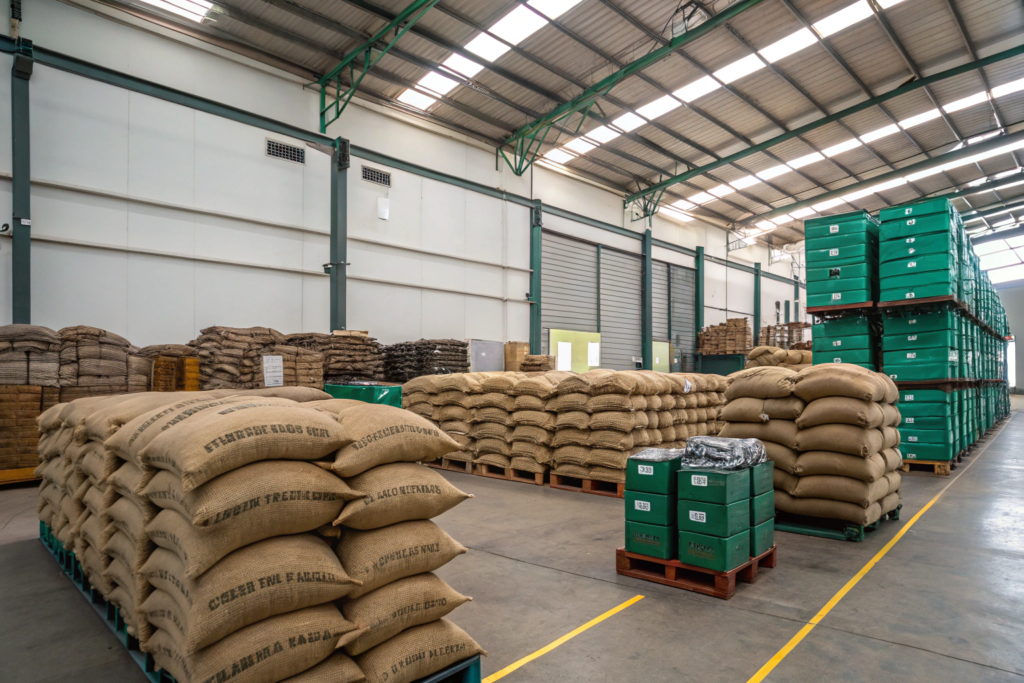
A crisis-ready roaster maintains three layers of supply chain redundancy. First, safety stock: a buffer of green coffee inventory held at the roastery or at a nearby third-party warehouse, sized to cover the maximum expected disruption duration for each origin. For an ocean-shipped origin like Yunnan, this might be 45 to 60 days of usage. Second, supplier diversification: for each core coffee in the blend, at least one qualified alternative supplier from a different origin or a different region within the same origin, with samples already cupped, pricing already discussed, and a framework agreement in place. Third, route diversification: pre-negotiated relationships with freight forwarders who can route through alternative ports, and documentation templates ready for different Incoterms and destination ports. These layers cost money to maintain. They are an insurance premium, not a wasted expense.
I have a client who learned this lesson the hard way. His entire espresso blend depended on a single lot from a single farm in Baoshan. When that farm had a poor harvest, he had no qualified backup. He spent weeks frantically cupping samples from other suppliers, trying to find something close enough to maintain his blend profile. He eventually found a substitute, but the transition was stressful and his blend shifted slightly for a quarter. He now maintains a qualified backup supplier for every core component of every blend, with samples refreshed every harvest. He has not needed to activate the backup since he established it. That is the point of insurance: it is there when you need it.
How much safety stock is appropriate for a roaster importing from Yunnan?
Calculate your average weekly usage for the coffee. Estimate the maximum reasonable disruption duration. For a Yunnan-to-US supply chain, the most severe disruptions in recent history have ranged from 4 to 8 weeks of delay. Multiply your weekly usage by your chosen coverage period. A roaster using 1,000 pounds per week who wants 6 weeks of coverage needs 6,000 pounds of safety stock for that coffee. This stock sits in a warehouse, tying up capital and space. It is a deliberate cost. But the cost of running out—lost production, lost sales, lost customers—is almost always higher.
What is a "qualified backup supplier" and how do you maintain the relationship without giving them significant business?
A qualified backup supplier has been through the same vetting process as your primary supplier. You have cupped their coffee. You have visited their farm or done a virtual tour. You have verified their certifications and their logistics capability. You have agreed on a pricing framework, even if no contract is active. You maintain the relationship by placing a small annual order, just enough to keep the account active and the logistics tested. Even 5% to 10% of your volume for that coffee, sourced from the backup, keeps the relationship warm and the quality verified. If the primary supplier fails, scaling up the backup is a conversation, not a cold start.
How Do You Create a Communication Protocol for When a Coffee Shipment Goes Wrong?
The difference between a crisis that strengthens a client relationship and one that destroys it is almost always communication. I have made mistakes in both directions: communicating too slowly, hoping the problem would resolve before the client noticed, and communicating too chaotically, sending fragmentary updates that confused and alarmed. A communication protocol fixes this by defining in advance who says what, to whom, when, and through what channel.
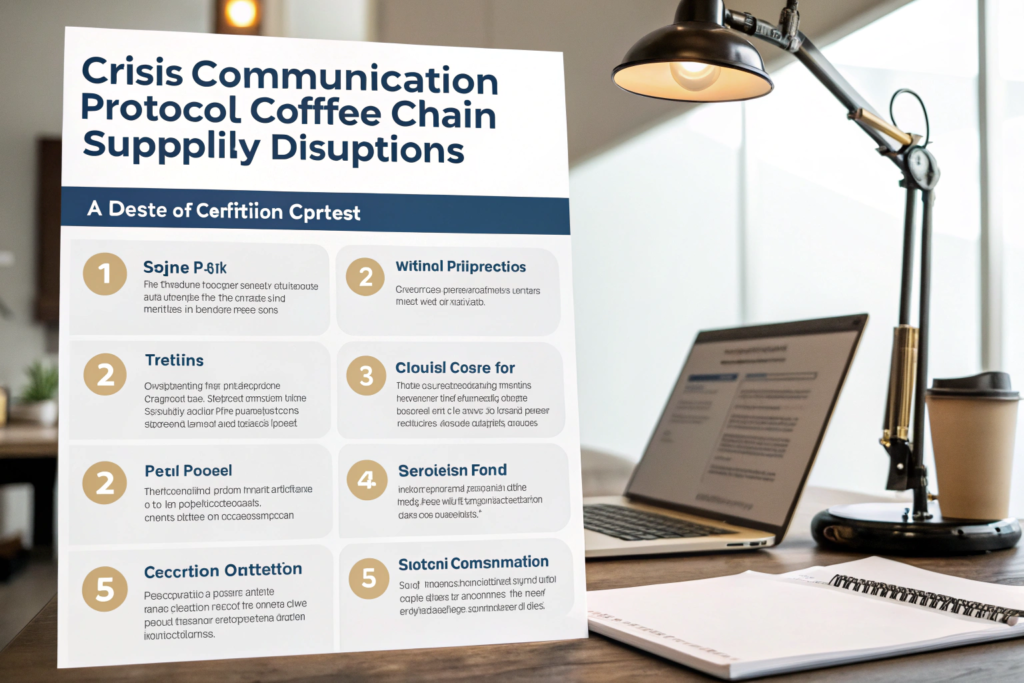
A crisis communication protocol for coffee supply chain disruptions has five elements. First, a single point of contact: the supplier designates one person, usually a client relationship manager or logistics coordinator, as the sole crisis communicator to each client. Second, an initial notification timeline: the supplier commits to notifying the client within 24 hours of confirming a disruption that will impact the shipment timeline by more than a specified threshold, typically 5 days. Third, a standardized update format: a written status report that includes the nature of the disruption, the current estimated impact on delivery date, the steps being taken to resolve, and the next update time. Fourth, an escalation protocol: if the disruption exceeds a severity threshold, communication escalates from coordinator to a senior leader call. Fifth, a post-crisis debrief: a scheduled call after the disruption is resolved to review what happened, how it was handled, and what process improvements are needed.
The 2020 port closure taught me the value of this protocol. In the first week, my communication was reactive and inconsistent. Different clients got different information depending on when they called. By the second week, I had implemented a daily email update to all affected clients, sent at the same time every day, with the same format. The complaints about communication stopped, even though the coffee was still delayed. The clients were not upset about the delay as much as they were upset about the uncertainty. The protocol replaced uncertainty with predictability. The Crisis Communication Center's best practices provide templates that can be adapted for supply chain disruptions, and the Institute for Supply Management's risk management resources include communication frameworks specifically for procurement and supply chain crises.
What should the first notification to a client contain when a shipment is severely delayed?
The first notification should be direct, factual, and delivered by phone or video call, not email, for any disruption that will delay delivery by more than two weeks. It should cover: what happened, in specific terms, not vague language; when you learned about it; the current estimated impact on their delivery date; what you are doing right now to resolve or mitigate it; and when they will receive the next update. Do not make promises you cannot keep. Do not minimize the severity. Clients respect honesty and specificity, even when the news is bad. They lose respect for sugarcoating and evasion.
Why is a post-crisis debrief more valuable than a flawless recovery?
A flawless recovery without a debrief is a wasted learning opportunity. The debrief captures what broke, why it broke, and what will change to prevent it from breaking again. It should involve both the supplier and the client, and it should produce a short written summary of agreed process improvements. This document becomes part of the relationship's institutional memory. When the same situation arises two years later, the debrief notes are there, and the response is faster and smoother. A client who participates in a constructive debrief is a client who feels invested in the partnership, not just dependent on it.
Conclusion
A crisis plan for coffee supply chain disruptions is not a document you write and file away. It is a living system that you build, test, and update. It starts with understanding the most common disruptions and mapping your supply chain to find the vulnerabilities. It builds redundancy into inventory, suppliers, and logistics routes so that no single failure can halt your operation. It establishes communication protocols that replace chaos with predictability when things go wrong. And it treats every disruption as a learning opportunity that makes the next response faster and smoother.
If you are a roaster who wants to build or strengthen your supply chain crisis plan, or if you are looking for a supplier who approaches disruptions with the seriousness and preparedness they deserve, we have built these systems into our operations. We maintain backup processing capacity, pre-negotiated alternative routing, and a communication protocol that we have tested and refined across multiple real-world disruptions. Contact Cathy Cai at cathy@beanofcoffee.com. She can walk you through our contingency planning approach, share our supply chain map, and help you build the redundancy and communication protocols that protect your business. Crises will happen. The only question is whether you will be ready when the next one arrives.