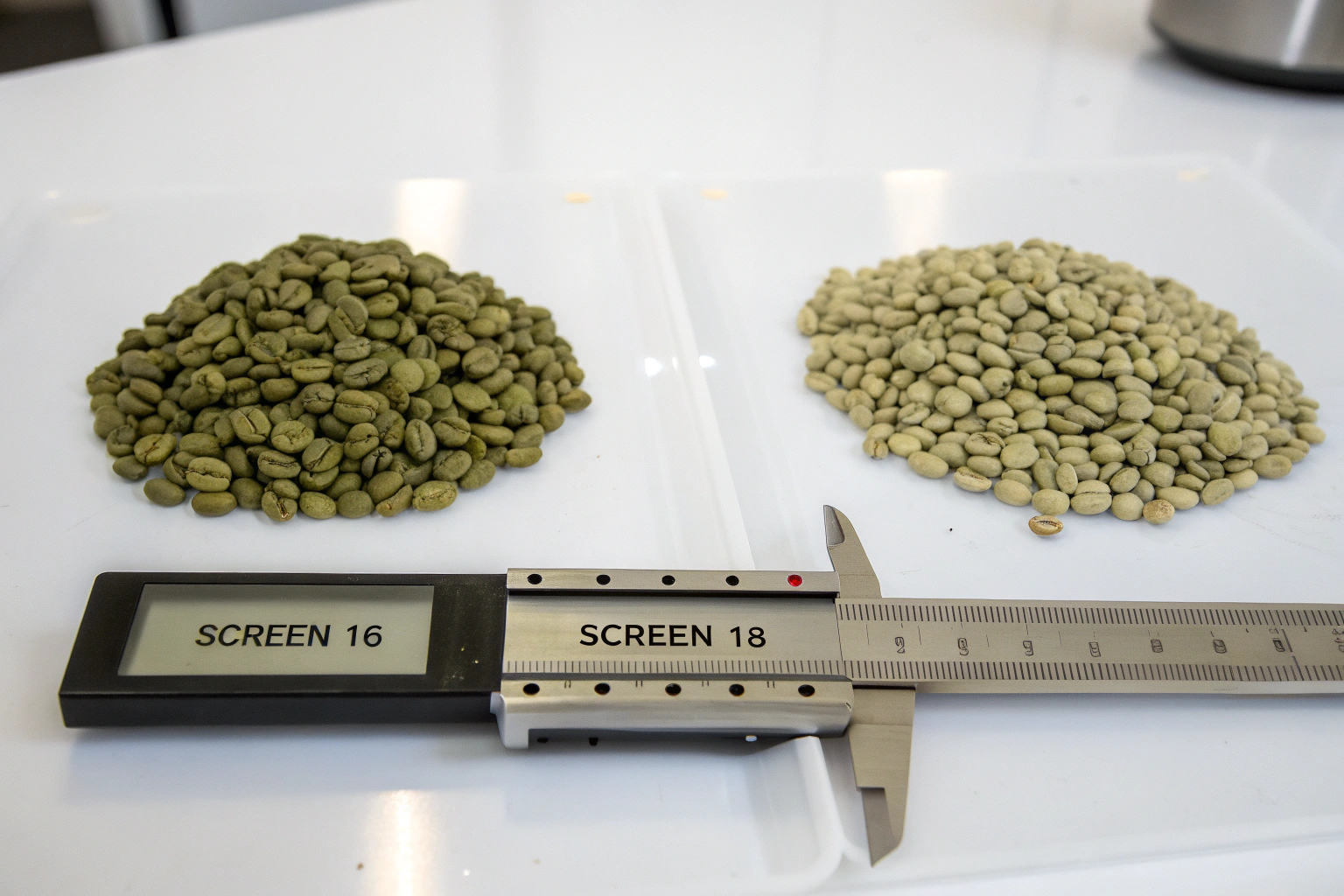
Early in my exporting career, a buyer in Italy asked me for a quote on "Screen 18 Yunnan Arabica." I had the coffee. It was good. I sent him the price. He replied immediately: "This price is for Screen 16. I need Screen 18. The price is too high for Screen 16, too low for Screen 18. Which is it?" I was caught. I didn't really know the difference. I had been calling my coffee "large bean" without ever measuring it precisely. I bought a set of grading screens the next day. I spent a week sieving every lot in the warehouse. I discovered that most of what I thought was Screen 18 was actually Screen 16. The buyer knew. He could tell just by looking at the photo. That's when I learned that screen size is not a rough estimate. It's an exact measurement, and it matters.
The difference between Screen 16 and Screen 18 beans is a precise 2/64 of an inch in diameter. Screen 16 retains beans that are larger than 16/64 of an inch, or approximately 6.35 millimeters. Screen 18 retains beans that are larger than 18/64 of an inch, or approximately 7.14 millimeters. This 0.8 millimeter difference has significant implications for bean density, roasting behavior, flavor potential, and market price. Screen 18 beans are generally denser, more uniform, and associated with higher-quality, slower-maturing, higher-altitude coffee. They command a premium price. Screen 16 beans are still specialty-grade quality, but they are the standard size for most washed Arabica, and they are priced accordingly.
Screen size is one of the most fundamental physical grading parameters in coffee. It's a number that every green coffee buyer understands. It appears on contracts, on offer sheets, and on quality reports. But its meaning goes deeper than just a measurement. It's a window into how the coffee was grown, how it will roast, and what it's worth. Let me explain what those two numbers really mean for your cup and your business.
How Is Coffee Bean Screen Size Measured?
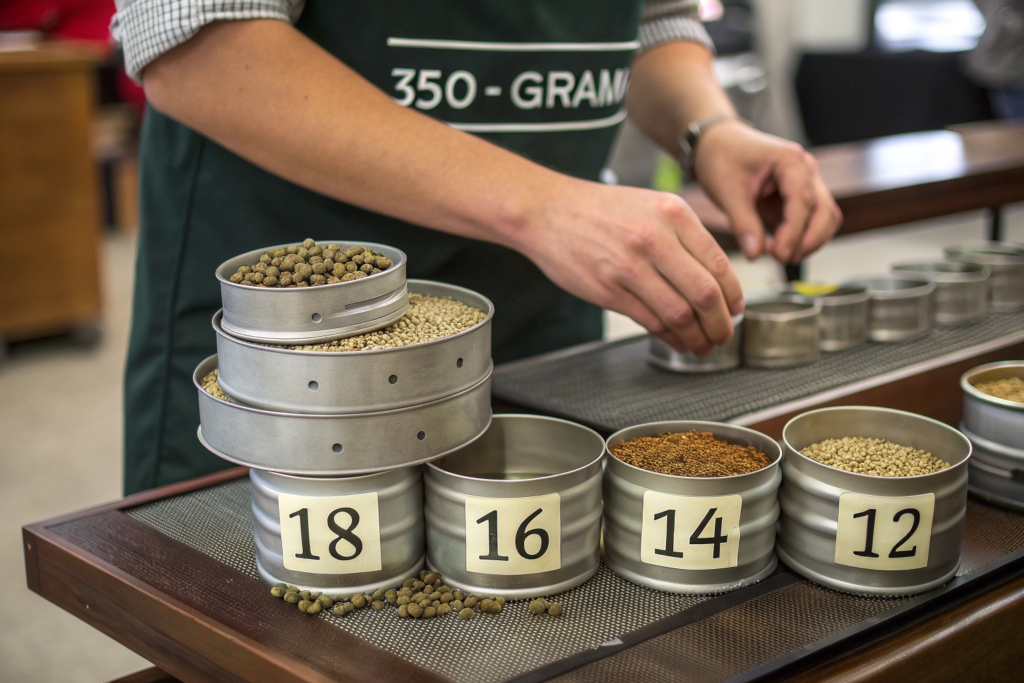
Screen size measurement is beautifully simple and rigorously standardized. It doesn't require a computer or a lab. It requires a set of metal trays with round holes, a scale, and a trained hand. The method has been used for over a century and remains the global standard for physical coffee grading.
Coffee bean screen size is measured by passing a 350-gram sample of green coffee through a stack of graduated metal screens. Each screen has precisely drilled round holes of a specific diameter, measured in fractions of an inch. A Screen 16 screen has holes that are 16/64 of an inch in diameter. A Screen 18 screen has holes that are 18/64 of an inch. The beans that are too large to pass through a given screen are retained on top of it. The percentage of beans retained on each screen is weighed and recorded. A lot classified as "Screen 16, 90% above" means that 90% of the beans, by weight, did not pass through the Screen 16.
What Does the Fraction System Mean?
The coffee screen system uses 1/64 of an inch as its base unit. It's an old system, inherited from the early days of the coffee trade when English measurements were dominant. It persists because it's universally understood.
Screen 16 means 16/64 of an inch. Simplify that fraction, and it's 1/4 of an inch. Screen 18 is 18/64 of an inch, which simplifies to just over 1/4 of an inch. The difference is 2/64, or 1/32 of an inch.
In metric, Screen 16 is approximately 6.35 millimeters. Screen 18 is approximately 7.14 millimeters. The difference is about 0.8 millimeters. It's tiny. But in the world of coffee, tiny differences matter.
How Are Screen Size Distributions Reported?
A lot is rarely 100% one screen size. There is always a distribution. The grade report specifies the percentage of beans retained on each screen.
A typical specialty Arabica lot might show: 5% above Screen 18, 85% between Screen 16 and Screen 18, 8% between Screen 14 and Screen 16, and 2% below Screen 14. The lot might be sold as "Screen 16, 90% above," meaning 90% of the beans are Screen 16 or larger.
The tighter the distribution—the higher the percentage on the target screen—the more uniform the lot. Uniformity is a quality attribute in itself. It means the beans will roast evenly. A lot with a wide distribution, with beans ranging from Screen 12 to Screen 18, will roast unevenly and produce a muddled cup.
Why Do Larger Beans Generally Indicate Higher Quality?
Size is not everything. There are delicious coffees with smaller beans and disappointing coffees with huge beans. But as a general rule, across the same varietal and the same origin, larger beans are associated with higher quality. It's not the size itself that causes the quality. It's what the size indicates about how the bean grew.
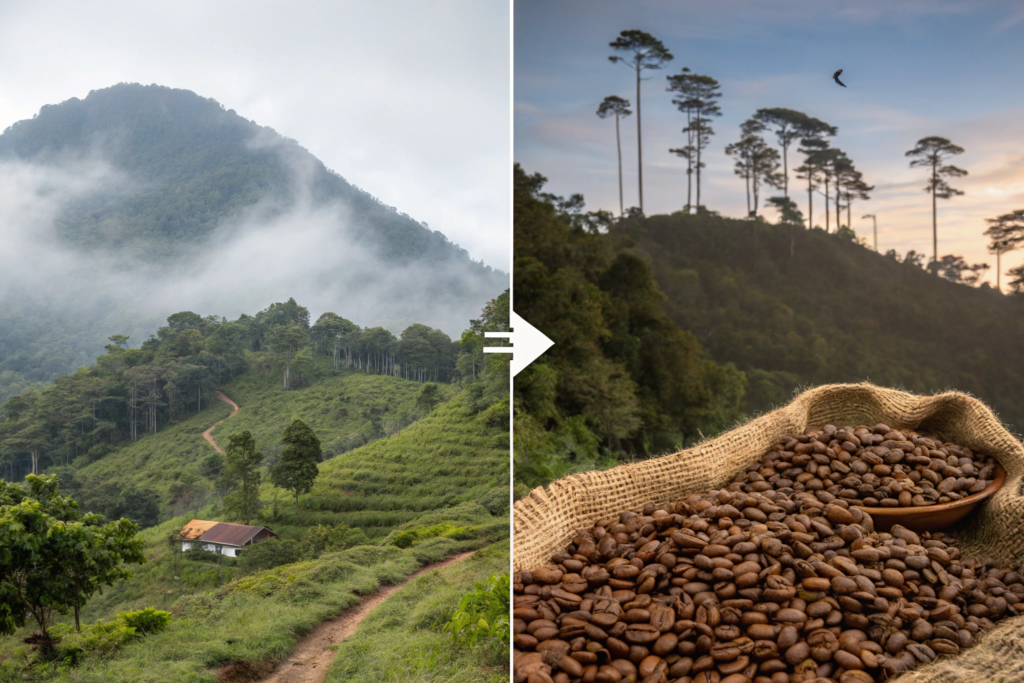
Larger beans generally indicate higher quality because they are typically the product of slower cherry maturation, which is most often the result of higher altitude cultivation. At higher altitudes, cooler temperatures slow the development of the coffee cherry. The bean spends more time on the tree, accumulating sugars, developing complex flavor precursors, and growing a denser cellular structure. This slow maturation produces a larger, heavier, more nutrient-dense bean. The same varietal grown at 1,600 meters will typically produce larger, denser, more flavorful beans than the same varietal grown at 1,000 meters. Screen size is a rough proxy for this altitude effect.
What Is the Relationship Between Altitude and Bean Size?
Altitude is the engine of bean density and size. The cooler the temperature, the slower the cherry grows. The slower the cherry grows, the more time the seed has to fill with stored energy.
At our farm in Baoshan, the Typica grown at 1,600 meters consistently screens at 16 and above, with a significant portion reaching Screen 18. The same Typica grown at 1,200 meters produces mostly Screen 15 and 16 beans. The difference in the cup is noticeable: the higher altitude beans are sweeter, more complex, and more acidic in a pleasant, balanced way.
This is why altitude is always mentioned in specialty coffee marketing. It's not just a number. It's a predictor of bean size, bean density, and flavor potential. Buyers know this. A lot of large, dense, high-altitude beans commands a premium.
Are There Exceptions to the Size-Quality Rule?
Yes. Always. Coffee is a biological product, not a manufactured widget. There are many exceptions.
Peaberry is the most famous exception. A peaberry is a natural mutation where the coffee cherry produces a single, round, pea-shaped bean instead of two flat-sided beans. Peaberries are small. They would fall through a Screen 16. But they are often exceptionally dense and flavorful. They are sorted out and sold as a premium product, despite their small size.
Some varietals are naturally small-beaned. Pacamara, for example, is famously huge. Geisha is famously long and slender, not necessarily round and large. Comparing bean size across different varietals is less meaningful than comparing within the same varietal.
The general rule holds: within the same varietal and origin, larger beans correlate with higher quality. But a great cupper trusts their palate first and the screen size second.
How Does Bean Size Affect Roasting Behavior?
A roaster does not roast sizes. They roast beans. But bean size dramatically affects how heat penetrates the seed. A batch of uniformly sized beans roasts evenly. A batch of mixed sizes roasts unevenly, with small beans scorching while large beans remain under-developed. Screen size uniformity is a gift to the roaster.
Screen size affects roasting behavior because it directly influences the bean's surface-area-to-volume ratio and the rate of heat transfer. Smaller beans have a higher surface area relative to their volume. They absorb heat faster. They reach first crack sooner. They can easily scorch if the roaster applies too much heat. Larger beans have a lower surface-area-to-volume ratio. They absorb heat more slowly. They require more aggressive heat application, especially early in the roast, to penetrate their dense structure. A roaster must adjust the charge temperature, the heat application, and the development time based on the screen size of the beans.
What Happens When Small and Large Beans Are Roasted Together?
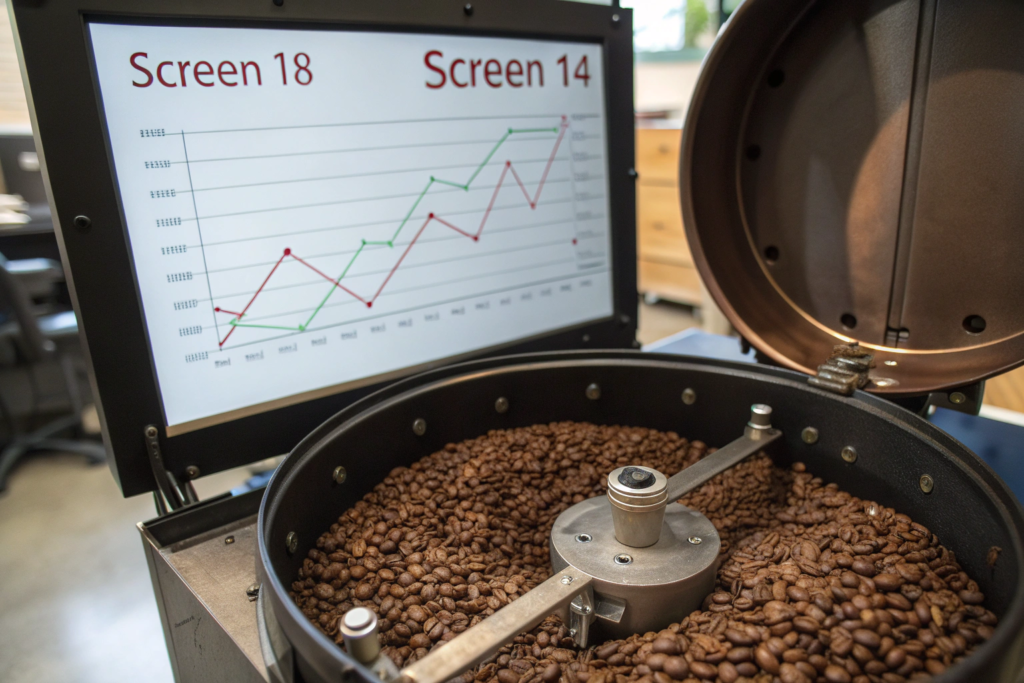
It's a recipe for a bad roast. The small beans, with their higher surface-area-to-volume ratio, will roast faster. By the time the large beans are properly developed, the small beans are over-roasted—scorched, oily, and bitter.
Conversely, if the roaster stops the roast when the small beans are perfect, the large beans are under-developed—grassy, astringent, and sour. The resulting cup is a muddled combination of both defects. It tastes simultaneously burnt and raw.
This is why screen size uniformity is a critical quality parameter. A lot with 90% of beans above Screen 16 is good. A lot with 90% of beans retained precisely between Screen 16 and Screen 18 is excellent. The tighter the size distribution, the more evenly the coffee will roast.
How Should a Roaster Adjust for Screen 18 Versus Screen 16?
Screen 18 beans, being larger and typically denser, need a hotter start. A higher charge temperature. More aggressive heat in the drying phase. The goal is to drive heat into the dense core of the bean quickly, before the surface scorches.
Screen 16 beans, being slightly smaller and slightly less dense, need a slightly gentler start. The heat penetrates more easily. Too much heat too early will scorch the surface.
The difference is not extreme, but a skilled roaster adjusts. A roast profile designed for a dense, high-grown Screen 18 Yunnan Typica will not work perfectly for a softer, lower-grown Screen 16. Understanding the screen size is part of the roaster's preparation.
What Price Premium Does Screen 18 Command?
The market is clear: larger beans cost more. Screen 18 commands a premium over Screen 16, sometimes a significant one. This premium reflects both the inherent quality association and the simple economics of supply. Screen 18 beans are rarer. Not every lot produces them. Not every farm can grow them.
The price premium for Screen 18 over Screen 16 Arabica varies by origin, market conditions, and quality tier, but it typically ranges from $0.20 to $0.60 per pound FOB. This premium reflects the market's association of large bean size with high altitude, slow maturation, and superior cup quality. It also reflects the reality of sorting: to produce a lot that is 90% Screen 18, the producer must discard or downgrade the smaller beans, reducing the overall yield from the harvest. The buyer pays for this exclusivity.

Why Is the Supply of Screen 18 Limited?
Nature sets the limit. Even on a high-altitude farm with perfect agronomy, not every cherry produces a Screen 18 bean. There is always a natural variation in cherry size, even on the same tree.
To produce a pure Screen 18 lot, the mill must sort the coffee aggressively. Beans that fall through the Screen 18 but are retained on Screen 16 must be sold separately, at a lower price. The producer sacrifices volume for the premium.
This is why Screen 18 is often reserved for a farm's best plots, the highest altitudes, the most meticulous processing. It's a deliberate choice to pursue the premium market, and it involves costs and risks that are reflected in the price.
Does Screen Size Matter for All Coffee Applications?
Not equally. For a premium single-origin offering, a retail bag of specialty coffee, Screen 18 is a badge of honor. It signals quality before the bag is even opened.
For an espresso blend, Screen 18's density and uniformity are genuinely functional. They enable a more even roast and a more consistent extraction. The premium is worth paying.
For cold brew or commercial blends, where the coffee is roasted darker and the nuances are muted, Screen 16 is often perfectly adequate. The price premium for Screen 18 may not translate into a perceptible difference in the final cup. The buyer must match the bean size to the application.
At BeanofCoffee, we offer both Screen 16 and Screen 18 Arabica, and we help our buyers choose the right specification for their product and their market.
Conclusion
The difference between Screen 16 and Screen 18 is measured in 32nds of an inch. It's a tiny physical gap. But that gap represents a world of difference in growing conditions, roasting behavior, cup quality, and market value.
Screen 18 beans are the elite athletes of a coffee lot—the product of high altitude, slow maturation, and careful sorting. They command respect and a premium price. Screen 16 beans are the solid professionals—still specialty grade, still excellent quality, but more widely available and more affordably priced.
Understanding this distinction is essential for any green coffee buyer. It allows you to specify exactly what you want, to pay a fair price for it, and to roast it correctly. It's one of the fundamental building blocks of coffee knowledge.
If you're sourcing green coffee and want to explore the difference between our Screen 16 and Screen 18 lots, we can send you samples of each from the same harvest, the same varietal, the same processing. You can cup them side by side, roast them side by side, and taste the difference that those 2/64 of an inch make.
To request a comparison sample set, or to discuss which screen size is right for your application, reach out to Cathy Cai.
Email: cathy@beanofcoffee.com. Let's find the right size for your success.