
I sat in a cold convention hall in Geneva earlier this year, surrounded by traders, roasters, and logistics executives. The mood was strange. Not panic. Not celebration. A kind of tense watchfulness. Everyone knows the coffee world is shifting under our feet. The old rules about supply, demand, and pricing feel fragile. A frost in Brazil, a drought in Vietnam, a new EU regulation, a shipping route re-routed by geopolitics. Any one of these can send a shockwave through the market in 48 hours. The question I heard repeated at every table was simple: "What do we plan for?"
The global coffee market in 2026 will be defined by a persistent supply deficit for Arabica, historically elevated C-market prices driven by climate volatility and rising Asian demand, a rapid regulatory tightening led by the EU Deforestation Regulation, and a structural shift toward direct-trade relationships that bypass traditional intermediary chains to secure supply reliability.
This is not a forecast of doom. It's a forecast of transformation. The market is not collapsing. It's reorganizing. The winners in 2026 will be the buyers and producers who understand that the old model—buying cheap spot coffee from a broker when you need it—is dying. The new model is planned, partnered, and transparent. If you are a roaster reading this, you need to start thinking like a supply chain strategist, not just a coffee buyer.
How Will Climate Change Impact Global Coffee Production in 2026?
The coffee belt is not a fixed line on a map. It's a climatic envelope. And that envelope is being squeezed. In 2025, we saw Brazil suffer one of its worst droughts in decades, followed by frost events in key Arabica regions like Minas Gerais. Vietnam, the robusta powerhouse, dealt with prolonged dry spells that slashed output. These are not one-off bad years anymore. They are the emerging pattern.
Climate change is reducing the total arable land suitable for coffee production, increasing the frequency of extreme weather events during flowering and cherry development, and pushing viable growing altitudes higher. In 2026, global Arabica production will remain volatile, with Brazil's biennial off-year cycle compounding weather losses.
For a buyer like Ron, this means one thing: price spikes are structural, not temporary. The C-market price for Arabica futures has broken through levels that were unthinkable five years ago. We are trading in a new range. The days of $1.20 per pound Arabica might be gone for good. The supply side is simply too fragile to support cheap coffee anymore. Every year, the harvest in some major origin disappoints. That collective disappointment accumulates into a permanent risk premium on every green bean traded globally.
Will Rising Temperatures Shift the Coffee Belt Geography?
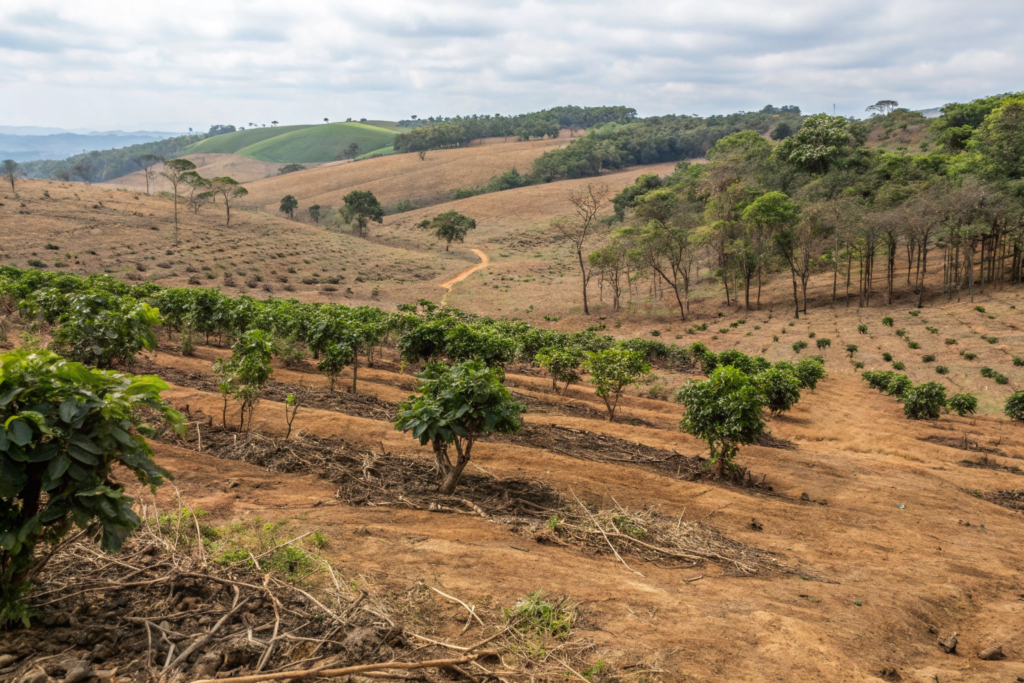
Yes, and it's already happening. The optimal temperature range for Arabica is 18°C to 22°C annual average. As lowland tropical zones heat up, they push past the upper limit. Pests like the coffee berry borer thrive in warmer conditions and move higher up the mountain. The land that was prime coffee territory fifty years ago is becoming marginal.
This geographic squeeze has a surprising consequence. It opens opportunity for non-traditional origins at higher latitudes or altitudes. Yunnan, at 25 degrees north, historically sat near the northern edge of the coffee belt. Cold winters limited expansion. But with gradual warming, our frost risk is declining, and the growing season is extending. Regions like ours, which were once considered "fringe" coffee zones, are becoming more central. The same is true for parts of Colombia where farmers are planting above 1,800 meters, altitudes that were once too cold. The coffee belt is moving uphill and away from the equator. The map of quality coffee production in 2030 will look different from the map of 2000. Smart buyers are already looking at these shifting zones to secure long-term supply before prices adjust to the new reality.
How Are Farmers Adapting Cultivation Practices?
Adaptation is not passive. It's an investment race. On our estate in Baoshan, we are planting more shade trees than ever before—Inga and banana, fast-growing species that create a canopy microclimate. The shade lowers the ambient temperature at the cherry level by 2 to 3 degrees. That small difference protects the bean during heat waves and reduces water loss from the soil.
We are also changing varietal selection. The old Catimor strains, which we discussed in earlier articles, have robusta genes that confer some heat tolerance. But we are also experimenting with pure Arabica varieties like Geisha and Typica at our highest altitude blocks. The strategy is diversification. Don't bet the entire farm on one genetic line. A single disease or heatwave could wipe it out. Other origins are adopting similar tactics. In Brazil, farmers are investing in drip irrigation at unprecedented scale. In Vietnam, they are intercropping pepper and avocado to diversify income and shade the coffee. The common thread is capital investment. Climate-smart farming is more expensive than traditional farming. That higher production cost feeds directly into higher green bean prices. The era of cheap, climate-vulnerable coffee is ending.
What Role Will the EUDR Play in Reshaping Coffee Trade in 2026?
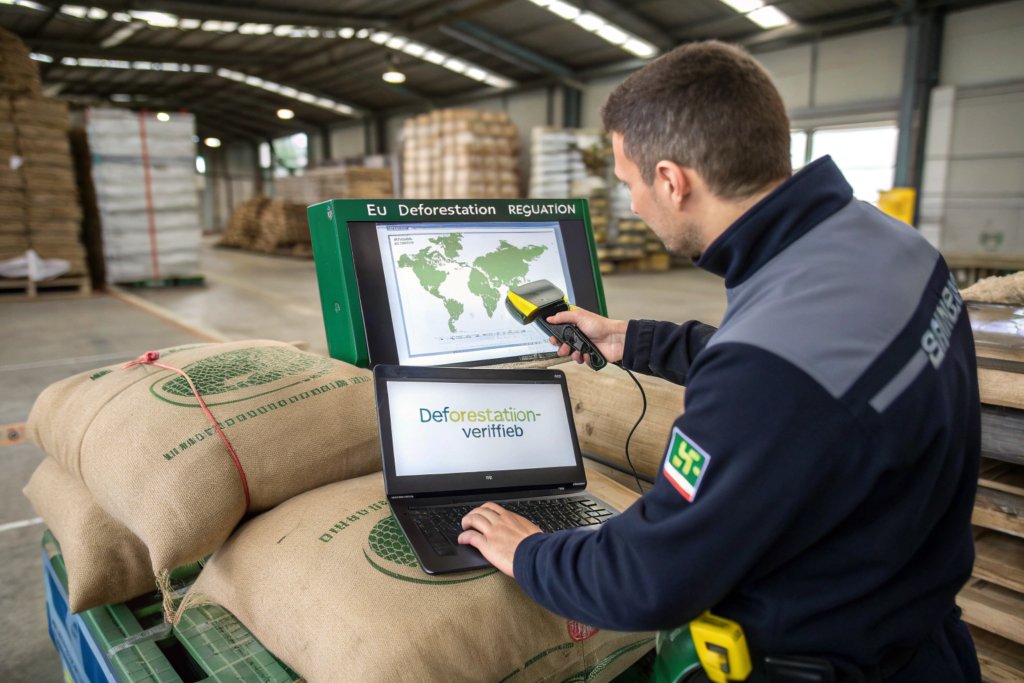
If you are importing coffee into Europe in 2026, you cannot just fill out a customs form and walk away. You need a digital dossier on every bag. The EU Deforestation Regulation, which enforcement deadlines are hitting now, requires proof that the coffee was not grown on land deforested after December 31, 2020. This regulation is not a suggestion. It is a hard legal requirement with penalties including fines of up to 4% of annual EU turnover.
The EUDR is reshaping global coffee trade by mandating full geolocation traceability for every coffee lot entering the European market, creating a compliance cost that favors large, organized producers and direct trade relationships, while potentially excluding smallholder farmers who cannot provide the required digital documentation.
This regulation alone is redrawing trade flows. Some European roasters are panicking. Their suppliers in certain origins cannot provide the polygon maps required. The farmer might not have a smartphone, much less the ability to map their five-acre plot digitally. These roasters face a choice: either invest in their suppliers to get them compliant, or switch origins to farms that already have the infrastructure. Guess where that puts a 10,000-acre estate in Yunnan with full digital traceability already in place? It puts us in a strong position. We can provide the exact GPS coordinates, the harvest date, and the deforestation-free certification that the EU market now demands as table stakes.
How Will Traceability Technology Become a Market Access Requirement?
Traceability used to be a marketing nice-to-have. You could charge an extra 20 cents a pound for a "farm traceable" lot. Now, traceability is your passport. Without it, your coffee is legally barred from the European Union, the world's largest coffee importing bloc.
The technology is scaling fast. Blockchain platforms, satellite monitoring of deforestation, and QR-coded bag tracking are becoming standard operating procedure. The cost per bag for this technology is dropping, but the initial setup requires investment. Smallholder cooperatives need funding to digitize. This creates a two-tier market. Tier one is the compliant, documented, premium market. Tier two is the non-compliant, undocumented market that will be forced into non-EU destinations at a discount. I expect a price spread to open between EU-ready coffee and non-compliant coffee. Maybe 5 to 10 cents a pound initially, widening as full enforcement bites. For a buyer sourcing for the European market, the cheapest bean is no longer the best bean. The most documented bean is the safest bet. This plays directly to the strengths of a managed, data-driven operation like ours.
What Are the New Opportunities for Asian Coffee Producers Under EUDR?
Here is where the story gets interesting for us. Many traditional coffee origins—parts of Africa, some regions in South America—are struggling with the compliance burden. The smallholder structure, the lack of central digital land registries, and the prevalence of forest-edge farming make EUDR compliance genuinely difficult and expensive.
In contrast, China's coffee production is highly organized. Land tenure is clear. The government has digital mapping infrastructure. Our estate, and others in Yunnan, can generate a polygon map and a deforestation-free certification with relative ease. This creates an unexpected competitive advantage. Asian coffee, specifically from China and to some extent Vietnam's larger estates, can position itself as the "easy compliance" option for European roasters. Instead of wrestling with fragmented smallholder documentation in another origin, a roaster can buy a clean, documented container from Yunnan and sleep soundly. The opportunity is not just about cup quality anymore. It's about regulatory safety. A 84-point coffee that is guaranteed to clear customs is worth more than an 86-point coffee stuck in legal limbo. I believe this will accelerate the acceptance of Asian specialty coffee in the European premium market.
Is the C-Market Price Model Still Relevant for Specialty Coffee?
The C-market is having a crisis of relevance. It was designed to price a fungible commodity, a generic "mild Arabica" from a set of approved origins. But specialty coffee is not a fungible commodity. A 85-point washed Yunnan has nothing in common with a 78-point commercial Brazilian except that they both come from a cherry. Yet the C-market price anchors the base negotiation for both.
The C-market price model is becoming less relevant for specialty coffee because the futures price no longer reflects the cost of differentiated production, and the increasing volatility makes fixed-price forward contracts more attractive to both farmers and roasters seeking stability.
I no longer sell my specialty lots based on "C plus a differential." The differential model assumes the C-price is a fair baseline. It's not. The C-price today is driven by algorithmic trading, macroeconomic hedge fund positioning, and weather speculation. It can swing 10% in a week on a rumor about frost in Brazil, even if my farm in Yunnan had a perfect harvest and my costs didn't change. Why should my coffee's price be tethered to that? More and more specialty buyers agree. They want a price that reflects the cost of production plus a fair margin, locked in for the season. That price might be higher than the C-market when the market dips, and lower than the C-market when the market spikes. Both sides get predictability. That is the trade-off.
How Are Direct Trade and Fixed-Price Contracts Replacing the Differential Model?
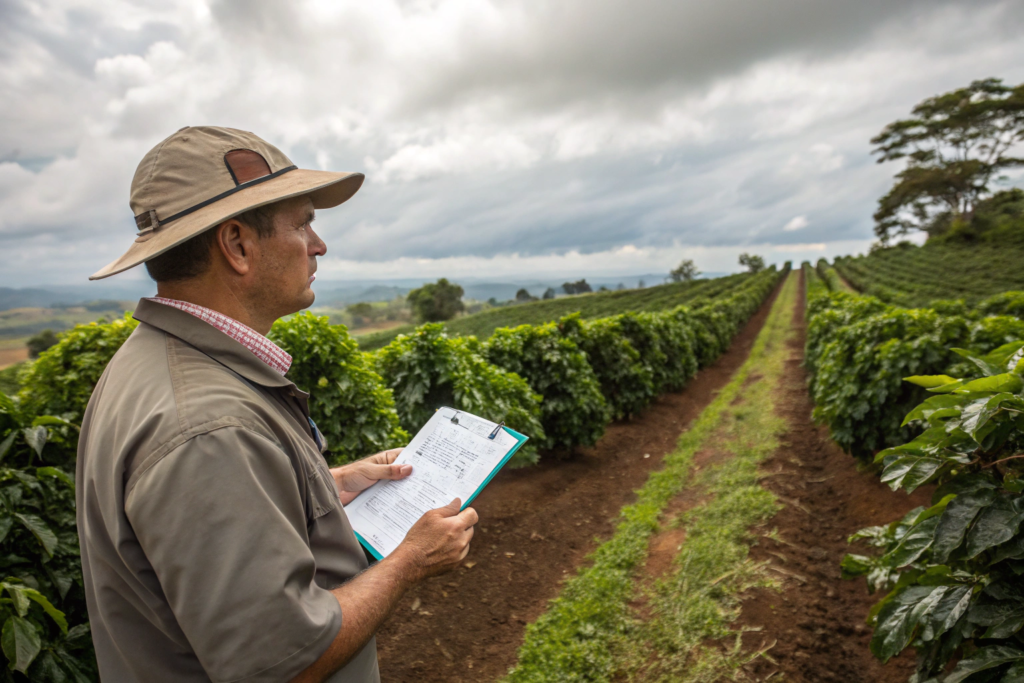
The differential model—C price plus or minus a quality spread—was the standard for decades. A roaster would call me and say, "I'll pay C plus 40 cents." If the C-market was at $1.50, my price was $1.90. If the C-market dropped to $1.20, my price dropped to $1.60, even though my picking and processing costs were fixed at $1.55. I'd lose money. That model only works when the C-market is stable and the differential is generous. Neither is true anymore.
Now, I sit down with a roaster and we agree on a fixed floor price. Let's say $3.20 per pound FOB for an 85-point lot. That price is calculated based on my real production costs, a quality premium, and the roaster's target landed cost. The contract spans one harvest cycle. If the C-market spikes to $3.50, the roaster is protected at $3.20. If the C-market crashes to $2.00, I am protected at $3.20. Both sides sacrifice potential windfall gains for the elimination of potential losses. This is not a theory. This is how BeanofCoffee now structures the majority of our long-term partnerships. It requires trust. The roaster must trust that my cost calculation is honest. I must trust that the roaster will honor the fixed price even if the market drops. That trust is built over years of consistent delivery and honest communication.
Will There Be a Decoupling of Commodity and Specialty Coffee Pricing?
I believe the decoupling is already happening, but slowly. The commodity market and the specialty market operate on completely different logics. The commodity market is about volume, efficiency, and substitutability. The specialty market is about distinction, relationship, and sensory experience. They should not be priced by the same mechanism.
Some industry voices are pushing for a formal split—a specialty coffee index that tracks actual transaction prices for scored lots, independent of the ICE futures. This would be a massive shift. It would allow specialty farmers to escape the gravitational pull of commodity speculation. But it faces practical hurdles. How do you define a standardized specialty contract that can be traded? Coffee is not just a score. It's a perishable product with specific logistics. The movement toward decoupling will likely come from the buyer side. As more large roasters sign direct fixed-price agreements, the volume of coffee traded on the C-market differential system shrinks. The tail no longer wags the dog. At some tipping point, the C-market becomes a reference only for the lowest commercial grades, and specialty finds its own pricing language.
Where Will New Coffee Demand Growth Come From in 2026?
For decades, the coffee demand story was simple: North America and Europe. The rest of the world drank tea or instant. That story is now outdated. The most exciting demand growth in coffee is happening thousands of miles from the traditional centers of consumption. It's happening in China, in India, in Southeast Asia, in the Middle East. These are not small, incremental markets. They are massive populations with rising disposable income and a rapidly developing coffee culture.
New coffee demand growth in 2026 will be driven primarily by the Asian consumer market, particularly China and India, where coffee consumption is growing at double-digit annual rates from a low base, creating a structural shift in global demand that is already absorbing a significant portion of global production.
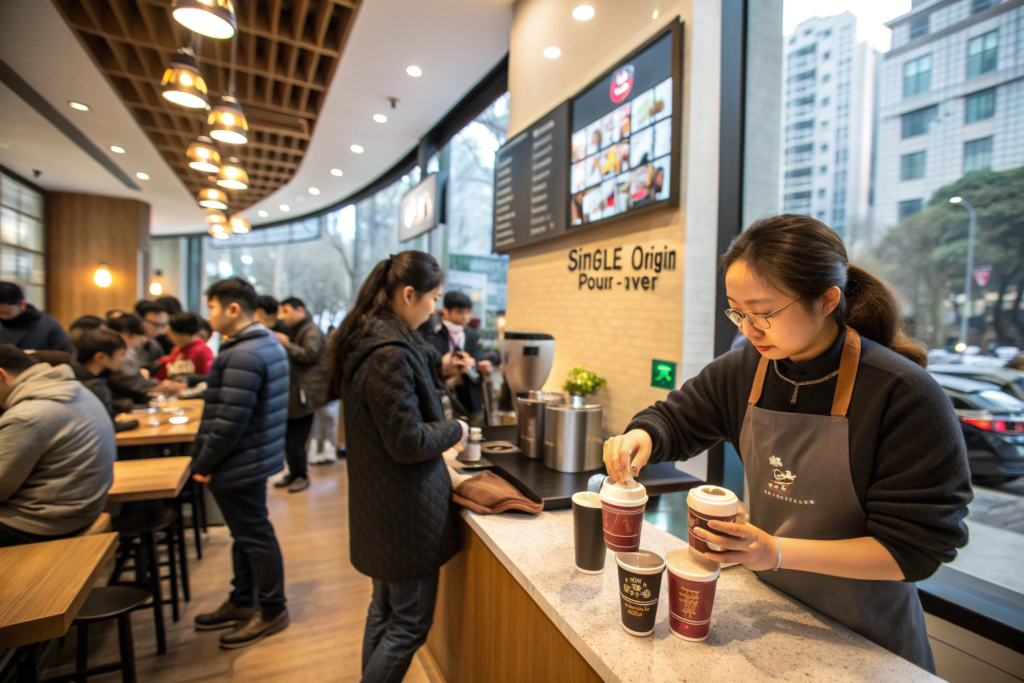
Here is a number that keeps me optimistic. Coffee consumption in China has been growing at over 15% annually for the past five years. The number of coffee shops in Shanghai alone now exceeds the number in London or New York. This is not just expats drinking espresso. This is a generation of young Chinese consumers who grew up with Starbucks, Luckin, and independent specialty cafes as part of urban life. They are now moving from milk-based drinks to black coffee, from blended to single-origin. The domestic Chinese market is so large that it now absorbs a significant share of our Yunnan production. We used to export 95% of our crop. Now, we sell maybe 30% domestically. That domestic demand provides a price floor and reduces our dependency on export market volatility.
How Is China's Domestic Coffee Culture Influencing Global Trade?
China's emergence as a major coffee consumer changes the flow of beans. Yunnan coffee no longer has to travel 8,000 miles to a roaster in California or Hamburg. It can travel 200 miles to a roaster in Kunming or Chengdu. This short supply chain is faster, cheaper, and lower carbon. It also allows Chinese farmers to capture more of the value chain by selling roasted coffee directly to domestic consumers.
But the impact goes beyond logistics. Chinese consumers are developing distinct taste preferences that influence production. They tend to favor slightly darker roasts, with emphasis on body and chocolate notes over bright acidity. This aligns well with the natural Yunnan cup profile. As a result, farmers in Yunnan are not forced to chase the bright, floral profile that the Western specialty market demands. They can cultivate a profile that their home market loves and that exports well to other Asian markets like Japan, Korea, and Thailand. This dual-market strategy—serving both domestic and international preferences—creates resilience. I can sell one lot into the Shanghai specialty market and another lot, a brighter washed process, into the Melbourne filter market. Two different products, one farm, zero dependency on a single buyer profile.
What Does Rising Middle-Class Coffee Consumption Mean for Supply?
More coffee drinkers means more coffee demand. Simple math. The International Coffee Organization estimates that world coffee consumption will grow by 1.5% to 2% annually through 2030. But that global average masks the real story. Developed markets are flat. The U.S. and Europe grow at maybe 0.5%. The developing markets, led by Asia, grow at 4% to 6%. That incremental demand, year after year, adds up to tens of millions of additional bags needed.
Where will those bags come from? Brazil and Vietnam will remain the volume giants, but they face the climate constraints discussed earlier. The supply gap will have to be filled by origins that can expand production sustainably. Yunnan has the land, the government support, and the climatic window to do exactly that. We are not trying to out-produce Brazil on volume. That's impossible. We are positioning to capture the premium segment of the new demand—the middle-class consumer in Chengdu or Mumbai who wants a better cup than instant but at a reasonable price. That segment is enormous and underserved. The future market is not just about selling to the top 1% of specialty connoisseurs. It's about selling traceable, quality coffee to the emerging hundreds of millions of everyday coffee drinkers.
Conclusion
The global coffee market in 2026 is not in crisis. It is in metamorphosis. The comfortable certainties of the past—cheap Arabica, anonymous supply chains, and a European-American demand monopoly—are breaking apart. In their place, a new market structure is emerging. Climate change is making supply unpredictable and pushing prices to a permanently higher baseline. The EUDR is forcing transparency and rewarding organized producers. The C-market is losing relevance as direct trade fixed-price contracts take hold. And the center of demand gravity is shifting east, toward the very countries that produce the coffee.
For a buyer like Ron, who prioritizes price and timeliness, the strategy in this new market is clear. Stop chasing the cheapest spot price. It no longer exists. Instead, lock in reliable supply from a transparent, compliant, and geographically diversified origin. Build a partnership that insulates you from the volatility.
If you want to position your coffee program for the realities of 2026 and beyond, we should talk. Our farm in Baoshan is structured for this exact future: climate-resilient, EUDR-ready, and connected to both global and booming Asian demand. Reach out to Cathy Cai at cathy@beanofcoffee.com. She can walk you through our forward contract options and help you secure your supply before the next market shock hits.