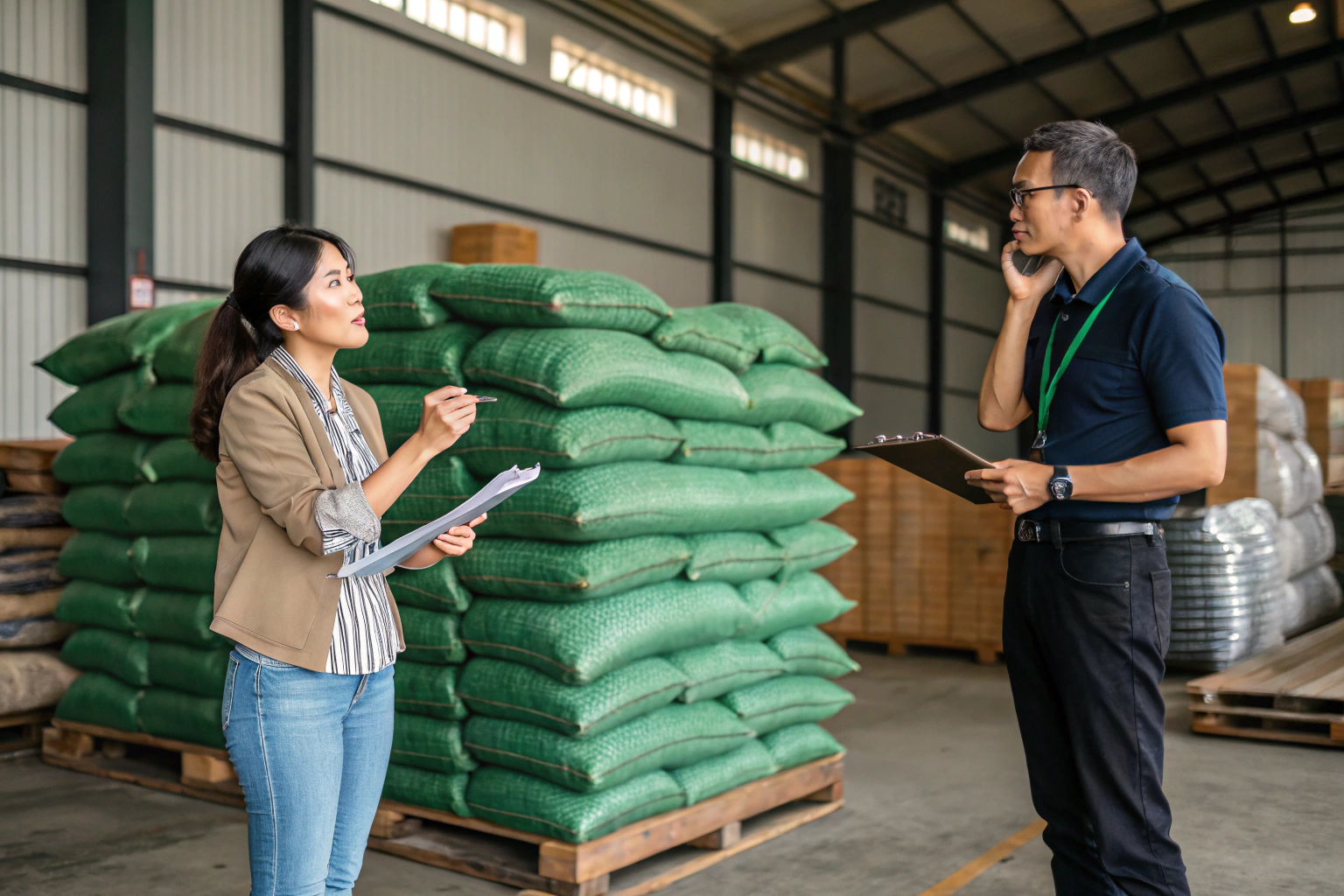
A small roaster from Dublin emailed me last month. He had been buying coffee from a local importer in 10-kilo boxes. He wanted to step up and buy directly from a farm. His first question was not about price or quality. It was: "How much do I have to buy?" He was nervous. He imagined I would demand a full container, 20 tons, nothing less. When I told him we could start with a single pallet, he audibly exhaled. The barrier he had built in his mind was not real.
The minimum order quantity for wholesale green coffee varies widely depending on the supplier. Large commodity exporters often set a minimum of one full container load, around 19 to 21 metric tons. But plantation-direct sellers like BeanofCoffee increasingly offer flexible minimums starting from a single pallet, roughly 300 to 500 kilograms, to accommodate small and medium roasters entering the direct trade market.
There is no industry-wide standard MOQ. The number you hear depends on who you are talking to. A massive Brazilian export cooperative has a different business model than a family-owned estate in Yunnan. Understanding why MOQs exist, and how to navigate them, is the key to unlocking direct sourcing at a scale that works for your business.
What Are the Typical MOQ Tiers in the Green Coffee Industry?
The green coffee market operates in tiers. Each tier has a different logistics profile, different pricing, and different supplier expectations. Walking into a negotiation without understanding these tiers is like walking into a car dealership without knowing the difference between a sedan and a truck. You might get sold something that does not fit your needs.
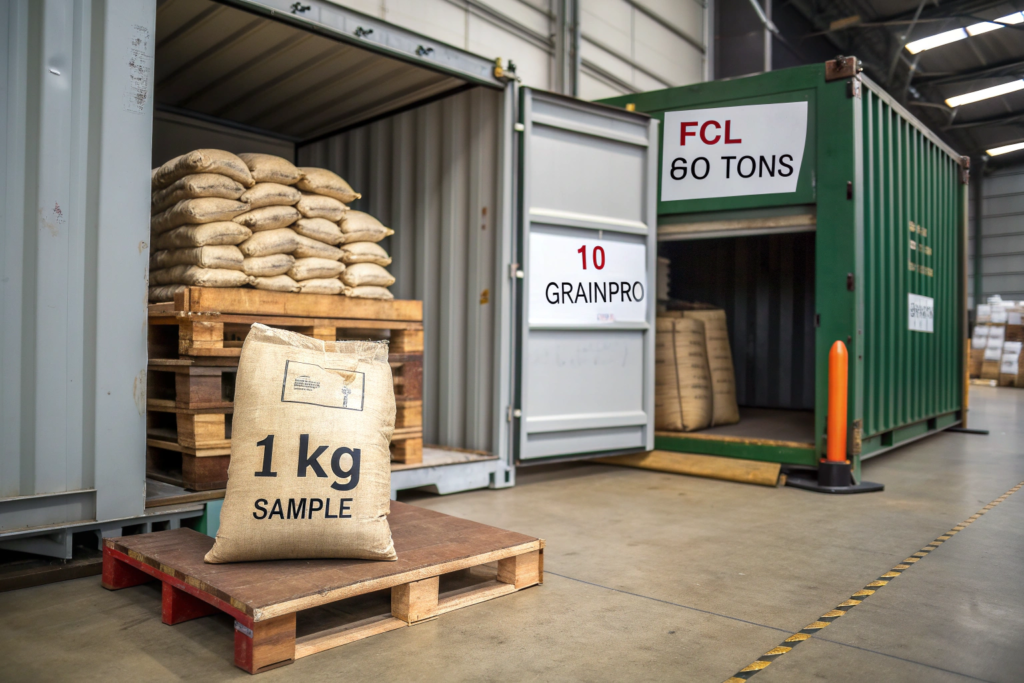
The typical MOQ tiers in green coffee are: sample size with no minimum, micro-lot pallet orders starting around 300 to 600 kilograms, less-than-container-load shipments consolidating multiple pallets from 1 to 10 metric tons, and full container loads of 19 to 21 metric tons. Each tier unlocks progressively lower per-pound pricing but requires greater storage capacity and working capital.
A roaster buying 500 kilos a year and a roaster buying 50 tons a year are playing different games. The small roaster values flexibility and freshness. The large roaster values consistency and the lowest possible unit cost. Suppliers structure their MOQs to serve these different customer profiles. There is no single right size. There is the right size for your specific business.
Why Do Large Exporters Prefer Full Container Loads?
Logistics economics. A container ship does not care if a box is full or half-empty. It charges the carrier roughly the same base ocean freight for the box. If an exporter ships a half-full container, the freight cost per kilogram doubles. That cost either erodes the exporter's margin or makes the FOB price uncompetitive.
Large exporters are optimized for volume. Their mills run continuously. Their warehouses are designed to stuff multiple containers per day. A small order of a few pallets disrupts that flow. The administrative cost of processing the export documents, arranging the phytosanitary inspection, and managing the payment is roughly the same for a pallet as for a container. The per-kilogram administrative cost on a small order is much higher. So, large exporters set the MOQ at one FCL to maintain their cost efficiency. This is not greed. It is the math of their operating model. They are built for big throughput. If a buyer cannot meet the FCL minimum, the large exporter directs them to a local importer or distributor who aggregates small orders.
How Do Micro-Lot and Pallet Programs Work for Small Roasters?
Small roasters are not an afterthought for all suppliers. Some of us have built our business model specifically to serve them. A micro-lot or pallet program allows a roaster to buy a smaller, defined quantity directly from the farm.
At BeanofCoffee, we offer a pallet program. A standard pallet holds about 10 to 12 GrainPro bags, roughly 600 kilograms. This is a manageable volume for a small roaster. It fits in a corner of their storage room. It represents a few months of production. We arrange Less-than-Container-Load shipping, where the pallet shares a container with other cargo. The freight cost per kilogram is higher than FCL, but the total cash outlay is far lower. The roaster gets farm-direct traceability and quality without committing to a volume that strains their storage capacity or cash flow. The MOQ is a conversation, not a wall. If a roaster says, "I want to start with 300 kilos and grow," I listen. The relationship is the investment. The volume can scale later.
How Does the MOQ Affect Your Landed Cost Per Pound?
The per-pound price on an invoice is not the whole story. The landed cost—the total price of getting one pound of green coffee into your warehouse—includes the FOB price, ocean freight, insurance, customs fees, and inland trucking. MOQ directly impacts several of these line items.
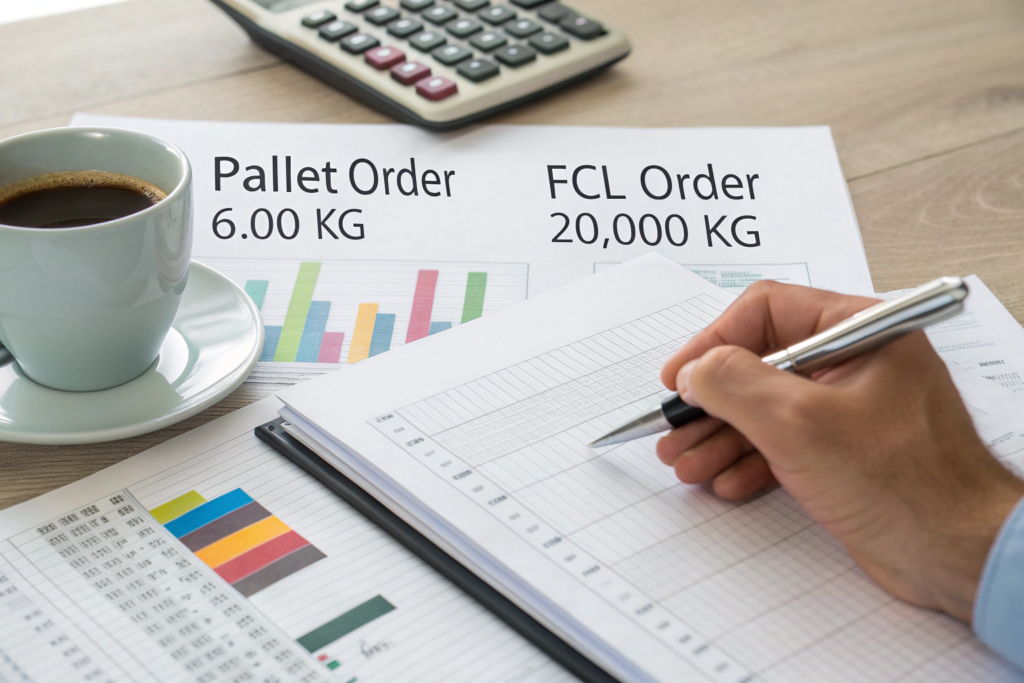
A larger MOQ reduces your landed cost per pound primarily by spreading fixed logistics costs over more kilograms. The ocean freight for a full container might be $0.15 per pound. For a shared container pallet, it might be $0.40 per pound. The FOB price may also drop with volume, but the logistics efficiency is usually the bigger savings driver.
Let me put numbers on this. A 600-kilogram pallet order of our washed Catimor might have an FOB price of $3.20 per pound and a freight cost of $0.45 per pound, landing at $3.65. A full container of the same coffee might have an FOB price of $2.95 per pound and a freight cost of $0.18 per pound, landing at $3.13. The 52-cent difference per pound, multiplied by 44,000 pounds in a container, is nearly $23,000 in savings. But that saving requires the roaster to have the storage space, the working capital, and the sales volume to absorb 20 tons before the coffee stales. The lower MOQ has a higher unit cost, but a lower total cash commitment and lower inventory risk.
Is It Cheaper to Share a Container with Other Roasters?
Container sharing is a practical middle path. Several small roasters pool their orders to fill a container. They each take a few pallets. They split the ocean freight proportionally. Everyone gets the FCL freight rate.
This model works well when roasters have complementary needs and trust each other. I have seen informal buying groups among roasters in the same city. They agree on a coffee, each commit to a pallet, and one roaster handles the import logistics. The challenge is coordination. If one roaster backs out, the others must cover the volume or pay higher freight. There is also the question of quality agreement. Everyone in the pool must cup the sample and agree it meets their standards. If opinions differ, the group can fracture. A more structured version is when an importer or a forwarder acts as the consolidator, buying the container and reselling pallets. This adds a small margin but removes the coordination headache. It is not pure direct trade, but it is a practical step between buying from a broker and buying a full container yourself.
What Are the Hidden Costs of Ordering Below the Standard MOQ?
Ordering below a supplier's standard MOQ often triggers surcharges that are not advertised up front. It is important to ask about these explicitly before committing.
A supplier might charge a "small lot fee" to cover the extra handling at the warehouse. The freight forwarder might add a "minimum bill of lading" charge because the document costs are the same regardless of shipment size. The customs broker might charge a flat fee per entry that becomes disproportionately high when spread over a small shipment. There is also the quality risk. A pallet shipped LCL shares container space with unknown cargo. If the container mate is a pallet of dried fish or chemical fertilizer, your coffee could absorb those odors. Reputable forwarders segregate food-grade cargo, but not all do. The hidden cost of a ruined pallet is far higher than any shipping saving.
How Can You Negotiate a Lower MOQ with Coffee Suppliers?
The MOQ on a supplier's website is often a starting position, not a fixed rule. Everything in coffee is negotiable if you bring something valuable to the table beyond immediate volume. The key is to understand what the supplier needs and offer it in a different form.
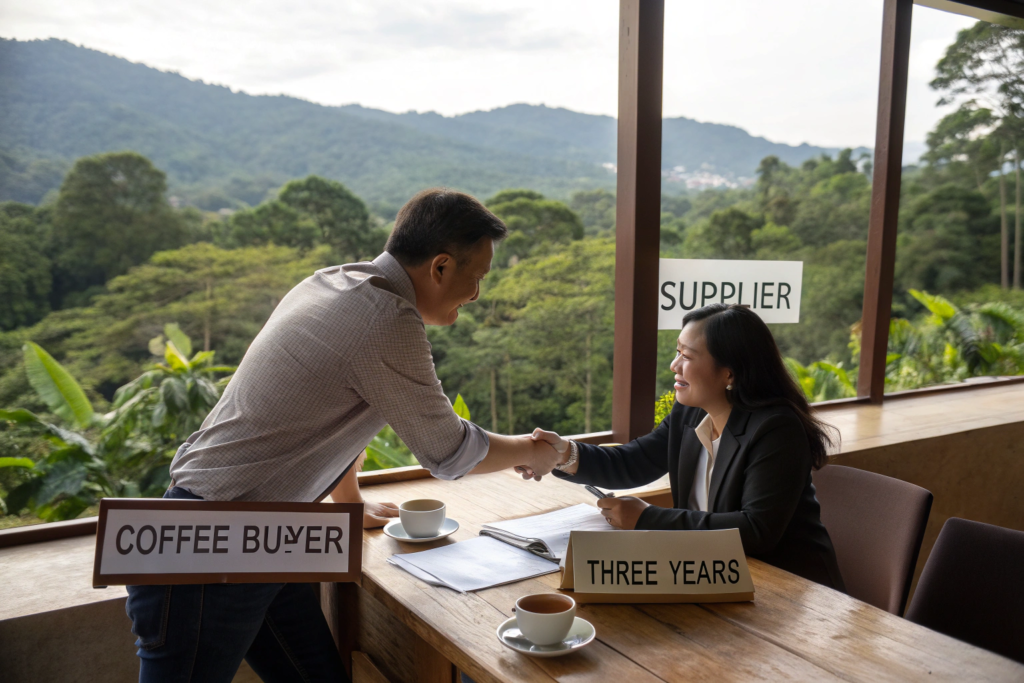
You can negotiate a lower MOQ with coffee suppliers by committing to a growth trajectory over multiple years, offering faster payment terms that improve the supplier's cash flow, accepting a slightly higher per-pound price for the flexibility, or agreeing to buy multiple smaller shipments that together meet the annual volume threshold.
The worst approach is to simply ask for a discount without offering anything in return. That signals you are a price-focused, low-loyalty buyer. The supplier has no incentive to accommodate you. The best approach is to frame the request as a long-term partnership. Say: "I want to start with two pallets now, but I project needing a full container within 18 months as my business grows. Can we structure a pricing tier that reflects that trajectory?" This shows you are serious and thinking long-term.
What Payment Terms Make Suppliers Flexible on MOQ?
Cash flow is the lifeblood of a coffee farm. We pay for labor, fertilizer, and processing months before we receive payment from buyers. A buyer who helps with that cash flow timing earns flexibility on other terms.
Offering a 50% deposit with the order and 50% against shipping documents, rather than payment 30 days after shipment, is a significant concession. It saves the supplier from financing the production. I am more willing to accept a smaller order from a buyer who pays promptly, or even in advance, than from a buyer who demands net-60 payment terms on a full container. The small order with good payment terms is less risky and less capital-intensive for me. Another option is a revolving credit agreement. The buyer places a standing order for a certain annual volume, pays a deposit against the annual commitment, and draws down pallets throughout the year. This smooths the buyer's inventory and the supplier's cash flow.
How Does a Trial Order Build Trust for Future Flexibility?
A trial order is the bridge between no relationship and a long-term partnership. Nobody wants to commit a full container to a supplier they have never worked with. A small trial order lets both sides test the water.
I encourage new buyers to start with a sample, then a pallet, then a container. The sample proves the quality. The pallet proves the logistics. By the time we discuss a full container, we have a track record of successful transactions. The buyer knows the coffee arrives as expected. I know the buyer pays on time and communicates clearly. The trust built during the trial phase makes me comfortable reducing the effective MOQ or offering flexible terms for future orders. The trial order is not a one-off transaction. It is the first chapter of a relationship.
What Are the MOQ Differences Between Arabica and Robusta Wholesale?
Arabica and Robusta are different markets with different structures. The MOQ expectations reflect those differences. A roaster who buys both types needs to understand why the rules differ.
Specialty Arabica typically has lower or more flexible MOQs because it trades on quality and relationship rather than commodity volume. Commercial Robusta and low-grade Arabica are commodity products with thin margins, so suppliers depend on high volume and set MOQs at the full container level to maintain profitability.
Specialty Arabica is a differentiated product. A 85-point washed Yunnan Catimor is not interchangeable with a 85-point Colombian Castillo. The buyer is paying for that specific flavor profile. The supplier has pricing power based on quality, not just volume. This allows the supplier to offer smaller lot sizes at a premium price. The business model works at smaller scale. Commercial Robusta, by contrast, is largely undifferentiated. A Vietnamese Robusta is very similar to a Ugandan Robusta in the commodity stream. The margin per kilogram is a few cents. The only way to make money is to move massive volume with ruthless logistics efficiency. The MOQ is necessarily high because the profit on a small order would be negative after fixed costs.
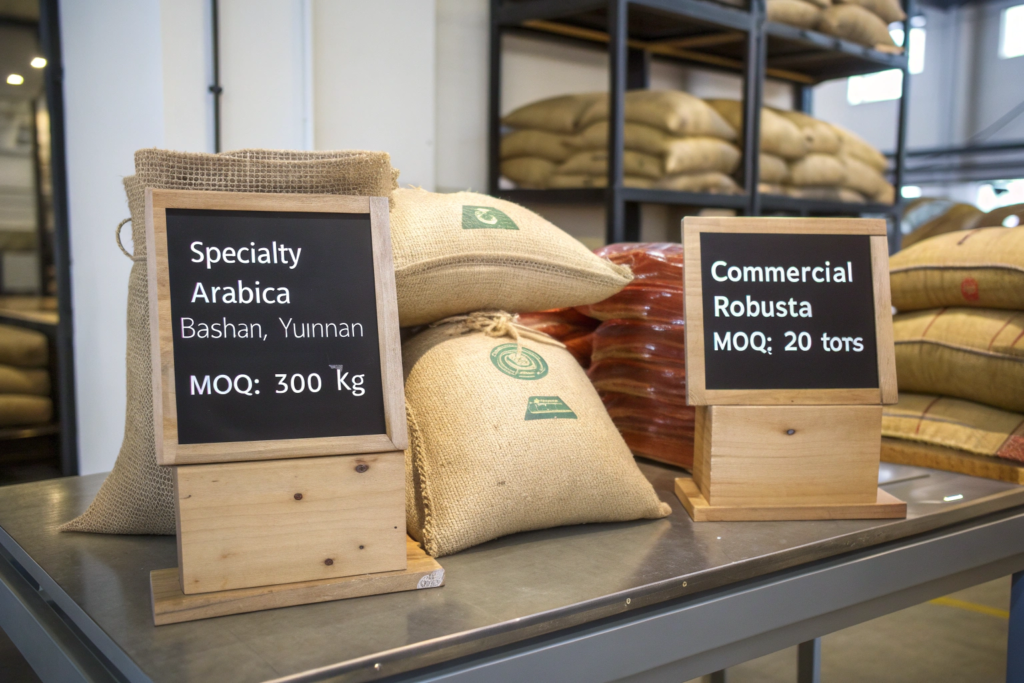
How Do Specialty Grade vs. Commercial Grade MOQs Compare?
The specialty-commercial divide is a sharper predictor of MOQ than the Arabica-Robusta divide. A specialty-grade Robusta, a clean, well-processed lot intended for the premium espresso blend market, might have a flexible MOQ similar to specialty Arabica. A commercial-grade Arabica, destined for instant coffee or mass-market blends, will have a high container-level MOQ.
The logic is the same. The higher the cup score and the more traceable the lot, the more the supplier can price based on quality and offer smaller volumes. The lower the cup score and the more commoditized the product, the more the supplier depends on volume. When you see a supplier advertising "no minimum order" or "sample roast available," they are almost certainly selling specialty-grade coffee. When you see "FOB container lots only," they are dealing in commercial grades. Know which market you are buying in before you inquire.
Can You Mix Arabica and Robusta in a Single Container Order?
Yes, and this is a practical option for roasters who use both species. If you are buying a full container from a single supplier who grows or trades both Arabica and Robusta, you can often split the container load.
The container might hold 200 bags of washed Arabica and 100 bags of natural Robusta. The total volume meets the FCL minimum. The buyer gets the logistics efficiency of a full container and the product mix they need for their blends. The paperwork requires clear separation on the bill of lading and the phytosanitary certificate, but this is standard practice. If the supplier does not produce both species, a good freight forwarder can sometimes arrange a "buyer's consolidation" at the port of loading, where pallets from two different suppliers are combined into one container. This is more complex and requires careful coordination, but it is a viable strategy for a roaster who wants direct sourcing but does not have the volume for separate FCL orders from each origin.
Conclusion
The minimum order quantity for wholesale coffee is not a fixed number carved in stone. It is a function of the supplier's business model, the product type, the logistics chain, and your negotiating position. A large commodity exporter will tell you one container. A specialty plantation will tell you one pallet. Both answers are correct in their context.
The MOQ question is really a question about your own business. How much coffee can you store properly? How much capital can you tie up in inventory? How quickly can you sell through a shipment? The right MOQ is the one that matches your answers to these questions.
If you are a roaster who wants to start direct sourcing but feels blocked by high MOQs, I invite you to talk to us. We built our export program to serve a range of order sizes, from a single trial pallet to annual container contracts. Contact Cathy Cai at cathy@beanofcoffee.com. Tell her your volume needs, your storage capacity, and your growth plan. She will put together an order structure that makes sense for where you are now, with room to scale when you are ready.