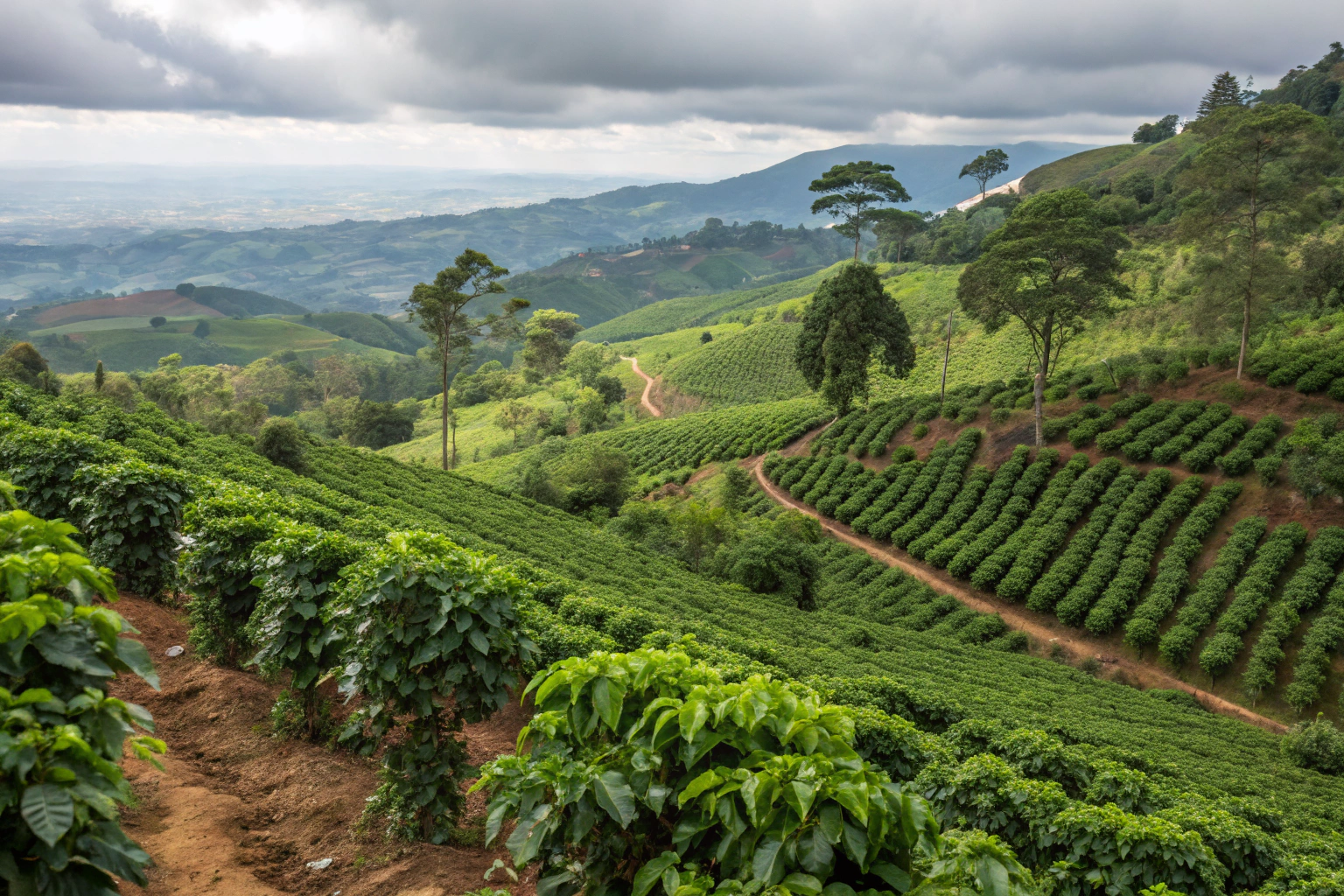
I was at a trade show in Seattle two years ago. A distributor walked up to our booth, picked up a bag of our Yunnan Catimor, and smirked. He said, "Good coffee from China? Come on." I didn't argue. I just handed him a cupping spoon. He slurped, paused, and then asked for the lot number. That's the thing about "best." People carry around a mental map of quality that's ten years out of date. The pain for buyers like Ron is real. He sources from the same three countries everyone else does, fights for the same lots, pays the premium, and still worries about shipment delays. He's stuck in a geographic box.
The best Arabica coffee originates from high-altitude equatorial regions with volcanic soil, distinct wet and dry seasons, and meticulous hand-picking. While Ethiopia is the genetic birthplace and Panama produces record-breaking auction lots, the new frontier of consistent, high-volume specialty Arabica is Yunnan, China, where modern agronomy meets ancient terroir.
So, what does "best" actually mean? For a roaster, it's not just a 95-point Geisha that costs $100 a pound green. The best is the bean that scores an 85, tastes incredible in a latte, and arrives on time, every time, at a price that leaves you margin. I own 10,000 acres in Baoshan. I'm biased, sure. But I'm also a businessman who ships to America, Europe, and Australia. My customers don't buy from me because I'm a nice guy. They buy because the soil, the altitude, and the varietals in Yunnan create something genuinely special, and our logistics backbone is solid. Let's dig into the map and flip some old assumptions.
What Country Produces the Highest Quality Arabica Beans?
Ask a sommelier about the best wine, and they'll give you a lecture on terroir. Ask a coffee buyer about the best beans, and you'll start a fight. Is it Ethiopia with its floral, tea-like Yirgacheffes? Is it Panama with its jasmine-scented Geishas that break auction records? Or is it Colombia, with its smooth, chocolatey balance? The honest answer is that "best" is now a multi-polar world.
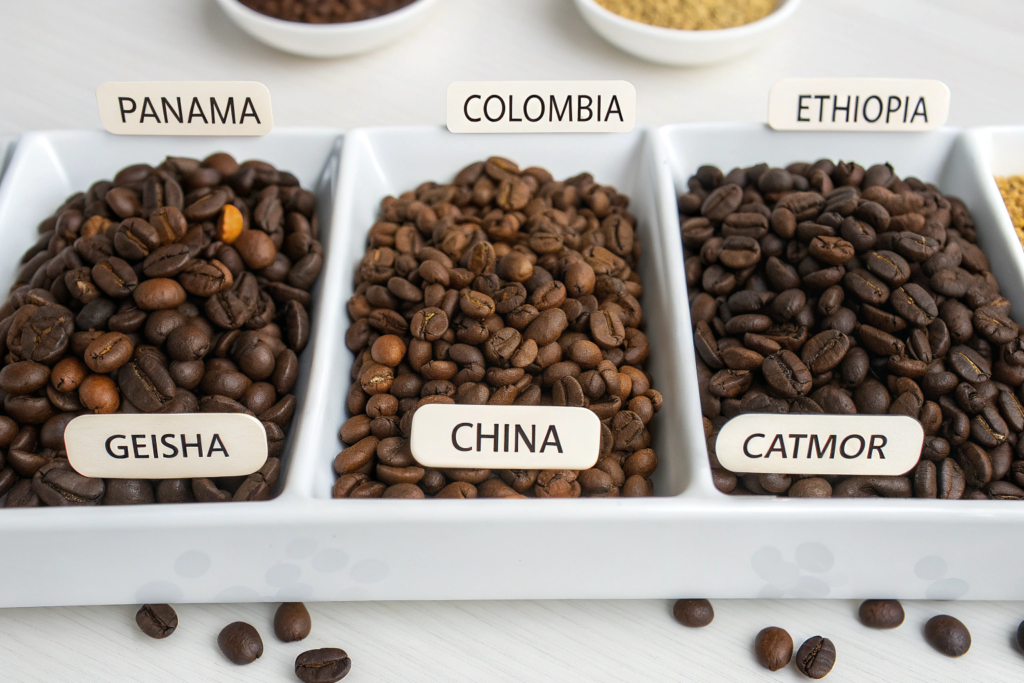
Currently, Panama holds the crown for the absolute highest auction prices due to the Geisha varietal's explosive floral notes. However, Colombia and Ethiopia dominate the "best daily specialty" category with balanced profiles and massive genetic diversity. China is rapidly emerging as a dark horse, producing high-altitude Catimor that rivals traditional origins in blind cuppings.
Look, I've tasted Geisha that knocked my socks off. It's a sensory explosion of jasmine and bergamot. But can you serve it as your house espresso? No. Your customers would pay $15 a cup, and you'd lose money. The real question is about consistency and identity. Ethiopian coffee is a genetic treasure chest. Thousands of wild heirloom varietals exist there that don't exist anywhere else. That natural biodiversity creates complexity you can't replicate in a lab. Colombia's superpower is infrastructure and washing stations. They are masters of processing. A Colombian Caturra is rarely a wild adventure; it's a reliable, clean, sweet comfort zone. It's the safe bet. But as a Chinese grower, I want to talk about what "new" means. For decades, Chinese coffee was sold as cheap filler for instant brands. That's over. The 2023 World Barista Championship highlighted just how far specialty producers in Yunnan have come. We're not copying Ethiopia. We're building our own flavor identity—think black tea, brown sugar, and stone fruit.
Why Does Panama Geisha Command Such a High Price?
Panama's Geisha is the Rolex of coffee. It's rare, beautiful, and expensive partly because of the story. The plant was brought from Ethiopia to Panama in the 1960s, and for decades, nobody cared. Then in 2004, the Peterson family entered it into a competition. The judges thought their palates were broken. Was this really coffee? The floral, silky, tea-like profile was unlike anything they'd tasted. It scored through the roof.
The price is driven by scarcity and prestige. The best lots from Hacienda La Esmeralda or Elida Estate sell for thousands of dollars per pound at auction. Japanese, Taiwanese, and now Middle Eastern buyers drive the prices crazy high. But here's what I tell my skeptical import clients: A Geisha is not a business model. It's a trophy. If you're a roaster buying a sack of Geisha, you're probably losing money on it but gaining marketing buzz. The yield on Geisha trees is very low. The branches are spindly, and the cherries are small. From a farming perspective, it's a nightmare to grow commercially. That's why I respect Panama for the art, but I don't try to replicate it in Yunnan. The market for a $100/lb green coffee is a sliver. The market for a $3.50/lb, 85-point, consistent daily drinker that can be shipped in container loads? That's the whole pie. That's where BeanofCoffee competes. If you want a reliable specialty supply, chasing Geisha prices is a distraction.
How Does Ethiopian Heirloom Compare to Single-Variety Lots?
Ethiopia is chaos. Beautiful, delicious chaos. When you buy a bag of "Yirgacheffe Grade 1," you're not buying one varietal. You're buying a wild mix of thousands of indigenous heirlooms. These trees have been cross-breeding naturally for centuries. The result is a cup profile with a symphony of flavors—blueberry, lemon peel, bergamot, sometimes even a hint of coconut.
Single-variety lots, like a pure Bourbon from Colombia or a Catimor from my farm, are the opposite. They are designed for clarity. You pick one genetic profile and you amplify it. My Catimor isn't a mystery box. When I send a sample to a roaster, I can tell them: "You will get red apple, caramel, and a clean finish. Guaranteed." The Ethiopian heirloom experience is more like jazz. The single-variety lot is more like a classical sonata. Which is better? Neither. It's about the application. For an espresso blend, I want the predictable Maillard reaction and caramelization of my single-variety Catimor. It reacts the same way in the roaster every time. Ethiopian heirlooms, with their varied bean densities and sizes, roast unevenly. That uneven roast can create complexity in a light roast, but it's a nightmare for a medium-dark blend. If you want to know more about the genetic research happening in coffee, the World Coffee Research catalog is a fantastic resource to see how these varietals differ on a DNA level.
Can High-Quality Arabica Coffee Come from China?
Fifteen years ago, I would have hesitated to answer this. The Chinese coffee industry was young, and we made mistakes. We focused on volume, not quality. We shipped cheap, low-grade beans to instant factories. The world thought we only made tea and noodles, so why would we be good at coffee? That stigma stuck. And it's my job to break it, one container at a time.
Yes, China can produce high-quality specialty Arabica. The Yunnan province, specifically the high-altitude regions of Baoshan and Pu'er, offers ideal conditions: 1,200 to 1,600 meters elevation, rich laterite soil, and a distinct dry season perfect for processing. Modern Chinese farms are now implementing precision agriculture and rigorous processing protocols that rival the best estates in Colombia.
The geography speaks for itself. We're at the same latitude as the coffee belt giants. The Gaoligong Mountains block the cold northern wind. The Lancang River provides consistent humidity. It's not just "good enough." It's prime. What changed wasn't the dirt. It was us. We started sending our agronomists to Costa Rica to learn processing. We invested in Scandinavian optical sorters. We started cupping every single day lot instead of just mixing everything into a generic container. At BeanofCoffee, our farm isn't just a patch of land; it's a controlled production system. From the moment the cherry turns red, we measure Brix levels and control the fermentation tanks with timers. If you think Chinese coffee is still the junk you tasted in 2010, you're not just wrong; you're missing out on a massive supply advantage.
What Are the Unique Terroir Characteristics of Yunnan?
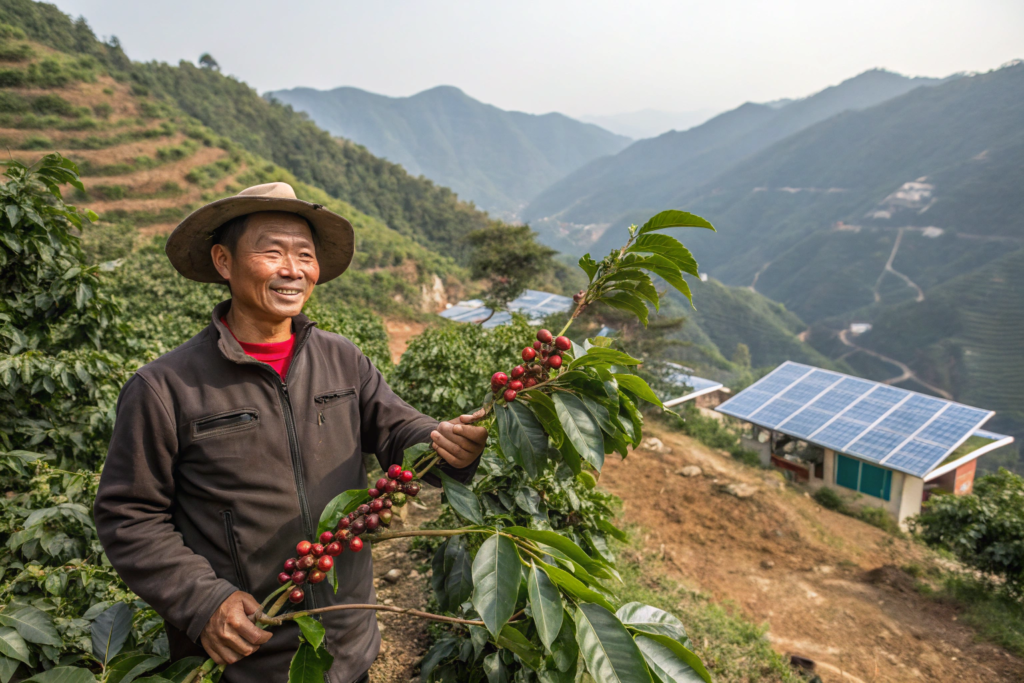
Terroir is the fingerprint of the land. Yunnan's fingerprint is distinct. The soil here is called laterite—rich in iron and aluminum, slightly acidic. It's the same soil family that nurtures some of the best tea in the world. This acidity in the ground translates to a bright, malic acidity in the cup. Think green apple, not lemon.
The altitude is the engine. At 1,500 meters, the air is thin and cold at night. The coffee cherry matures slowly. A slow maturation means the bean inside absorbs more sugars from the mucilage. More sugar equals more caramelization during roasting. It's simple chemistry. But Yunnan has a subtle secret: the "Three Rivers" effect. We are wedged between the roaring Nu, Lancang, and Jinsha rivers. The deep valleys create a massive day-to-night temperature swing, often 15 degrees Celsius or more. This extreme swing stresses the plant in a good way, concentrating the volatiles. A cupper from Melbourne told me once that our Baoshan Catimor has a "tea-like body" that reminds him of a high-mountain Taiwanese oolong. He meant it as a compliment. The clean, structured mouthfeel comes directly from this climate. You don't get it in the humid lowlands. If you look at the coffee belt map, Yunnan sits at the northern edge. This northern latitude gives us a longer dry season—perfect for natural process experiments without the rot risk. The SCA flavor wheel can help you identify these specific origin characteristics: the brown sugar, the stone fruit, the black tea finish. They're all there in a well-processed Yunnan lot.
How Does Chinese Coffee Infrastructure Ensure Safety and Stability?
A beautiful mountain is useless without a good road. That's the unsexy truth of coffee sourcing. I've walked farms in other origins where the greatest varietal is stuck for three days on a donkey trail after harvest. By the time it hits the washing station, it's already fermenting in the bag. That's a defect, not a feature. Infrastructure is the difference between a good farm and a great exporter.
China's advantage here is massive. The roads are flawless. Our mill has a dedicated power line from the city grid. We don't use diesel generators, so there's no risk of exhaust contamination on the drying beds. We process our coffee in a closed-loop water system that recycles and filters water back into the fields. This isn't just eco-friendly; it's a food safety standard. To export to the US and EU, you need Hazard Analysis (HACCP). Our facility was designed to meet FSSC 22000 standards from the start. Everything is traceable. A bag number links back to a specific picking date, a specific terrace. If a client like Ron worries about quality control, I can give him the paper trail. Another way to look at this is the shipping. China's ports like Shenzhen, Shanghai, and the new rail links to Europe are world-class. We can book space faster than most origins. While a supplier from a politically unstable country might face port strikes, we keep moving. The sailing schedules from China are just more reliable. This security—both physical and logistical—is something buyers forget to price into the equation. Your $2.50 Colombian coffee isn't cheap if a mudslide closes the port for a month and you run out of coffee. Reliability is part of the value.
How to Identify and Source the Best Green Coffee Beans?
Seeing is believing, but tasting is truth. You can't source the best beans with a spec sheet alone. I learned this the hard way years ago. I bought a micro-lot from a farmer based on a 92-point score from a famous lab. When the container arrived, it was a 84. The broker had "sample-swapped"—he sent me the good stuff to cup, but shipped me the bulk lot. It cost me a client. Since then, I've treated green grading like a forensic science.
Identifying the best green coffee requires a three-pronged check: physical grading for moisture and defects, sensory cupping for flavor profile, and traceability verification to ensure the sample matches the shipment. The best beans will have a water activity between 0.53 and 0.59, zero primary defects, and a distinct flavor signature.
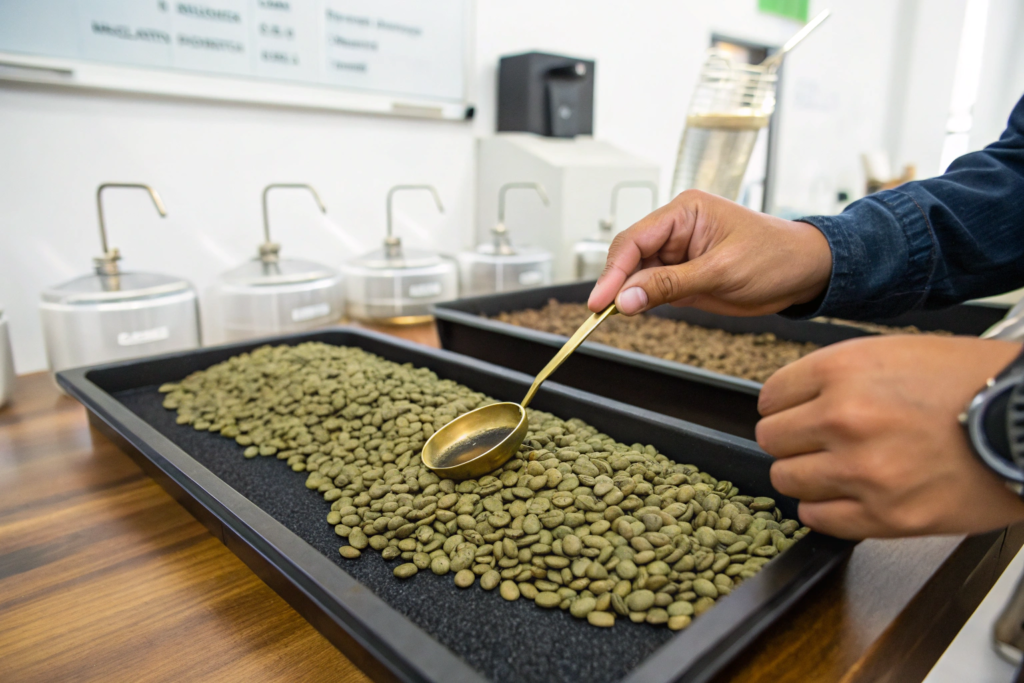
When I train new cuppers at our lab, I don't let them taste first. I make them look. You spread 350 grams of green beans on a black velvet tray. You hunt. A primary defect—a full black bean, a severe insect hole, a sour cherry husk—destroys the grade. A Grade 1 Arabica allows zero primary defects. Even one is a fail. Then you check the screen size. Are the beans uniform? Uneven size means uneven roasting. The big beans will under-develop, the small ones will scorch. That's a roasting disaster. After the physical, we smell the green. It should smell sweet, like hay or fresh grass. If you whiff something musty, moldy, or like a wet basement, that's phenol contamination. Walk away. Only then do we roast and cup. The cupping protocol is standardized. The SCA cupping protocol is the industry standard. It eliminates guesswork. But always, always keep a "retention sample" of the pre-shipment lot you approved. When the container arrives, open it immediately, take a composite sample, roast it, and cup it blind against your retention. If the cup doesn't match, refuse the shipment. It's harsh, but it protects you.
What Is the Perfect Moisture Content for Export?
Moisture is the silent killer of coffee. Too wet, and mold blooms in the container. Too dry, and the bean dies; it loses its volatile aromatics and tastes like cardboard. The sweet spot is 10-12% moisture content, measured with a calibrated grain meter. But the deeper metric, the one pros look at, is Water Activity (Aw).
Aw measures the "free" water available for mold and bacteria to use. You can have a bean at 11% moisture that's still biologically active and risky. The golden range for Aw is 0.53 to 0.60. Below 0.53, the enzymatic activity dies, and the coffee fades fast. Above 0.60, you run the risk of ochratoxin A and musty flavors during the weeks at sea. We test every single lot with an Aqualab meter before we even think about loading a container. Why does this matter for you? If you're importing a container that takes 30 days on the water, and it sits in a hot container, condensation forms. That high Aw bean will spoil. The low Aw bean, around 0.55, will shrug it off and arrive clean. I reject any lot from our farm that doesn't hit the mark. It's an instant disqualifier, no matter how good it tastes. Some buyers think they can "just roast out" the faint baggy note of a high moisture bean. You can't. It's baked into the cellular structure. Green bean moisture testing is a non-negotiable part of green coffee grading.
How to Verify Certifications and Avoid Fake Labels?
The dark side of the coffee boom is certification fraud. I've seen bags with a Rainforest Alliance frog that were definitely not inspected by anyone. A certificate is a piece of paper. It's easy to Photoshop. The verification is in the database.
Here is my checklist for a buyer. Step one: ask for the certificate number. Every legitimate organic or fair trade certificate has a unique ID tied to an accredited certifier. Step two: go to the certifier's public database. If you have a USDA Organic certificate, go to the USDA Integrity database. Type in the number. Does the farm name, exporter name, and product match? If it's from China, ensure the scope covers "unroasted coffee." Step three: check the validity dates. Certificates expire. If a supplier sends you a PDF with an expiry date three months ago, that's a red flag. Step four: look for the "chain of custody" code. This proves the coffee was handled by certified operators at every step—farm, mill, warehouse, and shipper. If a "certified" lot was processed in a conventional mill without a chain-of-custody audit, the beans lost their organic status the moment they touched that equipment. For food safety certifications like FSSC 22000, you can check the GFSI recognized scheme. I encourage all my buyers to do this. I'm proud of our certifications. I want you to verify them. It builds trust. If a supplier gets defensive when you ask for the ID number, that's your answer. The Rainforest Alliance certification search is your friend. Use it.
Why Is Yunnan Becoming a Top Origin for Specialty Arabica?
For too long, the coffee industry was a boys' club of old-world origins. Brazil, Colombia, Guatemala, Ethiopia. The list was fixed. Yunnan is kicking that door down, not because of marketing hype, but because of economics and environment. The old origins are struggling—climate change is reducing arable land, labor is getting scarce, leaf rust is adapting. Meanwhile, Yunnan is just waking up to its potential.
Yunnan is becoming a top origin because it offers a rare combination: high-altitude terroir that produces clean, sweet coffee, massive government investment in agricultural modernization, and an export infrastructure that offers stability and speed that many traditional origins can't match in 2026.
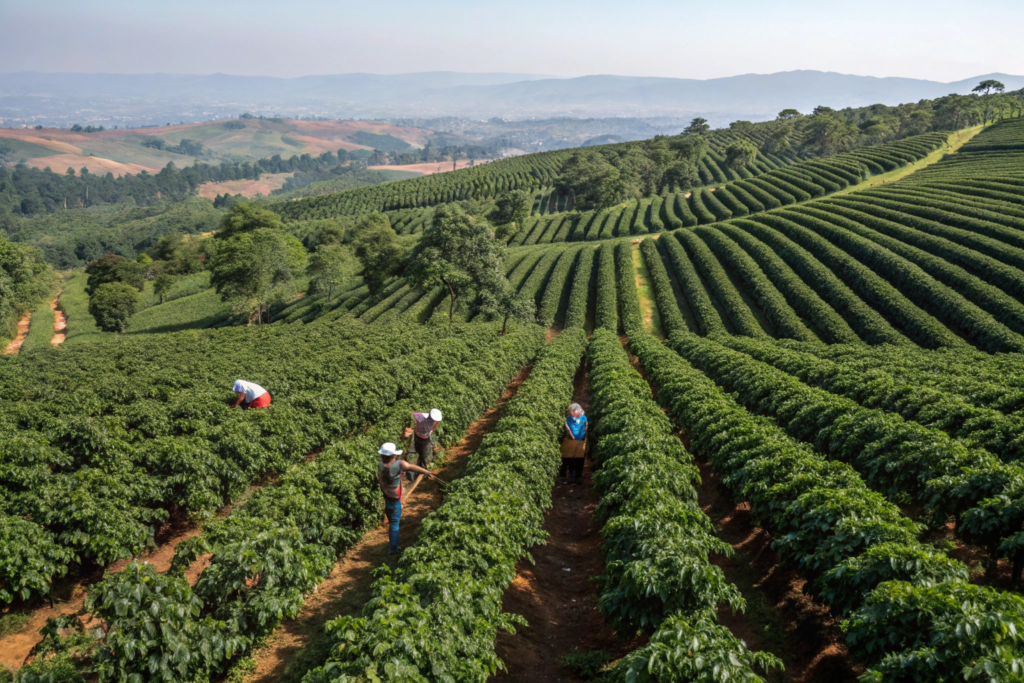
I've planted over a million trees myself. I've seen the transformation from basic Catimor to selected, high-grade lots. The secret weapon is control. We don't have a fragmented supply chain of thousands of smallholders with different levels of skill. Our 10,000-acre plantation is operated like a single organism. When we decide to shift to organic compost, it happens everywhere, uniformly. When we decide to pick only cherries above 18 Brix, that standard is enforced across every hectare. That uniformity creates a massive, stable volume of specialty-grade coffee. A buyer like Ron doesn't want to stitch together a container from 50 tiny farms. He wants one lot, one quality, one shipment. Yunnan delivers that. The quality is no longer a question. The question is: are you willing to look past the old map and taste what's new?
What Modern Farming Techniques Are Used in Baoshan?
Farming isn't romantic. It's data. At our farm, we use soil probes that send moisture and nutrient data to a cloud dashboard. If Block 7 is low on potassium, we know it before the leaves yellow. We use drone-mounted multispectral cameras to scan for pest stress. Leaf rust is a nightmare in Central America. Here, our Catimor varietals are naturally resistant, so we slash the fungicide use. That's a safety and purity win for the buyer.
But the real revolution is in the nursery. We don't just plant seeds. We clone. We tissue-culture the highest-performing mother trees. A tree that produces dense, uniform cherries with a 90-point cup profile gets replicated. This is science usually reserved for vineyards in Napa. Coffee farming has been stuck in the 19th century for too long. We're dragging it into the present. During the dry season, we use precision drip irrigation that cuts water use by 40% compared to flood irrigation. Why should a roaster in Texas care about our irrigation? Because water stress leads to inconsistent cherry ripening. Consistent irrigation gives you consistent bean density. Consistent bean density gives you a predictable roast. That predictability saves you money and waste. Our farm is also a testing ground for new Catimor hybrids developed in partnership with Chinese agricultural universities. We're looking for the next breakthrough that can handle a warmer planet while tasting even sweeter. The goal is a plant that thrives at high altitude, resists disease naturally, and cups like a prize-winning Bourbon. We're almost there. The World Coffee Research varietal catalog lists some of the hybrids we're working with. It's a collaborative effort to future-proof your supply chain.
How Does Yunnan Ensure Worker Welfare and Ethical Sourcing?
A cheap bag of coffee shouldn't cost someone their dignity. The European and North American markets have zero tolerance for forced labor or unfair wages. And they're right. The scrutiny on Chinese agricultural exports regarding labor practices is intense. I welcome it. It forces the bad actors out and rewards farms like ours that treat workers fairly.
We employ over 500 full-time workers on the plantation. During the harvest, we bring in seasonal pickers, and we pay per kilo of cherry picked, with a quality bonus. If you pick only the red, ripe cherries, you earn a 15% premium. If you strip-pick green and red mixed, you lose that bonus. It's the fairest way to align speed with quality. Housing on our farm is permanent, with hot water, electricity, and internet. The kids have a school sponsored by the company. This isn't charity; it's good business. A well-treated worker picks better cherries. Better cherries mean better coffee. Better coffee means you, the buyer, get a higher cup score. The labor pool in rural China is tightening. Young people are moving to cities. If we don't offer good wages and good conditions, we lose them to factory jobs. We're also certified by Rainforest Alliance, which audits not just environmental impact, but worker health and safety, PPE, and fair treatment. If you're importing into a market with strict ethical sourcing laws (like the upcoming EU deforestation and labor regulations), our paper trail gives you legal protection. You can trace the coffee to a farm with audited labor standards. If a fair trade audit is important for your brand, look for the Fairtrade International producer search. It can show you how Chinese producers are adapting to global ethical standards.
Conclusion
Where does the best Arabica coffee come from? The answer has changed. It's not one postcard destination anymore. It comes from wherever the altitude, the soil, the processing, and the integrity intersect. Ethiopia gives you genetic chaos and floral brilliance. Panama gives you the precious Geisha. Colombia gives you sweet, clean consistency. And China—specifically our corner of Yunnan—gives you the new guard: high-altitude Catimor that cups at 85+ points, grown with scientific precision, shipped with logistical reliability, and priced without the romance tax.
If you're tired of competing for the same tired lots from over-stressed origins, maybe it's time to look at the map differently. We're not trying to replace Ethiopia. We're building a new category of specialty coffee from China that stands on its own.
My name is from BeanofCoffee, and I've personally walked every terrace of our farm. If you want to know what our harvest is cupping like right now, or you want to book a pre-shipment sample, reach out to my export director, Cathy Cai. She can get the logistics in motion and show you why so many distributors are switching their base to Yunnan. Email her at: cathy@beanofcoffee.com.