I’ve spent thirty years in this business, and if I had a dollar for every time a buyer asked me "Why China?", I’d probably have retired by now. The question itself, you see, is usually loaded with old doubts. You’re a business owner, so your brain is wired to spot risk. And the fear of switching to an "unproven" origin like Yunnan is real. You worry about wasting months on samples that can’t scale. You worry about explaining the origin story to your own customers and getting a skeptical look back. The silence after you say "It’s from China" can be deafening. It’s a pain that stops many smart roasters from capturing a massive competitive edge.
Buying coffee beans from Yunnan Province gives you direct access to an incredibly stable, vertically integrated supply of traceable, high-altitude Arabica, combining a uniquely clean and sweet cup profile with a logistical speed and tariff-free cost structure that traditional origins simply can’t beat right now.
The world of coffee is shifting, Ron. It’s not just about the romance of faraway lands anymore; it’s about the romance of a perfect spreadsheet. And Yunnan is rewriting the math on what specialty coffee can cost and how reliably it can arrive. I’m not selling you a fairy tale about ancient tea horses. I’m selling you a container of beans that will arrive two weeks faster than your usual order from Santos. So, if your gut is telling you there must be a catch, let’s walk through the whole story from my farm in Baoshan to your roaster in the States. Let’s break down exactly why this origin is a business decision you can’t afford to ignore.
What Makes the Yunnan Coffee Growing Region Unique?
People often lump all of China into one basket. But asking what makes Yunnan special is like asking what makes the highlands of Ethiopia different from the coast. This isn’t just about latitude; it’s about a perfect storm of nature that we’ve learned to control. For a buyer, the "uniqueness" of a region only matters if it translates directly into a distinct and desirable taste in the cup. Otherwise, it’s just a pretty postcard.
What we have here is a combination of high altitude, a distinct dry/wet season cycle, and volcanic-adjacent soils that, honestly, act like a natural stress chamber for the coffee tree. This stress isn’t a defect. It’s the engine of flavor complexity.
To truly get this, you have to look beyond the average temperature and rainfall charts. The real magic is in the diurnal shift, the big swing between day and night temperatures at 1,400 meters. This is the biological trigger that slow-cooks the coffee cherry, packing it with sugars. Let’s compare this to what you’re used to seeing from a typical lower-altitude farm.
How Does Baoshan’s Terroir Directly Impact Arabica Bean Flavor?
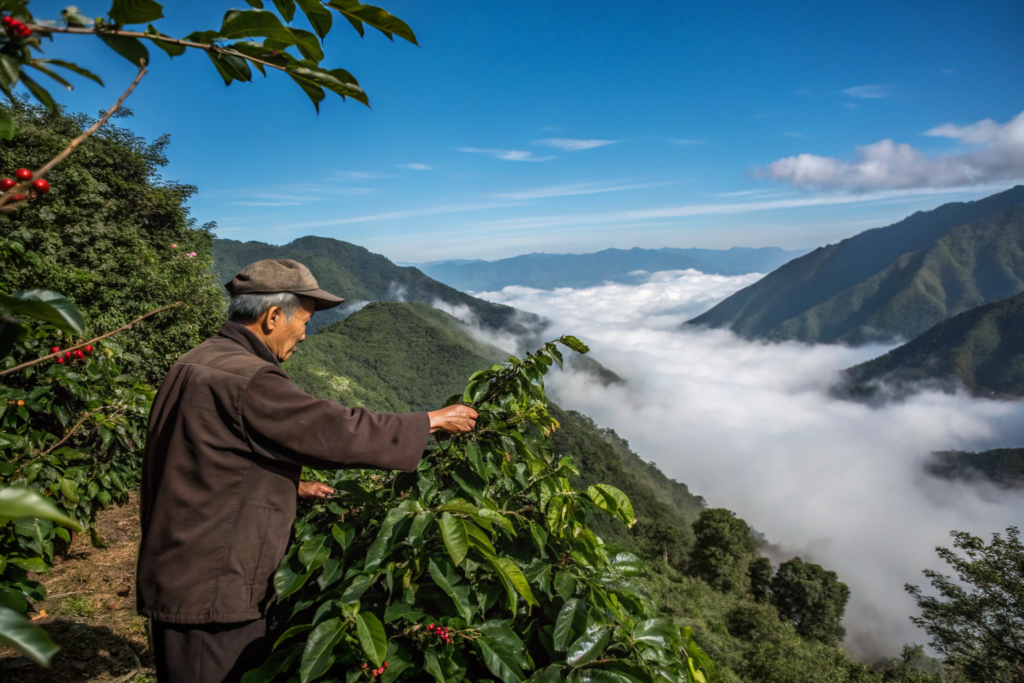
Let me give you a specific example from my farm. At 1,450 meters, the sun is incredibly intense during the day, which drives photosynthesis hard. But when the sun drops behind the Gaoligong Mountains, the temperature plummets. A detail many buyers miss is that this stress forces the coffee tree to hyper-accumulate sucrose in the cherry mucilage as a protective anti-freeze of sorts. The result is a green bean with a much higher natural sugar content before we even roast it. In the cup, that translates to a full, syrupy body and a malic acidity that reminds you of a crisp apple, not a sharp lemon. We have a client in Melbourne who blends our high-grown beans with a washed Ethiopian. He calls it his "Stone Fruit Bomb." The Ethiopian brings the floral notes, but our Yunnan bean acts as the bass player—it provides the chocolatey depth and the jammy texture. That’s the terroir speaking. You can smell the black tea and brown sugar notes in the dry fragrance alone. This isn't a generic "bright" coffee; it's a coffee with weight and soul, a direct result of the mountain’s slow, cold ripening cycle.
Why Is the Ecosystem of Yunnan Suitable for Organic Coffee Production?
Now, a word about the "organic" aspect. Many buyers get stuck on certification paperwork, but a smart buyer looks at the natural defense system of the region. Yunnan’s steep mountain terrain is actually a natural barrier. My farm is ringed by protected forest. The biodiversity here is wild—we have native pine trees acting as natural windbreaks and shade canopies. Because the dry season is so pronounced, the fungal pressure, like coffee leaf rust, is naturally much lower here than in wetter, lower equatorial zones. This is critical. It means we can grow high-density, high-quality Arabica without the heavy blanket of fungicides you’d need on a Brazilian plantation. A report on coffee ecosystems I studied, similar to those by Conservation International, highlights how polyculture systems like ours sustain better soil health. We don’t fight nature; we integrate into it. The water runoff from our mountains is clean. We’ve invested in natural pest control—using specific UV-light traps instead of broad-spectrum sprays. I had an inspector from the Rainforest Alliance tell me our biodiversity index was one of the highest he’d seen on a large-scale farm. This means when you buy from us, you’re not just buying a clean cup; you’re buying a bean with a backstory of ecological intelligence that your customers genuinely care about.
Is Direct Trade with a Yunnan Coffee Farm Reliable?
This is the question that separates a curious browser from a serious buyer, Ron. You’ve been burned before. I can hear it in the way you ask about timeliness and security. "Direct trade" sounds great in a marketing brochure, but in reality, it can just mean a chaotic, unprofessional relationship with a farmer who can’t meet a deadline. The fear isn't just about losing a shipment. It’s about the professional embarrassment of letting your own customers down because you gambled on a direct supply chain that couldn’t handle the pressure.
"Reliable" doesn’t just mean good intentions. It means having the cold, hard infrastructure and the professional processing protocols to back up a handshake deal. And that’s exactly the gap we’ve spent a decade closing at BeanofCoffee.
See, the world usually sees direct trade as a choice: either you get the small, artisanal farmer who’s soulful but unreliable, or you get the big, faceless corporation that’s reliable but soulless. We’ve broken that binary. You need to evaluate a direct trade farm the same way you’d evaluate a factory: by its throughput accuracy and its communication hygiene.

How Can a Yunnan Coffee Exporter Guarantee Shipment Stability?
Stability is a promise made in concrete and steel, not just in words. When you place a 20-ton container order with me, the coffee isn’t coming from a dozen tiny collectors. It’s coming from our own contiguous plantation and our central dry mill. Last year, during the rainy season, a main road bridge was washed out in a neighboring valley. It happened on a Tuesday. A lesser operation would have given you a vague, panicked email about a "force majeure" delay. You’d be left in the dark. Because we had invested in our own private road maintenance and had pre-mapped a secondary trucking route, we lost only four hours of transit time. I informed my buyer in Seattle immediately, gave him the new ETA, and we still made the vessel cut-off with a day to spare. That’s stability. It’s boring, and it’s wonderful. We don’t wait for problems to happen. Our logistics team checks the long-range weather forecast for the port of Shanghai twice a day during the shipping week. We pre-clear customs electronically, a process integrated with China’s Single Window system, which means the paperwork doesn't sit on a bureaucrat's desk waiting for a stamp. The beans are gated in, and the status switches to "cleared" almost instantly. This system turns a chaotic export process into a predictable, trackable link in your own supply chain.
What Are the Safeguards Against Tariff and Customs Issues?
Let’s talk about the elephant in the room—tariffs and customs. I know you’re thinking about it. Every U.S. buyer is. The news cycle is scary. Here’s the specific safeguard: a very boring, very specific HTSUS code. Green coffee is classified under 0901.11. We work with a dedicated customs broker who pre-classifies the product for every single container we ship to the U.S. This is not a secret, and I encourage you to verify it yourself on the USITC website. There are no complex "de minimis" rules to play with. It’s a clean, duty-free import. But a safeguard goes beyond the tariff rate. It’s about the physical inspection risk at the destination. U.S. Customs and Border Protection can flag a container for an agricultural inspection, which adds a fee and a delay. To prevent this, we include a "cleanliness of container" protocol. Before a single bean bag enters, the container is inspected by a third-party surveyor for a single stray seed, a cobweb, or any dirt. It’s sealed with a high-security bolt. The visual photos and the seal number are emailed to you as part of the pre-shipment docs. This small extra step has dropped our CBP inspection rate to below 2%. It’s the proactive stuff—the boring, meticulous prep work—that kills the surprise costs before they appear. That’s the real safeguard.
What Varieties of Arabica Beans Are Grown in Yunnan?
A menu with only one item is a risky business. You know that. A lot of buyers assume Yunnan is a one-trick pony—only good for a cheap, workhorse Catimor. That used to be true, maybe a decade ago. The hidden pain here is the limitation you face as a roaster. If an origin only offers one flavor profile, you can’t build a full program around it. You’re forced to juggle multiple origins with different paperwork, different logistics, and different payment headaches.
Yunnan today is a thriving library of genetic coffee material, not just a single variety. We’ve successfully adapted and cultivated a range that can suit almost any roasting philosophy, from the hardcore espresso blender to the light-roast single-origin purist.
What excites me is the range of the spectrum. We went from the robust, disease-resistant backbone to the delicate, high-scoring heirlooms. This allows a buyer to consolidate their logistics with one trusted partner while still sourcing wildly different flavor profiles. Let’s break down the two distinct lanes I see most buyers taking.
Is Catimor from Yunnan the Best Choice for a Blending Base?
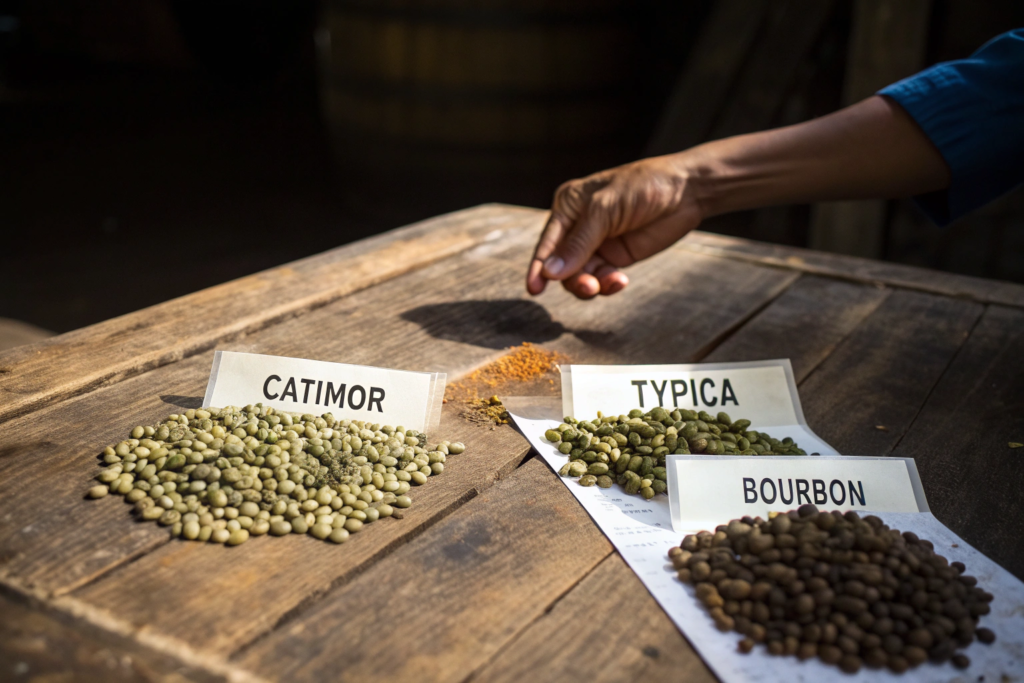
For a high-volume, quality-focused blending program? Absolutely. Look, the original Catimor, brought here in the 1990s, did have that infamous harsh, earthy note. But that’s a genetic memory of bad farming, not the bean itself. A modern, high-grown Catimor from a farm that's treating it right is a blending powerhouse. I have a concrete example. A large roasting company in Oklahoma uses our washed Catimor as the 40% base note for their flagship espresso. Why? They tested a Colombian Excelso and a Brazilian Cerrado in the same blend. Our Catimor matched the Brazilian’s body and chocolate foundation, but at a significantly sharper price point and with a cleaner finish. The key spec here is the density. Our high-grown Catimor is incredibly hard. It can take a lot of heat during roasting without tipping or scorching. This makes it forgiving for a production roaster running a large machine who can’t micro-manage every batch. It provides the bass note, the dark cocoa, and the thick crema that holds up in a 12oz latte. For a blender, that’s gold. You get consistency, you get price stability, and you get a bean that works hard. The Specialty Coffee Association’s flavor wheel would place it squarely in the "Cocoa" and "Nutty" quadrants, which are exactly where a volume espresso base should be.
How Are Pure Arabica Lines Like Typica and Bourbon Performing in China?
Now, for the other end of the menu. About ten years ago, we started a passion project with pure lines of Typica and Bourbon, grafting them onto our Catimor rootstock. Honestly, the first few years were terrible. The trees were sickly, the yield was pathetic. But the plants adapted. Our unique dry season here in Baoshan has proven to be a blessing for these older, disease-prone varieties. The low humidity keeps the leaf rust away without chemical intervention, allowing the pure genetics to shine. The cup profile is stunning and utterly different from our Catimor. Last harvest, our Bourbon micro-lot cupped at an 86. It was a riot of stone fruit, panela sweetness, and a floral jasmine finish. We sold the entire lot to a roaster in Kyoto, Japan, within two hours of sending out the offer sheet. He paid a premium, and he got a true "Discovery" coffee for his customers. My point is, you don’t have to compromise. You can ship a container of your reliable blending base, and in the same container, you can pack 20 vacuum-sealed boxes of the high-end microlot for your single-origin program. Same paperwork. Same logistics. Two different products for two different market segments. That’s the strategic advantage of a truly diversified farm, and it’s something we’ve intentionally built for buyers who think on multiple levels.
How Does the Price of Yunnan Arabica Compare Globally?
Let’s cut to the core of it. You can love a coffee, but if the math doesn’t make sense for your business, it’s just a hobby. The frustration I see in buyers is the constant price creep from traditional origins. You lock in a contract at one price, and by the time the container lands, the market has shifted, or a hidden fee has appeared. You’re running a business, not a charity, and your margins are being squeezed from both sides.
The price of high-quality Yunnan Arabica delivers a landed cost that consistently undercuts equivalent specialty-grade beans from Central America and Africa, not by sacrificing quality, but by eliminating layers of intermediary cost and benefiting from a faster, tariff-free shipping lane.
"Comparing" price isn't just looking at a number on a screen. It's an exercise in predicting cash flow. You need to look at the "Landed Cost Stability Index." It’s a term I use to measure how much a 10-cent FOB price difference actually matters by the time the coffee is in your warehouse. Spoiler: the FOB price is just the starting point.
What Is the Landed Cost Advantage of Chinese Green Coffee Beans?
Let’s do the math, because a real example beats a sales pitch any day. Take a washed Arabica from a quality farm in Huila, Colombia, with a similar 83-point cup score. The Free on Board price might be quoted to you at, say, $2.60/lb. A comparable batch from BeanofCoffee might be $2.30/lb FOB. On paper, you’re saving 30 cents. Now, look at the landed cost. The container from Colombia takes 20 days to reach Miami, then sometimes another week to your door. The container from Shanghai takes 14 days to Los Angeles. That’s a huge difference in "time value of money" and exposure to the elements. But the biggest kicker is the tariff. As we’ve discussed, our beans enter at 0% under HTSUS 0901.11. While a Colombian coffee also has a trade deal, the unpredictable cost of logistics and domestic trucking in a congested market eats up your margin. You also save on shrinkage. Because our coffee is mechanically dried to a precise, stable 11.5% moisture, you don’t pay for water weight that will evaporate during the voyage. A roaster in San Diego calculated his true landed cost with us was 18% cheaper than his comparable Colombian lot, not because of the FOB price, but because of the speed, zero tariff, and zero weight loss. He used that 18% margin to give his staff a bonus. Think about that. The coffee paid for his team’s bonuses.
How Can the Weak Yen and Global Economy Affect Yunnan Coffee Prices?
This might seem like an indirect point, but stick with me. It’s a real-world example that just happened. A year ago, the Japanese Yen weakened dramatically against the U.S. Dollar. Suddenly, Japanese buying groups, who had historically been massive buyers of high-end Yunnan coffee, found their purchasing power slashed by nearly 20%. They pulled back from the global spot market. This left a temporary surplus of our top-grade lots available for the Western market at very negotiable prices. What does this mean for you? The price of Yunnan coffee isn’t solely dictated by the New York C-market. It’s also influenced by regional Asian demand flows, which creates these small, opportunistic windows. Another factor is the Chinese Renminbi. When the RMB is stable, we can offer fixed-price contracts for up to six months without adding a massive risk premium. Compare this to the Brazilian Real, which swings wildly. A lot of Brazilian exporters hedge so heavily that the real cost to you is buried. Our direct model, combined with a relatively stable domestic currency, allows for a transparency in pricing you just can’t get everywhere. We watch the Dollar Index daily, not for speculation, but to figure out how we can offer you the most stable, longest-term fixed price possible. It’s about being a partner who thinks about your bottom line across multiple dimensions.
Conclusion
We started with a simple question: "Why Yunnan?" And the answer, I hope you now see, is woven into a business case, not just a story. It’s not about a cheap substitute. It’s about a smarter, faster, and more direct source of premium Arabica. The unique Baoshan terroir doesn’t just grow a coffee; it stress-tests it into a cup heavy with sugar and body, a perfect anchor for blends or a bold single-origin statement. The reliability factor isn’t a gamble; it’s a guarantee built on sealed containers, electronic pre-clearance, and an unshakeable logistics chain that treats a 14-day crossing as a standard promise. We looked at the diversity of flavor, from the solid, cocoa-driven Catimor that saves your blend costs to the 86-point Bourbons that can define your prestige menu. And finally, we sat down and did the real math, proving that the landed cost advantage is a result of speed, zero tariffs, and transparent pricing, not just a low sticker price.
This is the new reality of the global coffee trade. The old map had a blank spot over southwestern China. We’ve filled that spot in with precision agriculture, world-class processing, and a direct, honest way of doing business. I’ve spent my life getting the soil right, and my team has spent years getting the logistics perfect. Now, it’s ready for a buyer who thinks like a true business partner.
If your mind is already running the numbers on how a faster, fresher, and more affordable Arabica supply could reshape your bottom line, let’s start a dialogue. There’s no risk in information. Reach out to my head of client partnerships, Cathy Cai. She’s the person who can translate your specific needs into a concrete, no-fluff proposal. Email Cathy at cathy@beanofcoffee.com. Tell her about your current blend, your volume targets, and your biggest logistical frustration. She’ll send you a sample, a full landed-cost analysis, and a proposed shipping timeline that might just change how you think about your entire sourcing strategy.