I once had a client—a very experienced roaster—call me frustrated. He had been roasting our high-altitude Baoshan Arabica using the same profile he used for his Colombian Excelso. "It is taking forever to develop," he complained. "First crack is late, and I am baking the coffee trying to get any sweetness." I asked him one question: "Did you adjust your charge temperature for the bean density?" There was a long silence. He had not. He was treating a dense, high-altitude bean like a softer, lower-altitude bean. The physics were working against him.
Bean density testing is crucial for high altitude coffee roasting because density directly dictates the rate of heat transfer into the bean, with denser beans acting as a greater thermal mass that requires a higher charge temperature and more aggressive early heat application to fully develop their complex sugars and avoid the underdeveloped, grassy flavors of a "baked" roast.
You cannot roast by sight and time alone. You must roast by the physical properties of the bean. Density is the master variable. Let me explain why and how you can use this data to unlock the full potential of our mountain-grown coffee.
What Is Bean Density and How Does Altitude Affect It?
Density is a measure of mass per unit of volume. In coffee terms, it is how much "stuff" is packed into the bean. A dense bean feels heavy in your hand, like a small pebble. A less dense bean feels lighter. Altitude is the primary engine of density.
Bean density is defined as the weight of a given volume of green coffee (typically expressed in grams per milliliter, or g/ml), and it is directly affected by altitude because cooler temperatures at higher elevations slow the cherry's maturation process, allowing more time for the seed to fill with complex carbohydrates, sugars, and cellular material, resulting in a physically harder, denser bean structure.
This is a biological response to environmental stress. The plant is working harder to survive, and it packs more energy into its seeds.
How Does the Diurnal Shift in Yunnan Contribute to Exceptional Density?
While altitude is the main factor, Yunnan's specific climate adds another layer of density-building stress. We have discussed Diurnal Shift before—the difference between daytime high and nighttime low temperatures.
- The Yunnan Pattern: In the Gaoligong Mountains, even at 1,600 meters, the days are sunny and relatively warm. The nights are sharply cold. This swing can be 12-15°C (22-27°F) .
- The Plant's Response: During the warm day, the plant photosynthesizes and produces sugars. During the cold night, the plant's respiration slows dramatically. It does not "burn off" as much of the sugar it created during the day. The result is a net accumulation of sugars and complex carbohydrates within the developing cherry and seed.
- The Density Outcome: This sugar accumulation, combined with the slow maturation from the cool climate, results in a bean that is not only dense but also high in sugar content. This is the "sweetness potential" of the coffee.
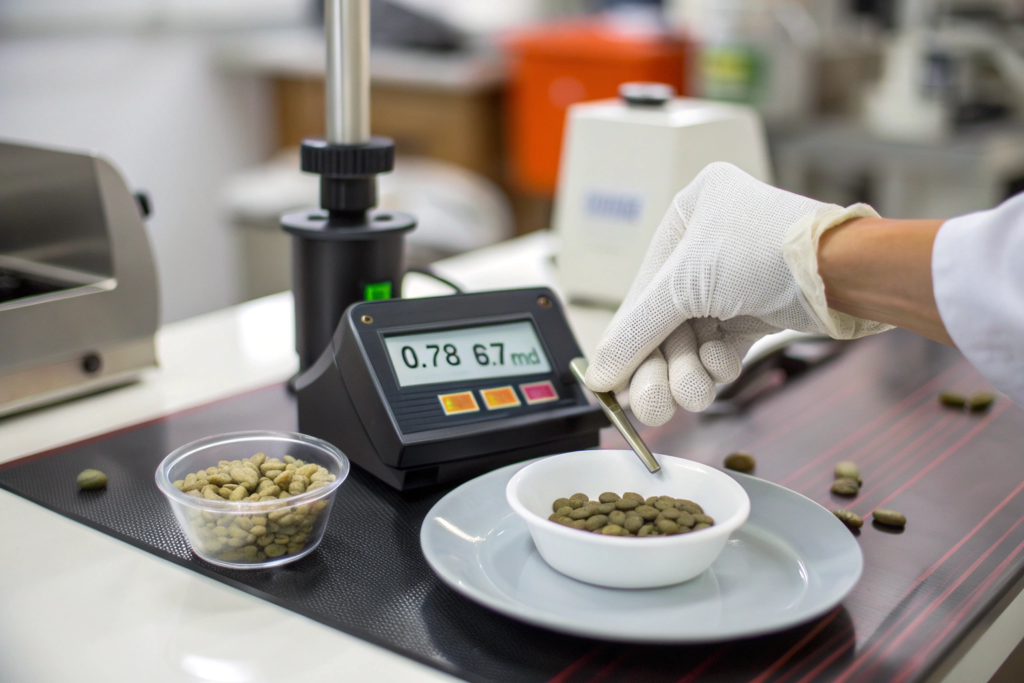
This is why a Yunnan Arabica grown at 1,600 meters can have a density reading comparable to a Strictly Hard Bean (SHB) from higher altitudes in Central America. The diurnal swing acts as a density multiplier. At Shanghai Fumao, we measure the density of every single lot from our different altitude blocks. Our Grade 1 Arabica from the upper slopes consistently shows density readings in the 0.70 - 0.74 g/ml range. This is "Very High Density" by SCA standards.
What Is the SCA Classification for "Very High Density" Beans?
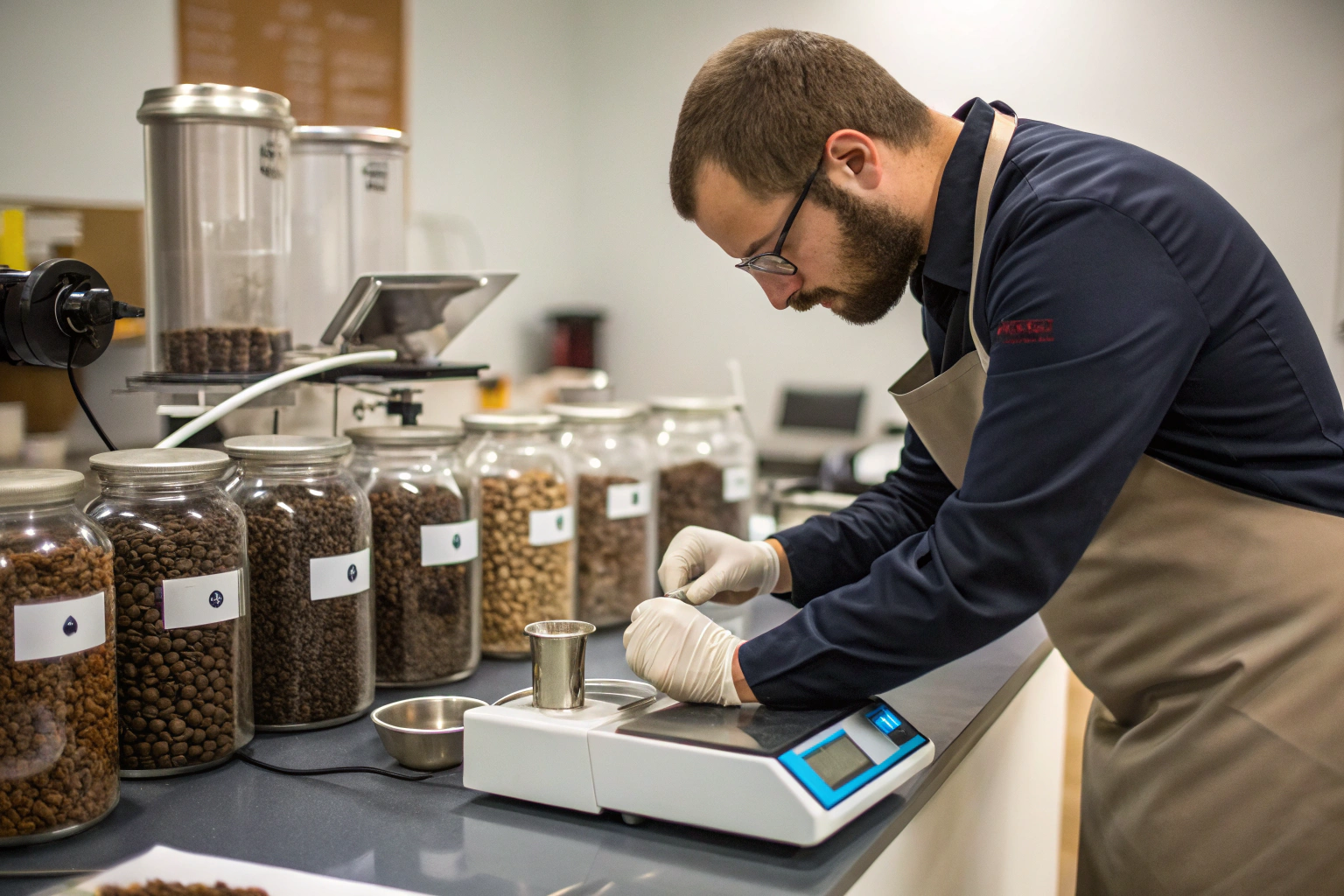
The Specialty Coffee Association provides a framework for classifying bean density. This is measured using a simple water displacement method (weighing a specific volume of beans).
| Density (g/ml) | SCA Classification | Roasting Implication |
|---|---|---|
| < 0.68 | Low Density | Soft bean. Absorbs heat very fast. Prone to scorching. Use low charge temp. |
| 0.68 - 0.72 | Medium to High Density | Standard specialty coffee. Predictable heat absorption. |
| > 0.72 | Very High Density | Hard bean (SHB). High thermal mass. Requires high charge temp and aggressive early heat. |
Our premium high-altitude lots consistently fall into the Very High Density category. This is a quality marker, but it is also a roasting instruction. It tells you, the roaster, that this bean will not behave like a standard Central American coffee. You must respect its density.
You can find the official SCA water displacement protocol on the Specialty Coffee Association website. For a deeper dive into the science of coffee density, World Coffee Research has published studies on the relationship between environment and bean physical properties.
How Does Density Dictate the Roaster's Approach to Heat Application?
The density number on the spec sheet is not just trivia. It is the key to unlocking your roast curve. If you ignore it, you will struggle. If you use it, the coffee will reward you.
Density dictates the roaster's approach to heat application by determining the bean's thermal mass and conductivity, requiring a significantly higher charge temperature for very dense beans to overcome their initial resistance to heat and ensure that sufficient energy penetrates to the core of the bean before the outside scorches.
Think of it like cooking. A thick, dense steak needs a hot sear to develop a crust while keeping the center rare. A thin, flimsy steak will burn under the same heat. Coffee is the same.
Why Does a Dense Bean Require a Higher Charge Temperature?
Charge temperature is the temperature of the roasting drum when you drop the green beans in. This is the single most important variable for dense beans.
The Physics:
- A dense bean is a large thermal sink. It takes a lot of energy just to warm up the entire mass of the bean to the point where chemical reactions (Maillard, caramelization) can begin.
- If you use a low charge temperature, the dense bean will absorb the heat from the drum too slowly. The drum temperature will crash. It will take a long time for the bean temperature to recover and start climbing.
- The Result: The coffee spends too much time in the early, endothermic phase. The outside of the bean dries out, but the inside remains under-energized. You end up with a "baked" roast. The cup will be flat, papery, and lack sweetness. The vibrant origin character will be gone.
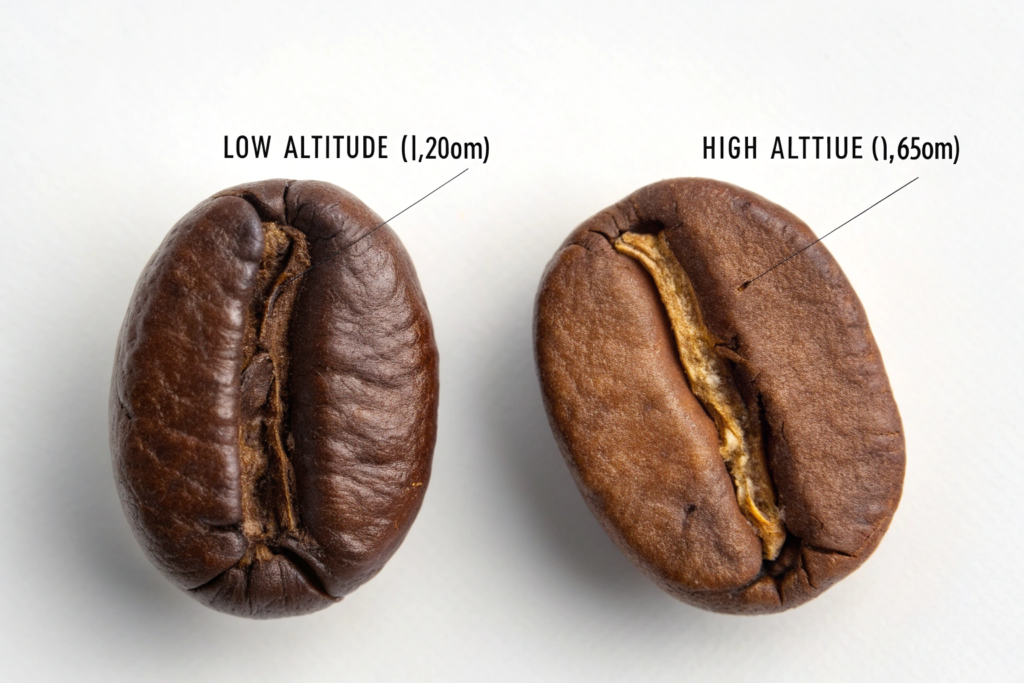
The Solution: Use a higher charge temperature. For our Yunnan SHB lots, we often recommend a charge temperature 10-15°C (20-30°F) higher than you would use for a medium-density Central American coffee. This provides the "thermal shock" needed to drive heat into the core of the dense bean quickly. The drum temperature still crashes, but it recovers faster, and the bean is properly energized for the Maillard phase.
At Shanghai Fumao, we include the measured bean density on every lot's Specification Sheet. We want you to have this data so you can make this critical adjustment before you waste a batch. For more on roast profile development, Roast Magazine is an essential resource for technical articles.
How Does Density Influence the Timing and Audibility of First Crack?
First crack is the moment when the bean's internal water vapor pressure overcomes the structural strength of the cell walls. The bean physically fractures and expands. Density directly affects this event.
- Low-Density Beans: The cell structure is weaker. Water escapes easily. First crack tends to be early, loud, and vigorous. It sounds like popcorn popping.
- High-Density Beans: The cell structure is thick and strong. It takes more energy and a higher internal pressure to fracture. First crack tends to be later, quieter, and more muffled. It can sound more like tearing paper or snapping twigs than a sharp pop. It is also less uniform; you might hear individual cracks spread out over a longer time period.
The Roaster's Trap:
An inexperienced roaster might wait for a loud, rolling first crack that never comes. They keep applying heat, waiting. Meanwhile, the bean is getting hotter and hotter. By the time they realize first crack has already started (quietly), they have overshot their target and are heading into second crack. The coffee is over-roasted and ashy.
The Solution: Do not rely on sound alone. Watch your Rate of Rise (RoR) and your bean temperature. You should see the RoR dip as the bean absorbs energy for the phase change, even if the cracks are quiet. Use all your senses and your data.
Knowing the bean is "Very High Density" prepares you for a subtle, quiet first crack. It helps you stay calm and trust your instruments.
How Can Roasters Use Density Data to Predict Roast Color and Development?
Density is not just about the first part of the roast. It has implications all the way through to the final color and development time. It is a predictive variable.
Roasters can use density data to predict that a very dense bean will require a longer overall roast time and a slightly longer development time ratio (DTR) to achieve the same visual roast color compared to a less dense bean, as the compact cellular structure scatters light differently and develops color more slowly.
A dense bean at an Agtron 55 will have undergone more actual chemical development than a soft bean at Agtron 55. The color meter does not tell the whole story.
Does a Denser Bean Require a Longer Development Time Ratio (DTR)?
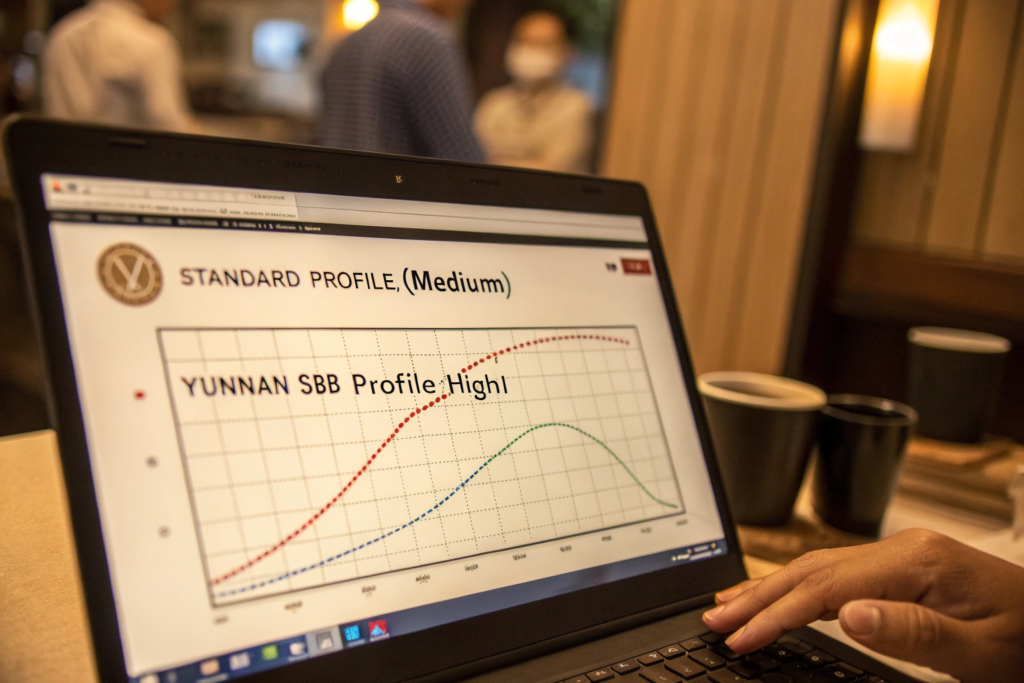
Development Time Ratio (DTR) is the time from the start of first crack to the end of the roast, expressed as a percentage of the total roast time. A standard target for many roasters is 20-25% DTR.
The Density Effect on DTR:
For a very dense bean, you might need to push the DTR slightly higher—say 22-26% —to achieve the same level of soluble development and sweetness as a softer bean at 20% DTR.
Why?
The dense cellular structure takes longer to fully break down and caramelize the internal sugars. If you drop a dense bean too soon after first crack (a short DTR), the center of the bean will be underdeveloped. It will taste grassy, sour, and vegetal.
The Practical Advice:
Do not be afraid of a slightly longer roast time and a slightly higher DTR with our high-density Yunnan lots. They can take the heat. They need the time to fully express their sweetness. Rushing a dense bean is the fastest way to ruin it.
This is why our Custom Blends Program allows us to match the density of the components in your blend. We can select lots that have similar density profiles, ensuring they roast evenly together and reach their peak development at the same time.
Why Is the Agtron Number Not the Whole Story with Dense Beans?
The Agtron meter measures the reflectance of the roasted coffee. It tells you the color. But color is only a surface-level measurement. It does not tell you what happened inside the bean.
The Scenario:
You roast a dense Yunnan bean and a softer Colombian bean. You stop both roasts when they reach an Agtron Ground 55. They look the same.
The Reality:
The dense Yunnan bean likely had to be roasted longer and with more energy to reach that color. Its internal bean temperature reached a higher peak. It underwent more caramelization and Maillard reactions. The softer Colombian bean reached Agtron 55 more quickly and with less internal development.
The Taste Difference:
The Colombian might taste bright, acidic, and slightly underdeveloped. The Yunnan might taste sweeter, heavier, and more fully developed, even though the color is identical.
This is a critical insight. You cannot roast by color alone. You must calibrate your roast profiles based on the whole bean experience—the combination of time, temperature, and color. Density data helps you understand why a 55 Agtron Yunnan tastes different from a 55 Agtron Colombian. It is a guide to the bean's inner life.
Conclusion
Bean density testing is not an academic exercise for coffee scientists. It is a practical, essential tool for any roaster who wants to consistently produce delicious coffee from high-altitude origins like Yunnan. It is the Rosetta Stone that translates the physical properties of the green bean into the language of the roast curve.
By understanding that high altitude and a sharp diurnal shift create an exceptionally dense, sugar-rich bean, you can anticipate its behavior in the roaster. You can adjust your charge temperature to overcome its thermal inertia. You can listen for its quiet first crack with patience. And you can give it the time and heat it needs to fully develop its deep, sweet, and complex flavor potential.
At BeanofCoffee, we provide the density data because we want you to succeed. We want our coffee to taste as good in your roastery as it does in our cupping lab.
If you want to receive a sample of our high-density Baoshan Arabica along with its full physical specification sheet, we can arrange that. Email Cathy Cai. Ask for a "High-Density Sample Pack" with the lot data. Contact Cathy at: cathy@beanofcoffee.com