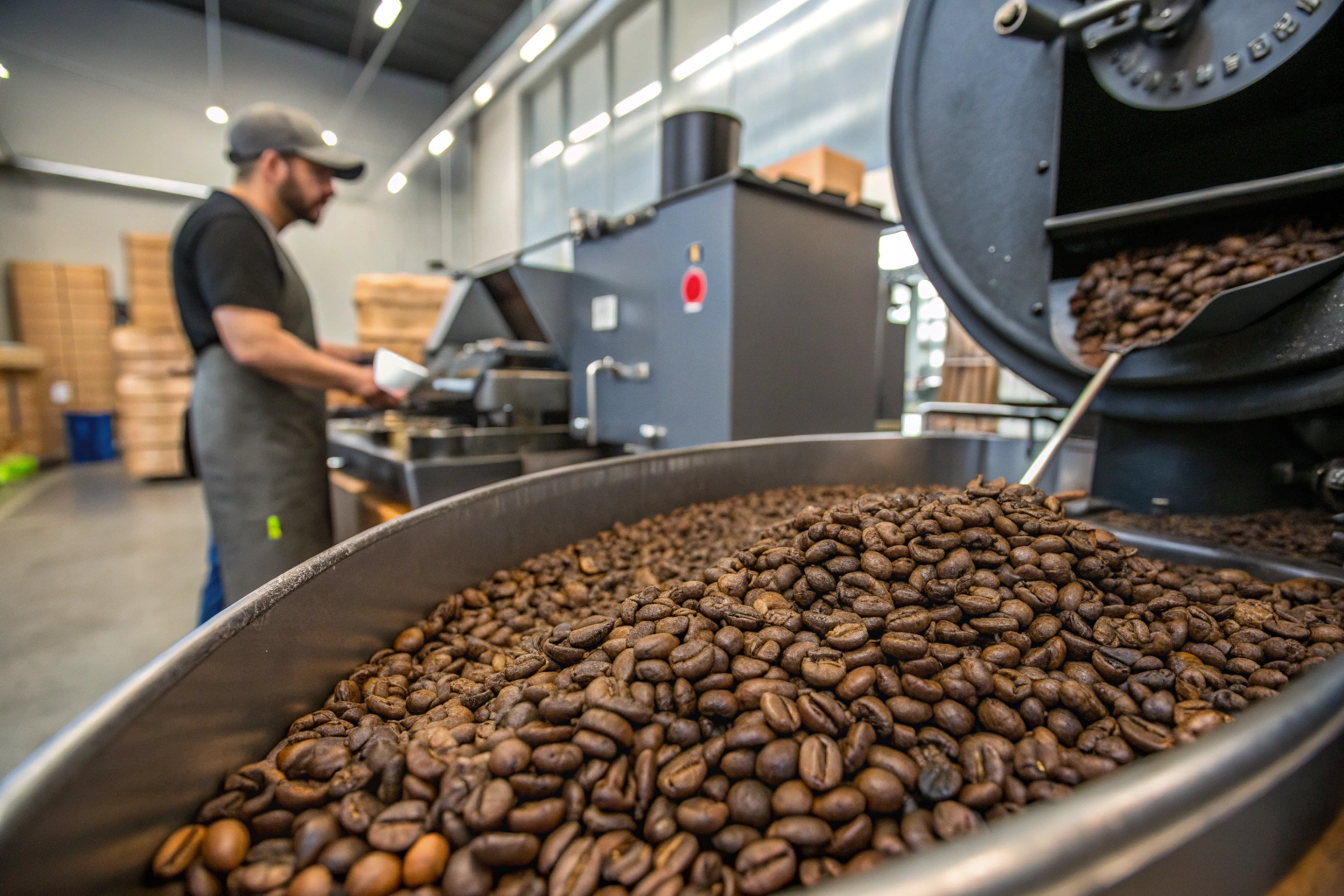
You have a roast profile that works. It is dialed in. The coffee comes out perfect, batch after batch. Then you get a new shipment. Same origin. Same process. Same supplier. But the roast is off. The beans are uneven. Some are scorched. Some are underdeveloped. You check your roaster. It is fine. You check your profile. It is unchanged. You check the beans. They are a different size. This is the hidden variable. Screen size. It is the silent saboteur of many a good roast. I have seen this happen to my clients. It is why I obsess over screen size consistency in my export lots.
Screen size is critical for your roast profile because it determines how heat penetrates the bean. Uniformly sized beans roast evenly. Mixed sizes roast unevenly, with the small beans scorching while the large beans remain underdeveloped. At BeanofCoffee, I sort my export lots to a precise screen size, ensuring that your roast profile behaves the same way, batch after batch.
The roast profile is a recipe. The screen size is an ingredient. If the ingredient changes, the recipe fails. Let me explain the physics and the practical implications.
Why Does Bean Size Have a Direct Impact on Heat Transfer?
The roaster works by transferring heat to the bean. This is a physical process. The rate of heat transfer depends on the surface area of the bean and its mass. A small bean has a different ratio than a large bean. This ratio determines how fast the bean roasts.
Heat transfer is a function of surface area to volume ratio. A small bean has more surface area relative to its volume, so it absorbs heat faster. A large bean has less surface area relative to its volume, so it absorbs heat slower. At BeanofCoffee, I understand this physics. That is why I screen my beans. It is not about aesthetics. It is about giving you a predictable roasting experience.
The physics is simple. A pebble heats up faster than a boulder. The same principle applies in the roaster. A screen 15 bean will reach first crack faster than a screen 18 bean.
What Happens When You Roast a Mix of Screen 15 and Screen 18 Beans?
Imagine a drum full of beans. Half are small, screen 15. Half are large, screen 18. The heat comes on. The small beans start to absorb heat quickly. Their internal temperature rises fast. The large beans lag behind. After five minutes, the small beans are turning yellow, while the large beans are still green. After eight minutes, the small beans are approaching first crack. The large beans are just starting to brown. You have a problem. If you stop the roast when the small beans are perfect, the large beans will be underdeveloped, grassy, and sour. If you wait for the large beans to develop, the small beans will be scorched, bitter, and ashy. The result is a compromise. A muddled, uneven roast. This is the cost of mixed screen sizes.
How Does Uneven Roasting Translate to an Inconsistent Cup?
The uneven roast translates directly to an uneven cup. The underdeveloped beans contribute sour, vegetal, and astringent notes. The overdeveloped beans contribute bitter, smoky, and carbonized notes. The desired sweet spot, the caramelized sugars and the balanced acidity, is lost in the noise. The cup is not clean. It is confusing. It lacks the clarity that defines a quality specialty coffee. Your customer might not know why they do not like it. They just know it is not good. And they will not buy it again. The screen size is not a minor detail. It is a fundamental determinant of cup quality.
How Do Professional Mills Achieve Screen Size Uniformity?
Screen size uniformity does not happen by accident. It is the result of a deliberate, multi-step process. It starts with the raw harvest and continues through the dry milling. It is a combination of machinery and human oversight.
Professional mills achieve screen size uniformity by passing the green coffee through a series of perforated screens. These screens separate the beans by size. The final lot is a specific screen size, like 17/18. At BeanofCoffee, my dry mill uses a modern, calibrated screening system. It is the foundation of the consistency I offer my clients.
The process is simple in principle, but it requires precision in execution. The screens must be clean. The calibration must be accurate. The process must be monitored.
What Machinery Is Used to Separate Beans by Size?
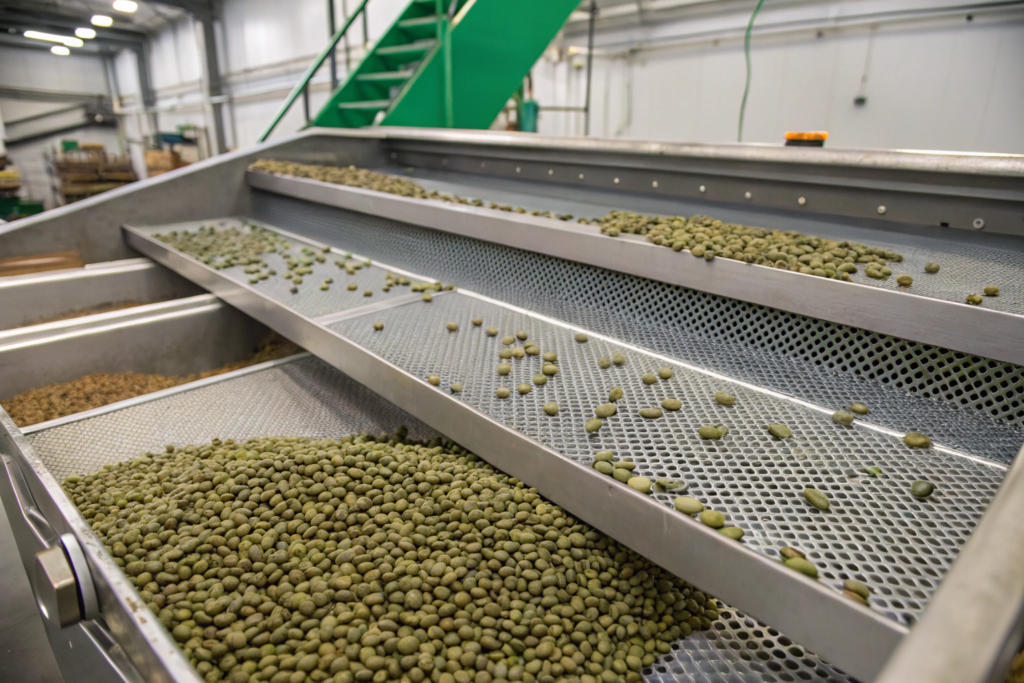
The key machine is the screen grader. It is a large, vibrating machine with multiple decks. Each deck is a metal sheet with precisely sized holes. The beans are fed into the top. The vibration moves them across the screens. Beans that are larger than the holes stay on top. Beans that are smaller fall through to the next deck. This separates the beans into different size fractions. The holes are measured in 1/64ths of an inch. A screen size 17 hole is 17/64ths of an inch. A screen size 18 hole is 18/64ths. The machine is not new technology, but it is effective. The key is the maintenance and the calibration. A poorly maintained screen grader will produce inconsistent results.
How Does Hand Sorting Complement Mechanical Screening?
Mechanical screening is efficient, but it is not perfect. It cannot remove every single defective bean. It cannot distinguish between a good bean and a bean of the same size that is black, sour, or broken. This is where hand sorting comes in. After the mechanical screening, a team of trained workers inspects the beans on a conveyor belt. They remove the visual defects. This is a labor-intensive process, but it is essential for producing a truly premium lot. The combination of mechanical screening and hand sorting is the gold standard. It is what we do at BeanofCoffee. It is why our lots are clean, uniform, and consistent. It is an investment in quality that you can taste in the cup.
How to Adjust Your Roast Profile for Different Screen Sizes?
You will encounter different screen sizes. A dense, high-altitude lot might be screen 16. A large-bean variety might be screen 18. You need to know how to adjust your roast profile accordingly. You cannot use the same profile for a screen 16 and a screen 18.
Smaller beans require a gentler roast. They absorb heat quickly and can easily scorch. You should start with a lower charge temperature and reduce the heat early in the roast. Larger beans require more aggressive heat. They absorb heat slowly and need a push to develop properly. At BeanofCoffee, I provide my clients with roast profile suggestions for each of my screen sizes.
The roast profile is not a fixed document. It is a living tool that you adjust based on the characteristics of the bean.
Why Do Smaller Beans Need a Lower Charge Temperature?
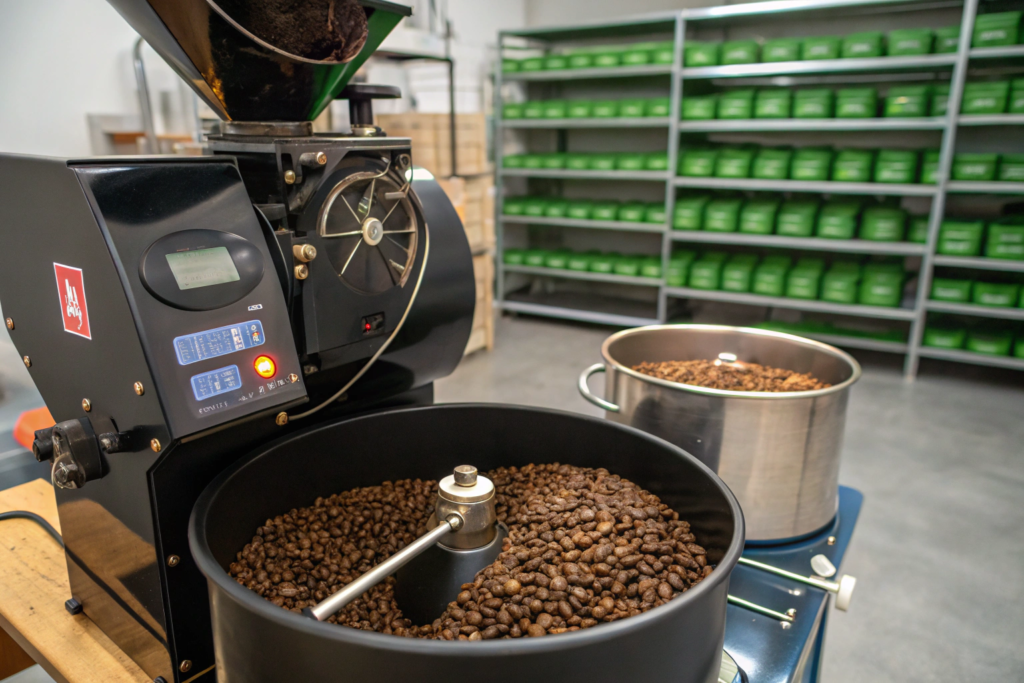
The charge temperature is the temperature of the roaster when you drop the beans in. A smaller bean has less mass. It reaches the roaster temperature faster. If you drop a batch of screen 15 beans into a roaster that is charged for screen 18 beans, the initial heat shock will be too intense. The outside of the bean will scorch before the inside has a chance to develop. The fix is to lower the charge temperature. This gives the smaller beans a gentler start. It allows the heat to penetrate more slowly and evenly. The result is a more controlled, even roast.
How Should You Adjust Development Time for Larger Beans?
Larger beans need more time to develop. The development phase is the period after first crack, when the sugars caramelize and the flavors deepen. A large bean has more mass. It takes longer for the heat to penetrate to the center of the bean. If you stop the roast too early, the center will be underdeveloped, even if the outside looks done. The fix is to extend the development time. This gives the heat time to reach the core. The result is a fully developed, balanced cup. The larger bean rewards patience.
How to Specify Screen Size in Your Purchase Contract?
Screen size is not just a technical detail. It is a commercial term. It should be specified in your purchase contract. This protects you. If the coffee arrives and it is not the specified screen size, you have a basis for a claim.
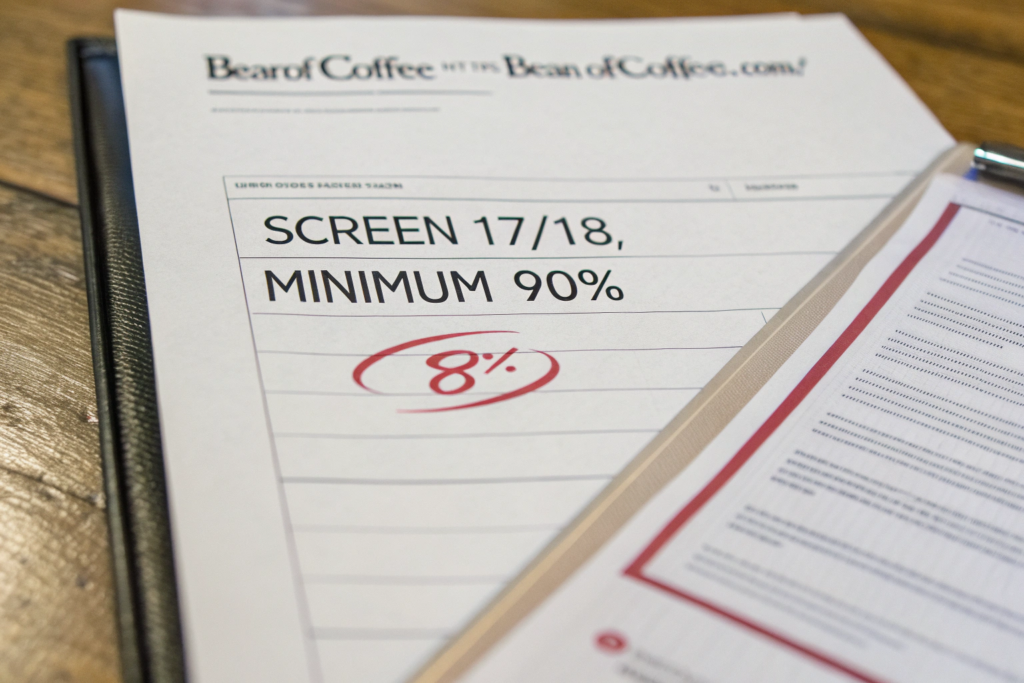
You should specify the screen size in your purchase contract. The standard language is "Screen 17/18, minimum 90%." This means that at least 90% of the beans must be in the 17/18 size range. At BeanofCoffee, I encourage my clients to include this specification. It is a guarantee of the physical consistency of the lot.
The contract is your shield. It turns a verbal agreement into a measurable, enforceable standard.
What Does "Screen 17/18, Minimum 90%" Mean in Practice?
This is a precise specification. It means that when the coffee is tested with a set of standard screens, at least 90% of the beans must sit on the 17 and 18 screens. The remaining 10% can be slightly smaller or slightly larger, but the vast majority must be uniform. This is a high standard. It is the standard I apply to my premium export lots. When you see this specification in a contract, you know what you are getting. You are getting a lot that has been carefully sorted for size uniformity. You are getting a lot that will roast predictably.
How to Verify Screen Size Upon Arrival?
You do not have to take the supplier's word for it. You can verify the screen size yourself. You need a set of standard coffee screens. They are not expensive. You take a representative sample of the coffee, weigh it, and pass it through the screens. You then weigh the beans that remain on each screen. This gives you the percentage of each screen size. If the coffee is supposed to be 90% screen 17/18, and your test shows only 70%, you have a discrepancy. You can then contact the supplier and present your evidence. A professional supplier will address the issue. This is a simple, objective test. It is a tool for protecting your quality standards.
Conclusion
Screen size is not an arcane detail for coffee nerds. It is a fundamental factor that determines the success of your roast and the quality of your cup. The physics of heat transfer is unforgiving. Mixed bean sizes will always produce an uneven roast. The solution is to buy from a supplier who sorts for screen size uniformity. The solution is to specify screen size in your contract. The solution is to verify screen size upon arrival. When you do all of these things, you take control of a critical variable. You ensure that your roast profile performs as intended, batch after batch. You ensure that your customers get the same great cup, every time. This is the foundation of a consistent brand. It is built on the simple, measurable, and critical variable of screen size.
Take control of your roast. Contact me, Cathy Cai, at cathy@beanofcoffee.com. I will send you the screen size analysis for our current lots, along with samples. I will show you the data that proves our commitment to uniformity. Let's build a supply relationship that gives you the predictability you need to roast with confidence. Your roast profile deserves a bean that matches its needs. Let's find it together.