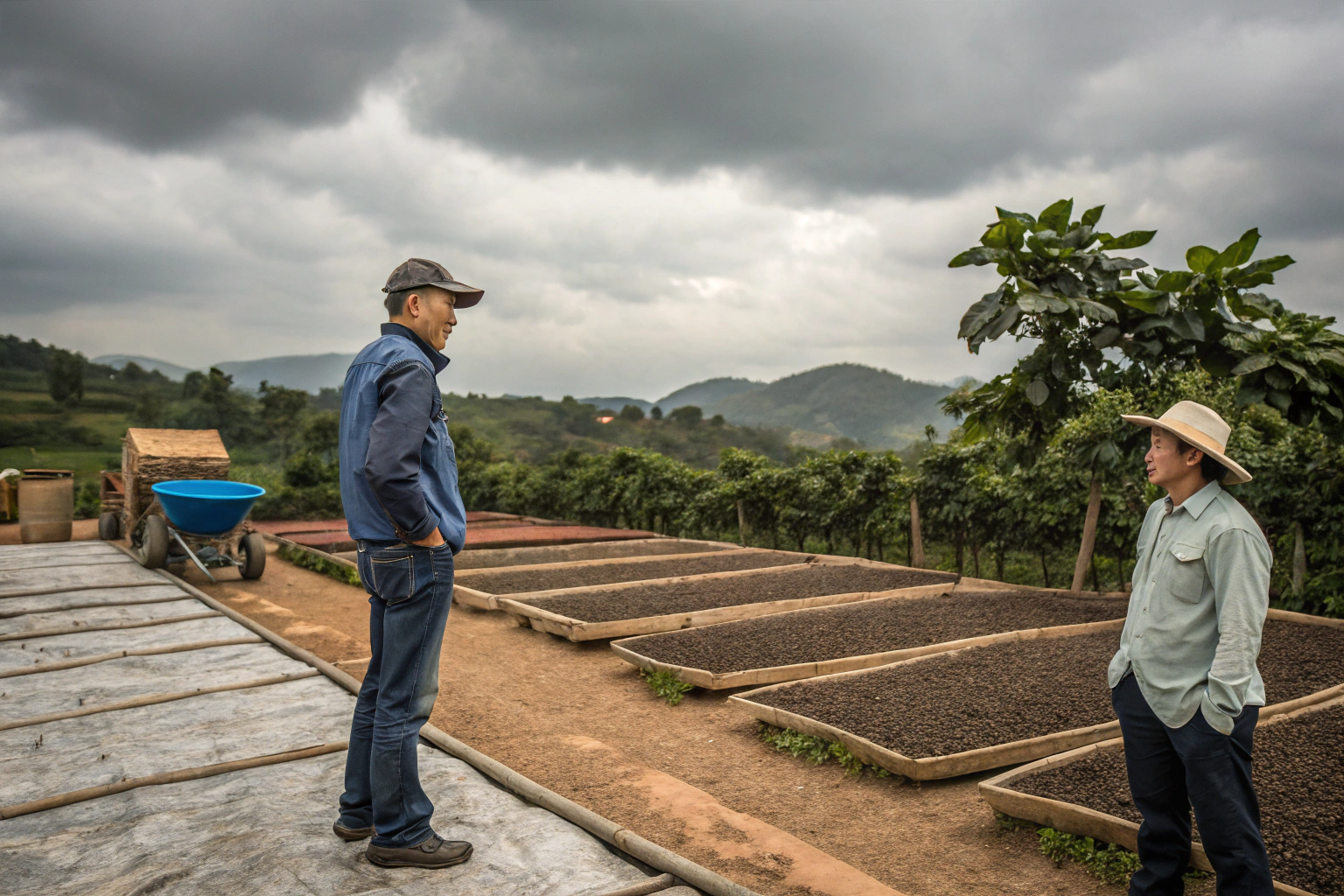
Ten years ago, a European coffee buyer visiting our farm in Baoshan was a rare event. I'd see one, maybe two, a year, usually from a large trading company. They'd cup a few samples, ask about the FOB price, and leave. The conversation was always about the numbers on a sheet. Last year, I hosted eleven different European roasters, and only two of them opened the conversation with a price negotiation. The others started with questions about our fermentation protocols, the varietal separation in our drying beds, and whether we could commit to a fully traceable single-farm lot for their microlot program. Something fundamental has shifted in the European coffee market. The focus has moved from buying a commodity to investing in a specific piece of land and the people who farm it.
More European roasters seek direct farm partnerships because a combination of strict EU due diligence regulations, an intensely competitive specialty market demanding unique traceable stories, and the escalating unreliability of traditional commodity supply chains has made a transparent, single-farm relationship the most effective way to guarantee quality, secure long-term supply, and meet new legal compliance standards. It's no longer a romantic marketing choice. It's becoming a hard business requirement. A European roaster who can't name the specific farm and prove the farming practices behind their single-origin bag is starting to look outdated and, in some jurisdictions, potentially non-compliant. For a farm like ours, with 10,000 acres of controlled production in Yunnan, this shift is the defining opportunity of the decade.
I want to walk you through why this is happening now, from the perspective of the farm receiving these visits. The shift isn't just about the coffee in the cup. It's about a new law in Brussels that's sending ripples through Yunnan. It's about the collapse of trust in anonymous bulk containers. And it's about a pricing model that finally makes a long-term partnership more profitable for both the roaster and the farmer than a series of cheap spot buys. Let's start with the single biggest driver, a piece of legislation that's fundamentally redrawing the map of who can sell coffee into Europe.
How Do EU Deforestation Rules Impact Coffee Sourcing From China?
The EUDR—the European Union Deforestation Regulation—is not a future problem. It's the new reality, and it arrived with a lot of confusion and quiet panic among coffee exporters. The core demand is shockingly simple to state and incredibly complex to execute. Starting December 30, 2024, for large operators, any coffee entering the European market must be accompanied by a due diligence statement proving, with geolocation data, that the land where the coffee was grown was not deforested after December 31, 2020. It sounds reasonable. But for a commodity supply chain where beans from a hundred small farms are routinely blended at a dry mill, the traceability requirement is a logistical earthquake. You can't just provide a country-level assurance. You need the GPS polygon of the specific plot.
The EU Deforestation Regulation directly impacts coffee sourcing from China by making traditional, anonymous, blended supply chains legally non-compliant, thereby giving a massive competitive advantage to farms and exporters that can provide the precise geolocation polygons and full chain-of-custody documentation required for a clean due diligence statement. For a large, consolidated farm like ours in Baoshan, this is a challenge we can meet. We control the land. We have the digital maps. We've been working with satellite monitoring for three years to map every single one of our plots. For a smallholder aggregator, this regulation is an existential threat. For a European roaster, buying from a single verified source isn't just a quality decision anymore; it's a legal risk management decision.
This regulation is the heavy hand of law pushing the market exactly where the specialty coffee movement has been trying to go for years: toward absolute transparency. But the law isn't just a vague principle. It comes with a specific data requirement that forces farmers to digitize their land records.
What Geolocation Data Must a Yunnan Farm Provide for EUDR Compliance?
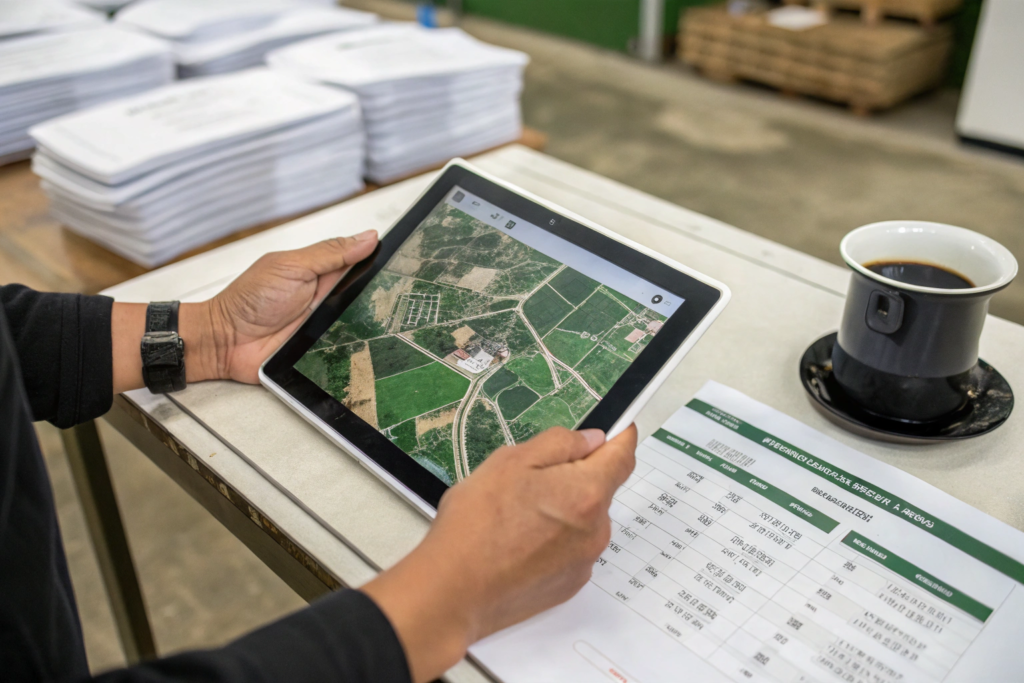
The regulation is brutally specific. You can't just provide an address or a village name. We must provide geolocation coordinates that map the precise perimeter of the land where the coffee was grown. For a farm our size, this means a digital polygon file for every single production block. The data must include the latitude and longitude of at least six points defining the boundary of the plot. If the plot is under 4 hectares, a single GPS point might suffice, but for a 10,000-acre farm, it's a mosaic of hundreds of polygons.
We invested in a mapping team two years ago. They walked every boundary with high-precision GPS units. We then overlaid this data with satellite imagery from 2020 to prove our land was already planted with coffee before the cut-off date. This data package—the polygon map, the satellite time-slice, the harvest date—is what now accompanies the traditional export documents. The electronic submission of this data aligns with the traceability systems being developed under the EUDR due diligence framework. It's a complete digital twin of the physical coffee, and without it, the coffee literally cannot cross the European border.
Can a Direct Farm Partnership Simplify the Due Diligence Statement?
This is the exact question a smart European roaster should be asking. If you buy from a multi-tiered supply chain—a local collector, a regional trader, an exporter, an importer—the due diligence statement is a headache. Every intermediary must pass along the geolocation data, and each one must verify that the coffee wasn't mixed with non-compliant beans at any stage. The risk of a broken data chain is high. The legal liability is shared. It's a mess.
A direct farm partnership collapses this chain. There is one point of origin: our farm. There is one data provider: us. The roaster or the importer deals directly with the source. This makes the due diligence statement drastically simpler and legally cleaner. The entire supply chain is transparent and auditable in a single step. This simplification is a powerful, hard-edged business argument for direct trade. It transforms the due diligence process from a nightmare of fragmented data into a clean submission of a single, verified geolocation data package. A direct relationship isn't just a warm, fuzzy feeling; it's a legally efficient structure.
That legal efficiency protects the roaster from fines. But the European market isn't just demanding legal compliance. It's demanding a product that stands out, a coffee with a face and a name. The legal push is forcing a transparency that the marketing side has been craving. The next wave of demand is purely about what's in the bag and the story that makes it sell for a premium.
What Single-Origin Profiles Do Yunnan Catimor Lots Offer?
For a long time, "Yunnan Catimor" was a dirty word in European specialty coffee. It was the cheap, filler bean. The flavor profile was described as "earthy," "woody," and "flat." Honestly, some of it was. Years ago, much of the Catimor in Yunnan was processed with poor post-harvest handling. The varietal itself was blamed. But the plant isn't the problem. The processing is. Over the last seven years, we've been running silent, obsessive experiments on our Catimor lots. Extended anaerobic fermentations. Slow-dried honey processes. Single-varietal microlots separated by a single hillside's altitude band. The results have been so dramatic that a specialty coffee judge from Berlin told me last year, blind cupping one of our lots, that he thought he was tasting a washed Ethiopian heirloom. He was genuinely shocked.
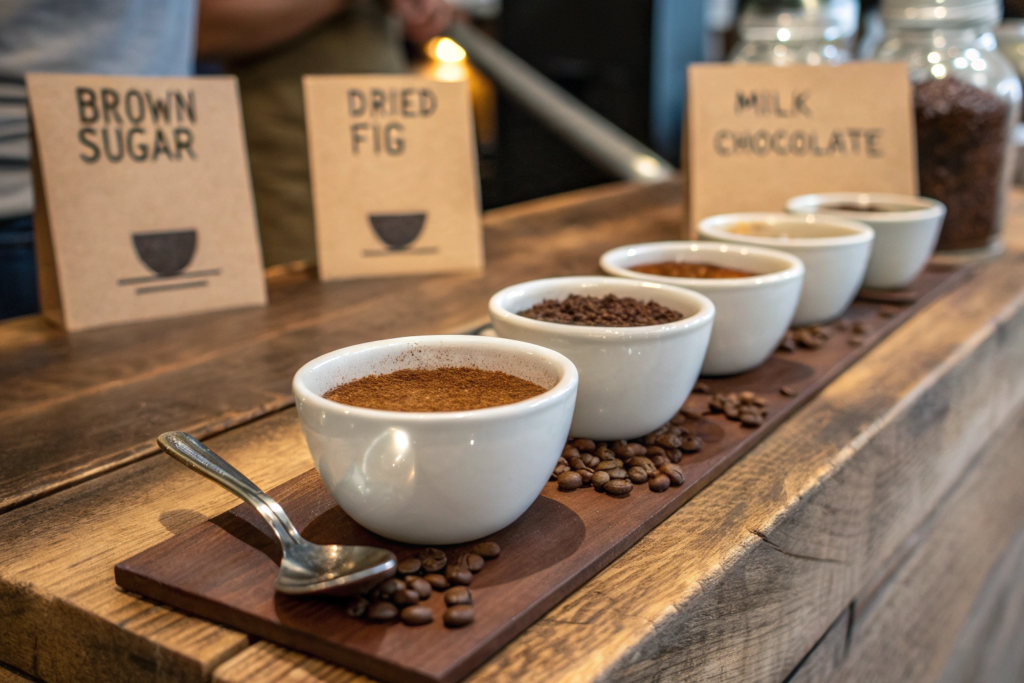
Yunnan Catimor single-origin lots now offer a surprisingly broad and complex flavor spectrum—from intensely fruity and winey profiles in experimental anaerobic ferments to clean, brown-sugar-sweet, and nutty profiles in carefully washed lots—giving European roasters a unique origin story and a high-margin alternative to saturated African and South American offerings. The key is the processing control and the altitude. Our high-altitude blocks, above 1,400 meters, produce a much denser bean with a brighter, more complex acidity than the lower-altitude bulk lots. The varietal, when treated with precision, yields a heavy, syrupy body that makes it a dream for espresso blends and single-origin espressos.
A European roaster isn't just buying a generic "China" coffee anymore. They're coming to us for a specific lot profile, a specific fermentation style. Let's look at one experimental method that's been generating the most buzz and the highest cup scores.
How Does Extended Anaerobic Fermentation Change the Cup Score?
Traditional washed Catimor is clean but can be one-dimensional. We started playing with extended anaerobic fermentation about four years ago, just a few small sealed tanks as a trial. The results were staggering. The process involves sealing the pulped cherries in airtight stainless steel tanks with a one-way valve. The coffee sits in its own mucilage, with no oxygen, for 72 to 96 hours. The temperature is carefully controlled. Inside that tank, a different set of microbial reactions happens compared to open-air fermentation.
The impact on the cup is a total transformation. The "woody" note disappears completely. It's replaced by an intense, jammy fruitiness—think ripe strawberry, passion fruit, and sometimes a distinct note of dark rum. The body becomes even heavier and creamier. This isn't a subtle tweak. It's a 3 to 4 point jump on the SCA cupping scale. A standard 82-point washed Catimor becomes an 85 to 86-point anaerobic lot that a roaster can confidently sell as a premium micro-lot. The science of anaerobic coffee processing is still being documented, but our practical results are undeniable. This is what creates the exclusive lot that a direct-trade roaster can't find on the open commodity market.
Why Is Single-Varietal Separation Critical for a Micro-Lot Program?
A common practice on many farms is to plant mixed varietals in the same block. Catimor next to Typica next to Bourbon. They get harvested together, creating a jumbled, muddy flavor profile. You can't taste the distinct character of anything. For a European roaster seeking a clean, definable product, this is a non-starter. Single-varietal separation is the first, most basic step of a genuine micro-lot program.
On our farm, specific hillsides are planted exclusively with a single Catimor strain. They are harvested on separate days. They are processed, dried, and stored in separate, labeled lots. This allows a roaster to cup five different Catimor lots from five different altitude bands and choose the exact profile that fits their brand. This level of granular selection is the foundation of a direct-trade premium. It's a practical commitment that not every farm makes, because it's logistically more expensive. But it's the only way to produce a coffee with a distinct and repeatable identity, a true single-origin coffee that tells a specific story of a specific place.
That specific story, that unique and traceable product, commands a higher price. And the financial structure that supports this higher price is radically different from the anonymous commodity market. The money flows differently in a direct partnership. It bypasses the layers that take a cut and rewards the specific investments we make on the farm.
Can Direct Trade Stabilize Green Coffee Prices for EU Buyers?
The C-market price is a brutal, volatile mechanism. It's not designed to protect a farmer's cost of production, and it's not designed to give a roaster a predictable cost of goods. It's a global betting pool. I've seen the Arabica price swing by 30% in a single month because of a frost scare in Brazil, an event that had absolutely nothing to do with our production costs in Yunnan. For a European roaster trying to build a brand with a stable retail price, this volatility is poison. You can't print a wholesale menu if your green coffee cost might jump 15% before the next shipment. This is the financial chaos that a direct trade fixed-price contract is designed to solve.
Direct trade stabilizes green coffee prices for EU buyers by replacing the volatile, speculation-driven C-market benchmark with a negotiated, fixed-season contract price that reflects the farm's actual cost of production plus a mutually agreed margin, completely insulating both the farmer and the roaster from speculative commodity price spikes. It's a complete departure from the "price + differential" model. When a European roaster signs a twelve-month fixed-price contract with us, that price is based on a spreadsheet of our real costs: labor, fertilizer, processing, certification. It's a transparent calculation. The price doesn't move if the C-market spikes. It doesn't move if the C-market crashes. It's a stable number that allows the roaster to set their own retail price with confidence for an entire year. This is the financial bedrock of a genuine, long-term partnership.
This stability is the single most valuable thing we offer a partner. It transforms green coffee from a speculative gamble into a predictable budget line. Let's break down exactly how this contract structure removes the "differential" gamble that many roasters don't even realize they're taking.
How Does a Direct Fixed-Price Contract Remove the C-Market Risk?
In a typical specialty contract, you pay "C-price + a quality differential." The differential is the fixed premium for the quality, say 40 cents per pound. The problem is the C-price itself. If the C-price was $1.20 when you signed, and it spikes to $1.90 three months later, your price just jumped by 70 cents. The differential didn't change. You're paying the same quality premium, but the base commodity cost exploded. This is the risk a roaster carries in a traditional model.
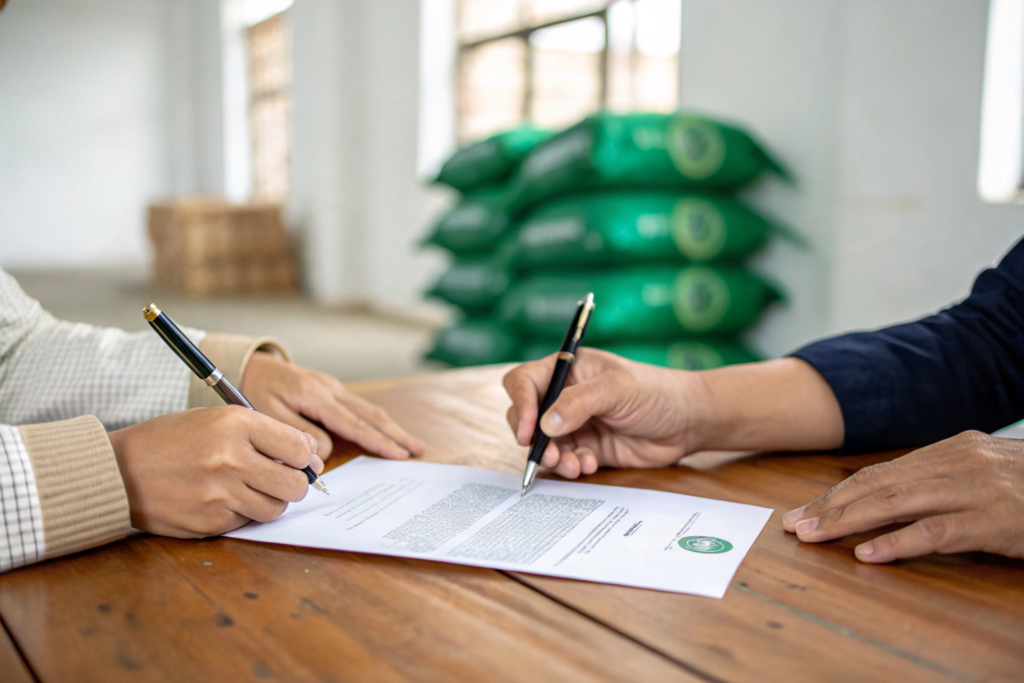
A direct fixed-price contract removes the C-market variable entirely. The price is a single, hard number. We agree on $4.20 per kilo. That's it. It doesn't matter what the C-market does. This means the roaster has a fixed cost of goods sold for the life of the contract. They can plan their marketing, their margins, and their growth without a financial surprise lurking around the corner. This is a legitimate hedging strategy for the roaster, using the farm relationship itself as the hedge instrument, rather than complex and costly financial derivatives on the commodity exchange.
Can a Long-Term Farm Agreement Offer Better Payment Terms and Security?
Beyond the price itself, a direct partnership also stabilizes the flow of the product and the payment. A European roaster who commits to a seasonal volume often receives priority allocation. When a specific microlot is harvested and only 50 bags exist, the direct partner gets the first call, not the spot buyer. This security of supply is a huge competitive advantage. The coffee is guaranteed. The volume is reserved.
In return, we often negotiate better, simpler payment terms. A confirmed, irrevocable Letter of Credit at sight is standard for first-time transactions. But a trusted, multi-year partner can move to a cleaner, faster open account system or a documentary collection, which reduces bank fees and speeds up the document flow. This mutual financial trust, built over years, lowers transaction costs for both sides. It's a level of supply chain finance efficiency that a transactional spot-buying relationship can never achieve.
This financial partnership—the fixed price, the priority allocation, the streamlined payments—builds a deep economic connection. But underneath all the contracts and the numbers, there's a more fundamental human shift happening. The European roasters who visit us aren't just negotiating a deal. They're coming to look at the trees, to meet the pickers, to confirm with their own eyes that the story on their coffee bag is true. This shift from remote certification to personal verification is the deepest, most irreversible trend I see.
Why Do European Roasters Visit Yunnan Farms Before Signing a Contract?
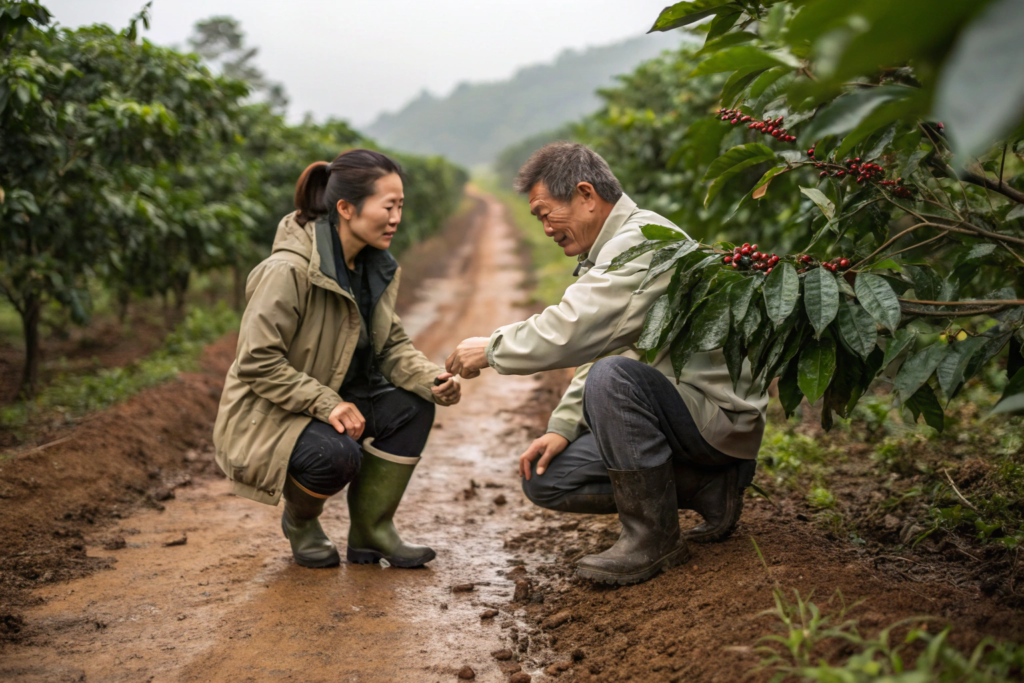
A contract signed over email is a legal document. A contract signed after three days of walking the farm together is a relationship. The difference is everything. I can send a hundred photos of our processing station. I can send a dozen cupping reports from an independent lab. But none of it has the same weight as a European roaster kneeling in our drying beds, picking up a handful of parchment, and feeling the moisture level with their own fingers. This physical visit changes the power dynamic. It moves the conversation from "I hope this supplier is honest" to "I know exactly what this farm is about." The visit makes the coffee real in a way that a PDF can never achieve.
European roasters visit Yunnan farms before signing a contract to personally verify the farming and processing standards that will underpin their brand story, to build an authentic human connection that makes the supply relationship more resilient during market disruptions, and to co-create specific processing profiles that can only be developed through face-to-face collaboration with the farmer. This isn't a coffee tourism trip. It's a high-level due diligence audit combined with a product development workshop. The roaster returns to Berlin or Copenhagen not just with photos, but with a co-owned story and a custom lot that no competitor has access to.
The visit is the ultimate transparency tool. It answers the questions that a certification can't fully capture. Are the seasonal workers living in decent conditions? Is the fermentation process genuinely as clean as the report states? The roaster becomes an eyewitness. This co-creation of a lot profile is the single most valuable outcome of these visits. Let's look at what it actually looks like when a roaster and a farmer design a coffee together.
How Does an On-Farm Visit Build a Co-Branded Micro-Lot Story?
This is the magic that happens on the cupping table during a visit. The roaster tastes through twelve different experimental lots. They pause on one. "This anaerobic one has amazing strawberry notes, but the body is a little thin. Can you try extending the drying time by two days on the next harvest?" That's a product design conversation happening in real-time, right next to the drying beds where the change will be implemented. I've had roasters walk into our fermentation room, smell the tanks, and suggest we adjust the temperature by a single degree for the next batch.
This collaboration creates a coffee that is genuinely co-owned. The roaster isn't just buying a bag. They helped design the product. They were part of the process. This creates an incredibly powerful, authentic story for their customers. "I worked with Farmer Li to tweak the fermentation on this lot." That's not marketing fluff. It's a documented, truthful account. This depth of sustainable sourcing narrative is the gold standard for a premium European specialty brand. It makes the coffee un-copyable.
What Social Compliance Details Are Verified In Person?
A Fair Trade or Rainforest Alliance certificate provides a paper audit. But a personal visit verifies the human reality behind the paper. A roaster can see the worker dormitories with their own eyes. They can talk to the seasonal pickers in private, without a manager present, and ask if they're being paid on time and fairly. They can check if the safety equipment listed in the audit report is actually being used on the processing floor, or if it's just hanging on a wall for show.
This direct verification carries a moral weight that a third-party audit cannot match. The roaster becomes personally accountable for the claims on their bag. They've seen the conditions. They've shaken the hands of the people doing the work. This direct, personal validation is the ultimate form of supply chain security. It protects the roaster's brand from the reputational risk of hidden labor abuses. It's the final, irreplaceable step in a genuine direct-trade partnership, moving far beyond the basic check of a social compliance audit. It becomes a personal bond, a promise made face-to-face. This is why the roasters who visit once almost always come back. The relationship is no longer just about the coffee.
Conclusion
The European shift toward direct farm partnerships is the most significant structural change I've witnessed in 15 years of exporting Chinese coffee. It's not a passing trend. It's a convergence of three powerful forces. First, the law—the EUDR—now demands a level of geolocation traceability that only a direct, single-farm supply chain can provide with true efficiency. Second, the market—European specialty consumers—craves a unique flavor profile and an authentic, un-copyable story, the exact combination that a co-developed Yunnan Catimor microlot delivers. And third, the economics—a fixed-price direct contract—offers both the roaster and the farmer a stable, predictable financial future that the chaotic C-market can never provide.
At BeanofCoffee, this is the model we're building every day. We're not a passive supplier shipping anonymous containers. We're a farm that's ready with the geolocation polygons for your EUDR filing, the experimental fermentation logs for your microlot selection, and a guest room with a view of the drying beds for your next visit. We've done the hard work of making our 10,000 acres in Baoshan not just productive, but transparent, traceable, and ready for a true partnership. If you're a European roaster considering a direct sourcing trip to Yunnan, or if you just want to explore the specific profiles and fixed-price structures we can offer, my export partner Cathy Cai is the person to connect with. She can provide sample roasts, EUDR data sheets, and a season's harvest schedule. Reach her directly at cathy@beanofcoffee.com. Let's start a conversation that goes deeper than an FOB price.