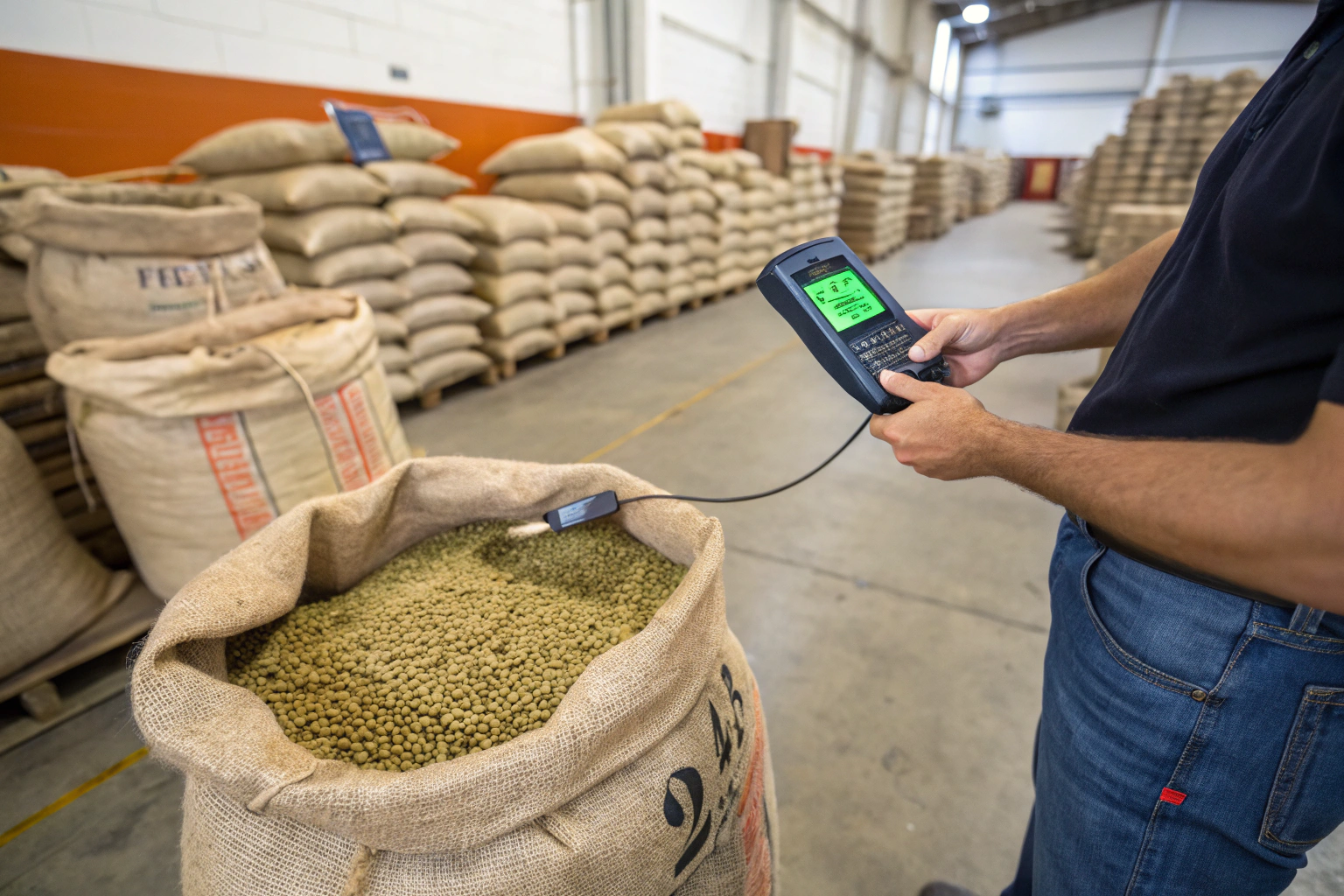
Let me tell you a story. Last year, a distributor in Texas almost lost $45,000. He bought a container of green beans from a new supplier. The price was great. The samples looked perfect. But when the container arrived in Houston, the bags were sweating. The beans were covered in white mold. The moisture content was over 14%. He couldn’t use them. He couldn’t sell them. And the supplier? They just said, “It was fine when it left our warehouse.” No insurance covered it. No refund was given. That nightmare is 100% avoidable. You just need to test the moisture content before the coffee leaves the port.
You must test moisture content before shipment because it directly stops mold growth, prevents cargo rejection at the destination port, and locks in the physical stability of the green bean during long ocean freight. At BeanofCoffee, I require a digital moisture reading for every single batch. If the number is above 12.5%, it doesn’t get on the truck to the terminal. It’s that simple.
You might think this is just a basic farm step. It’s not. It’s the safety valve for your entire investment. I’ve been exporting Catimor and Arabica from our 10,000-acre base in Baoshan for years. I’ve seen too many buyers in North America and Europe focus only on the price per pound and the sailing schedule. They ignore the invisible risk—the water activity inside the bean. So, I want to walk you through why this single test defines the outcome of your deal. You know?
How Does High Moisture Damage Green Coffee During Transit?
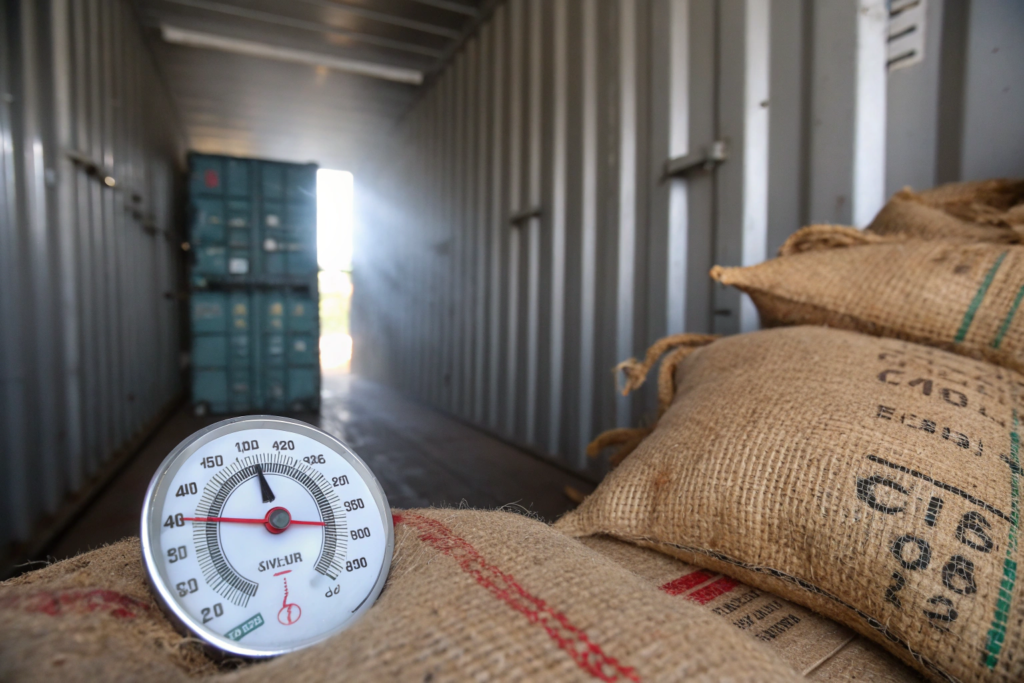
No one sees the damage happening. That’s the scary part. A container leaves Shanghai on a Monday. The weather is cool. By the time it crosses the equator, the external hull temperature hits 60°C. If your coffee has a moisture content of 13% or higher, the inside of that jute bag turns into a mini-sauna. The water doesn’t just sit there. It moves. It reacts. It destroys.
High moisture triggers a chemical chain reaction inside the container. The heat accelerates water migration from the inside of the bean to the surface. This creates a micro-environment inside the bag where mold spores—which naturally exist on all green coffee—begin to germinate within 48 to 72 hours.
Why Does Mold Grow Even if the Container Looks Dry?
Here is where most buyers get tricked. They open the container doors at the destination, and the floor looks dry. The walls look dry. So, they think everything is fine. But the disaster is hiding right in the center of the pallet.
Mold doesn't need a flood. It just needs water activity above 0.65 aw. A bean with 13% moisture sitting in a hot container reaches that level easily. The heat doesn't come from outside air leaking in. It comes from the beans themselves. They respire. They generate their own heat. I’ve measured center-bag temperatures that were 8 degrees Celsius higher than the air temperature at the door.
Another way to look at this is through the lens of insurance. If a surveyor finds that the damage was caused by "inherent vice"—meaning the product was already too wet when it was stuffed—your cargo insurance is void. You pay for the destruction.
Can You See the Damage Immediately?
Sometimes, yes. But usually, no. The visible mold—the white or green fuzz—only appears after the beans have been wet for a long time. The real danger is invisible. It's called "musty cup."
Musty cup means the bean looks perfect on the outside. It roasts beautifully. But when you grind it and pour hot water, you smell a damp basement. That flavor is permanent. It’s caused by mold metabolites that formed during the voyage. You can’t roast it out. You can’t blend it away.
| Moisture Level | Container Risk | Expected Cupping Result |
|---|---|---|
| 10% – 11.5% | Very Low | Clean, stable acidity |
| 11.6% – 12.5% | Low | Bright, standard profile |
| 12.6% – 13.5% | High | Risk of woody notes |
| 13.6% + | Extreme | Musty, moldy, rejected |
A small detail people miss: the jute bag itself. A dry bag protects the bean. A damp bag feeds the bacteria. When we load at BeanofCoffee, we check the absolute dryness of the packaging material. It’s a two-part system: the bean and the bag.
How Does Moisture Testing Affect Tariff and Customs Valuation?
This is the part nobody tells you about. When Ron—a confident business owner like you—negotiates a price, he looks at the FOB cost. But the final price you pay isn’t just the invoice. It’s the tariff bill from U.S. Customs. If your beans arrive damaged, the shipment might get flagged. And when that happens, the customs value gets complicated.
A pre-shipment moisture certificate stabilizes your customs valuation. It proves the goods were in sound condition when they left the country of origin. This prevents customs from reclassifying your shipment as "waste" or "damaged goods," which would trigger entirely different duty rates and inspections.

What Happens if Customs Finds Mold?
If U.S. Customs and Border Protection opens a container and finds organic growth, they don't just let it go. They issue a "Emergency Action Notification." The shipment is held. You can’t just pay the standard tariff and walk away. You have to pay for destruction, re-export, or fumigation.
A moisture certificate from a third-party lab, like one following SCA standards, is your first line of defense. It shifts the liability. It tells the officer: "This was safe when it was sealed. The problem is the voyage, not the source." Honesty, that’s a conversation you don't want to have without paperwork.
Another angle is the cost of demurrage. While you argue with customs, the container sits at the terminal. The clock ticks. Ports like Long Beach charge $150 to $300 a day after the free days expire.
Does Water Weight Affect Your Import Tax?
You pay duty on the total weight of the coffee, including the water inside it. If I sell you beans at 14% moisture, you are paying the tariff on water. Not coffee. Just water.
Let’s do the math. One container holds about 19,000 kg of green coffee. If the moisture is 14% instead of 11%, you have an extra 570 kg of water in there. If the import duty is, say, $0.05 per kg, you just paid $28.50 extra for water. It sounds small, but if you import 100 containers a year, that’s $2,850 wasted. Plus, you’re paying freight on that water.
At BeanofCoffee, we dry our Catimor mechanically. We target 11.5%. This keeps the weight honest. Your dollar buys coffee solids, not steam. We work with buyers who rely on precise logistics, and this small detail makes the numbers work. You can check our specific Arabica specifications on our Arabica product page.
What Is the Standard Moisture Level for Export-Grade Arabica?
I get this question a lot. "What number should I look for?" Some buyers think coffee should be bone-dry. Others think a little extra moisture keeps the bean alive and fresh. They’re confusing green coffee with roasted coffee. For green coffee, the standard is strict. It has to be.
The specialty coffee industry standard for export-grade green Arabica is a moisture content between 10% and 12%. The absolute ceiling for safe transport is usually 12.5%. The International Coffee Organization (ICO) Resolution 420 mandates that exporting countries must not ship coffee with a moisture content exceeding 13%, but for premium buyers, we set the bar lower to protect the cup.
Why Is 10% to 12% the Sweet Spot for Green Coffee?
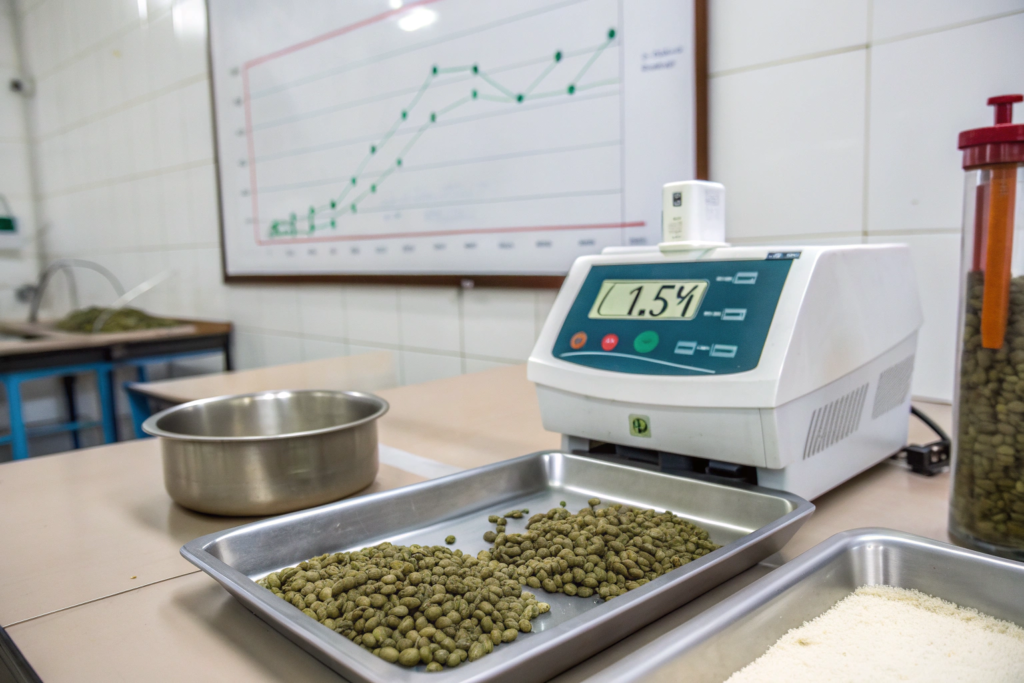
It’s a balance between physical safety and chemical structure. If you go below 9%, the bean cell walls become brittle. They shatter during the milling process. The silver skin falls off too fast in the roaster, causing fires.
If you go above 12.5%, the enzymes start to work. The seed is still alive. It uses its energy reserves, leading to a "faded" flavor over time. The bioactive compounds, like chlorogenic acids, start to degrade.
We use a Halogen moisture analyzer, which is quite common, but calibrate it against the oven-drying method reference every week. A key check is water activity. We aim for 0.55 aw to 0.60 aw. At that level, the Maillard reaction during roasting will be perfect. The sugars won’t be consumed by mold before they reach your roastery.
Can Robusta and Catimor Have Different Standards?
Yes. The biology is slightly different. Robusta beans are denser and smaller. They hold onto water differently. If a Robusta bean is at 12%, it might actually behave like an Arabica bean at 13% because of the internal cellular density.
Catimor—which we grow a lot of in Yunnan—is a hybrid. It’s more robust than pure Arabica against rain, but it needs to be dried down carefully. Because it has a slightly higher density, moisture migration can be slower. If you dry it too fast, the outside reads 11% but the center is still 13%.
This is why we let Catimor rest in parchment for 30 days before dry-milling. It lets the moisture equalize. It’s an old-school technique, but it works. A buyer in Melbourne told me our Catimor from Baoshan was the most uniform in density he’d seen all year.
How to Verify a Supplier’s Moisture Report Before Payment?
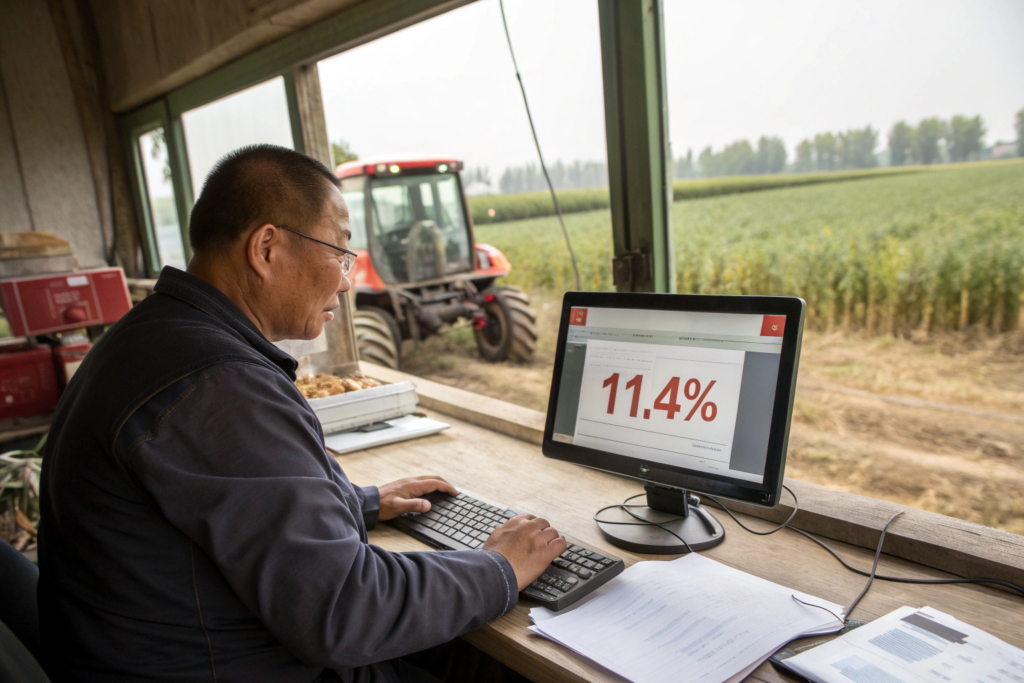
Trust is good. Control is better. I’ve been on both sides of the fence. As a farm owner in China, I know how easy it is to write any number you want on a PDF. You just type "11.4%" and send it. That’s not a test. That’s a lie. So, when you are dealing with a new supplier—maybe from a trade show or Alibaba—you need to verify the data, not just read it.
You verify a moisture report by demanding a third-party certificate from an internationally recognized surveyor like SGS, Bureau Veritas, or a local China affiliate. You must cross-check the seal number on the certificate with the seal on the container. And you must ask for the raw data log from the meter, not just the average.
Why Demand the Raw Data Log?
Averages hide the truth. Imagine a lot of 100 bags. 95 bags are at 11.0%. 5 bags are at 14.0%. The average reads 11.15%. Looks safe, right? But those 5 wet bags will rot. They will contaminate the whole pallet.
The raw data log shows you the standard deviation. If I see a standard deviation higher than 0.8%, I get nervous. It means the drying patio was uneven. It means the supplier mixed old coffee with new coffee. At BeanofCoffee, our quality team records the moisture of every single IBC tote before it's blended. The variance is kept below 0.5%.
Here’s a trick: ask for a photo of the test being done, with your name and the date written on a sticky note next to the meter. It sounds like a spy movie, but it prevents them from sending you a generic photo from last year. A real supplier won’t complain about this.
What Lab Equipment Should the Supplier Use?
Don’t accept a cheap wooden pin meter. Those are for rough harvest checks, not export. The standard is the capacitive or halogen loss-on-drying meter.
| Equipment Type | Accuracy | Cost | Best For |
|---|---|---|---|
| Wooden Pin Meter | +/- 2% | Low | Field Harvest |
| Capacitance Meter | +/- 0.5% | Medium | Factory Floor |
| Halogen Drying Balance | +/- 0.1% | High | Export Laboratory |
The test method also matters. For export, we follow the oven method—drying at 105°C for 16 hours. It’s slow, but it's the only way to get a true legal reference value. A quick 10-minute halogen test is fine for process control, but the final shipment document needs to be correlated to that oven standard.
So, if a supplier hesitates to provide a Certificate of Analysis from an entity like Bureau Veritas, you should hesitate to send the 30% deposit. It’s that simple.
Conclusion
Moisture content is invisible. You can’t see it in a photo. You can’t taste it in a Zoom call. But it determines whether your container arrives as premium specialty coffee or as a pile of bio-waste.
We walked through the damage it causes. It’s not just about mold. It’s about the chemical death of flavor. It’s about the hidden fees at the port. It’s about paying tariffs on water instead of coffee. The standard is clear: keep it between 10% and 12%. But more importantly, you have to verify the report. Don't trust an average. Demand the raw data.
This is the kind of headache I help buyers avoid every day. Running 10,000 acres in Baoshan, Yunnan, isn't just about growing coffee. It’s about logistics. It’s about science. If you’re tired of suppliers who cut corners on drying just to make the weight look heavier, let’s talk. We ship dry, clean, stable beans to North America, Europe, and Australia.
To get a real-time moisture data log for our current harvest, or to lock in a container booking, just reach out to our export manager, Cathy Cai. She’s direct, she’s fast, and she knows the numbers.
Email her at: cathy@beanofcoffee.com. Let’s get the numbers right before the container moves.