I remember the first small roaster who reached out to me directly. His name was Ben. He ran a tiny operation in Portland, Oregon—a 5-kilo roaster in a converted garage, selling at farmers markets. He wrote me a short email: "I love Yunnan coffee. Can I buy just two bags directly from you? I know I'm small. But I want a direct relationship, not a middleman." My sales team said it wasn't worth the paperwork. Two bags? The export documentation costs more than the coffee. But I said yes anyway. Something about his email felt honest. Today, five years later, Ben buys two containers a year from us. He's grown. We've grown. And the direct relationship we built when he was just a two-bag buyer is the reason he never looked for another supplier.
Small roasters love buying direct from Yunnan because it eliminates the traditional layers of importers and brokers, allowing them to build a personal, transparent relationship with the producer. They get direct access to the farmer's knowledge about the coffee—the varietal, the processing, the harvest date. They get better pricing by cutting out intermediaries. They get the ability to commission custom lots—specific fermentation experiments, specific roast profiles, specific packaging. And they get a story of direct partnership that their customers value. Buying direct transforms coffee from a commodity purchased from a catalog into a collaboration between two passionate, small businesses.
The direct trade model between Yunnan and small roasters is one of the most exciting developments I've witnessed in my career. It's changing how coffee is sourced, how it's priced, and how it's marketed. It's giving small roasters an edge over big chains. And it's giving my farm a network of loyal, long-term partners who care about quality as much as I do. Let me explain why this model works so well.
What Is Direct Trade and How Does It Differ from Fair Trade?
The coffee industry has a language problem. Terms like "fair trade," "direct trade," and "relationship coffee" are used loosely, sometimes interchangeably, often misleadingly. Understanding the real differences is essential for a roaster who wants to make an informed sourcing decision.
Direct trade is a sourcing philosophy, not a certification. It means the roaster buys directly from the producer, without intermediaries. The relationship is personal and collaborative. The roaster visits the farm, or at minimum, communicates directly with the farmer via video calls and messages. The price is negotiated directly between the two parties, often above Fair Trade minimums, and is based on quality and the cost of production. Fair Trade, by contrast, is a third-party certification system with fixed minimum prices and community development premiums, administered by a certifying body. Direct trade is about the relationship. Fair Trade is about the standard.
Why Do Small Roasters Prefer Direct Trade?
Small roasters are not multinational corporations. They can't send a procurement team to spend a week in Yunnan and negotiate a 50-container contract. They need a sourcing model that matches their scale and their values.
Direct trade gives them flexibility. They can start with two bags. They can talk to the actual farmer. They can ask questions and get answers directly, without going through a chain of salespeople. They can request a custom process—a longer fermentation, a specific drying protocol—and have a reasonable chance of the farmer saying yes, because the farmer values the direct relationship.
Direct trade also aligns with the values that small roasters market to their customers. They can say, "I talked to the farmer on Tuesday. The coffee was harvested in January. It's a Typica from plot 4B." That specificity is marketing gold.
Is Direct Trade More Expensive for the Roaster?
Not necessarily. In many cases, buying direct is cheaper than buying through traditional importers, even at higher green coffee prices.
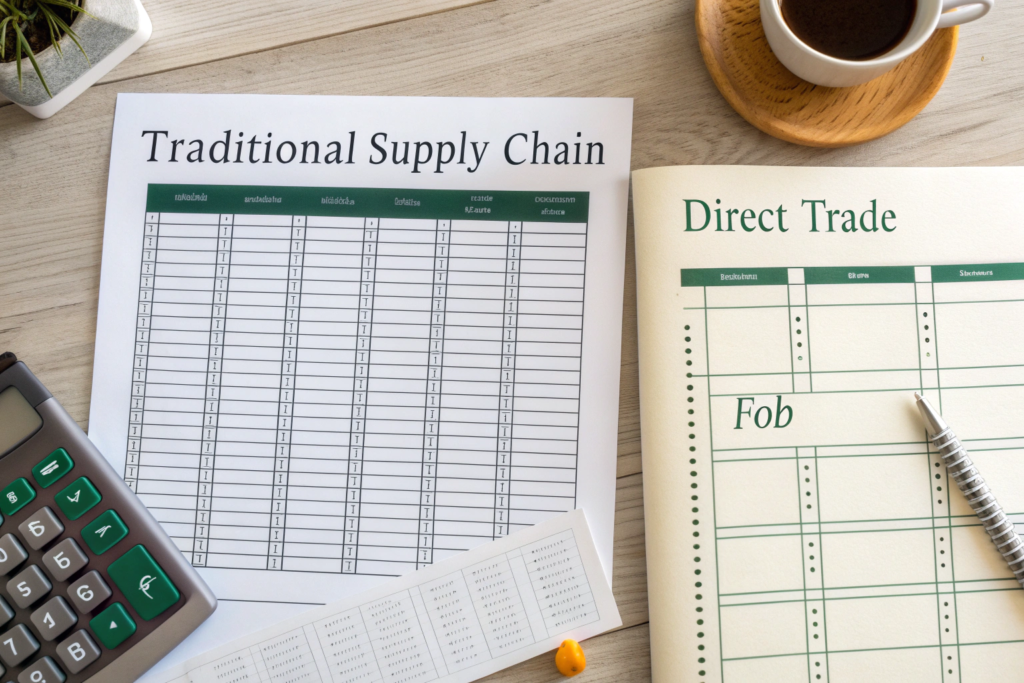
A traditional supply chain has multiple layers, each taking a margin. The exporter, the importer, the broker—each adds a percentage. In a direct trade relationship, those layers are removed. The roaster might pay the farmer more per kilo, but the total landed cost can be lower because the middlemen's margins are eliminated.
This is the win-win at the heart of direct trade. The farmer gets a higher price. The roaster gets a lower landed cost. The money that was going to intermediaries now goes to the producer and stays in the roaster's pocket. The Specialty Coffee Transaction Guide provides data showing that direct trade relationships often result in higher prices for farmers and competitive costs for roasters.
How Does Direct Sourcing Impact Roaster Profitability?
Romance is nice, but business is about numbers. Small roasters operate on razor-thin margins. Every cent per pound matters. Direct sourcing is not just a feel-good story. It's a profitability strategy.
Direct sourcing improves roaster profitability by lowering the cost of goods sold and allowing the roaster to capture the storytelling premium. The elimination of importer and broker margins can reduce the landed green coffee cost by $0.50 to $1.50 per pound. Simultaneously, the direct trade story allows the roaster to price the retail bag at a premium—consumers will pay more for coffee with a verified, personal, transparent origin story. The combination of lower cost and higher retail price significantly expands the roaster's margin.
What Is the Cost Breakdown of a Direct Container?
Let's do the math on a direct trade container of Yunnan Arabica.
The FOB price might be, say, $3.20 per pound. This is the price paid to the exporter, covering the green coffee, the processing, the bagging, and the local logistics. Ocean freight to the US West Coast adds roughly $0.15 to $0.25 per pound, depending on the spot rate. Customs clearance, inland trucking, and warehousing add another $0.10 to $0.15. The total landed cost is around $3.50 to $3.60 per pound.
Now compare this to buying the same quality coffee from an importer. The importer's catalog price might be $4.80 to $5.50 per pound for a specialty single-origin. The importer is covering their own margin, their warehousing costs, their financing costs, and their sales team. The direct trade roaster saves at least $1.00 per pound, often more.
How Does Exclusivity Create a Competitive Advantage?
When a small roaster buys a generic lot from an importer's catalog, they are selling the same coffee that a dozen other roasters in their city might also be buying. The coffee is good, but it's not unique.
When a roaster buys direct from a specific farm in Yunnan, they can negotiate exclusivity. They can be the only roaster in their state, or even their country, with that particular coffee. This exclusivity is a powerful marketing tool. It differentiates them from every other cafe on the block.
I've worked with roasters to create exclusive micro-lots. A specific plot, a specific processing method, a specific roast. That coffee is theirs alone. Their customers can't get it anywhere else. That drives loyalty and allows for premium pricing.
What Kind of Support Do Small Roasters Need from Exporters?
Small roasters are experts at roasting, brewing, and building community. They are not necessarily experts at international logistics, customs clearance, or foreign exchange. They need an exporter who can bridge that knowledge gap. A direct trade relationship is not just a transaction. It's a support system.
Small roasters need exporters to provide logistics education, transparent documentation, and flexible ordering options. The exporter must guide the roaster through the complexities of FOB versus CIF, explain the required import documents, and recommend reliable freight forwarders and customs brokers in the roaster's country. The exporter should also provide marketing support: high-resolution farm photos, farmer profiles, and suggested social media copy. A good direct trade exporter acts as a partner, not just a vendor.
What Logistics Support Is Most Valuable?
For a first-time direct buyer, the logistics can be intimidating. A container? A Bill of Lading? FDA Prior Notice? The terminology is unfamiliar, and a mistake is costly.
The exporter should provide a clear, step-by-step guide. What documents will be provided, and when. What the roaster needs to do on their end. Who to contact at the port. What to expect with customs.
I walk every new small roaster client through this process personally, or Cathy does. We don't assume they know what a "Telex Release" is. We explain it. We provide a checklist. We check in at each milestone: "The coffee is at the port. The vessel is booked. Here is the Bill of Lading draft. Please confirm the consignee details." This hand-holding is the difference between a smooth experience and a disaster.
Why Is Flexible Ordering So Important?
Small roasters can't always commit to a full container. A full container of green coffee is roughly 19,000 kilos—about 42,000 pounds. That's a lot of coffee for a small operation.
We offer flexible ordering options. A roaster can buy a single pallet, about 600 to 800 kilos. They can share a container with another roaster. They can start with a pallet and scale up to a container as their business grows.
This flexibility lowers the barrier to entry. A roaster who might never be able to commit to a full container can still access the benefits of direct trade—the relationship, the quality, the story, the margin—at a scale that fits their business. At BeanofCoffee, our minimum order for a direct trade relationship is intentionally low, because we believe in the model.
How Do Relationships in Yunnan Become a Brand's Story?
The final product is a bag of coffee on a shelf. But that bag can be a commodity, or it can be a story. The difference is the relationship behind it. A direct trade relationship with a farm in Yunnan gives a small roaster a narrative that no generic wholesale coffee can match.
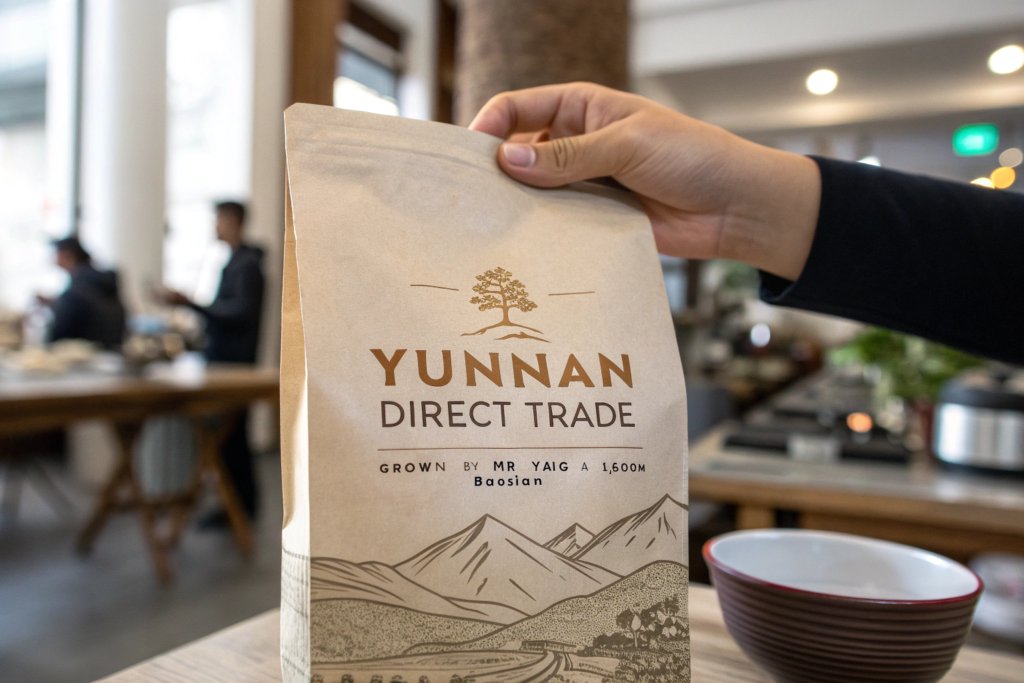
A direct relationship with a Yunnan farm becomes a brand story when the roaster integrates the farm's details into their packaging and marketing. This includes naming the farm or the farmer on the label, sharing photos and videos from the origin on social media, offering QR codes that link to a "Meet the Farmer" page, and telling the specific story of that season's harvest. The story transforms the coffee from an anonymous product into a personal experience for the consumer.
What Specific Details Make the Story Compelling?
A good story is specific. "From our partner farm in Yunnan" is weak. "From Mr. Yang's Typica plot at 1,600 meters on the slopes of the Gaoligong Mountain, hand-picked in January 2025 and honey-processed for 18 hours" is strong.
Include the challenges. If the harvest was late because of a cold spring, share that. If the farm transitioned to organic practices this year, share that. The imperfections and the struggles make the story human.
We provide our direct trade partners with a digital media kit for each lot. It includes photos of the farm, the processing, and the team. It includes a farmer profile. It includes the GPS coordinates and a farm map. This kit is designed to be plugged directly into the roaster's website, social media, and bag design.
How Do You Market the "Direct Trade" Concept to Consumers?
Consumers are increasingly skeptical of marketing claims. They've seen "fair trade" and "ethically sourced" on everything from bananas to chocolate. They need specifics to believe.
Instead of just slapping a "Direct Trade" sticker on the bag, tell them what it means. "We talk to our farmer, Mr. Yang, every month. We visited his farm in 2024. The price we paid for this coffee was 40% above the Fair Trade minimum. Here's the receipt." Radical transparency builds trust.
One of our roaster partners in Seattle includes a "Transparency Report" on the inside of every bag. It details the FOB price, the farm-gate price, the harvest date, and the cupping score. His customers love it. It turns a bag of coffee into a conversation piece.
Conclusion
The direct trade model between Yunnan and small roasters is a quiet revolution. It's dismantling the old, opaque supply chain and replacing it with something personal, transparent, and mutually beneficial. Small roasters get better coffee, better pricing, better stories, and a genuine competitive advantage. Farmers get better prices, direct feedback, and long-term, loyal partners.
This model is not just for the elite few. It's accessible to any roaster willing to send an email, cup some samples, and build a relationship. The barriers are lower than ever. The infrastructure—the logistics, the documentation, the communication tools—is in place. The only missing ingredient is the initiative.
If you're a small roaster curious about sourcing directly from Yunnan, I invite you to start the conversation. You don't need to commit to a container. You can start with a sample, a video call, a pallet. You can grow with us.
To request samples, schedule a video call with our farm team, or learn more about our direct trade partnership model, reach out to Cathy Cai.
Email: cathy@beanofcoffee.com. Let's build a direct relationship, from our mountain to your roastery.