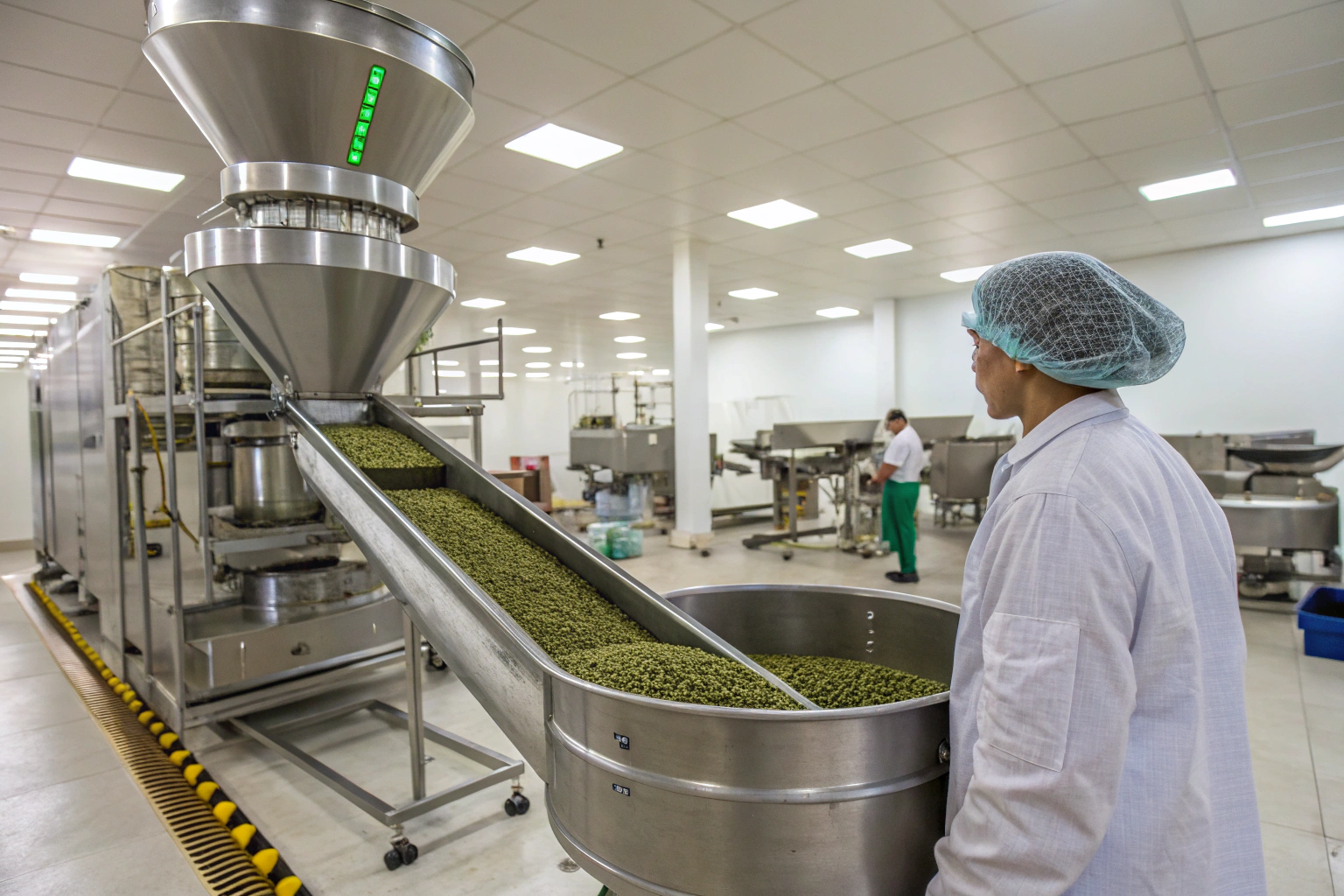
I once sent a container of Grade 1 Arabica to a roaster in Seattle. He called me complaining. Not about the taste. The taste was great. He complained that his roast profiles were all over the place. One batch finished in 11 minutes. The next batch, using the exact same settings, took 12 and a half minutes. He was pulling his hair out. I knew immediately what the problem was. The bean density was inconsistent. The beans were all screen 17/18. They were all the same size. But some were dense like pebbles. Others were lighter, more porous. They absorbed heat differently. The roaster was trying to cook a mixed bag of rocks and sponges. The pain here is real. Inconsistent density ruins roast consistency. It wastes your time. It wastes your coffee. And it confuses your customers.
Chinese coffee factories handle bean density sorting by using a multi-stage process that includes pre-cleaning to remove light foreign matter, followed by a gravity separator (or densimetric table) that uses controlled airflow and vibration to stratify beans by weight, separating the heavy, high-altitude beans from the lighter, lower-grade beans and physical defects.
This is not just about making the coffee look pretty. It is about making the coffee behave predictably in your roaster. It is about physics. Let me walk you through the machines and the methods we use at Shanghai Fumao to make sure every bean in that bag roasts the same way.
What Is Green Bean Density and Why Does It Matter for Roasting?
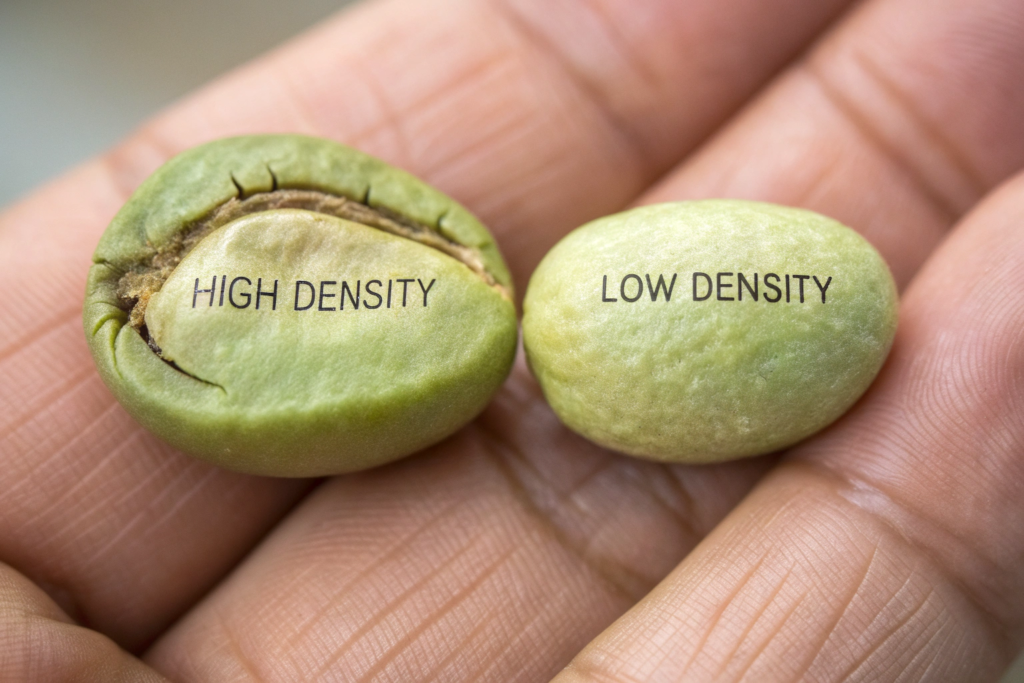
Let's start with the basics. Density is not size. You can have a big, fat bean that is light as a feather. You can have a small, peaberry bean that is dense as a bullet. Density is mass divided by volume. In coffee terms, it is how much "stuff" is packed into the cellular structure of the seed.
Green bean density is a critical physical attribute determined primarily by altitude and varietal, with denser beans possessing a tighter cellular structure that conducts heat more slowly and uniformly, requiring more energy at the start of the roast but developing sweetness more completely, while less dense beans heat faster and are prone to scorching or underdevelopment.
If you do not sort for density, you are essentially putting two different materials into your roaster at the same time and expecting the same result. Physics does not work that way.
How Does Altitude in Baoshan Affect the Density of Catimor Beans?
Altitude is the main driver of density. This is true everywhere in the coffee world. But the effect is pronounced in Yunnan because of the specific geography. Baoshan coffee grows between 1,200 and 1,700 meters above sea level. The Gaoligong Mountains create a unique microclimate.
Here is the simple science. At higher altitudes, the air is cooler. The cherry matures more slowly on the branch. This extended maturation period allows the seed (the bean) to fill with more complex carbohydrates and structural cellulose. The bean becomes physically harder and denser.
Conversely, coffee grown at the bottom of the valley—say, 800 meters—matures faster. The beans are softer. They have a lower density.
At Shanghai Fumao, we map our estate by altitude. Our top blocks produce beans with a density that rivals Strictly Hard Bean (SHB) Central American coffees. Our lower blocks produce a softer bean. Both can be good coffee. But they roast differently. And if we mix them together, we create a roasting nightmare for you. This is why we separate them. Not by guesswork. By machine. For more scientific data on how altitude impacts coffee physiology, the research published by World Coffee Research is the best resource available.
Why Do Less Dense Beans Cause Scorching and Tipping in the Roaster?
Picture your roaster drum. It is hot. You drop in a batch of mixed-density beans. The heavy, dense beans are like cold stones. They resist the heat. The light, porous beans are like dry kindling. They absorb the heat instantly.
The roaster's temperature probe is reading an average. It does not know some beans are cooking faster than others. You apply heat based on that average. The light beans get too hot, too fast. The tips of the bean (the ends) burn. This is called tipping. The flat surface of the bean scorches. This is called facing.
Those burnt spots taste ashy and bitter. They ruin the cup. Meanwhile, the dense beans in the same batch are still trying to get enough heat to develop their sweetness. They come out underdeveloped. Grassy. Peanutty.
This is the roaster's dilemma. You can either roast for the dense beans and burn the light ones. Or roast for the light beans and under-develop the dense ones. The only solution is to not have them mixed in the first place. Density sorting removes the light beans (and the hollow shells, and the insect-damaged beans) so that everything in the roaster has the same thermal mass.
What Machines Are Used in Yunnan Mills to Sort Coffee by Weight?
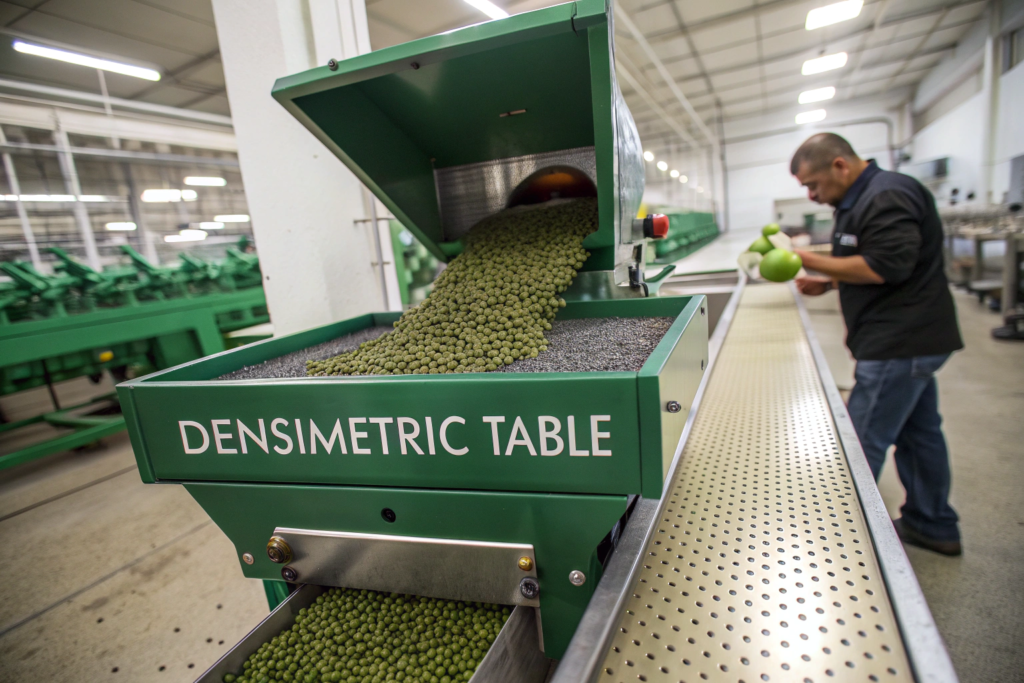
The workhorse of density sorting is not a computer. It is a beautifully simple piece of physics equipment called a Gravity Separator, or Densimetric Table. It looks like a big, tilted, vibrating metal box. It is loud. It shakes the whole building. And it is brilliant.
The primary machines used in Yunnan mills for density sorting are gravity separators, which use a combination of a vibrating inclined deck and upward forced air to fluidize the bean mass, causing denser beans to sink and move uphill while lighter beans float and slide downhill, effectively separating the lot by specific gravity.
Before we get to the gravity table, we use a few other tools to help it do its job.
How Does a Gravity Separator Table Differentiate Heavy vs. Light Beans?
Let me walk you through the process as it happens in our dry mill.
- Pre-Cleaning and De-Stoning: Before the gravity table, the coffee goes over a Catador or a De-Stoner. This is a simpler version of the same principle. A strong blast of air lifts the coffee. Heavy stones and metal fall out the bottom. Very light chaff and sticks blow away. This protects the gravity table and gets rid of the extreme outliers.
- The Gravity Table Feed: The clean, sized coffee (e.g., all screen 17/18 beans) is fed onto the high side of the tilted, vibrating deck.
- Fluidization: A powerful fan blows air up through the tiny holes in the porous deck. This lifts the beans slightly. They are not flying around. They are "fluidized." They act like a liquid.
- Stratification: This is the magic. The heavy, dense beans sink to the bottom of this fluidized layer. They make contact with the vibrating deck. The vibration of the deck walks them uphill against the slope.
- Separation: The light beans (and hollow shells, and insect beans) float on top of the heavy bean layer. They do not touch the vibrating deck as much. Gravity pulls them downhill with the slope of the table.
The table has adjustable gates at the bottom edge. The heavy beans exit the high gate. The light beans exit the low gate. A middlings fraction exits in the middle. It is a physical separation based purely on weight. No camera. No AI. Just air and vibration. You can see this technology in action in many agricultural processing videos; the University of California Agriculture and Natural Resources department has excellent resources on post-harvest processing equipment.
What Is the Role of the Destoner in Removing Foreign Material?
The Destoner is the gravity table's older, tougher brother. Its job is simple. Remove rocks. Remove clods of dirt. Remove screws or nails that might have fallen into the coffee.
Yunnan coffee is grown on hillsides. Sometimes a small stone gets scooped up with the cherry during harvest. If that stone gets through the pulper and into the dry mill, it can destroy a grinder. It can chip a grinder burr in your roastery, costing you hundreds of dollars in repairs.
The Destoner uses a similar principle of air and vibration, but it is tuned to the specific weight of a stone. Stones are much heavier than coffee beans. They sink straight to the bottom of the fluidized bed and are vibrated out a separate exit.
At Shanghai Fumao, we run every single lot through the Destoner twice. First, before hulling (to protect the huller). Second, after grading (to protect your grinder). It is a small step that takes time and electricity. But I sleep better knowing I am not shipping a piece of the Baoshan mountain to your roastery.
What Are the Different Density Grades Produced by Chinese Coffee Factories?
The gravity table does not just give you "good" and "bad." It gives you a spectrum. And smart coffee businesses, like any smart agricultural business, find a market for every part of that spectrum. Nothing is wasted. But it is all labeled correctly.
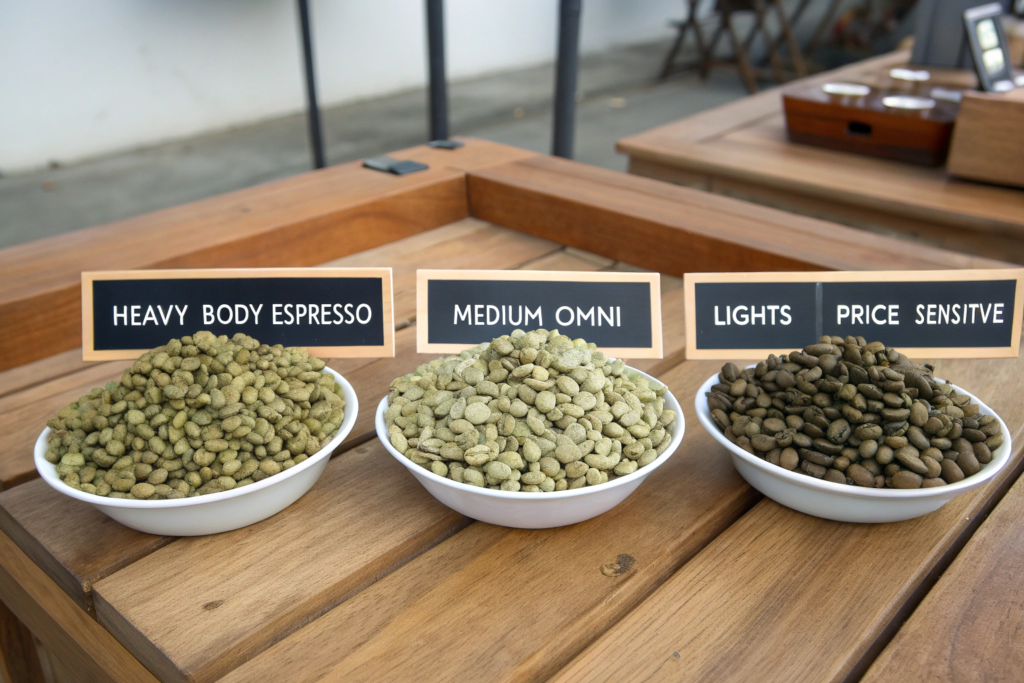
Chinese coffee factories typically produce three density grades from the gravity separator: a high-density export grade (premium specialty and high-end commercial), a medium-density domestic or blending grade, and a low-density "lights" fraction containing hollow beans, insect damage, and floaters that is sold for instant coffee or fertilizer.
Knowing which grade you are buying is the difference between a premium product and a commodity filler.
How Does the "Heavy" Fraction Translate to Better Espresso Performance?
The heavy fraction is the money beans. This is the stuff that comes off the high side of the gravity table. These beans are dense. They are uniform. They are what we reserve for our Grade 1 specialty exports.
Why are they better for espresso? Espresso is a brutal extraction method. It uses high pressure and very hot water. Low-density beans cannot stand up to it. They extract too fast. The water channels through the coffee puck, creating a watery, sour shot with no crema.
Dense beans create more resistance in the espresso puck. The water has to work harder to find a path through. This slows down the shot. It allows for a more even extraction. It builds that thick, syrupy body and the rich, reddish-brown crema that espresso drinkers crave.
When I sell a lot designated "Espresso Grade," it means it came exclusively from the heavy side of the table. It means it has the structural integrity to survive the 9-bar pressure. At Shanghai Fumao, we cup the heavy fraction separately to confirm it has the sweetness to match the body. You can learn more about espresso extraction physics from the research shared by the Specialty Coffee Association on their Barista Guild resources.
What Happens to the "Lights" and Floater Beans After Sorting?
The lights do not go into our export bags. That is a promise. But they do not go into the trash either. That would be wasteful and bad for the environment.
The "lights" fraction contains several things:
- Floaters: Beans that were damaged during drying and became hollow.
- Insect Damage: Beans with a tiny hole from the Coffee Berry Borer. They weigh less.
- Immature Beans: Beans that were picked too green and did not develop fully.
This fraction is separated out. We collect it in big supersacks. It is sold into different channels:
- Domestic Instant Coffee Market: China has a massive instant coffee industry. These factories need soluble solids. They do not care about bean density or roasting consistency. They just extract caffeine and flavor compounds. The lights are perfect for this.
- Local Market Blends: Some local roasters buy this fraction at a steep discount to blend into very low-cost commercial products.
- Compost/Fertilizer: If the quality is too low even for instant coffee, we compost it. It goes back into the soil on the farm as organic matter.
This is a key difference between a professional mill and a smallholder operation. A professional mill uses the gravity table to upgrade the export lot and monetize the byproduct. It is good business and good environmental stewardship. You can read about coffee byproduct utilization in sustainability reports from the International Coffee Organization.
How Can Roasters Verify That a Shipment Has Been Properly Density Sorted?
You have my word that we sort by density. But you should not rely on my word. You should rely on your own eyes and a simple set of tools. Verifying density sorting at your warehouse is not difficult. It takes about 15 minutes and it can save you from accepting a sub-par shipment.
Roasters can verify density sorting by performing a simple water displacement test to check bean density, visually inspecting a 350-gram sample for the presence of hollow shells and floaters, and tracking roast data consistency across multiple batches from the same lot to detect thermal behavior anomalies.
If the lot is properly sorted, these tests will be clean. If it is not, the evidence will be right in front of you.
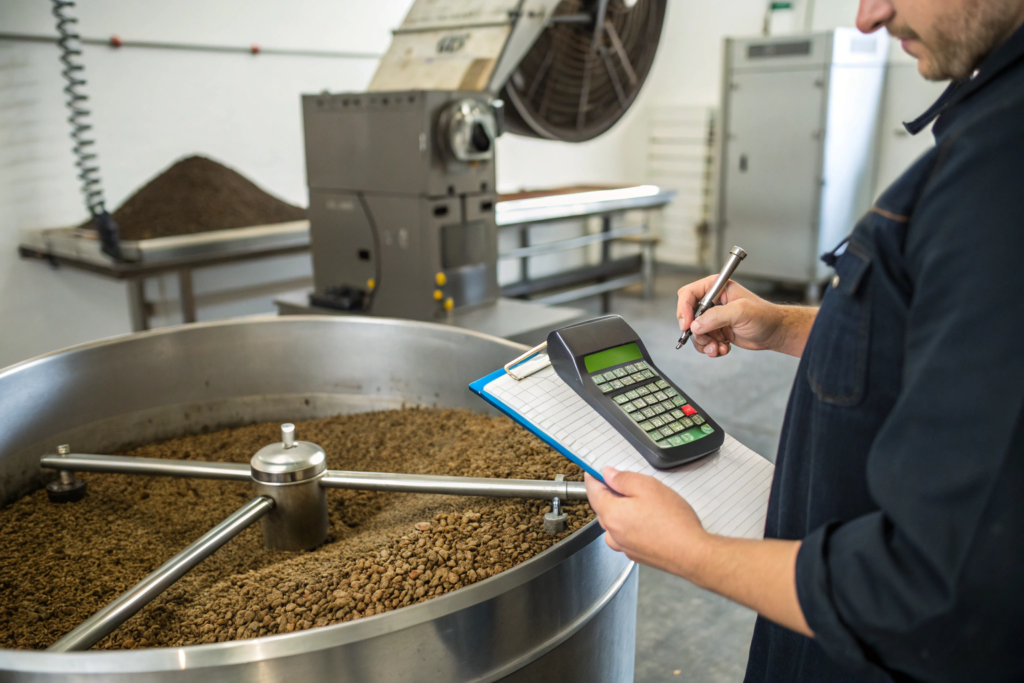
What Is the Simple Water Test for Checking Green Coffee Density?
This is an old-school trick. It is not as precise as a lab instrument, but it is very effective at catching poor sorting.
- Take a random 100-gram sample of green beans from the bag.
- Fill a large beaker or measuring cup with room temperature water.
- Dump the beans in the water.
- Wait 60 seconds. Stir gently once to dislodge any air bubbles clinging to the beans.
Observe the results:
- Properly Sorted Lot: Almost all the beans will sink to the bottom immediately. You might see one or two floaters. That is acceptable. A well-sorted heavy lot will have less than 1% floaters.
- Poorly Sorted Lot: You will see a layer of beans floating on the surface. These are the hollow shells, the insect-damaged beans, and the low-density seeds. If more than 2-3% of the beans are floating, the lot was not run over a gravity table properly, or the table was set incorrectly.
This test is simple. It is visual. And you can do it while you are waiting for your sample roaster to warm up. If I ship you a container and you send me a photo of a beaker full of floating beans, I will have some explaining to do. That has never happened. Because we run the same test in our lab before stuffing. For more detailed physical testing methods, the Green Coffee Association provides technical resources for green coffee evaluation.
How Should Roast Data Consistency Reflect Proper Density Uniformity?
This is the ultimate test. It is the one that matters for your business. You have your roast profile dialed in for a specific lot. You roast five batches back-to-back on a Monday morning.
What you should see with a density-sorted lot:
- Drop Temperature: Consistent within 1-2 degrees Fahrenheit.
- Turning Point: The time when the bean temp starts rising again. Consistent within 5-10 seconds.
- First Crack: Happens within a 10-15 second window across all batches.
- Development Time Ratio: Very stable.
What you see with a poorly sorted lot:
- Erratic Turning Points: One batch turns at 1:45. The next at 2:10.
- Roast Color Variation: Even if the time is the same, the color of the beans is uneven. Some look darker (the light beans burned). Some look lighter (the dense beans underdeveloped).
- "Flicking" Rate of Rise: The RoR curve on your software looks like a mountain range instead of a smooth decline.
If you are fighting your roaster every day, and you are sure your machine is calibrated, look at your green coffee. The problem is likely in the bag. Density inconsistency is the silent killer of roast efficiency.
At Shanghai Fumao, we want you to have a boring roasting day. We want the curves to be flat and predictable. We want you to be able to focus on blending and marketing, not on fighting the physics of the bean. That boring consistency is what we build with our density sorting.
Conclusion
Density sorting is not the most glamorous part of the coffee business. It happens in a loud, dusty mill far away from the cool cupping labs and the trendy roasteries. But it is the foundation of a reliable coffee supply. It is the difference between a coffee that is easy to roast and a coffee that fights you every step of the way.
In Yunnan, the best factories have invested heavily in this technology. We use gravity tables and destoners with the same precision and care as the best mills in Colombia or Brazil. Because we know that our reputation in your roastery depends on the consistency of every bean in the bag.
When you buy from BeanofCoffee, you are buying the heavy fraction. You are buying the beans that sink. You are buying the beans that will roast evenly, extract beautifully, and make your job easier.
If you want to discuss how our density sorting protocols can improve the consistency of your roasts, or if you just want to see a video of the gravity table in action, let's connect. Email Cathy Cai. She can arrange a virtual tour of the dry mill so you can see the machines working for yourself. Contact Cathy at: cathy@beanofcoffee.com