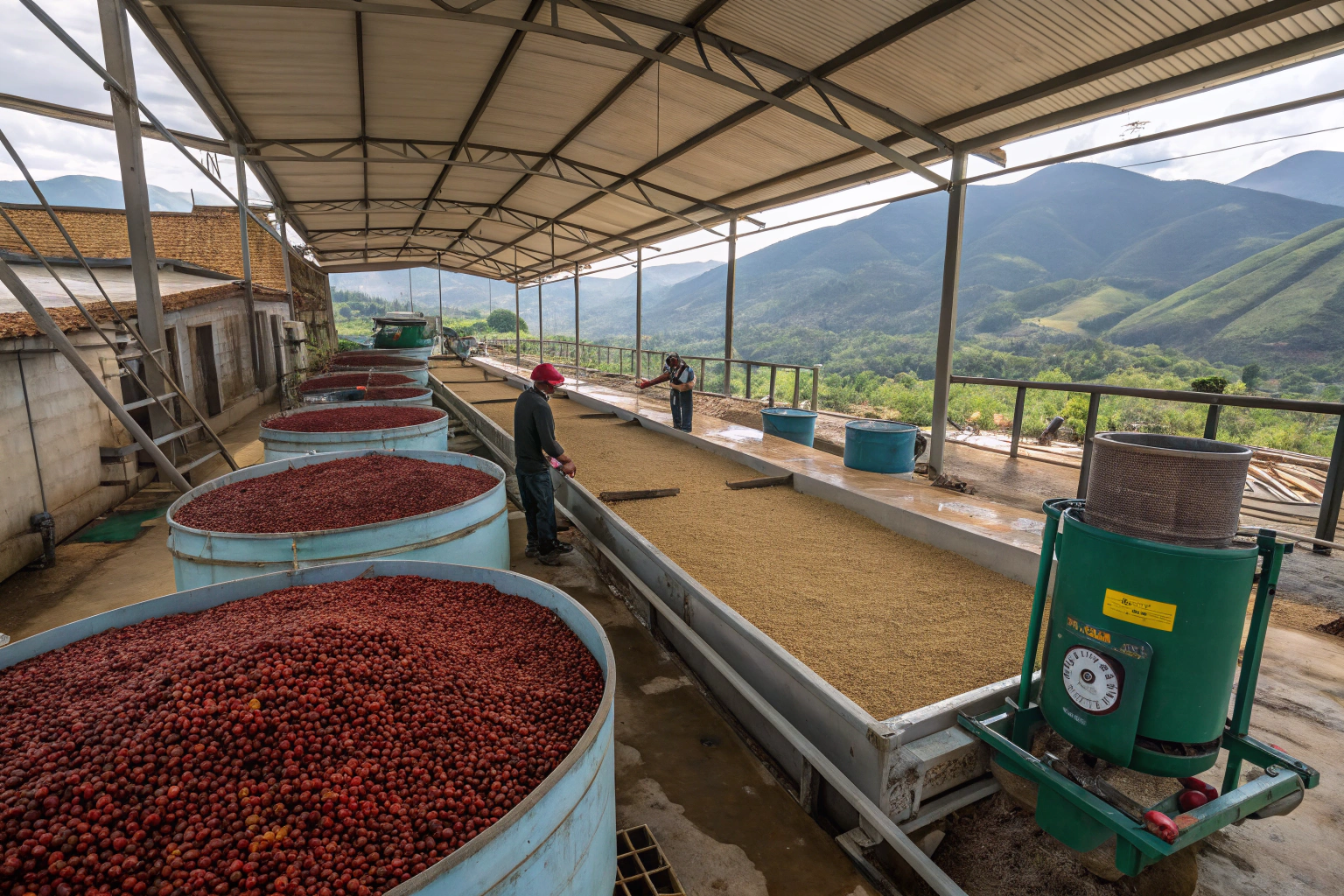
I still remember the first time I truly understood that processing is not just a step between the tree and the cup. It was 2018, and I had brought two sample lots to a cupping session with a visiting roaster from Melbourne. Both lots came from Block 12 on our Baoshan plantation. Same trees. Same harvest week. Same altitude. Same pickers. But one lot had been washed, and the other had been naturally processed—dried inside the whole cherry. The washed lot cupped clean, with a bright lemon acidity and a crisp green apple finish. The natural lot cupped wildly different: heavy body, deep blueberry jam notes, a slightly winey, fermented complexity. The roaster looked at me across the cupping table and said, "If I did not know better, I would swear these were from two different continents." He was right. Processing had transformed the same raw material into two completely different sensory experiences. That moment shifted how I think about coffee. Processing is not a post-harvest chore. It is a flavor creation process.
The coffee processing method fundamentally determines the flavor profile of the final cup by controlling how the fruit mucilage and skin interact with the bean during the drying phase, with washed processing stripping all fruit material early to produce a clean, bright, and acid-forward cup, natural processing drying the bean inside the whole cherry to create a heavy-bodied, intensely fruity, and sometimes fermented cup, and honey processing occupying the spectrum between them by removing the skin but leaving controlled amounts of mucilage on the bean to add sweetness and body while preserving some clarity.
Every coffee roaster and buyer knows that origin matters. But within a single origin, on a single farm, processing can create more flavor variation than a hundred kilometers of distance. Understanding processing is not just for cuppers. It is for anyone who buys green coffee and needs to predict what will end up in the roaster and, ultimately, in the consumer's cup. In this article, I want to walk through the four main processing methods we use on our plantation—washed, natural, honey, and the increasingly popular anaerobic fermentation—and explain not just how they work, but what they do to the bean and to the flavor.
What Is Washed Processing and Why Does It Produce a Clean, Bright Cup?
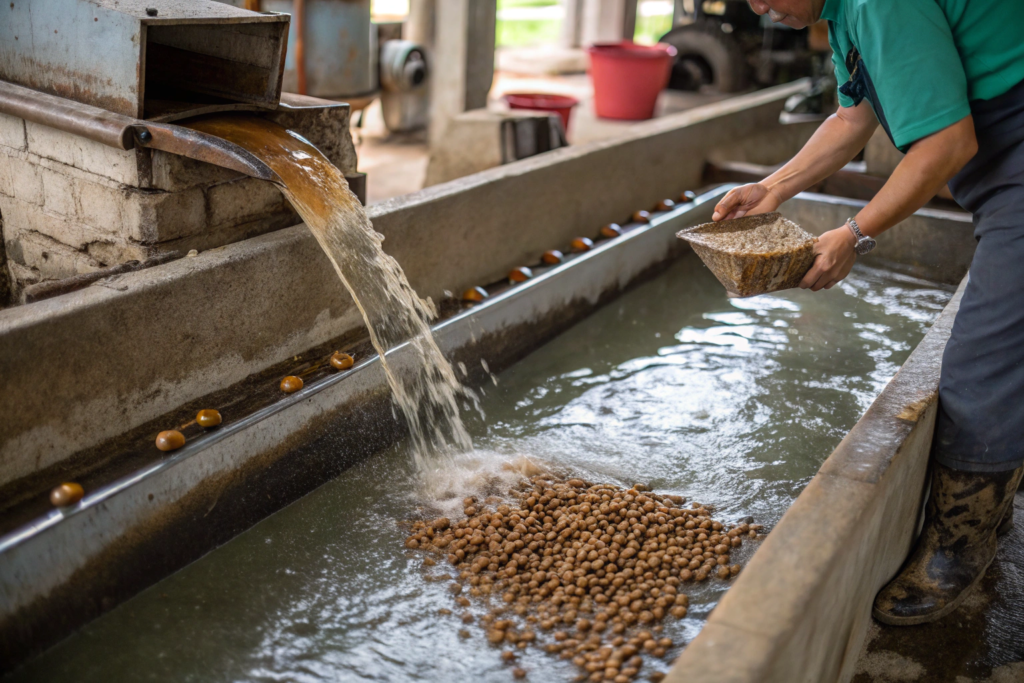
Washed processing, also called wet processing, is the method that most of the specialty coffee world was built on. When I walk a buyer through our wet mill in Baoshan, I start at the receiving tank, where the freshly picked cherries are dumped into water. The floaters—the overripe, underripe, or insect-damaged cherries that float instead of sink—are skimmed off. Only the dense, ripe cherries proceed. This first separation is a critical quality gate. It removes the cherries that would add fermented, earthy, or sour defects to the cup before the process has even begun.
Washed processing produces a clean, bright cup by mechanically removing the cherry skin and fruit mucilage from the bean within 24 to 36 hours of harvest, then washing the parchment-covered bean in clean water channels until all traces of fruit sugar are stripped away, leaving a bean that, when dried, expresses the pure, unadorned flavor of the seed itself—citrus acidity, floral aromatics, and a light, tea-like body that showcases the coffee's terroir rather than the fruit it grew inside.
The mechanical removal of the skin happens in the depulper, a machine that squeezes the cherry between a rotating drum and a fixed plate, popping the skin and most of the mucilage off the parchment. The parchment-covered bean, still slick with a thin layer of sugary mucilage, then goes into a fermentation tank. Fermentation in washed processing is not about adding flavor. It is about breaking down that remaining mucilage layer through natural enzymatic activity so that it can be washed away. The beans sit in water for 12 to 36 hours, depending on the ambient temperature and the desired outcome. In Baoshan's cooler mountain climate, we often ferment for closer to 24 hours. The fermentation is carefully monitored. Over-fermentation creates acetic acid, which produces a vinegary defect. Under-fermentation leaves mucilage on the bean, which can cause uneven drying and microbial growth later. When the fermentation is complete, the beans are washed in channels of clean, flowing water, then spread on raised drying beds or mechanical dryers until they reach 10.5% to 12% moisture content. The result, in the cup, is clarity. The flavor notes come from the variety, the soil, the altitude, and the climate—not from the fruit. For a Catimor grown at 1,400 meters in Baoshan, a washed process typically yields notes of lemon, green tea, and toasted almond, with a crisp, clean finish. It is the processing method that puts the origin, not the process, on display.
How does fermentation time in washed coffee influence acidity and body?
Fermentation time is the washed process's primary control lever for flavor modulation. At the shorter end of the spectrum—12 to 18 hours in cool water—the enzymatic breakdown of the mucilage is just sufficient to allow complete washing. The resulting cup tends to have a brighter, more pronounced acidity, often described as citrus or malic. The body is lighter, the mouthfeel closer to tea than syrup. This short-fermentation profile is common in East African washed coffees and is increasingly popular among specialty producers in Yunnan who want to highlight the unique acidity of high-altitude Arabica.
At the longer end—24 to 36 hours—the extended contact with the fermenting mucilage begins to introduce subtle secondary flavors. The acidity remains but becomes slightly softer, more integrated. The body builds, gaining a slightly creamy or silky texture. Some cups develop a mild stone-fruit note—white peach, apricot—that was not present in the short ferment. The risk, however, rises sharply with time. Beyond 36 hours in water, the risk of acetic acid development and the growth of undesirable bacteria increases. The beans can develop a sour, vinegary note that is a defect, not a feature. The temperature of the fermentation water is a co-factor. In cooler temperatures—below 18°C—fermentation proceeds more slowly and the window for a clean, extended ferment is wider. In warmer temperatures—above 22°C—fermentation accelerates, and the margin for error shrinks. Our wet mill in Baoshan benefits from natural cool mountain water, which gives us a wider safe operating window for washed fermentation than a mill in a hotter climate would have. This is why altitude and water temperature are not just terroir variables. They are processing variables.
Why is washing channel water quality critical for defect-free green coffee?
The water that washes the fermented beans is the last liquid that touches the parchment before drying. If that water is not clean, the parchment will carry the water's impurities into the drying phase, and those impurities—organic matter, bacteria, dissolved minerals—can produce off-flavors that no amount of careful roasting can remove. I learned this lesson during a rainy season when the stream that feeds our washing channels ran turbid with silt from upstream erosion. The silt deposited a fine, earthy film on the parchment. The coffee from that lot, when cupped, had a muted acidity and a slightly muddy, flat finish. It was not a full defect, but the cup score dropped by 1.5 points. We now filter all washing water through a series of settling tanks and a sand filter before it enters the washing channels, and we test the water for turbidity and microbial load weekly during the harvest season.
Water quality in the washing channel is also a function of flow rate. If the water is too slow, the sugars and organic acids washed from the beans accumulate in the channel and begin to ferment, creating a micro-environment that can taint the next batches of beans passing through. If the water is too fast, the beans are agitated too violently, which can nick the parchment and expose the bean to direct water absorption, affecting moisture content uniformity. The ideal flow is a steady, laminar movement that carries away the washing byproducts without damaging the beans. The washed process, for all its reputation as the "clean" method, is actually a delicate balance of mechanical, enzymatic, and hydraulic variables. Getting all three right on a consistent basis is what separates specialty-grade washed coffee from commercial-grade.
How Does Natural Processing Create Intense Fruity and Wine-Like Flavors?
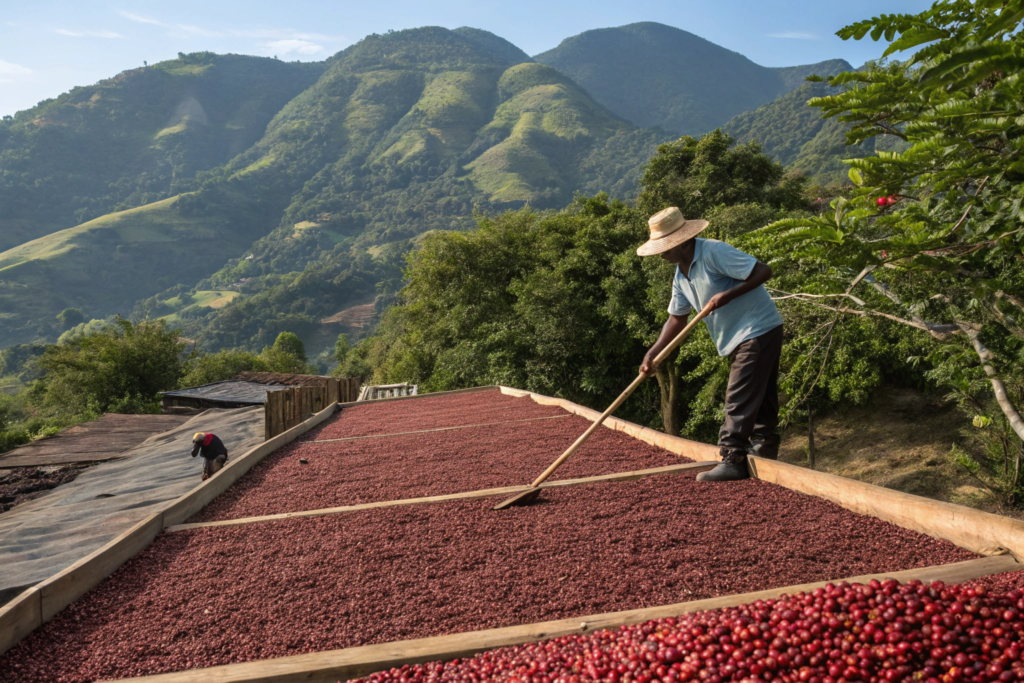
Natural processing, also called dry processing, is the oldest method of preparing coffee. Before there were depulpers and fermentation tanks and washing channels, there was the sun, the cherry, and time. In a natural process, the whole coffee cherry is picked, sorted for ripeness, and then laid out to dry intact—skin, mucilage, parchment, and bean all together. The bean dries inside the cherry for two to four weeks, depending on the weather, the thickness of the cherry layer on the drying beds, and the frequency of turning. During this long, slow drying period, the fruit flesh surrounding the bean ferments and desiccates, and the sugars and organic compounds in the mucilage migrate into the bean itself.
Natural processing creates intense fruity and wine-like flavors because the coffee bean dries while still encased in the whole cherry, allowing the fruit's sugars, organic acids, and aromatic compounds to infuse into the bean over an extended period, producing a cup characterized by heavy body, low acidity, and dominant notes of dried blueberry, strawberry jam, tropical fruit, and sometimes a boozy, winey complexity that is entirely absent from washed coffees of the same variety and origin.
The chemistry of natural processing is fundamentally different from washed processing. In a washed coffee, the bean's internal sugar content is relatively unchanged by the processing method. The bean's intrinsic sugars are preserved and caramelized during roasting. In a natural coffee, the mucilage sugars are absorbed into the bean during drying, increasing the total sugar content and, more importantly, changing the composition of those sugars. The absorption of fructose and glucose from the dried mucilage gives the natural-processed bean a different sugar profile that, during roasting, produces different Maillard reaction products—the compounds responsible for the caramelized, chocolatey, and roasted flavors. The result is a cup that tastes distinctly of fruit, not because any fruit flavoring has been added, but because the fruit that grew around the bean has left its chemical signature inside the seed.
On our plantation, we produce a small volume of specialty natural Arabica each year, typically from a specific block where the dry-season weather is most consistent. Natural processing is riskier than washed processing. The thick layers of cherries on the drying beds are vulnerable to mold, over-fermentation, and insect infestation. A single day of unexpected rain can set the drying back and introduce moisture that promotes fungal growth. The labor requirement is higher, because the cherries must be turned by hand every two to three hours during the peak drying days to prevent fermentation hot spots. But the cup reward is unique. Our Baoshan natural Catimor regularly cups with notes of dried plum, dark chocolate, and a creamy, almost syrupy body that is entirely distinct from our washed lots. For a roaster looking for a coffee that will stand out in a blend or command attention as a single-origin offering, a well-executed natural process is hard to beat.
What are the critical turning and moisture monitoring practices for natural beds?
Turning the cherries on the drying beds is not a casual task. It is the single most important quality control activity in natural processing. If the cherry layer is not turned frequently, the cherries on the bottom, resting against the warm surface of the bed, will ferment faster and hotter than the cherries on top, which are exposed to the sun and air. The resulting temperature gradient can cause localized over-fermentation—hot spots that produce acetic acid and unpleasant boozy notes. The turning schedule we follow at our mill during the peak drying period is every two hours from 9 a.m. to 5 p.m., with the cherry layer raked into an even, single-cherry thickness by midday when solar radiation is strongest. At night, the cherries are gathered into a central pile and covered with a breathable shade cloth to protect against dew and nocturnal insect activity. In the morning, they are spread again.
Moisture monitoring is the parallel discipline. A natural-process bean is properly dried when its internal moisture content reaches 10.5% to 12%. But measuring the moisture of a whole dried cherry is misleading, because the dried fruit husk has a different moisture content than the bean inside. The measurement that matters is the moisture content of the green bean after the husk is removed. We sample cherries from different areas of the drying bed daily after the first 10 days of drying, manually remove the husk from a small sample, and test the bean moisture with a calibrated moisture meter. When the majority of samples register between 11% and 11.5%, the drying is considered complete. The dried cherries are then bagged and rested for 30 to 60 days in a cool, dry warehouse before hulling. This resting period, sometimes called reposo, allows the internal moisture to equalize and the volatile flavor compounds to stabilize. Rushing the hulling and shipping of a natural coffee skips this critical maturation step, and the coffee will taste raw, unbalanced, and green.
How can a buyer distinguish a well-executed natural from a fermented defect?
A well-executed natural is fruity, sweet, and complex. A poorly executed natural is sour, boozy, and medicinal. The line between the two is thin and is governed entirely by the producer's drying discipline. For a buyer evaluating a natural coffee sample, the cupping table is the primary diagnostic tool. A clean natural will have a dominant fruit note—blueberry, strawberry, dried mango—that is distinct, pleasant, and integrated into the cup. The acidity will be low but present, often described as malic or tartaric rather than citric. The body will be heavy and syrupy, coating the tongue. The aftertaste will be clean and sweet, not cloying or lingering with an off-note.
A fermented defect, by contrast, will present as a sour, vinegar-like acidity that dominates the cup and obscures the fruit notes. The aroma may have a sharp, acetic character. On the palate, the sourness will be accompanied by a thin, astringent body and a short, unpleasant finish. In extreme cases, the cup will taste medicinal, like iodine or burnt rubber, which is a sign of severe over-fermentation or Fusarium mold contamination. The physical appearance of the green beans also provides clues. A well-dried natural will have a uniform, slightly amber-brown color to the green bean, with no white, moldy patches and no excessive broken or insect-damaged beans. A poorly dried natural often has an uneven color, with some beans looking bleached and others looking dark and oily. For a buyer who cannot visit the farm, asking for a breakdown of the drying protocol—turning frequency, drying duration, final moisture content, and resting period—is a reasonable due diligence step. A producer who can provide this data is probably managing the natural process professionally. A producer who cannot is gambling with the buyer's cup quality.
What Flavor Spectrum Does Honey Processing Offer Between Washed and Natural?
Honey processing is the middle child of coffee processing methods, and for a long time, I did not pay it enough attention. I understood washed. I understood natural. Honey seemed like an unnecessary complication—a method that left some mucilage on the bean but not all of it, producing a cup that was neither as clean as washed nor as fruity as natural. I was wrong. Honey processing is not a compromise. It is a deliberate spectrum of flavor control that offers a producer the ability to fine-tune the balance between clarity and body, between acidity and sweetness, in a way that neither washed nor natural can match.
Honey processing occupies the flavor spectrum between washed and natural by removing the cherry skin while leaving a controlled percentage of the fruit mucilage on the parchment during drying, with the amount of mucilage retained—from white honey with minimal mucilage to black honey with nearly all mucilage intact—directly determining the cup's body, sweetness, and fruit intensity, producing a coffee that is sweeter and heavier than washed but cleaner and more balanced than a full natural.
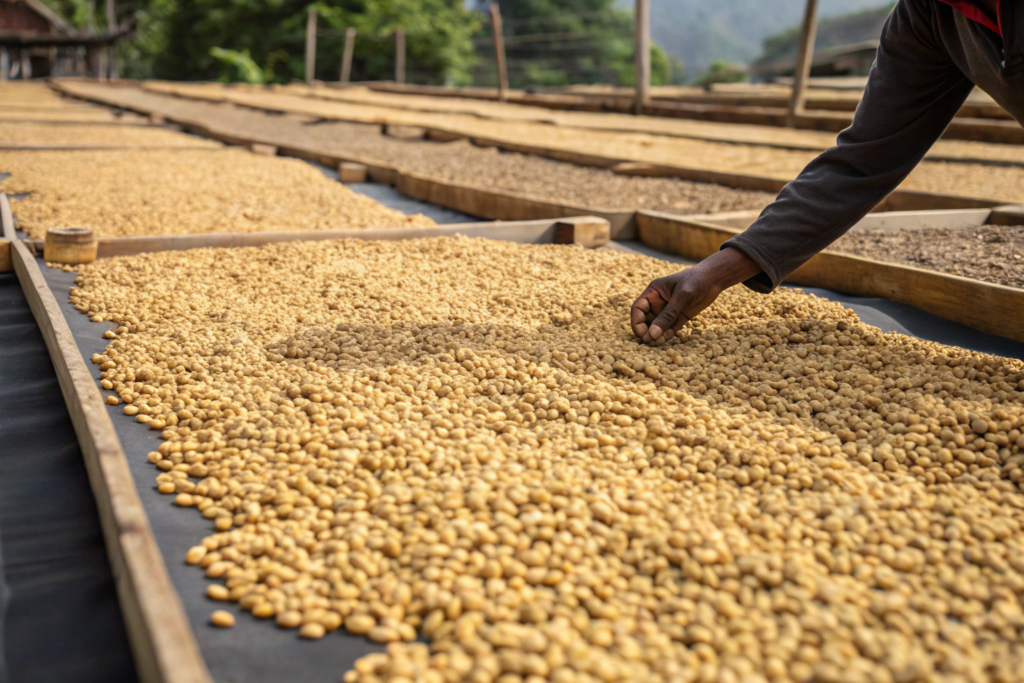
The name "honey" comes from the sticky, golden mucilage layer that coats the parchment, which looks and feels like honey during the drying process. It has nothing to do with actual honey flavor, though a well-executed honey process often produces a cup with a pronounced sweetness that reminds cuppers of honey or brown sugar. The process begins like washed: the cherry skin is removed in a depulper. But instead of fermenting and washing away the mucilage, the parchment with its mucilage intact is sent directly to the drying beds. The amount of mucilage left on the bean depends on the depulper setting and whether the beans receive a quick rinse after depulping. The mucilage then dries onto the parchment, forming a hard, sugary shell. The bean dries inside this shell over 10 to 18 days, absorbing mucilage sugars throughout the drying period.
On our plantation, we produce three honey variants. White honey uses a depulper setting that removes most of the mucilage mechanically; the remaining thin layer dries quickly and imparts a subtle sweetness and slightly fuller body than washed, with the acidity still prominent. Yellow honey retains about 50% of the mucilage and produces a visibly golden dried parchment; the cup has a distinct brown sugar sweetness, a medium body, and a stone-fruit acidity that sits comfortably between citrus and dried fig. Black honey retains nearly all the mucilage; the drying parchment is dark and almost black; the cup is heavy, syrupy, with notes of caramel, raisin, and a hint of dark berry, approaching natural complexity but with a cleaner finish. The honey spectrum gives a buyer incredible flexibility. A roaster who wants a clean, bright single-origin for filter brewing might choose our white honey. A roaster who wants a heavy-bodied, sweet espresso component might choose our black honey. Both come from the same block, the same harvest, and the same trees. The processing method is the variable.
What is the difference between white, yellow, red, and black honey coffee?
The color designations in honey processing refer to the amount of mucilage left on the parchment and the resulting color of the dried bean. White honey has the least mucilage. After depulping, the parchment is rinsed briefly with water to remove the loosest mucilage, and what remains is a thin, almost transparent film. The drying time is short—8 to 12 days—and the dried parchment appears pale, almost whiteish-tan. The cup is the closest to washed, with clean acidity and a light, tea-like body, but with a subtle, integrated sweetness that washed lacks.
Yellow honey retains slightly more mucilage and is not rinsed. The thicker mucilage layer dries to a yellow-gold color. Drying takes 10 to 14 days. The cup has a noticeable honey sweetness, medium body, and a mellow, rounded acidity. Yellow honey is, in my experience, the most versatile honey profile for roasters who want a coffee that performs well across multiple brew methods.
Red honey retains most of the mucilage. The drying parchment turns a reddish-brown as the sugars oxidize. Drying takes 14 to 18 days and requires very careful turning to prevent mold. The cup is rich, with a heavy body, notes of ripe stone fruit and caramel, and the acidity is subdued but present, like a dried cherry rather than a fresh lemon.
Black honey retains essentially all the mucilage. The depulper is set to strip only the skin, and the parchment goes to the beds with the mucilage completely intact. Drying takes 18 to 22 days, the longest and riskiest of the honey spectrum. The dried parchment is dark brown to nearly black. The cup is intensely sweet and heavy, with flavors of dark chocolate, raisin, and overripe dark berries, and the acidity is low and integrated. Black honey cups can be mistaken for naturals by experienced cuppers, but they lack the slightly fermented edge that a natural sometimes carries. The honey classification system is not standardized globally, and different producing countries use slightly different definitions. A buyer should always cup a honey sample and evaluate it against the supplier's description of the process, not against a presumed color category.
How does honey processing affect the body and sweetness compared to washed?
The body and sweetness differences between honey and washed processing are immediately apparent on the cupping table. A washed coffee typically has a light to medium body, with a mouthfeel that cuppers describe as "tea-like" or "silky." The sweetness is present—good washed coffees are sweet—but it is a clean, cane-sugar sweetness that supports the acidity rather than dominating it. A honey-processed coffee, even a white honey, has a noticeably heavier body. The mucilage sugars that dry onto the parchment and are absorbed into the bean during drying contribute both soluble solids and unfermentable sugars that survive roasting and increase the perceived viscosity of the brewed coffee.
The sweetness in a honey coffee is qualitatively different. It is often described as a "brown sugar" or "caramel" sweetness, with a depth and roundness that washed coffee rarely shows. This is a direct result of the mucilage sugar absorption and the gentle oxidation of those sugars during the longer drying period. The body increase is also a function of the mucilage polysaccharides, which contribute to the mouthfeel. A black honey, in particular, can have a body that rivals or exceeds a natural coffee, with a syrupy, coating viscosity that lingers on the palate. For a roaster who blends for espresso, honey-processed coffee is a valuable component because it adds body and sweetness without the fermented notes that a natural brings and without the sharp acidity that a washed brings. It is a bridging component that can round out an espresso blend's texture while keeping the flavor profile clean and approachable.
What Is Anaerobic Fermentation and How Is It Changing Processing Possibilities?
Anaerobic fermentation is the newest and fastest-evolving processing method in specialty coffee. Five years ago, almost no one in Yunnan was doing it. Today, our mill has a dedicated anaerobic fermentation room with temperature-controlled stainless steel tanks, and the coffee from those tanks sells out before it is even processed. Anaerobic fermentation sounds complex, but the principle is simple. In a standard washed or honey fermentation, the beans are fermented in open tanks or channels, exposed to the ambient air. This is aerobic fermentation. Oxygen is present, and the microorganisms that dominate the fermentation are aerobic bacteria and yeasts that produce a familiar spectrum of organic acids. In anaerobic fermentation, the beans—either whole cherry, depulped parchment, or anything in between—are sealed in a tank from which the air has been evacuated.
Anaerobic fermentation changes coffee flavor by eliminating oxygen from the fermentation environment, which encourages an entirely different population of microorganisms—mainly anaerobic lactic acid bacteria and specific yeast strains—to metabolize the mucilage sugars, producing lactic acid, malic acid, and unique ester compounds that create cup profiles with intense, unusual notes such as tropical fruit punch, cinnamon, clove, tiramisu, and a creamy, yogurt-like body that are unattainable through any aerobic processing method.
The flavor possibilities of anaerobic fermentation are genuinely exciting. Because the producer can control multiple variables—the temperature, the pressure, the duration, the specific bacterial or yeast inoculant, and the starting material—the flavor outcomes are far more programmable than in traditional processing. We have produced an anaerobic natural Catimor that cupped with explosive pineapple and coconut notes, a profile that would be chemically impossible to produce through standard natural drying. We have also produced an anaerobic washed lot that, despite having no mucilage sugars to ferment, developed a complex floral and spice profile from the controlled fermentation of trace carbohydrates on the parchment surface. The method is still young, and the specialty coffee world is still developing the vocabulary to describe anaerobic cups and the standards to judge them. But the direction of travel is clear. Anaerobic fermentation is not a gimmick. It is a new set of flavor creation tools that, when used with discipline, can produce cups that expand the boundaries of what coffee can taste like.
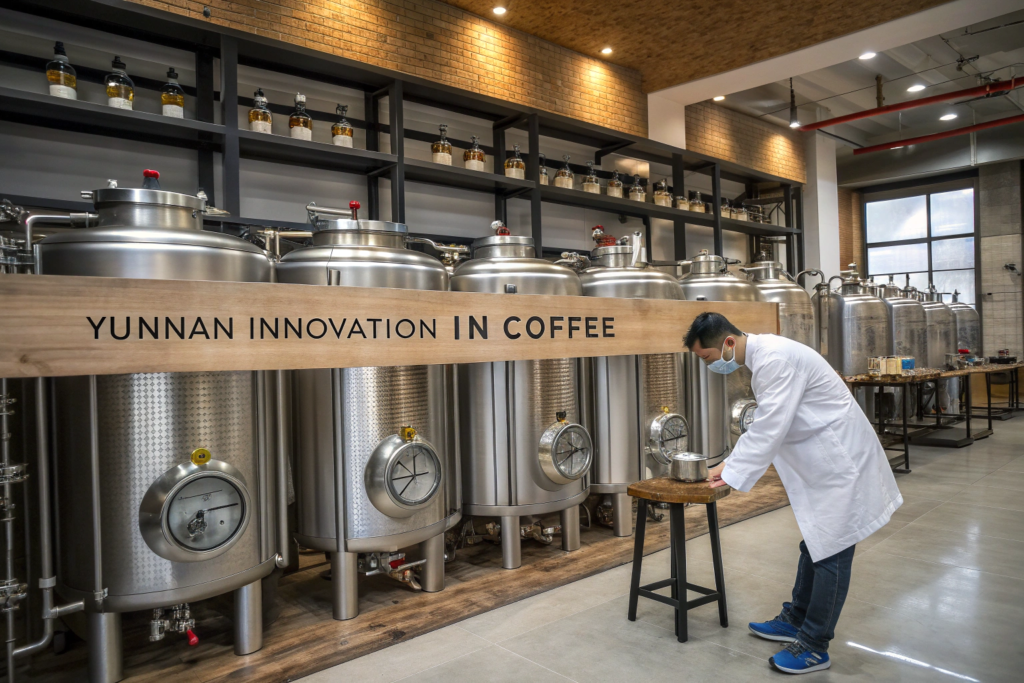
How do stainless steel tanks and temperature control improve fermentation consistency?
The move from open concrete tanks to sealed stainless steel tanks is not just about excluding oxygen. It is about controlling the fermentation environment with laboratory-level precision. Open tanks are subject to ambient temperature swings. A cool night can slow fermentation. A hot afternoon can accelerate it. The microbial population in an open tank is whatever is floating in the air that day. The result is batch-to-batch variability that, for specialty coffee, is unacceptable. Our anaerobic tanks are jacketed stainless steel vessels connected to a glycol cooling system that maintains the tank interior at a precise set temperature, typically 18°C to 22°C depending on the desired profile. The temperature is held constant for the entire fermentation duration, which we program into the tank's control system.
Inside the tank, we can also control the atmosphere. After the beans are loaded and the tank is sealed, we flush the headspace with carbon dioxide to displace any remaining oxygen. This ensures the fermentation begins in a fully anaerobic state from the first hour. A one-way airlock valve allows fermentation gases to escape without allowing external air to enter. The tank's pressure gauge tells us that anaerobic conditions are being maintained. The consistency gain from this system is remarkable. Before we had the tanks, our anaerobic lots varied noticeably between batches. With the tanks, the cup profile is reproducible within a narrow range, batch after batch. For a buyer, this means the anaerobic lot they approved from the pre-shipment sample will actually taste like the container they receive. The tanks are expensive, but they have paid for themselves through higher contract premiums and fewer rejected lots.
What unique flavor compounds develop under oxygen-free mucilage breakdown?
Under oxygen-free conditions, the metabolic pathways of the microorganisms shift. Aerobic yeast fermentation produces primarily ethanol and carbon dioxide. Anaerobic lactic acid bacteria produce lactic acid, which has a smooth, creamy, yogurt-like acidity rather than the sharp, vinegary acidity of acetic acid produced by aerobic Acetobacter species. The lactic acid contributes to the heavy, creamy body that is a hallmark of many anaerobic coffees. Other anaerobic bacteria produce malic acid, which contributes a green-apple-like acidity that is qualitatively different from the citric acidity of washed coffees.
The most interesting compounds, however, are the esters. Esters are volatile aromatic molecules formed when an alcohol reacts with an organic acid. In an anaerobic fermentation, the ethanol produced by yeasts reacts with the various organic acids present—lactic, malic, citric, and others—to form a wide range of esters that did not exist in the original cherry or bean. Some of these esters smell and taste intensely fruity—isoamyl acetate, for example, smells like banana and pear. Others have spicy, floral, or creamy aromas. The specific ester profile depends on the fermentation temperature, the duration, the mucilage sugar concentration, and the specific microbial strains present. The producer can influence this profile by inoculating the tank with a known starter culture of a specific yeast or bacteria strain, analogous to the way a winemaker selects a yeast strain for a particular wine style. The controlled production of esters is, in my view, the frontier of coffee processing. It is where coffee processing moves from a subtractive craft—removing the fruit to reveal the bean—to an additive one—using fermentation to create new flavor compounds that nature did not put in the cherry.
Conclusion
The processing method is not a post-harvest detail. It is the single most powerful flavor creation tool that a coffee producer controls. Washed processing strips the fruit away and reveals the bean's intrinsic character—its acid profile, its floral notes, its terroir-driven clarity. Natural processing locks the bean inside the drying cherry and infuses it with the fruit's sugars and aromatics, producing a cup that is heavy, fruity, and complex. Honey processing occupies the entire spectrum between these two poles, offering a graduated control of body and sweetness through the amount of mucilage retained during drying. Anaerobic fermentation opens a new frontier, using oxygen-free environments and controlled microbiology to produce flavor compounds that traditional methods cannot create. Each method is a different lens through which the same coffee variety, grown on the same land, expresses a completely different personality.
For a buyer, understanding these methods is not academic. It is the difference between ordering a washed Yunnan Arabica and getting a clean, bright filter coffee, versus ordering a natural Yunnan Arabica and getting a fruit-bomb espresso blend. The processing method should be specified in the contract with the same precision as the variety, the screen size, and the cupping score. A supplier who can articulate their processing protocols, show their equipment, and provide batch-level processing data is a supplier who treats coffee as a crafted product, not a commodity.
If you are a roaster or importer interested in tasting the processing spectrum from a single Chinese origin, our team at BeanofCoffee can prepare a sample set that includes our washed, natural, honey, and anaerobic lots from the same Baoshan plantation, each cupped and documented with the specific processing parameters used. Contact our export quality lead, Cathy Cai, at cathy@beanofcoffee.com. Let us send you the same beans, processed four different ways, and let the cupping spoons do the explaining.