I will tell you about the first time I recommended an escrow service to a nervous buyer. It was 2022, and a small-batch roaster from Portland, Oregon, had found us through our website. He wanted to buy a single pallet of our Baoshan specialty Arabica—about ten 60-kilogram bags, a modest order worth around $8,500. But he had never imported coffee from China before. He had read horror stories online about prepayments disappearing into foreign bank accounts, about containers that never materialized, about sellers who stopped answering emails the moment the wire transfer cleared. He wanted to work with us, but he was genuinely scared. "I cannot afford to lose this money," he told me over a video call, his face tense. "My business is too small to survive a fraud." I understood completely. So I suggested something I had used before on the buying side: an escrow service. We set up the transaction through a third-party escrow platform. The buyer deposited his funds into the escrow account. We shipped the coffee. He received it, cupped it, confirmed it matched the pre-shipment sample, and released the funds. The entire process added about $120 in fees and gave him ten weeks of peaceful sleep. That buyer has since placed five more orders with us, and we have not used escrow again because the trust has been built. But that first transaction would not have happened without it.
An escrow service protects a first-time coffee buyer by holding the purchase funds in a secure, neutral third-party account until the supplier ships the agreed goods and the buyer confirms their satisfactory receipt, eliminating the risk of prepayment fraud while also assuring the supplier that the buyer has the funds committed and available, creating a bridge of financial trust between two parties who have no transaction history.
First-time cross-border coffee purchases carry a specific kind of tension. The buyer does not know the supplier. The supplier does not know the buyer. The distances are vast. The legal systems are different. The product is a natural agricultural commodity that can legitimately vary within a range. In this environment, escrow is not a sign of distrust. It is a practical tool that allows both parties to proceed with a transaction that might otherwise be too risky for the buyer to attempt and too uncertain for the supplier to prioritize. In this article, I want to explain from my side of the table—the Chinese supplier—how escrow works for coffee purchases, which platforms are available, how the shipping and inspection timeline fits into the escrow process, and how to open a conversation with a supplier about using escrow without offending them.
What Exactly Is a Trade Escrow Service and How Does It Work for Coffee?
Most people have heard the word "escrow" in the context of real estate—a neutral third party holds the buyer's deposit until the property sale closes. Trade escrow works on the same principle but is adapted for physical goods. In a coffee transaction, the escrow service acts as a trusted intermediary. The buyer sends the agreed purchase amount to the escrow service, not to the supplier directly. The escrow service confirms to the supplier that the funds are secured in a segregated account. The supplier then ships the coffee, knowing the money exists and will be released once the buyer is satisfied. The buyer, in turn, knows the supplier cannot access the funds until the agreed conditions are met.
A trade escrow service for coffee works in four sequential stages: the buyer and seller agree on the transaction terms and register those terms on the escrow platform; the buyer transfers the full purchase amount to the escrow service's designated account; the supplier ships the coffee and uploads the shipping documents—bill of lading, commercial invoice, packing list, and phytosanitary certificate—to the platform as proof of shipment; and after the buyer receives the coffee and completes an inspection within an agreed timeframe, the buyer confirms acceptance and the escrow service releases the funds to the supplier.
The critical feature of this system is that the release of funds is conditional. The escrow service does not decide unilaterally when to release. It follows the instructions agreed upon by both parties at the start of the transaction. The most common condition for release is buyer confirmation after a specified inspection period. If the buyer confirms acceptance, the funds are released. If the buyer raises a dispute within the inspection period, the funds remain in escrow while the parties attempt to resolve the issue or while the escrow platform's dispute resolution process is activated. The escrow service is not a quality arbitrator. It is an escrow agent. Its job is to hold funds securely and follow the agreed release conditions. This is distinct from a letter of credit, where banks examine documents for compliance, or from an inspection company, which evaluates quality. Escrow handles the money. Other mechanisms handle the verification.
How does Alibaba Trade Assurance compare to an independent escrow platform?
Alibaba Trade Assurance is the escrow-like service that most first-time buyers of Chinese goods encounter. It is integrated into the Alibaba.com platform and offers a buyer protection program that holds payment until the buyer confirms satisfactory receipt of the goods. For a coffee buyer, Alibaba Trade Assurance has some advantages. It is widely used, the interface is available in English, and the dispute resolution process, while imperfect, is well-established. If a supplier has a verified Alibaba Gold Supplier account with Trade Assurance enabled, the buyer has a reasonably functional protection mechanism built into the ordering process directly on Alibaba.
However, Trade Assurance has limitations for coffee transactions. The inspection period is often shorter than what is practical for a thorough coffee quality evaluation, which requires cupping and possibly resting the beans for a few days after shipment. The dispute resolution process relies on Alibaba's internal mediation team, which may not have deep expertise in green coffee quality standards, cupping protocols, or the difference between a legitimate quality variation and a defective lot. For a straightforward transaction—a standard-grade coffee bought on the Alibaba platform from a supplier with a strong track record—Trade Assurance is a reasonable starting point.
An independent escrow platform, such as Escrow.com or a specialist trade escrow provider, offers more flexibility. The buyer and seller can customize the inspection period to match the realities of coffee quality evaluation—typically 5 to 10 business days after delivery. The transaction is not tied to a marketplace platform, so the buyer and seller can negotiate their own contract terms outside of any platform's standard terms of service. The escrow provider is a neutral financial intermediary, not a marketplace operator with its own commercial interests. For a buyer placing a larger order—say, a full container load—or a transaction involving a tailored quality specification, an independent escrow service provides a more customizable framework than Alibaba Trade Assurance. The fee structure also differs slightly, with independent platforms typically charging a percentage of the transaction value as an escrow fee, which can be split between buyer and seller per their agreement.
What are the typical escrow fees, and who should bear them?
Escrow fees are generally calculated as a percentage of the total transaction value, with a tiered structure that decreases as the transaction amount increases. For a coffee transaction in the $5,000 to $50,000 range—which covers a single pallet to a small container load—the escrow fee is typically between 0.5% and 1.5% of the transaction amount, with a minimum fee floor that varies by platform. For a transaction at the lower end of the scale, the minimum fee may be proportionally higher as a percentage. Using a widely known escrow provider as a reference point, a transaction value of $10,000 would typically incur a fee of approximately $80 to $120. A transaction of $50,000 might incur a fee of $250 to $500. These fees are transparently quoted on the escrow provider's website before the transaction is initiated. There are no hidden charges, though international wire transfer fees to and from the escrow account are separate and paid to the banks, not the escrow provider.
The question of who bears the escrow fee is a matter of negotiation. In my transactions, I usually propose splitting the fee equally between the buyer and the supplier. This split signals that both parties value the protection the escrow provides and both are investing in building the trust foundation for the relationship. The buyer is protecting their funds against non-delivery. The supplier is protecting their time and inventory against a buyer who might otherwise place an order and then fail to pay. Both benefit, so a 50/50 split is equitable. Some buyers prefer to absorb the full fee as a gesture of good faith, and some suppliers offer to cover it entirely to close the deal. There is no industry standard, only what the two parties agree upon. The escrow fee is negligible compared to the risk it mitigates. A buyer who loses a $10,000 prepayment has lost not just the money but the cost of the lost production time, the missed customer commitments, and the emotional toll. A $100 escrow fee is, in that context, one of the best-value insurance policies in international trade.
How Should a First-Time Buyer Structure the Escrow Inspection Period?
The inspection period is the operational heart of an escrow agreement for a coffee purchase. It is the window of time, measured from the delivery of the coffee to the buyer's warehouse, during which the buyer must evaluate the beans and either accept or reject the shipment. Set this window too short, and the buyer does not have enough time to rest, roast, and cup the coffee properly. Set it too long, and the supplier is left waiting for funds while the coffee sits in the buyer's warehouse, potentially deteriorating if storage conditions are suboptimal. The correct inspection period balances the practical needs of quality evaluation against the supplier's legitimate need for timely payment.
A properly structured escrow inspection period for green coffee should be 7 to 10 calendar days from the date of delivery to the buyer's warehouse, which allows sufficient time for the beans to rest for 24 to 48 hours after transit, for the buyer to roast and cup the coffee at least twice across different roast profiles, and for a physical grading and moisture check to be completed, while also being short enough that the supplier is not left waiting for an unreasonably long period for funds release.
I have learned from experience that five calendar days is too tight. The coffee may arrive on a Monday afternoon. The buyer needs time to unload, to let the beans rest, to schedule a roast, and to cup the roasted coffee with a rested palate. If the buyer cups on Friday and finds a concern, that leaves no business days within the window to discuss the concern with the supplier before the escrow auto-releases. A 7-day window gives one full week; 10 days gives two full business weeks, which comfortably accommodates at least two cupping sessions and a physical grading. I have also seen 14-day windows used for very high-value specialty lots where the buyer wants to roast and cup across multiple profiles and possibly send a sample to an external lab for a second opinion. The 14-day window is at the upper limit of what I, as a supplier, consider reasonable for a first transaction. Beyond 14 days, the supplier's working capital is tied up for too long, and the coffee itself is aging in the buyer's custody. The agreed inspection period must be specified in the escrow transaction terms. The clock starts from the date of delivery, as confirmed by the courier or freight tracking system. The buyer must initiate any dispute within the inspection period, in writing on the escrow platform, with supporting evidence such as cupping score sheets and photographs of any physical defects. If no dispute is raised within the window, the escrow service automatically releases the funds to the supplier.
What quality metrics should trigger an escrow dispute for green coffee?
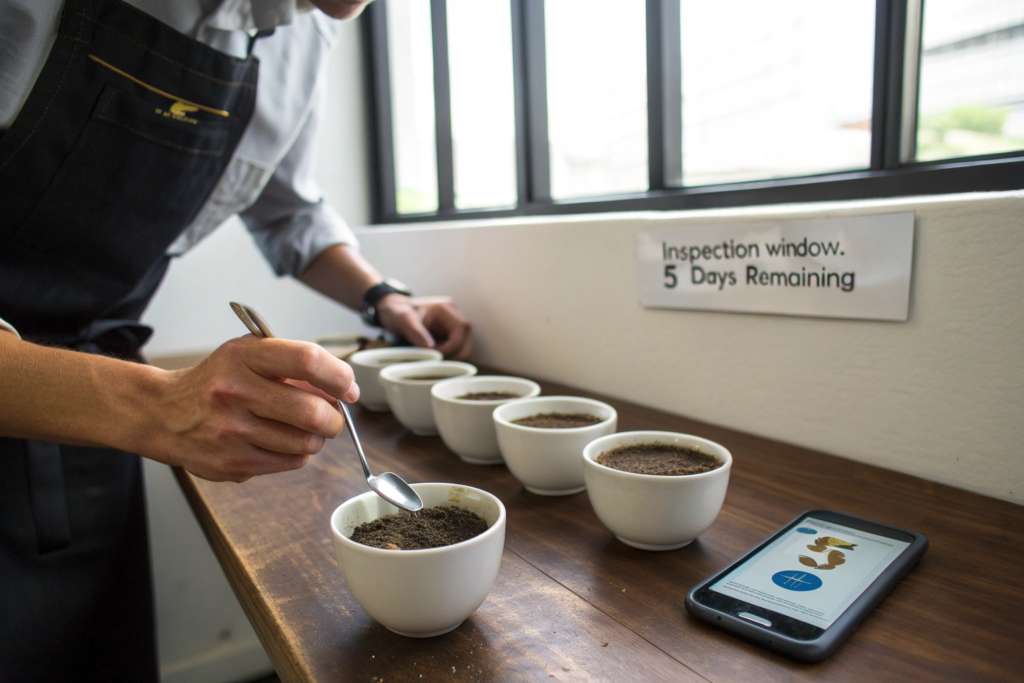
Not every minor variation from the pre-shipment sample should trigger a dispute. Coffee is an agricultural product, and some cup score variation between the pre-shipment sample and the arrival sample is normal, particularly after ocean transit. A dispute should be triggered only by material, documentable deviations from the agreed specifications. The specific metrics that constitute a material deviation should be defined in the supply contract before the escrow transaction is initiated. Commonly, these metrics include a cupping score that falls more than two points below the agreed minimum under SCA cupping protocol, a moisture content that exceeds the agreed maximum by more than 0.5 percentage points, a defect count that exceeds the specified grade threshold, or the presence of foreign matter or mold that renders the coffee unroastable.
If the pre-shipment sample was cupped at 84.5 and the arrival sample cups at 83, that is within the range of normal transit variation and should not trigger a dispute under a two-point threshold clause. If the arrival sample cups at 81, that is a material deviation. The dispute should be filed with the escrow service before the inspection window closes, and the supporting evidence—the cupping score sheet from a qualified cupper, the moisture meter reading, the defect count log—must be uploaded to the escrow platform. The escrow service will then hold the funds in a disputed status. The parties then enter into a resolution process: either a mutual negotiation leading to a price adjustment and partial release, or a third-party cupping of the retained sample, or, as a last resort, the escrow service's formal dispute resolution procedure. The key is that the metrics are objective, measurable, and agreed upon upfront. A dispute based on "I don't like the taste" will not be resolved efficiently. A dispute based on "the cupping score is below the contract minimum as verified by an SCA-certified cupper" is a factual claim that the escrow resolution process can handle.
Can a buyer extend the inspection window if cupping results are delayed?
Yes, but only by mutual written agreement before the original inspection window expires. The escrow service will not extend the window unilaterally at the buyer's request. The buyer cannot simply fail to act and expect the window to extend automatically. If the original window expires without a dispute being filed, the funds are released, and the transaction is closed. If the buyer anticipates a delay—for example, the cupping lab is backed up, or the buyer's head roaster is out sick—the buyer must contact the supplier before the window closes and request an extension. If the supplier agrees, both parties sign an amendment to the escrow instructions extending the window by a specified number of days, and the escrow service updates the timeline. If the supplier does not agree, the original window stands, and the buyer must make a decision within the remaining time.
In practice, I typically agree to reasonable extension requests. A buyer who communicates proactively that they need two more days to complete a thorough evaluation is operating in good faith. A buyer who goes silent until the day the window closes and then demands an extension is harder to trust. The escrow process, like any trade mechanism, works best when both parties communicate openly. The buyer should notify the supplier as soon as a delay is foreseen. The conversation is usually straightforward: "Our cupping lab confirmed they cannot run the analysis until Thursday. Can we extend the window by 48 hours?" For a supplier, a two-day extension is almost always preferable to a premature dispute that could have been avoided with more information. The escrow platform's messaging system facilitates this communication on the record.
Which Escrow Platforms Are Practical for International Coffee Transactions?
There is no single escrow platform that dominates the green coffee trade. The coffee industry, particularly at the specialty level, still relies heavily on direct relationship-based transactions, letters of credit for large volumes, and spot market terms. Escrow is used primarily for first-time transactions, smaller volumes, and scenarios where the trust deficit between buyer and supplier is high. Several platforms serve this function effectively. The choice depends on the transaction size, the degree of customization the parties need, and the countries involved.
The most practical escrow platforms for international coffee transactions are Alibaba Trade Assurance for buyers sourcing through the Alibaba.com marketplace, Escrow.com for independent transactions where the parties negotiate their own contract outside any marketplace platform, and for European buyers, specialized trade escrow services that operate under European payment services regulation and support EUR-denominated transactions, each offering a slightly different fee structure and dispute resolution process.
Alibaba Trade Assurance is the easiest entry point for a buyer who has found the supplier through Alibaba.com. The platform integration is seamless, the mobile app supports transaction tracking, and the supplier is already familiar with the system. The limitation, as discussed, is the relative inflexibility of the inspection period and the generalist nature of the dispute resolution. Escrow.com is the largest independent escrow provider and supports transactions in a wide range of currencies, including USD and EUR. It is not tied to a marketplace, so the buyer and supplier must upload their own contract terms. The platform allows the parties to specify the inspection period in days and attach a detailed description of the goods. Its fee structure is transparent and publicly available. For a standalone transaction outside of Alibaba, Escrow.com is a practical choice that both parties can verify and trust. For European buyers, there are also regional escrow providers regulated under European financial services law, which may offer additional consumer protections and support SEPA-based payments, reducing wire transfer friction.
How does the escrow process integrate with ocean freight shipping timelines?
Ocean freight introduces a timing challenge for escrow because the escrow inspection clock cannot start until the goods are physically delivered to the buyer. A typical ocean shipment from Shanghai to the U.S. West Coast takes 14 to 18 days of vessel transit, plus a few days for port discharge, customs clearance, and final truck delivery. The total elapsed time from the supplier's loading of the container to the buyer's receipt can be four to six weeks. The buyer's funds are held in escrow during this entire period. From the supplier's perspective, this is a significant working capital gap. The coffee has left my warehouse, I have paid the freight and the documentation fees, and I will not receive payment for another month or more. This is why some suppliers resist escrow for container-load transactions—not because they intend to defraud, but because the working capital burden is heavier than with a letter of credit or a prepayment arrangement.
The escrow process integrates with ocean freight by using the bill of lading as the milestone that triggers the transit phase of the escrow. Once the container is loaded and the bill of lading is issued by the shipping line, I upload a copy to the escrow platform as proof that the goods have been shipped. The escrow status updates to "Goods Shipped," and the buyer can see that the transaction is progressing. The inspection clock, however, does not start at the bill of lading upload. It starts at delivery confirmation. The buyer accepts this timing because the escrow funds are secure regardless of how long the ocean voyage takes. For a supplier, the working capital pressure of a long escrow hold can be partially mitigated by negotiating a partial advance payment outside of escrow for the freight cost specifically, with the remaining balance placed in escrow. This hybrid structure gives the supplier some cash flow to cover shipping costs while retaining the buyer's main purchase protection.
What payment methods fund an escrow account, and are there hidden costs?
Escrow platforms typically accept bank wire transfers as the primary funding method. The buyer receives wiring instructions for the escrow service's designated client trust account at a regulated bank. The buyer initiates the transfer from their own bank. The funds land in the escrow account, and the escrow platform confirms receipt. Wire transfers are the standard because they provide finality of settlement. Credit card funding is also available on some platforms, including Alibaba Trade Assurance and Escrow.com, but usually with a higher processing fee—typically around 3% of the transaction value—to cover the card network charges. For a $10,000 transaction, the credit card convenience premium would be roughly $300. That premium may be acceptable for a buyer who wants the speed and the additional layer of chargeback protection, but for larger transactions, the wire transfer route is almost always more economical.
There are no hidden costs in a legitimate escrow service. The fee is disclosed before the transaction begins. The fee is the escrow fee, either a flat fee or a percentage. The buyer also pays their own bank's outgoing wire fee. The supplier pays their own bank's incoming wire fee when the funds are released. There may be a currency conversion cost if the escrow service operates in a currency different from the buyer's funding currency or the supplier's receiving currency. This is not an escrow fee; it is a bank spread or a platform conversion fee, and it should be clearly disclosed. A buyer should read the escrow provider's fee schedule carefully and, if the transaction is large enough that the currency spread matters, ask the provider for a written estimate of the total conversion cost before initiating the transfer. A legitimate provider will provide this without hesitation.
How Do You Initiate an Escrow Conversation with a New Supplier Without Causing Offense?
Raising the topic of escrow with a new supplier requires some social intelligence. A buyer who opens the conversation with "I don't trust you, so I want to use escrow" has started the relationship on a note of accusation. The supplier, who may be perfectly honest and proud of their product, will understandably bristle. The conversation should be framed not as a matter of personal trust, but as a matter of mutual risk management in a first-time cross-border transaction. I have received this request from buyers many times, and when it is framed well, I do not take offense. When it is framed poorly, it still does not offend me—I understand the buyer's anxiety—but not all suppliers are equally thick-skinned.
The most effective way to propose escrow to a new supplier is to frame the request around "our company's standard first-transaction policy" rather than around a concern about the supplier specifically, to emphasize that the escrow protects both parties equally by confirming the buyer's financial capacity, and to offer to split the escrow fee as a gesture of shared investment in the relationship, presenting escrow as the bridge that enables the relationship to begin, not as a barrier that suggests suspicion.
I recommend wording the proposal along these lines: "For our first transaction with a new international supplier, our company policy is to use a third-party escrow service. This protects both of us—it confirms to you that our funds are secured and committed, and it gives us the standard buyer protection during the inspection period. We are happy to split the escrow fee. The platform we suggest is Escrow.com, but we are open to another platform you have experience with. Once we have completed one transaction successfully, we can move to direct payment terms for future orders." This framing accomplishes several things. It depersonalizes the request by attributing it to company policy. It highlights the mutual benefit. It offers to share the cost. It signals that the escrow is a temporary measure, not a permanent vote of no confidence. And it opens the door to the supplier's platform preference, showing flexibility. A legitimate, experienced supplier will recognize this proposal as reasonable and commercially standard. A supplier who reacts with anger, indignation, or a flat refusal without offering an alternative like a letter of credit may be revealing more about their own reliability than they intend.

How can the escrow discussion reveal the supplier's true experience and professionalism?
The way a supplier responds to an escrow proposal is, in itself, a valuable piece of due diligence. A professional, experienced supplier will have a ready response. They may say, "Yes, we use Escrow.com and here is our account," which indicates prior experience and smooth operational integration. They may say, "We prefer Alibaba Trade Assurance because that is where our verified account is," which is also a sign of established platform presence. They may say, "We do not have an escrow account yet, but we are willing to set one up for this transaction," which indicates flexibility and a willingness to invest in the relationship, even if they are new to the escrow mechanism specifically.
A less professional response is silence, followed days later by a vague statement that escrow is "too complicated." A frank supplier might explain that escrow creates a working capital burden for container-load shipments, which is a legitimate concern, and then offer a compromise: a smaller trial shipment on escrow terms, or a partial prepayment with the balance against scanned documents. This kind of negotiation is a green flag. It shows the supplier is thinking commercially and wants to find a solution that works for both sides. The absolute red flag is a supplier who becomes aggressive, accuses the buyer of bad faith, or insists that the only acceptable terms are 100% prepayment by wire transfer with no protection. That supplier is not willing to share any financial risk, and the buyer should walk away. The escrow conversation is a litmus test. The response reveals, in a single exchange, whether the supplier approaches the relationship as a partnership or as a one-sided extraction.
What alternative protections can a supplier offer if they genuinely cannot use escrow?
Not every legitimate supplier can use an escrow service. Some smaller producers in origins like Yunnan may operate through provincial export agents and do not have direct control over the transaction structure. Some suppliers may be locked into existing banking arrangements that make escrow logistically difficult. If the supplier cannot use escrow but is genuinely committed to finding a way to protect the buyer's first transaction, there are alternatives. The most straightforward is a letter of credit, or LC, issued by the buyer's bank and confirmed by a major Chinese bank. An LC eliminates the prepayment risk entirely, because the supplier is paid by the bank upon presentation of compliant shipping documents. The cost of the LC—typically 0.5% to 1% of the transaction value—is usually borne by the buyer, and it requires the buyer to have a credit line with their bank, which may not be available to a smaller roaster. But for larger first orders, an LC is the established international trade instrument that does exactly what escrow does: it bridges the trust gap with a bank's guarantee.
Another alternative is a smaller trial shipment on a documents-against-payment basis, where the supplier ships the coffee and the buyer pays when the original shipping documents arrive at the buyer's bank. This does not require prepayment, though the supplier carries the working capital burden until payment. A supplier willing to offer DAP terms for a first small shipment is demonstrating significant trust in the buyer. A third alternative is a performance bond or a standby letter of credit issued by the supplier's bank, which guarantees the buyer's prepayment will be refunded if the supplier fails to ship. This instrument is more common in large commodity contracts but is structurally available for coffee transactions. A supplier who offers any of these alternatives—an LC, a DAP trial, a standby LC—is showing that they understand the buyer's need for protection and are willing to meet it through a different mechanism. The specific instrument matters less than the supplier's demonstrated willingness to share the financial risk of the first transaction. That willingness is the true signal of a long-term partner.
Conclusion
Using an escrow service for a first-time coffee purchase from China is not a sign of distrust. It is a sign of commercial maturity. It acknowledges the reality that international trade involves risk, that the risk is not evenly distributed in a prepayment arrangement, and that a first transaction between strangers requires a financial bridge. The escrow process is simple in concept: the buyer deposits funds, the supplier ships, the buyer inspects, and the funds are released. The details that make it work in practice are the length of the inspection period, the definition of material quality deviations, the choice of platform, and the framing of the initial conversation with the supplier. All of these details can be managed with a small amount of preparation and a collaborative attitude.
The buyers who use escrow successfully are the ones who approach it as a partnership tool, not as a weapon. They communicate clearly with the supplier about why they want to use escrow for the first order. They agree on objective quality metrics before the transaction begins. They inspect the coffee promptly upon arrival and either accept or raise a documented dispute within the window. They understand that escrow is not a permanent condition but a stepping stone to direct, trust-based payment terms for future orders. The suppliers who accept escrow, myself included, are the ones who see a first-time buyer's caution not as an insult but as an opportunity to prove that we are exactly as reliable as we claim to be.
If you are a roaster or importer considering your first coffee purchase from our plantation in Yunnan, and you want to use an escrow service to secure the transaction, we at BeanofCoffee are ready to work with you on that basis. Our export director, Cathy Cai, can walk you through the escrow platform options we support, provide our escrow transaction terms template including the inspection period and quality metrics, and set up the transaction on the platform you prefer. Contact Cathy directly at cathy@beanofcoffee.com. Let us turn a cautious first transaction into the start of a confident, long-term coffee partnership.