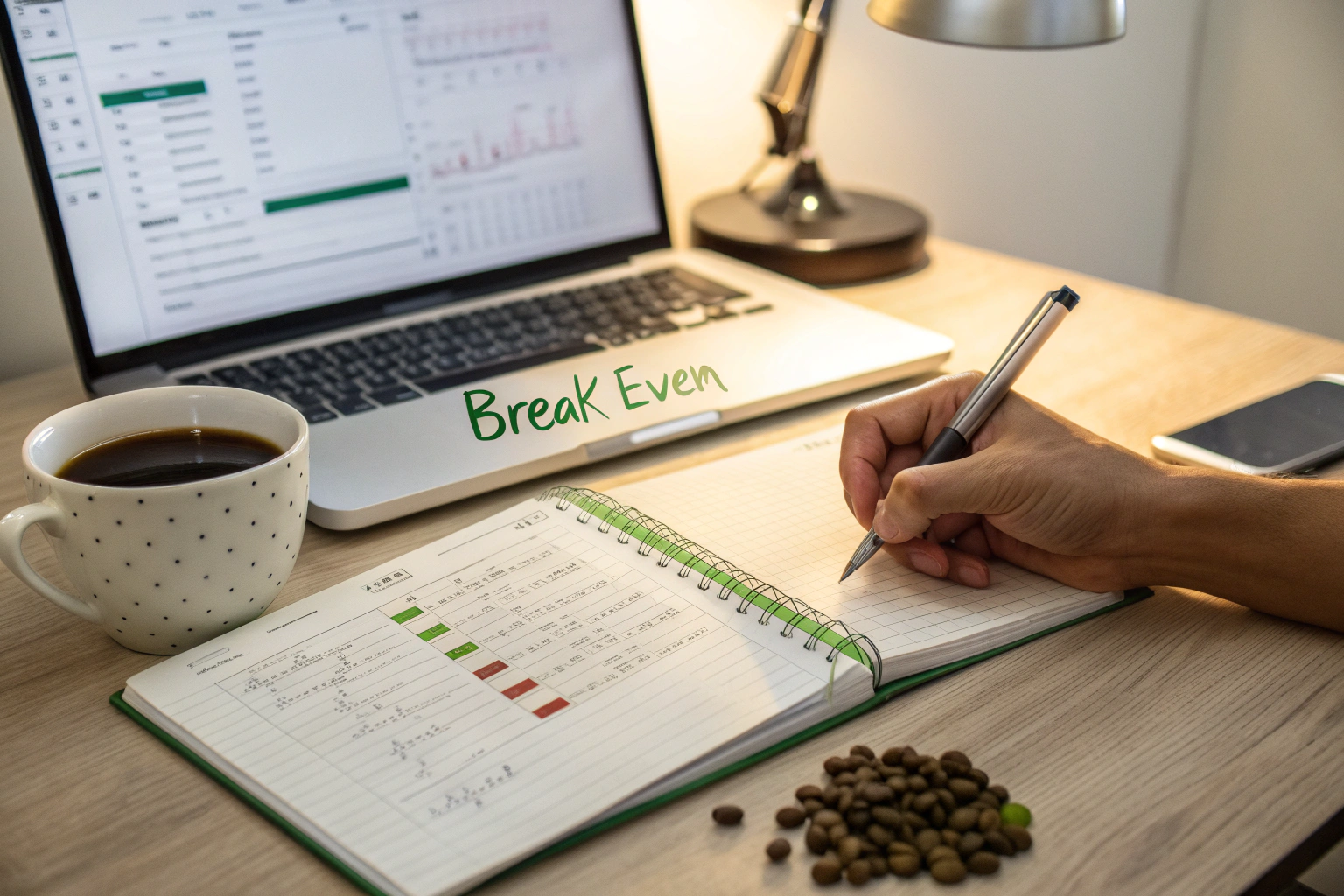
You are staring at your laptop. You have an invoice in front of you for a full container of green coffee. It is a lot of money. A single 20-foot container holds roughly 19,000 kilograms of coffee. That is a serious commitment. Your heart is racing a little. You know the math has to work, or your business is in real trouble. So you pull up a spreadsheet. You plug in the green coffee cost, the freight, the roasting loss, and the packaging. The numbers are big and a bit scary. You wonder, "How many bags do I actually have to sell before this container stops being a liability and starts making me money?" The fear of miscalculation is real. One wrong assumption, and you could be sitting on pallets of coffee for months, burning cash on storage and lost opportunity.
The break-even point on a full container is the single most important calculation in your coffee business. It is the invisible line between risk and reward. It tells you exactly how much coffee you need to sell, at what price, to recover every dollar you spent. After that point, every bag sold is pure profit. The calculation is not wildly complex, but it demands brutal honesty about your costs. You cannot ignore the small things. The pallet fee. The shrink from sampling. The free bags you give to influencers. Everything must be accounted for.
When you buy a container directly from a farm like Shanghai Fumao, you have a massive advantage in this calculation. Your landed cost per pound is significantly lower than buying through a traditional importer. This lower base cost shifts your break-even point dramatically. You might need to sell 500 fewer bags to break even compared to a similar container bought from a broker. That is the power of direct sourcing. It turns a risky, high-stakes gamble into a calculated, manageable business decision. Let me show you how to run these numbers with precision. Let's take the fear out of the spreadsheet and turn the container into your most profitable asset.
What Is the All-In Landed Cost for a Full Container of Specialty Coffee?
Your break-even calculation starts and ends with the all-in landed cost. This is the total amount of money that leaves your bank account to get the container from the farm to your roastery door. It is not just the FOB price. It is the FOB price plus every single logistics, customs, and delivery charge. You must capture every dollar. The components start with the coffee itself. A full container of 19,000 kilos of washed Yunnan Arabica at a direct farm price. Then, the freight forwarder charges. Ocean freight from Shanghai to a U.S. port. Marine insurance. The origin documentation fees. The destination charges at the port. The customs bond and clearance. The duties and merchandise processing fee. The trucking from the port to your door. The cost of the pallets.
You add all of this up to get a single number: Total Landed Cost. Let's say, for a realistic example, your all-in DDP cost from us is $3.00 per kilogram. That includes everything. For a full 19,000-kilo container, your total cash outlay is $57,000. You now have 41,887 pounds of green coffee in your warehouse. Your effective green cost is $1.36 per pound. This is your foundational number. Every subsequent calculation rests on it. If this number is wrong, your entire plan crumbles. It must be precise. It must come from a binding quote, not a casual estimate. We provide firm DDP quotes that lock in all these variables so your spreadsheet is built on a rock, not on sand. For a detailed breakdown of import costs, the U.S. Customs and Border Protection website offers guidance on duties and fees, though green coffee is currently duty-free.
How Do Weight Loss and Shrinkage Affect My Usable Inventory?
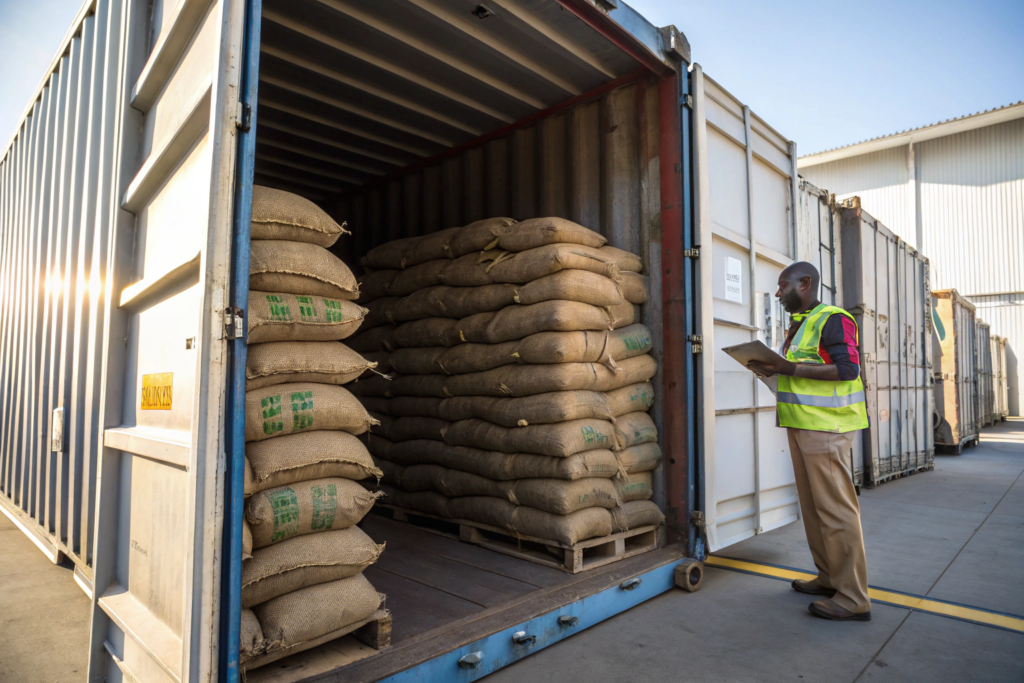
You bought 19,000 kilos. You do not have 19,000 kilos to sell. Weight loss during roasting is the biggest reduction. Green coffee is roughly 10% to 12% water. Roasting evaporates most of this moisture. Additionally, a small amount of dry matter is lost as chaff and volatile organic compounds. A standard weight loss range is 15% to 18%, depending on your roast level. If you roast to a medium profile, assume 16% loss. Your 41,887 pounds of green become approximately 35,185 pounds of roasted coffee. This is your roaster's yield.
But you are not done losing coffee. You have shrinkage from the roasting process. A small amount of beans will be lost to scorching, tipping, or just falling on the floor. You will pull samples for quality control. You will send free samples to potential wholesale clients. You might have a few bags returned or damaged. This is operational shrinkage. A good rule of thumb is to assume an additional 2% to 3% loss of the green weight to these factors. This reduces your saleable yield further. Your 35,185 pounds of theoretical roasted coffee becomes more like 34,100 pounds of actual, bagged, ready-to-sell coffee. This is the real inventory you have to work with. Use this number to calculate your break-even, not the original green weight. Overestimating your saleable yield is a classic and costly mistake. It makes you think you have broken even when you are still deep in the red. The Specialty Coffee Association's roasting resources offer standard yield calculation formulas that help benchmark your performance.
What Are the Hidden Carrying Costs of a Large Inventory?
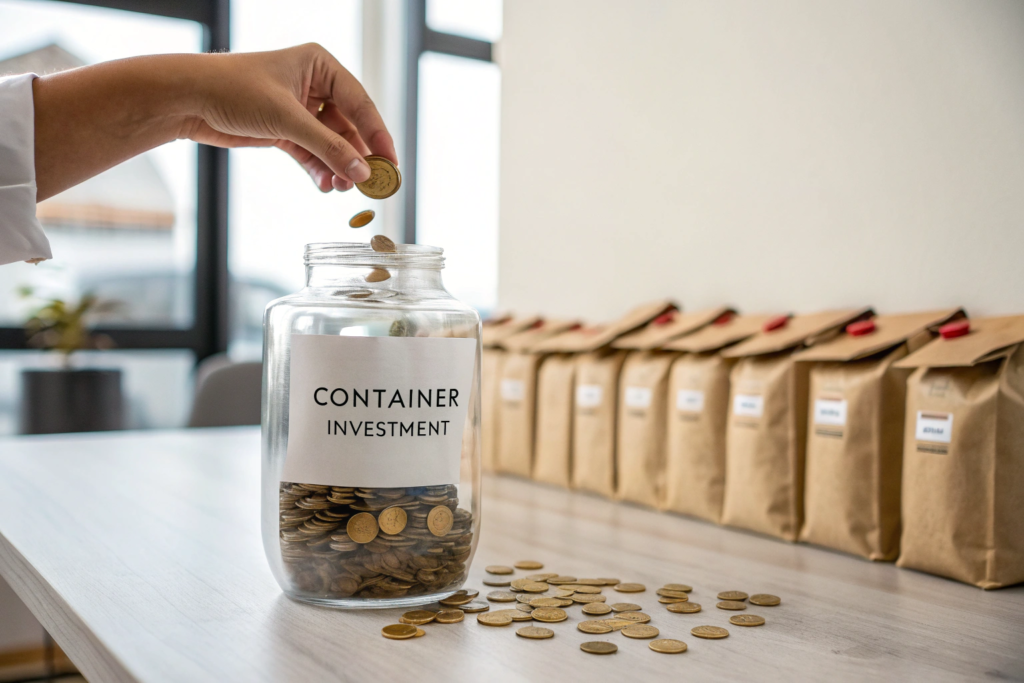
The container is on your floor. The clock is ticking. Every day that coffee sits in your warehouse, it is costing you money. This is the carrying cost. The first and most obvious is the capital cost. You spent $57,000 to buy the container. That money is now tied up in physical inventory instead of earning interest in a bank or being used for marketing. The second cost is physical storage. You are paying rent for your warehouse space. You must allocate a portion of that monthly rent to the coffee.
The third and most insidious cost is quality degradation. Green coffee is a preserved agricultural product, not a non-perishable good. It will slowly lose freshness. The vibrant acidity will mellow. The aromatics will fade. If you hold the coffee for more than 9 to 12 months, even in perfect GrainPro storage, it will begin to taste flat. You risk having to discount the coffee or, worse, lose customer trust by selling a past-peak product. This potential discount is a real carrying cost. You must include a target sell-through period in your break-even model. If you plan to sell the container over six months, the carrying cost is manageable. If it drags to twelve months, the risk of quality loss and associated discounting increases your effective cost per pound. Calculate a monthly storage and capital cost and add it to your model. A fast sell-through is not just a cash-flow goal. It is a quality goal.
How Many Units Must I Sell to Recover the Initial Investment?
Now we get to the heart of it. You know your total cost and your saleable yield. Now you divide that cost across your product lines. You must decide your product mix. Are you selling 12-ounce retail bags? 5-pound wholesale bags? Cold brew concentrate? The break-even calculation uses a weighted average price and cost. Let's assume your entire container will be sold as 12-ounce retail bags. Your saleable yield is 34,100 pounds. That is 45,466 bags of 12 ounces. Your total all-in cost, including a small monthly warehousing allocation, is $58,000. Your simple break-even cost per bag is $58,000 divided by 45,466 bags. That is $1.28 per bag. You must sell the bag for more than $1.28 to make a profit on the coffee itself.
But the bag and the label cost money. The roasting labor costs money. The shipping label costs money. Let's say your total fulfillment cost per bag—the bag, the one-way valve, the tin tie, the label, the labor, and the outbound shipping materials—is $1.20. Your total cost per bag, ready to ship, is $2.48. If you sell the bag for $15, you are doing very well. Your break-even point in units is much lower than you think. But if you sell through wholesale channels where the bag sells for $7.50, your unit contribution is smaller, and you need to sell more units. This is the leverage of a low landed coffee cost. Because your green coffee cost is only $1.28 per retail unit, you have a massive margin cushion to cover your other costs. If you were paying $2.00 per unit for green, your break-even point would be significantly higher. The direct farm model gives you breathing room. You can be profitable at a volume that would bankrupt a roaster paying high importer prices.
What Is the Average Contribution Margin Per Bag in Retail vs. Wholesale?
A contribution margin is the revenue from a bag minus the variable costs of that bag. It is the money that goes to covering your fixed overhead (rent, internet, marketing) and then to profit. Your retail bag sells for $15. The variable costs are the green coffee, the bag, the label, the credit card fee, and the outbound shipping. Let's say those total $6.50. Your retail contribution margin is $8.50. That is a 57% contribution margin. It is excellent.
Your wholesale 5-pound bag might sell to a cafe for $55. The coffee inside costs you $6.40 in green. The bag and label cost $1.50. The variable cost is $7.90. Your contribution margin is $47.10. That is an 85% contribution margin on the coffee portion. But the wholesale account likely demands more samples, more sales time, and perhaps free training. You must factor in those soft costs. The unit economics of wholesale are often superior on paper, but the sales cycle is longer. The beauty of a diverse product mix is that it spreads risk. Your high-volume wholesale accounts absorb the bulk of the container, quickly pushing you past the break-even point. Your high-margin retail bags then generate the pure profit. The direct model provides such a strong base margin that both channels are highly viable. You are not forced into one or the other. You can build a balanced business.
How Does a Subscription Model Accelerate the Break-Even Timeline?
Cash flow is the enemy of a large inventory investment. You pay for the container upfront. The money goes out in a lump sum. It comes back in small, slow drips as you sell bags. The faster those drips come, the faster you break even. A subscription model is a high-pressure fire hose compared to the garden hose of one-time sales. When a customer subscribes, they commit to a recurring shipment. You know the revenue is coming next month. You can count on it. This predictable revenue dramatically accelerates the absorption of your container cost.
If you can pre-sell 500 three-month subscriptions of your new Yunnan single-origin, that is 1,500 bags guaranteed. You have recovered a huge chunk of your investment before the container even arrives. You can use this pre-sale cash to partially fund the container payment. The subscription model also allows for more efficient roasting and fulfillment. You know the demand ahead of time. You can plan your roast days for maximum efficiency, lowering your per-bag labor cost. The subscription customer has a much higher lifetime value. Their acquisition cost is spread over many orders. This makes the entire container more profitable over time. The break-even is just the first milestone. The subscription model ensures that the journey from break-even to deep profitability is fast and sustained.
What Are the Profit Scenarios After Breaking Even?
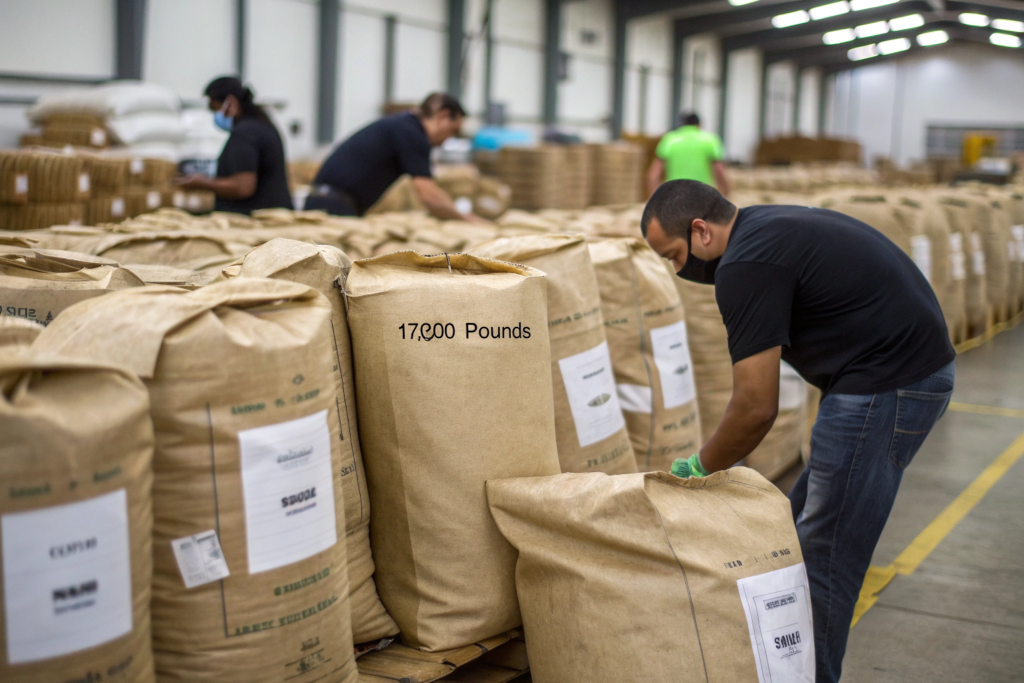
The moment of break-even is a psychological and financial turning point. The container is no longer a debt. It is an asset. Every single bag sold after that point is generating pure profit. Let's revisit the numbers. You have sold enough bags to cover the $58,000 total investment. You still have half the container left in inventory. Those remaining 17,000 pounds of coffee have a paper cost of near zero. Your only costs to sell them are the variable costs of the bag, the label, and the shipping. Your contribution margin on these remaining bags is now your entire selling price minus only those small variable costs.
If you sell a $15 retail bag, and the bag, label, and shipping cost you $5.50, your post-breakeven profit is $9.50 per bag. On a remaining inventory of 17,000 pounds, that is 22,666 bags. The total profit potential is over $215,000. This is the power of bulk buying. The profit is back-loaded. The upfront investment is the barrier to entry. The discipline to manage the sales channels is the challenge. But once you clear the break-even point, the container becomes a cash-generating machine. This is how large, successful roasting businesses are built. They are not making huge margins on every bag from day one. They are strategically investing in inventory, efficiently managing the sell-through, and then reaping the massive rewards in the back half of the container cycle. You are building a profitable asset, not just chasing one-time sales.
How Can Post-Break-Even Coffee Fund Your Next Container?
The profit from the back half of the container is not just for your pocket. It is the seed capital for your next, larger order. If you cleared $50,000 in profit from your first container, you have just self-funded a significant portion of the next one. You are no longer dependent on outside financing or personal savings to grow. The business begins to fund its own growth. This is the ultimate goal of a healthy physical product business. The inventory cycle becomes a self-perpetuating profit engine.
You can use this post-breakeven profit to scale. Buy two containers next time. Buy a container of the same coffee, but add a smaller container of a premium micro-lot. Invest the profit into a larger roaster that increases your throughput and lowers your per-bag labor cost even further. Each container cycle, executed well, compounds the growth. The break-even point becomes easier to reach with each cycle because your brand is more established, your customer base is larger, and your operational efficiency is higher. You are not starting from zero each time. You are leveraging the success of the last container to make the next one even more profitable. This is the virtuous cycle of a direct-sourcing, inventory-led coffee business. It is a long-term wealth-building strategy.
What Is the Risk of Over-Roasting to Move Inventory Faster?
When you see the pallets of green coffee sitting there, the temptation is to roast it all. To push it out the door as fast as possible. This is a dangerous impulse. Over-roasting, or rushing the roast process to darken the beans quickly, damages the quality. You lose the distinct origin character. You turn a beautiful specialty lot into a generic, bitter dark roast. You might sell it fast, but you sell it to customers who think your coffee is just average. They don't buy again. You have converted a long-term asset into short-term cash at the expense of your brand reputation.
The better strategy is patient discipline. Stick to your proven roast profiles. Market the coffee effectively to move it at a steady pace. If you face a real inventory crunch at the 9-month mark, consider a strategic, honest promotion. "Harvest Closeout: This incredible lot is at its peak. Stock up now before the new harvest arrives." Frame the discount as a celebration of the coffee, not a fire sale of old stock. The quality of the product in the customer's cup is the only thing that matters in the long run. A rushed, dark roast is a permanent scar on your brand. A well-timed, honest promotion is a smart inventory management tool. The direct farm model's lower cost gives you the margin flexibility to run these promotions without losing money. You can afford to be patient and strategic.
Conclusion
Calculating the break-even point on a full container of coffee is an act of business maturity. It moves you from being a passionate coffee enthusiast to being a disciplined business owner. The formula is clear. Accurately tally your all-in landed cost. Realistically account for weight loss and shrinkage. Honestly assess your unit economics across your sales channels. The break-even point is where your cumulative contribution margin equals your total container investment. After that, the business model's true profitability is unlocked. The back half of the container generates significant cash that can fund your next growth phase.
The most powerful lever in this entire equation is the initial landed cost of your green coffee. A direct relationship with a vertically integrated farm like ours dramatically lowers that base. It makes your break-even point smaller and your post-breakeven profits larger. It turns a full container from a terrifying risk into a calculated, strategic investment. The math works. The model is proven. The opportunity is to run your own numbers with a real, binding quote and see the potential for yourself.
If you are ready to move beyond small pallet orders and capture the full economic advantage of a container buy, we should talk. I invite you to reach out to our export director for a detailed, all-in DDP quote on a full container of our specialty Yunnan Arabica. She can also walk you through our fixed-price annual contract options.
Contact Cathy Cai at cathy@beanofcoffee.com. Let's run the numbers together and build a profitable, scalable supply chain for your brand.