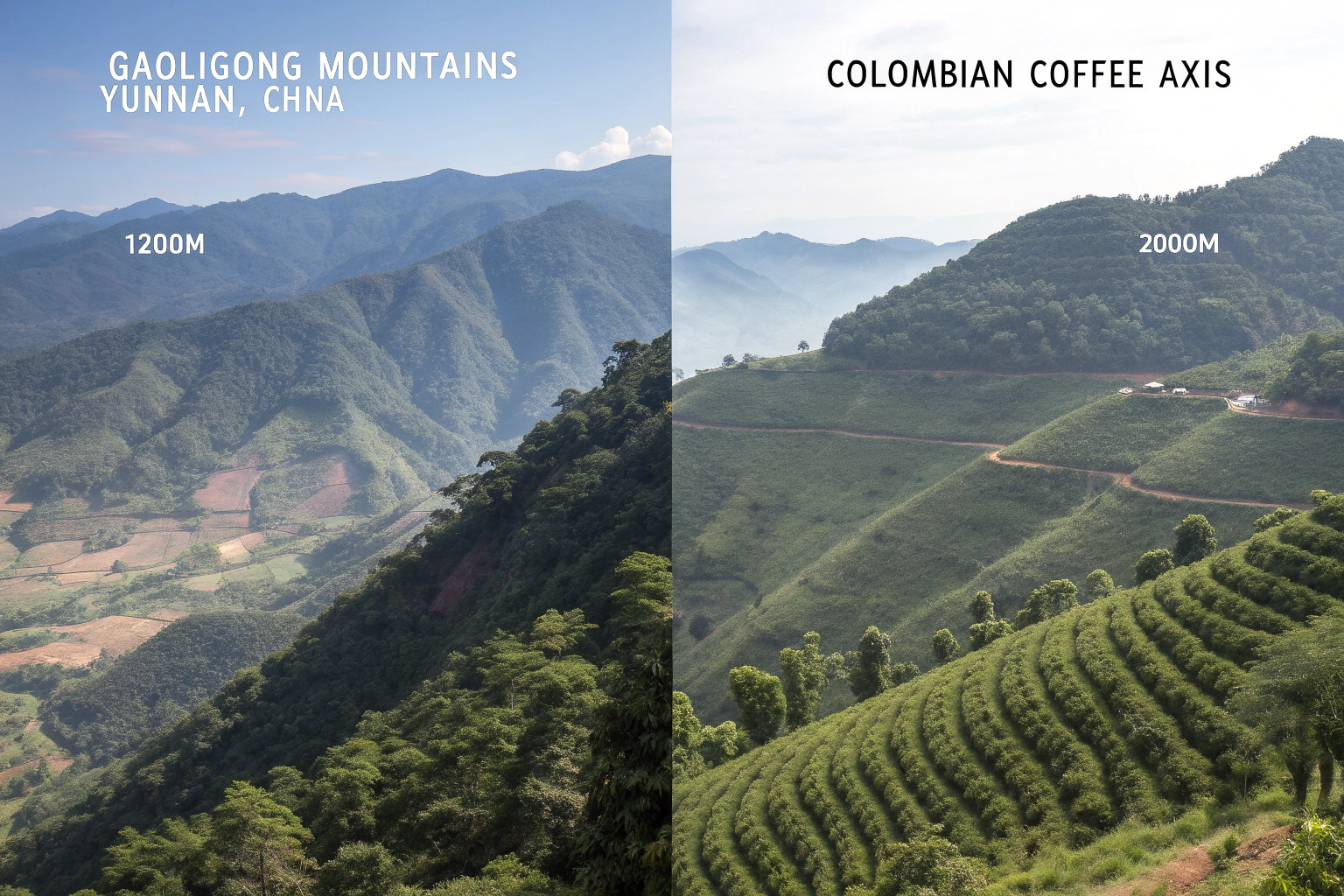
I was on a cupping panel last year. A well-known roaster from Portland put down his spoon and said, "This Yunnan is good. But it does not have that high-altitude sparkle of a Colombian." I asked him what altitude he thought it was grown at. He guessed 1,000 meters. I told him 1,600 meters. He was stunned. His palate had been tricked by latitude. He was tasting geography, not just elevation. This is the trap. We use "high altitude" as a universal shorthand for quality. But altitude does not work the same way everywhere on the planet. The pain here is making sourcing decisions based on a number on a spec sheet that does not tell the whole story.
To compare altitude effects on Chinese coffee versus Colombian coffee, you must consider not just the absolute meters above sea level, but the latitude and the diurnal temperature range, which together determine the effective growing degree days and the rate of cherry maturation, resulting in Colombian coffee typically showing brighter, more pronounced acidity at similar elevations, while Yunnan coffee develops a denser body and sweeter, more balanced cup profile.
A bag from Colombia marked 1,600 meters and a bag from Yunnan marked 1,600 meters will not taste the same. They will not roast the same. They will not perform the same in a blend. Let me explain the science behind why, and how to use this knowledge to your advantage.
Why Does Altitude Matter Differently for Coffee Grown Near the Equator vs. the Tropic of Cancer?
This is the foundational concept that most coffee buyers skip. It is not just about how high the farm is. It is about how far the farm is from the equator. The sun's angle changes everything.
Altitude matters differently for coffee grown near the equator versus the Tropic of Cancer because the closer a farm is to the equator, the more direct and consistent the solar radiation, allowing coffee to thrive at much higher elevations (up to 2,000m+) with a slower maturation that develops intense acidity, while farms further from the equator, like Yunnan, experience a more pronounced seasonal shift in daylight and temperature, effectively lowering the "altitude ceiling" for coffee production and shifting the flavor development toward sugar accumulation and body.
Think of it like this. The equator is a tropical conveyor belt of consistent growing conditions. Yunnan is on the edge of the subtropics. It is a different climate engine.
How Does Latitude Influence the "Altitude Ceiling" for Arabica Production?
The "Altitude Ceiling" is the maximum height at which coffee can reliably grow and ripen before frost or cold temperatures kill the plant or prevent cherry maturation.
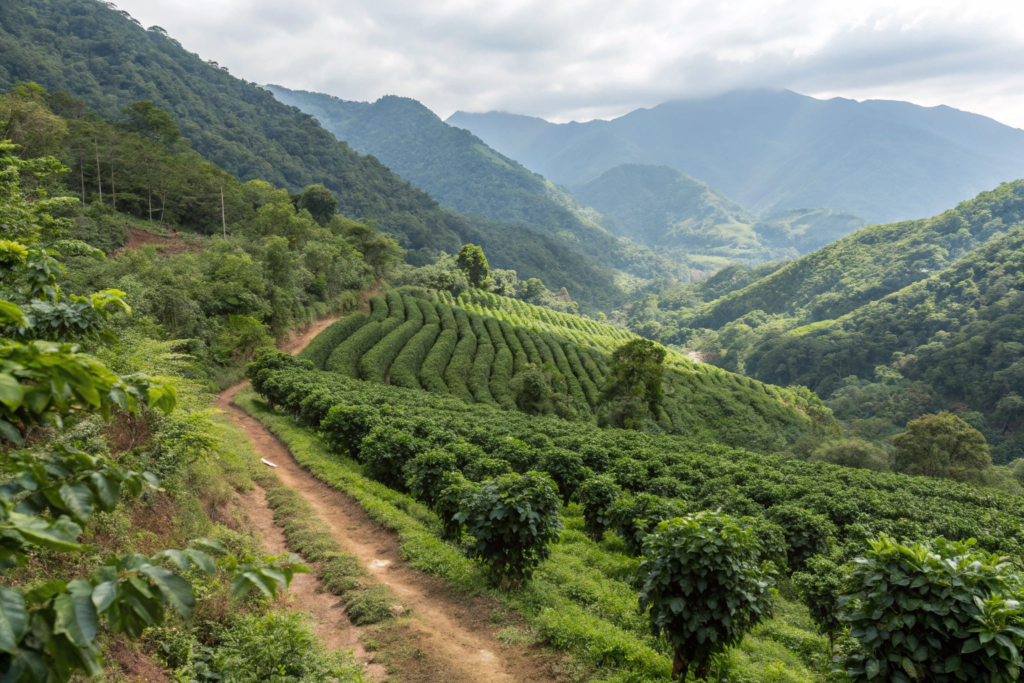
In Colombia, located between roughly 1°N and 12°N latitude, the climate is stable year-round. The temperature drops about 0.6°C for every 100 meters of elevation gain. Because the baseline temperature in the valleys is warm, coffee can climb very high—up to 2,000 or even 2,200 meters—before it gets too cold. This extreme altitude, combined with consistent tropical sun, creates a very long cherry maturation period, sometimes 8 to 9 months. That long, slow struggle produces the dense beans and the intense, complex acidity that defines high-end Colombian coffee.
In Yunnan, located at 25°N latitude, we are at the northern limit of the coffee belt. Our winters are cool and dry. Our summers are warm and wet. This seasonality means that if we plant coffee above 1,700 or 1,800 meters, the winter temperatures can drop below freezing, killing the trees. The "ceiling" is lower.
But—and this is crucial—the maturation period at 1,600 meters in Yunnan is already very long because of the cool winter temperatures. The cherry develops slowly. It accumulates sugars. It just does it under a different solar regime than Colombia. At Shanghai Fumao, our best plots are between 1,400 and 1,650 meters. That is our sweet spot. It is the equivalent "stress level" for the plant as a Colombian farm at 1,800 meters, but the outcome is different. For detailed climate and coffee data, World Coffee Research provides excellent geographic analysis.
What Is the Diurnal Temperature Shift and How Does It Vary by Origin?
This is the secret sauce of coffee quality. Diurnal Shift is the difference between daytime high temperatures and nighttime low temperatures. A big swing is good. It stresses the plant in a way that promotes sugar development in the cherry.
Let's compare two hypothetical farms, both at 1,600 meters.
| Location | Latitude | Day Temp (Avg) | Night Temp (Avg) | Diurnal Shift | Primary Effect on Bean |
|---|---|---|---|---|---|
| Colombia (Huila) | 2°N | 26°C (79°F) | 14°C (57°F) | 12°C | Slow, steady respiration. Bright acidity. |
| China (Baoshan) | 25°N | 24°C (75°F) | 10°C (50°F) | 14°C | Sharper stress response. High sugar density. |
Notice that the Baoshan farm actually has a larger diurnal shift than the Colombian farm. This is because of Yunnan's continental climate influence. The high plateau cools off rapidly at night.
This larger swing is why Yunnan coffee at 1,600 meters can have a body and sweetness that rivals or exceeds a Colombian coffee at the same altitude. The plant is shivering a bit at night. It responds by packing more carbohydrates into the seed for survival. When you roast that seed, those carbohydrates caramelize into deep, rich sweetness.
This is why you cannot just look at a number. You have to look at the climate data. The Yunnan bean might be physically denser than the Colombian bean at the same elevation, even if the cup acidity is lower.
How Does the Cup Profile Differ Between High-Altitude Yunnan and High-Altitude Colombian?
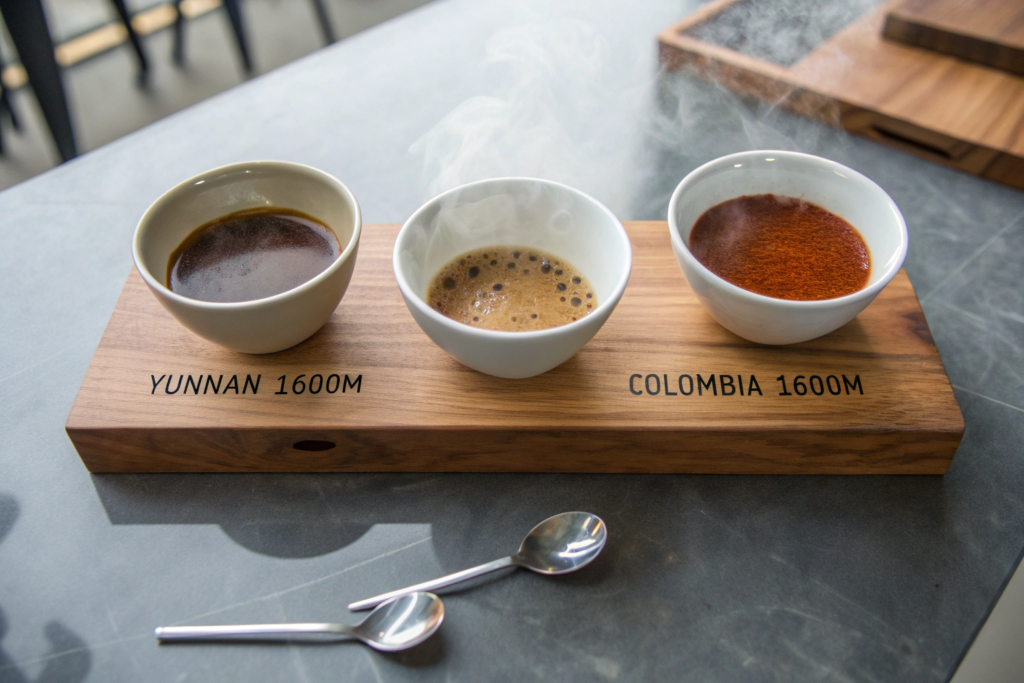
Now we get to what matters for your customers. The taste. You have two bags of green coffee. Both say "1,600 meters." One is Colombian. One is Yunnan. You roast them both to a light-medium profile. You cup them side by side. What do you find?
The cup profile of high-altitude Yunnan Arabica is characterized by a heavier, syrupy body, dominant notes of black tea, brown sugar, and dried stone fruit, with a gentle, malic acidity that fades quickly, while high-altitude Colombian Arabica offers a lighter, cleaner body with a pronounced, lingering citric or malic acidity, and flavor notes of red apple, caramel, and sometimes floral undertones.
Why Does Yunnan Arabica Show More Body and Colombian Show More Acidity?
This is the direct result of the climate differences we just discussed.
- Yunnan (Body Focus): The larger diurnal temperature shift pushes the plant to accumulate sugars and lipids. These compounds translate directly into body (mouthfeel) and sweetness in the cup. The cooler winter maturation also tends to mute the development of the sharp, fruity acids. The result is a coffee that coats your tongue. It feels heavy and satisfying. It is a comfort coffee.
- Colombia (Acidity Focus): The consistent tropical sun and slightly warmer nights allow the plant to slowly build complex organic acids (citric, malic, phosphoric). These acids are volatile. They hit your palate with brightness and sparkle. The body is often lighter because the bean's cellular structure is optimized for these acids rather than dense sugars.
Think of it like wine grapes. A cool-climate Pinot Noir from Burgundy has high acidity and light body. A warm-climate Shiraz from Barossa has lower acidity and huge body. Same fruit. Different climate. Different outcome. Yunnan is our Barossa Shiraz. Colombia is our Burgundy Pinot.
When I blend, I use Colombian for the top notes. I use Yunnan for the bass notes. They are natural partners. At Shanghai Fumao, we specifically market our high-altitude lots for their body and blending power.
How Do Processing Methods Interact with Altitude in Each Origin?
This is where human intervention changes the equation. The same climate that gives Yunnan its heavy body also gives us options in processing that are harder to execute in Colombia.
- Colombia (Washed Focus): The consistent climate is perfect for the Washed process. The fermentation is predictable. The drying is reliable. This is why washed Colombian coffee is the global benchmark for clean, bright coffee. The process highlights the natural acidity created by the altitude.
- Yunnan (Natural/Honey Opportunity): Our dry winter harvest season is a gift for Natural and Honey processing. We can lay out cherries on raised beds in November and not worry about a sudden rainstorm ruining the lot. This allows us to create natural processed Yunnan coffees with intense fermented berry and wine notes that rival the best Ethiopian naturals. The natural process adds a layer of fruit complexity on top of Yunnan's already heavy body. It is a game-changer.
A natural processed Colombian is riskier due to unpredictable weather in many regions. A natural processed Yunnan, especially from our high-altitude blocks, is a controlled, deliberate product. It takes the dense, sweet base and adds a wild, fruity layer. It is a profile you simply cannot get from a high-altitude Colombian. For more on processing science, Perfect Daily Grind has extensive case studies.
How Do Bean Density and Screen Size Compare at Equivalent Elevations?
We have talked about taste. Now let's talk about physics. How do these beans actually behave in your roaster? This is where the altitude and latitude differences show up in measurable, physical ways that directly impact your production.
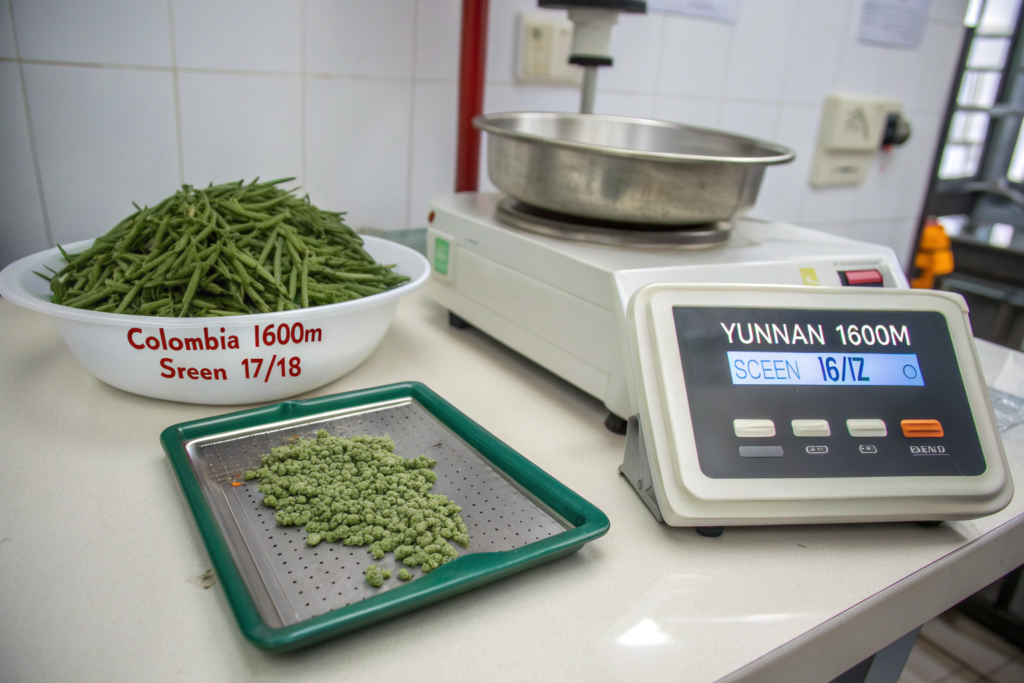
At equivalent elevations, Yunnan Arabica beans tend to be slightly smaller in screen size (typically peaking at 16/17 rather than 17/18) but exhibit comparable or even slightly higher density readings due to the greater diurnal temperature stress, while Colombian beans are often larger and more elongated, with a density that is high but more variable across different micro-climates.
What Roasting Adjustments Are Needed for Dense Yunnan Beans vs. Colombian?
The density of the bean dictates how it absorbs heat. A denser bean is like a thicker steak. It needs a gentler start to cook evenly to the center without burning the outside.
Here is a practical roasting guide based on my experience roasting both origins on a production machine.
| Bean Characteristic | Yunnan Arabica (1600m) | Colombian Arabica (1600m) | Roasting Adjustment |
|---|---|---|---|
| Density | Very High (SHB equivalent) | High (SHB) | Yunnan needs higher charge temp. |
| Bean Size | Screen 16/17 (Round) | Screen 17/18 (Elongated) | Yunnan has less surface area to mass ratio. |
| Heat Absorption | Slower, more even | Slightly faster, can be uneven | Yunnan tolerates a more aggressive mid-stage. |
| First Crack | Audible but less violent | Loud and distinct | Yunnan may have a "muffled" crack sound. |
For Yunnan, I use a Higher Charge Temperature. I need to get heat into that dense core fast. Then, during the middle phase (Maillard), I can back off the heat. The bean holds its thermal momentum well. It is very forgiving.
For Colombian, I use a Slightly Lower Charge. If I hit it too hard, the tips of those elongated beans will scorch. Colombian requires more finesse in the early stage to avoid tipping.
If you try to roast Yunnan using your Colombian profile, you will likely under-develop the center of the bean. It will taste grassy and sour. You need to adjust. At Shanghai Fumao, we provide detailed roast recommendation sheets with every sample. We want you to succeed on your first try.
Why Is Screen Size Not a Reliable Indicator of Quality Between Origins?
This is a bias that hurts Yunnan coffee. The global market has been trained that "AA" or "Screen 18" means "best." This is largely a historical artifact of the Kenyan auction system.
Yunnan Arabica, particularly the Catimor varieties common here, naturally tends to produce a slightly smaller, rounder bean. A screen 16/17 Yunnan bean can be denser and sweeter than a screen 18 Colombian bean. The size is genetic and climatic. It is not a quality defect.
If I sort our Yunnan coffee to only export screen 18 beans, I would have to discard a huge percentage of the crop that is cup-wise excellent. It would be wasteful and it would drive up the price artificially.
You, as a buyer, need to decouple "size" from "quality" in your mind. Judge the bean by its density, its moisture content, and most importantly, its cup. If a screen 16 Yunnan bean cups at 86 points and a screen 18 Colombian cups at 84 points, the smaller bean is the better coffee.
I have had this conversation with buyers a hundred times. They look at the sample and say, "It is small." I say, "Taste it." They taste it. They stop complaining about the size. The flavor wins. Every time. For objective green coffee grading standards, refer to the Specialty Coffee Association protocols.
What Are the Cost Implications of Altitude for Coffee Farming in China vs. Colombia?
Altitude affects more than flavor. It affects the cost of production. And those costs are very different in Yunnan compared to Colombia. Understanding this helps you understand the price you pay.
The cost implications of altitude are different in China versus Colombia because Colombian high-altitude farming relies heavily on manual labor on steep, smallholder plots, which drives up labor costs, whereas Chinese high-altitude farming benefits from larger, estate-style management and better access to agricultural inputs and mechanization, resulting in a different cost structure that often offers more price stability at high quality levels.
Neither is inherently cheaper. The money just goes to different places.
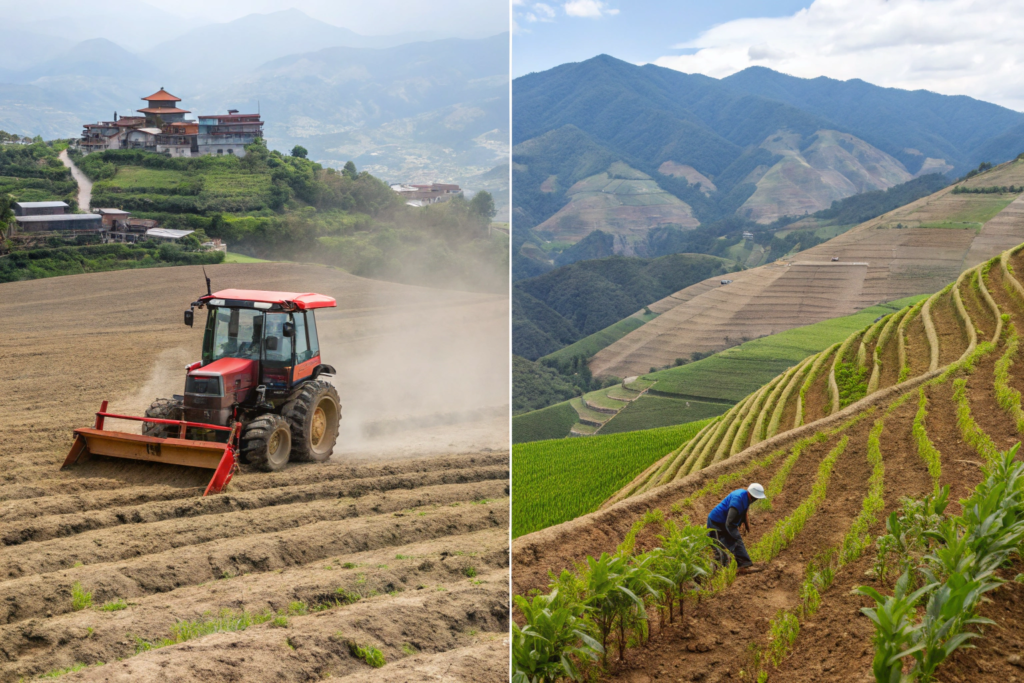
How Does Farm Labor and Terrain Differ Between the Andes and the Gaoligong Mountains?
- Colombia (The Andes): The terrain is incredibly steep. Farms are often tiny, 2-5 hectare family plots. Coffee is picked by hand, carried down the mountain on mules or by people. Labor is the single biggest cost. And as Colombia's economy grows, farm labor is getting harder to find and more expensive. This cost is directly reflected in the rising price of high-altitude Colombian coffee.
- China (Gaoligong Mountains): The terrain is also steep. But our farm is 10,000 contiguous acres. This scale allows for efficiencies that a smallholder cannot achieve. We have built roads into the plantation. We use tractors and trucks to move cherry. We have centralized wet mills. We employ a large, stable workforce that lives in company housing.
This estate model means our cost per kilo of cherry is more predictable. We are less vulnerable to sudden labor shortages. This is why Yunnan coffee can offer a stable, high-quality product at a consistent price. The volatility in the Colombian market is often due to labor and logistics. The stability in the Yunnan market is due to vertical integration.
At Shanghai Fumao, our size is our strength. We can invest in a new drying bed complex or a new gravity separator because we know the volume will support it. A smallholder in Huila cannot make that capital investment.
Does the Lower Altitude Ceiling in Yunnan Limit Specialty Grade Potential?
This is a fair question. Does the fact that we cannot grow coffee at 2,000 meters mean Yunnan will never be as "specialty" as Colombia? The answer is no. It just means we play a different game.
Specialty coffee is defined by cup score, not altitude. And Yunnan is consistently producing coffees scoring 84, 85, 86 points. How? By leveraging our other advantages:
- Diurnal Shift: As we discussed, our effective growing stress at 1,600m is comparable to higher altitudes elsewhere.
- Processing Control: Our dry harvest allows for immaculate Natural and Honey processing that is difficult to achieve in rainy origins.
- Varietal Selection: We are moving beyond Catimor and planting more Bourbon, Typica, and Geisha. These varietals thrive in our climate and push the cup score even higher.
Colombia has the advantage of pure altitude. Yunnan has the advantage of climate stability (dry harvest) and scale. Both can produce world-class specialty coffee. They just take different paths to get there. The ceiling for Yunnan specialty coffee is not defined by the mountain. It is defined by our investment in the trees and the process. And we are just getting started.
Conclusion
Comparing the altitude effects on Chinese and Colombian coffee is an exercise in nuance. You cannot just look at the number of meters. You have to look at the map. You have to feel the temperature swing. And you have to taste the cup with an understanding of the climate that shaped it.
Colombian high-altitude coffee gives you that brilliant, sparkling acidity that wakes up the palate. Yunnan high-altitude coffee gives you a deep, syrupy body and a comforting sweetness that grounds a blend. They are not competitors. They are complements.
The smart roaster understands this. They buy Colombian for the high notes. They buy Yunnan for the bass notes. Together, they make a symphony. If you want to cup our high-altitude Baoshan lots side-by-side with a Colombian reference sample and see the difference for yourself, we can arrange that. We have a library of samples from our different altitude blocks, each with its own distinct personality.
Email Cathy Cai. Tell her you want to explore the altitude range of our estate. She can send you samples from 1,200m, 1,450m, and 1,650m so you can taste the progression. Contact Cathy at: cathy@beanofcoffee.com