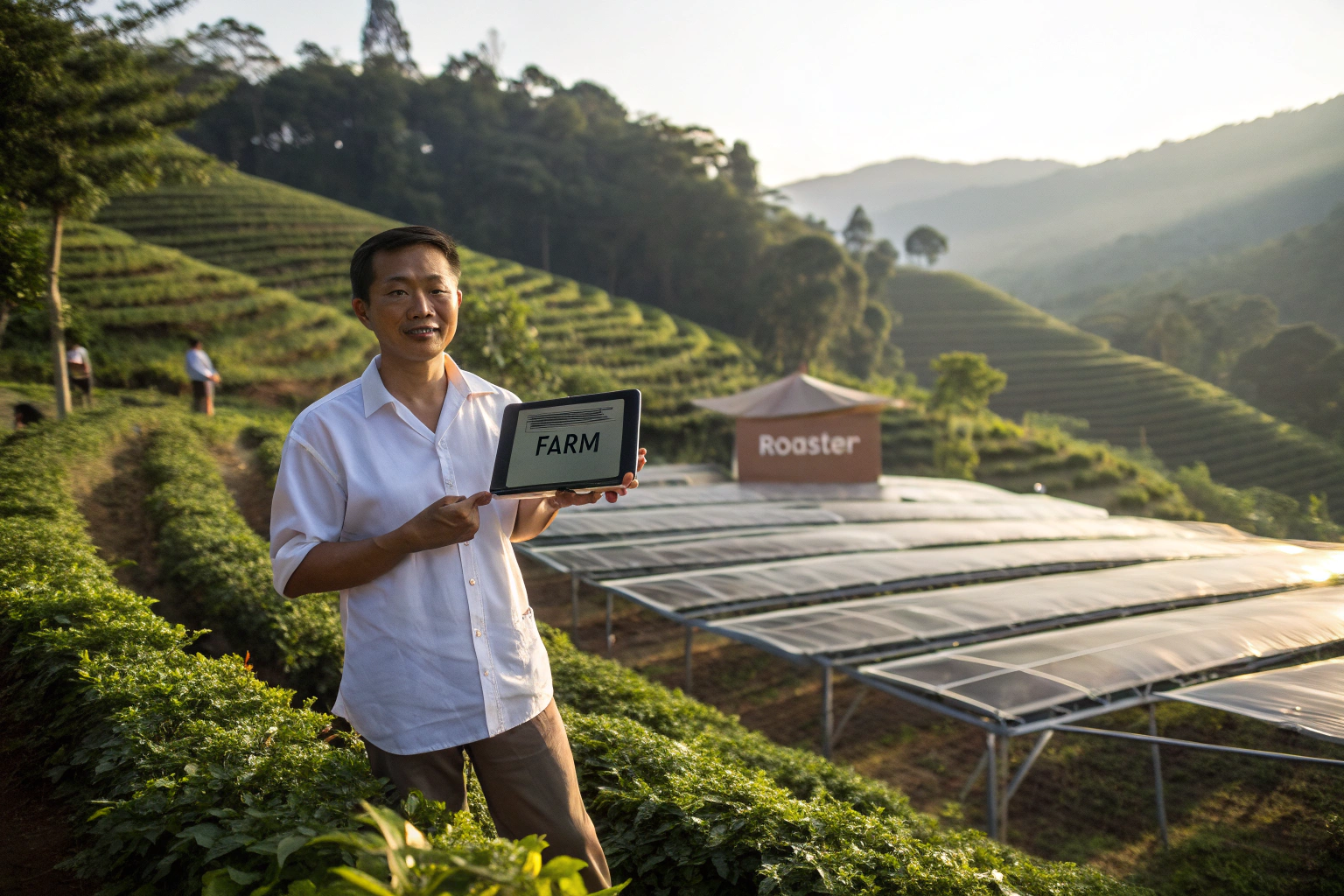
Let me tell you about the day I decided to build BeanofCoffee differently. I was sitting in a broker's office in Shanghai. He had samples from Vietnam, Indonesia, and a few bags of "Yunnan" that had changed hands four times before reaching his desk. The paperwork was a mess. The pricing was opaque. And the story? There was no story. It was just a commodity in a bag. I had spent my life on a farm in Baoshan, watching my family nurture coffee trees for three generations. And here, in this office, it was reduced to a number on a spreadsheet. I knew there had to be a better way. A way that connected the roaster directly to the dirt. A way that was built on ownership, transparency, and a genuine passion for Yunnan coffee.
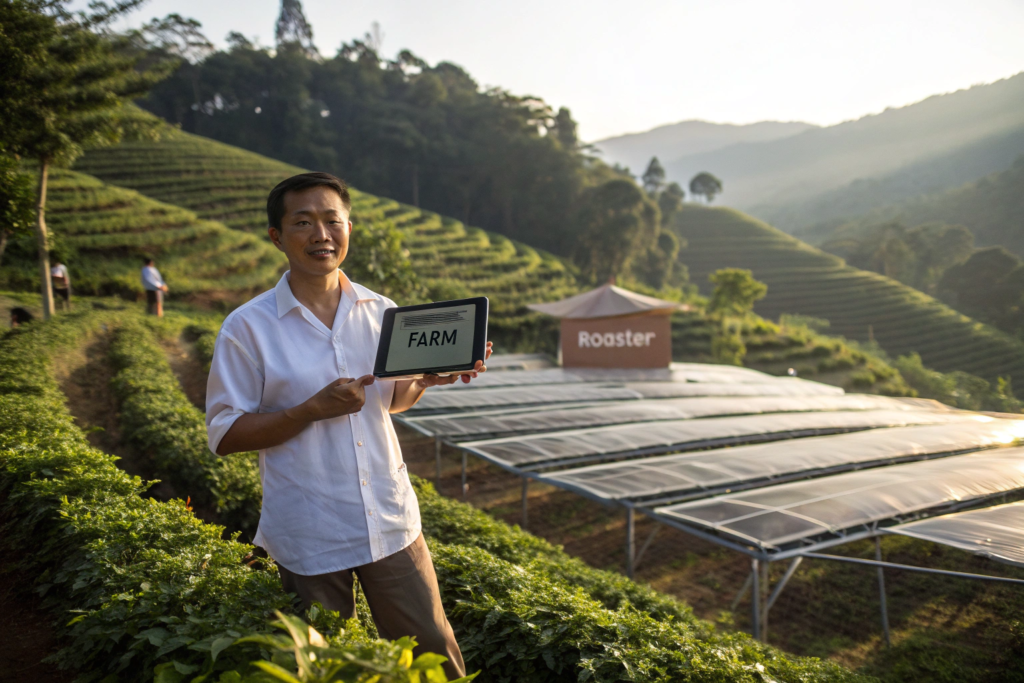
BeanofCoffee is different from other Asian coffee exporters because we are not brokers or traders; we are a vertically integrated estate owner with over 10,000 acres of family-managed land in Baoshan, offering complete chain-of-custody control from nursery to export container, combined with a transparent, relationship-driven approach that prioritizes long-term partnership stability over short-term transactional gains.
We are not a "sourcing platform." We are the source. That distinction changes everything about how we do business, how we price our coffee, and how we treat our clients. Let me explain exactly what that means for you, Ron, as a buyer who cares about price, timeliness, and trust.
Why Does Vertical Integration on a 10,000-Acre Estate Matter for Buyers?
Most Asian coffee exporters you will encounter on Alibaba or at trade shows are trading companies. They have a nice office, a good website, and a list of "partner farms." They buy coffee from local collectors, who buy from middlemen, who buy from smallholders. The chain is long. It is opaque. And every link in that chain takes a cut and adds a layer of uncertainty.
Vertical integration matters for buyers because it eliminates the multiple layers of middlemen that obscure true origin, inflate costs, and compromise quality consistency, allowing BeanofCoffee to guarantee a single, traceable lot from a specific block of our estate, milled and exported under our direct supervision and legal responsibility.
When you buy from us, you are not buying from a guy who knows a guy. You are buying from the guy who signed the check for the fertilizer.
How Does Owning the Land Ensure Consistent Quality and Traceability?
This is the core of our value proposition. Traceability is a buzzword. For us, it is just a description of our property line. We do not need a complex blockchain system to track our coffee back to 50 different smallholders. We just look at our farm map.
Here is what owning 10,000 acres allows us to do:
- Segregation by Terroir: We do not mix everything together. We harvest and process our different blocks separately. Block 14A, at 1,650 meters on the north slope, produces a distinctly different cup than Block 7B, at 1,350 meters near the river. We keep them separate. We cup them separately. We sell them as distinct micro-lots or we blend them intentionally.
- Uniform Agronomy: We do not have to hope that 500 different farmers are applying fertilizer correctly or pruning at the right time. Our team of agronomists manages the entire estate with a single, science-based protocol. The cherry quality is uniform because the care is uniform.
- Chain of Custody: The cherry is picked by our workers, loaded onto our trucks, delivered to our wet mill, dried on our beds, hulled in our dry mill, and bagged in our warehouse. At no point does the coffee leave our control. This is the purest form of traceability that exists.
At Shanghai Fumao, when I give you a lot number like "BOC-24-14A," I can walk you to the exact hillside it came from. I can show you the pruning records for those trees. I can show you the drying bed temperature logs. That is not possible with a trader's blend. For more on the value of vertical integration in agriculture, research from the Food and Agriculture Organization highlights the benefits of consolidated supply chains.
What Are the Financial Benefits of Cutting Out the Middleman for Roasters?
Let's talk about your bottom line, Ron. You are very concerned about price. I understand that. When you buy from a trading company, the price you pay includes the margin of the exporter, the margin of the local collector, and sometimes the margin of a broker in between.
By buying directly from the estate owner, you are eliminating at least one, and usually two, layers of profit margin. This does not mean our coffee is the cheapest on the market. Quality has a cost. But it does mean that for the same level of quality, our price is more efficient. More of your dollar goes into the coffee itself, and less into the pockets of intermediaries.
Here is a simple comparison of where your money goes:
| Cost Component | Typical Asian Trader Model | BeanofCoffee Direct Model |
|---|---|---|
| Farm Gate Cost | 40% (Variable, opaque) | 55% (Directly reinvested in farm) |
| Middleman Markup | 20% (Local collector + broker) | 0% |
| Exporter Overhead | 25% (Office, staff, margin) | 30% (Mill, logistics, QC) |
| Logistics & Freight | 15% | 15% |
| Total | 100% | 100% |
The BeanofCoffee model shifts the spend away from intermediaries and into the farm and the quality control. You are not paying for someone's Shanghai office rent. You are paying for better drying beds and more rigorous cupping. That is a better use of your money.
How Does BeanofCoffee's Pricing and Contracting Model Provide More Stability?
The coffee market is a rollercoaster. The C-price swings wildly based on weather in Brazil or the whims of hedge funds in New York. For a roaster, this volatility is a killer. You cannot budget effectively if the price of your base component changes by 20% month to month. This is a pain point you specifically mentioned.
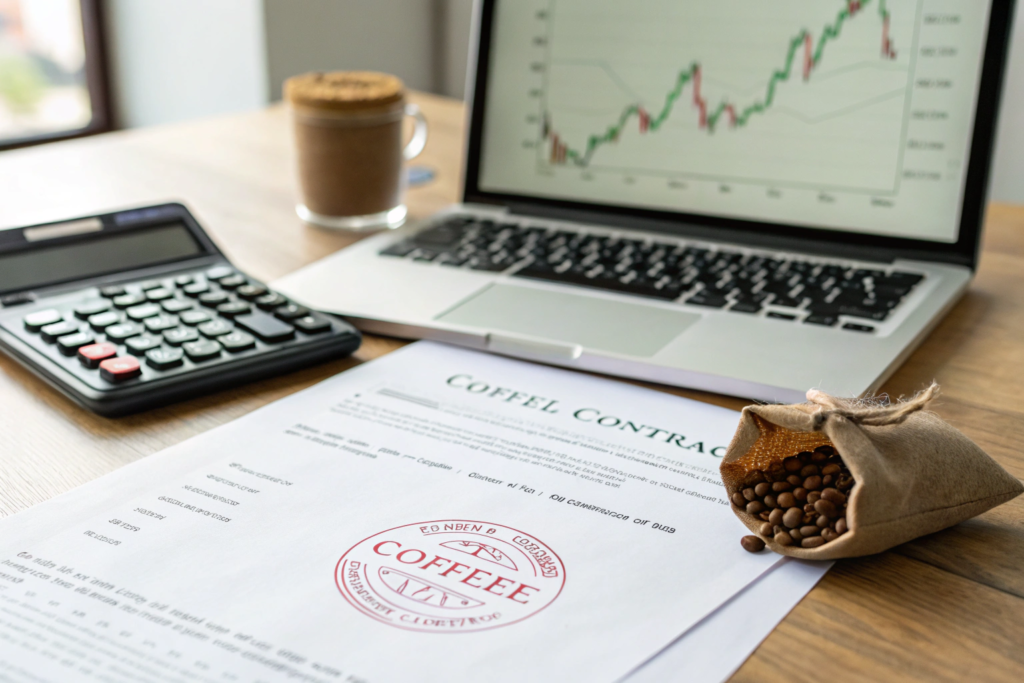
BeanofCoffee provides more pricing stability by offering fixed-price, quarterly contracts based on our internal cost of production plus a transparent margin, rather than tying our prices directly to the volatile C-market, allowing roasters to plan their budgets and menu pricing with confidence for 3 to 6 months at a time. We are not a hedge fund. We are a farm. We want predictability just as much as you do.
Why Is Our Pricing Less Volatile Than Origins Tied to the C-Market?
The C-market is the global commodities exchange for Arabica coffee. It is driven by speculation and macro-economic trends. It has very little to do with the actual cost of growing coffee in Yunnan.
Most coffee contracts are written as "C-price + differential." If the C-price spikes, your price spikes, even if nothing changed on the farm.
We operate differently. Because we own the land and control the production, we know our actual costs. We know what it costs to pay our workers, buy organic fertilizer, and run the dry mill. We calculate that cost. We add a reasonable margin. We give you a Fixed Price in USD per pound.
This fixed price is valid for the contract period, usually a quarter. If the C-market goes crazy, your price does not change. If the C-market crashes, your price does not change. It is stable. It allows you to print a menu and leave it alone for six months. It allows you to bid on a big wholesale account with confidence in your cost of goods sold.
This is a different way of doing business. It requires trust. But once you experience the peace of mind of a fixed-price contract, you will never want to go back to the daily anxiety of the C-market ticker. At Shanghai Fumao, we see this as a partnership. We want you to be profitable. A stressed, price-squeezed roaster is not a good long-term partner.
How Do Our Payment Terms and Logistics Support Reflect a True Partnership?
Some exporters treat payment terms as a weapon. They want 100% upfront before the coffee is even milled. That puts all the risk on you, the buyer. What if the coffee is bad? What if the ship sinks? You are out the money.
We structure our terms to share the risk fairly. For a new client, we typically use a 30% deposit to secure the booking, with the 70% balance due against a copy of the scanned Bill of Lading. This means you only pay the bulk of the money after the coffee is on the vessel and you have proof it is on its way. The risk is balanced.
Furthermore, our logistics support is hands-on. We do not just hand you a FOB price and say "Good luck with the freight." Cathy works with our trusted freight forwarders to provide you with CIF or DDP options. She can quote you a landed price to your warehouse door. She manages the documentation to ensure smooth customs clearance. She is proactive about potential port delays.
This level of service is rare. It comes from being the principal, not an agent. We have skin in the game. We want that container to arrive safely just as much as you do because your satisfaction is what drives our repeat business. For more on standard coffee contract terms, the Green Coffee Association provides useful templates and guidance.
What Is the BeanofCoffee Difference in Quality Control and Food Safety?
Many exporters claim to have "strict quality control." For many, this means someone looked at the beans and said, "Yeah, that looks like coffee." For us, it is a multi-stage, data-driven process that starts in the field and ends at the container door.
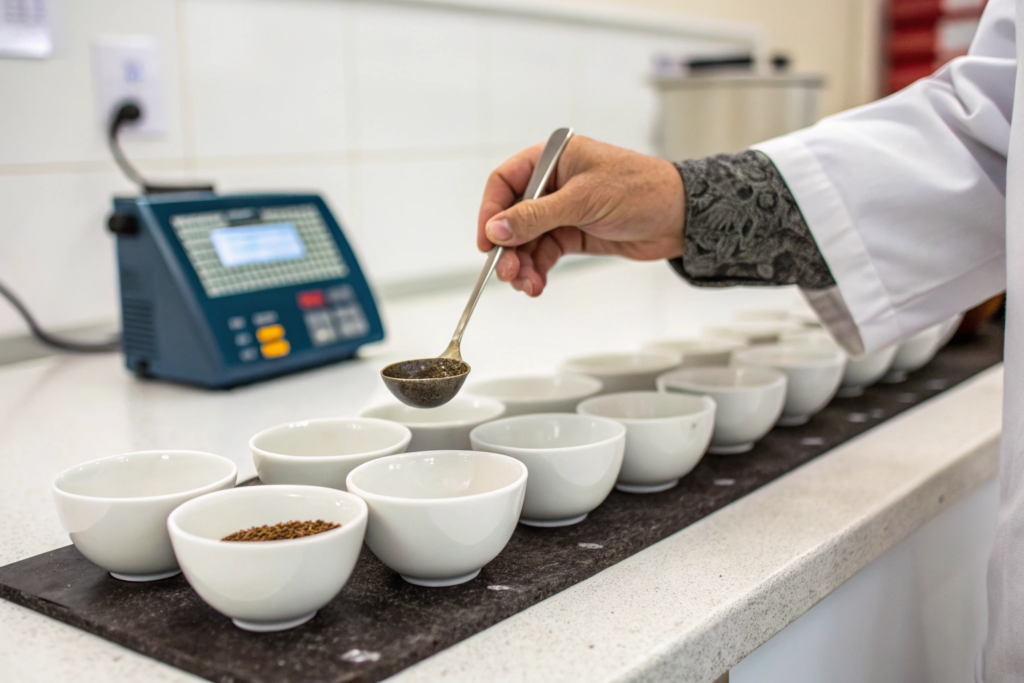
BeanofCoffee differentiates itself through rigorous, documented quality control that includes farm-block segregation, real-time moisture tracking during drying, multi-stage density and defect sorting in the dry mill, and a mandatory cupping protocol by an in-house Q-Grader for every single export lot before shipment approval.
How Does Our In-House Q-Grader Program Exceed Standard Export Requirements?
Most coffee exported from Asia is sold on physical appearance. "Grade 1" means "looks nice." It does not guarantee it tastes good. We reject that standard.
We employ a certified Q-Grader. This is a professional coffee taster licensed by the Coffee Quality Institute. Their job is to taste every single lot that leaves our mill. They use the standardized SCA cupping form. They score for fragrance, aroma, flavor, aftertaste, acidity, body, and balance.
Here is our approval protocol:
- Mill Sample: After dry milling, the Q-Grader cups a sample.
- Pass/Fail: If the lot scores below our threshold (e.g., 83 points for Grade 1), it is downgraded. It is not sold as specialty.
- Pre-Shipment Sample: Before stuffing the container, the Q-Grader cups the final blended and bagged lot. They compare it to the approved sample we sent you. If it does not match, the container does not move until we resolve the issue.
This is an internal cost center. It would be cheaper to just ship the coffee and hope you do not complain. But we do it because our reputation is worth more than the salary of a Q-Grader. When you buy from Shanghai Fumao, you are buying coffee that has been vetted by a trained palate.
What Specific Food Safety Investments Have We Made in Baoshan?
You asked about safety. This is not just about taste. It is about legality and health. We have invested heavily to meet the stringent requirements of the EU and US markets.
- ISO 22000 Certified Mill: Our dry mill is certified to the ISO 22000 Food Safety Management System standard. This means we have documented procedures for pest control, cleaning, allergen management, and foreign object detection. We are audited annually by a third-party certification body.
- Magnetic Separation and De-Stoning: We use powerful rare-earth magnets and a gravity destoner to remove any metal fragments or stones before the coffee goes into the bag. This protects your grinder.
- GrainPro Hermetic Storage: Every export bag is lined with a GrainPro TranSafeliner. This is not just for freshness. It creates a modified atmosphere that prevents insect infestation and mold growth during transit. It is a food safety barrier.
These investments are invisible in the cup. You do not taste a magnet. But you taste the absence of defects. And your lawyer sleeps better knowing the coffee was processed in a certified facility.
Why Is Our Commitment to Yunnan's Future a Long-Term Advantage for Buyers?
We are not a fly-by-night operation looking to make a quick profit and move on. Our family has been on this land for generations. We will be here for generations more. This long-term perspective shapes every decision we make.
Our commitment to Yunnan's future provides a long-term advantage for buyers by ensuring the sustainability of our supply chain, driving continuous investment in quality-improving varietals like Geisha and Pacamara, and fostering a stable, motivated workforce that sees coffee farming as a viable, respected career path.
When you partner with BeanofCoffee, you are not just buying this year's crop. You are investing in a origin that is getting better every year.
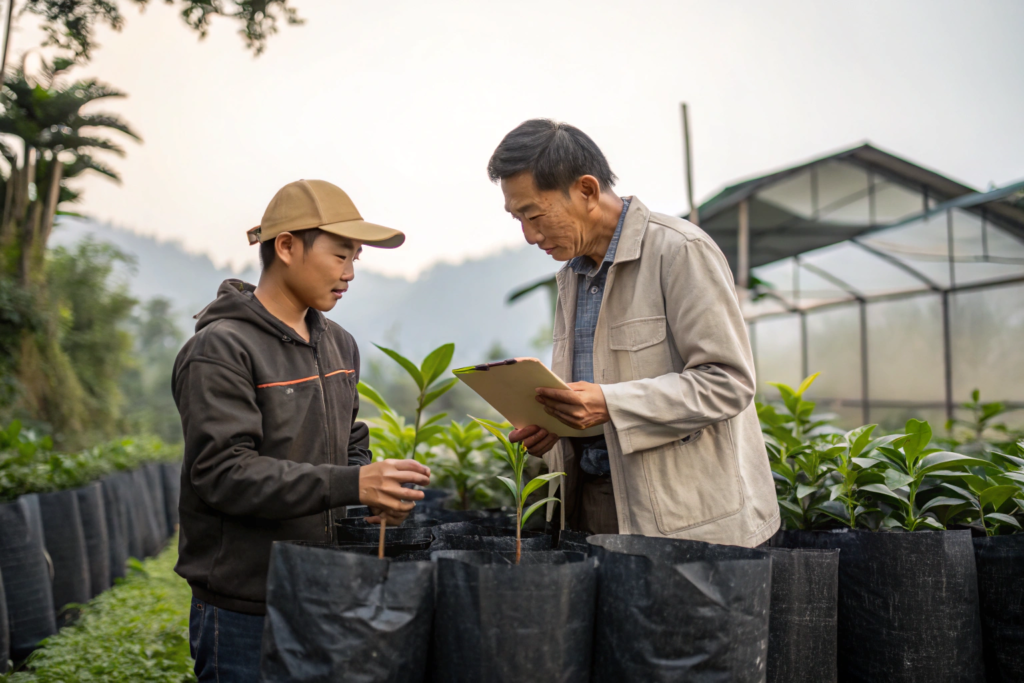
How Does Estate Ownership Allow Us to Experiment with New Varietals?
A smallholder farmer cannot afford to take risks. If they rip out their Catimor and plant Geisha, they have no income for the 3-4 years it takes for those new trees to produce. They are stuck with what they have.
Because we have 10,000 acres and financial stability, we can afford to experiment. We have a 20-hectare research plot dedicated to new varietals. We are growing:
- Geisha: The famous Panamanian varietal. Our first micro-lot harvested this year cupped at 88 points. It had intense jasmine and bergamot notes.
- Pacamara: A large-bean varietal from El Salvador. It shows incredible sweetness and body in our soil.
- SL28: The classic Kenyan varietal. We are testing its adaptation to Yunnan's climate.
These experiments are an investment in the future of Yunnan coffee. In five years, we will be offering commercial quantities of these exotic varietals, grown right here in Baoshan. This is the kind of innovation that only an estate owner can drive. You can read more about coffee varietals in the World Coffee Research Catalog.
What Does "Relationship Coffee" Mean in the Context of BeanofCoffee?
"Relationship Coffee" is another industry buzzword. For some, it means they visited a farm once and took a selfie with a farmer. For us, it is a business philosophy.
It means:
- Direct Communication: You have my WhatsApp. You have Cathy's email. You are not talking to a customer service chatbot. You are talking to the people who sign the checks.
- Long-Term Contracts: We prefer to work with a small number of dedicated roasters on multi-year agreements rather than chasing one-off spot sales. This allows us to plan our production and gives you security of supply.
- Transparency in Adversity: If there is a problem—a bad weather event, a quality issue—we tell you immediately. We work on a solution together. We do not hide it and hope you do not notice.
This is the hardest thing to scale. It is why we are not trying to be the biggest exporter in Asia. We are trying to be the best partner for a select group of roasters who value what we value: quality, integrity, and a genuine connection to the source.
At Shanghai Fumao, this is personal. When you succeed with our coffee, we feel proud. It is our family's name on that bag.
Conclusion
The difference between BeanofCoffee and other Asian coffee exporters is not just one thing. It is a combination of our structure, our philosophy, and our geography. We are vertically integrated, so our traceability is real. We price for partnership, so your business is stable. We invest in quality and safety, so your risk is reduced. And we are committed to Yunnan for the long haul, so your supply chain is getting better every year.
We are not just selling you a container of green beans. We are inviting you into a relationship with a specific piece of land in Baoshan. We want you to know the mountains, the people, and the taste of our soil. That is what makes us different. And that is what we believe makes us a better choice for roasters like you, Ron.
If you are tired of the runaround from faceless trading companies and want to experience the difference of working directly with a farm owner, let's start a conversation. Email Cathy Cai. She can tell you what we have available right now and get a sample on its way to you. Contact Cathy at: cathy@beanofcoffee.com