I was sitting in my office late one night two years ago, staring at our wholesale catalog PDF. It was seventeen pages long. It had beautiful photos of our Baoshan farms, detailed descriptions of every lot, cupping scores, pricing tables, and a cover letter from me personally. I was proud of it. But when I looked at the analytics for our website, I found something devastating. Almost nobody was downloading it. The few who did spent an average of forty seconds on the document before closing it. Forty seconds. On a catalog that took us weeks to produce. I realized we had built a catalog for how we wanted to present our coffee, not for how a busy buyer actually searches, evaluates, and decides.
A B2B coffee catalog that converts online searches is fundamentally a search-optimized, buyer-journey-aligned digital tool, not a static PDF. It must be built as a series of interconnected web pages, each targeting specific search terms that a professional buyer actually types into Google—terms like "washed Yunnan Arabica bulk wholesale price" or "private label coffee pods minimum order." Each product page must load fast, display on mobile, and contain the exact technical specifications, pricing ranges, and trust signals that a buyer needs to move from search result to sample request without ever picking up the phone. The PDF is a follow-up document for a buyer who is already interested. The website catalog is what creates that interest in the first place.
What followed that late-night realization was a complete rebuild of how we present our coffee online. It was not a design project. It was a search behavior project. We studied what our actual buyers were typing into Google. We looked at what pages they visited before contacting us. We talked to our existing clients about what information they wish they had found before they ever sent their first email. The catalog we have now looks nothing like the PDF I was so proud of. It is simpler. More technical. More searchable. And it converts.
Why Does a PDF Catalog Fail to Capture Search-Driven Coffee Buyers?
A PDF is a dead end. It sits on a server, invisible to Google for all practical purposes beyond the download page itself. The content inside the PDF—the cupping scores, the lot descriptions, the farm stories, the pricing logic—is trapped. A buyer searching for "specialty Catimor FOB price 2026" will never find your PDF unless your download page happens to rank for that term, and it almost certainly does not. The buyer lands on a competitor's web page instead, one where the product information is live, indexed, and immediately readable in a browser.
PDF catalogs fail because they violate every principle of modern B2B search behavior. Buyers search with specific, technical queries. They expect immediate, scannable answers in the search results or on the landing page. They are often on mobile devices, where a PDF is slow to load and difficult to navigate. They want to compare multiple products in multiple tabs. A PDF makes all of this difficult or impossible. A web-based catalog, structured as individual product pages with proper SEO, puts your coffee directly in front of the buyer at the exact moment they are searching for it.
I saw this play out in our own data. When we replaced our PDF catalog with individual product pages, each optimized for a specific search query, our organic search traffic from coffee-related commercial queries increased significantly. More importantly, the time spent on those pages tripled, and the contact form submissions from those pages went from nearly zero to a steady stream. The buyers were always out there. They just could not find us when our catalog was locked inside a PDF. The Search Engine Journal's guide to B2B SEO provides the framework for understanding why structured web content outperforms static documents, and the Google Search Central documentation explains how to ensure your product pages are properly indexed and crawlable.
What specific search terms do wholesale coffee buyers use that a PDF will never rank for?
Wholesale buyers use long, technical search queries that reveal buying intent. They search for "green coffee bulk price per pound," "private label coffee manufacturer China," "specialty Arabica wholesale minimum order," "Nespresso compatible pod supplier," "organic Yunnan coffee FOB Shanghai." These are not casual informational queries. These are procurement queries. Each one represents a buyer actively looking for a supplier. A PDF on a download page will rank for exactly none of these. A well-optimized web page with the query in its title tag, header, product description, and structured data has a chance to rank for all of them.
How does mobile browsing behavior make PDF catalogs even less effective?
I was surprised to learn how many of our buyers were doing initial supplier research on their phones. They would be at a trade show, hear about a potential supplier, and immediately search for them on their phone. Or they would be in their office, on a call, and quickly search for a specific product while talking. A PDF on a mobile device is a miserable experience. Pinch-zoom. Scroll horizontally. Wait for it to render. Most buyers simply close the tab. A mobile-responsive product page loads instantly, scrolls naturally, and presents the critical information—price range, minimum order quantity, product specs—without any friction. If your catalog is not mobile-first, you are invisible to a growing percentage of your buyers at the exact moment they are trying to find you.
What Product Information Do B2B Coffee Buyers Expect on a Digital Catalog Page?
A retail consumer buying a bag of coffee wants a story. They want tasting notes, origin romance, and a beautiful photo of a mountain. A B2B buyer wants all of that eventually, but first they want specifications. They want to know if this coffee fits their technical requirements, their price parameters, and their logistics constraints. If that information is not immediately visible, they leave.
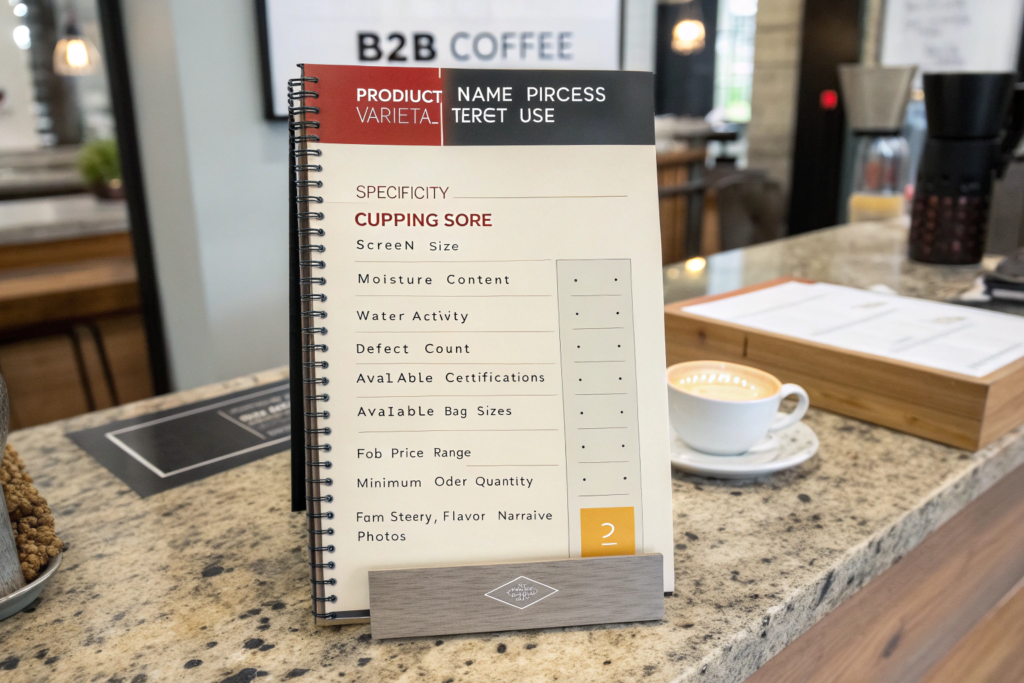
A B2B coffee catalog page must present information in a strict hierarchy of buyer priorities. At the top, before any story or farm photo, the buyer needs the product name and a one-sentence description that includes the varietal, process, and target use. Immediately below that, a specification block: cupping score, screen size, moisture content, water activity, defect count, available certifications, available bag sizes, FOB price range or "request quote" button, and minimum order quantity. Only after these technical specifications should the page present the farm story, the flavor narrative, and the photos. This ordering respects the buyer's decision process: first, does it fit my specs? Second, does the price work? Third, is the story compelling enough to differentiate it from other coffees that also fit my specs and price?
We tested this layout against our old story-first layout. The specification-forward pages had lower bounce rates and higher conversion rates across every product category. Buyers were not turned off by the technical information. They were relieved to find it. One buyer told me, "I looked at five supplier websites today. Yours was the only one that told me the moisture spec without me having to email someone. You got my sample request because you respected my time." That feedback shaped everything we do now.
Why does a technical specification block need to come before the farm story?
The farm story is a differentiator. But it only differentiates if the coffee has already passed the buyer's technical filter. A buyer sourcing for an espresso blend needs a coffee with a cupping score above 82, a moisture content below 12%, and a defect count below a certain threshold. If that information is buried at the bottom of a page full of romantic origin prose, the buyer does not read the prose. They hit the back button and go to a competitor who put the specs at the top. The story is what closes the deal. The specs are what opens the door. Open the door first.
What price information should a B2B catalog page show versus hide behind a "request quote" button?
This is a strategic decision, and there is no single right answer. Showing a price range publicly—"$2.80 - $3.50/lb FOB Shanghai"—immediately qualifies or disqualifies leads. Buyers who cannot afford your coffee leave, which saves your sales team time. Buyers who can afford it are more likely to inquire because they already know they are in the right ballpark. However, if your pricing is significantly higher or lower than the market average, a range can scare people off or attract the wrong kind of buyer. The middle ground is to show a price range for standard lots and use a "request quote" button for custom, large-volume, or private label inquiries. Whatever you choose, do not leave the buyer guessing. A page with no pricing information at all feels evasive. The Specialty Coffee Transaction Guide is a useful reference for understanding how your pricing compares to the broader market.
How Do You Optimize a Digital Coffee Catalog for Google and Other Search Engines?
A beautiful catalog page that no one finds is not a catalog. It is a secret. Search engine optimization is not a separate activity from catalog creation. It is the architecture of the catalog itself. Every product page needs to be built around a primary search term, with supporting terms woven naturally into the headers, the product description, and the metadata.
Optimizing a digital coffee catalog for search engines means treating every product page as an answer to a specific buyer query. The primary keyword—for example, "wholesale washed Yunnan Arabica"—should appear in the page's title tag, its H1 header, its meta description, its URL slug, and at least once in the first paragraph of body text. Related keywords—"specialty coffee from China," "bulk Arabica beans," "FOB Shanghai coffee"—should appear in subheadings and throughout the description. The page should load in under three seconds, be fully responsive on mobile, and include structured data markup that tells Google the price, availability, and product category. These technical factors are not optional extras. They are the price of entry for appearing in front of a motivated buyer.
We worked with an SEO consultant to rebuild our product pages. It was tedious work. Rewriting titles, restructuring content, compressing images, adding structured data. But the results were undeniable. Within six months, our product pages began ranking on the first page of Google for several high-intent commercial search terms. The traffic was not just higher. It was better. Visitors from organic search spent more time on the pages and converted at a higher rate than visitors from any other channel.
What is structured data markup and why does it matter for a coffee product page?
Structured data is code added to a web page that tells search engines exactly what the content means, not just what it says. For a coffee product page, you can use Product schema markup to specify the product name, the price, the currency, the availability, and the product category. When Google understands this, it can display rich results—star ratings, price, availability—directly in the search results. This makes your listing stand out visually and gives the buyer critical information before they even click. It is a competitive advantage that surprisingly few coffee suppliers use. The Schema.org product markup documentation defines the exact structure, and Google's Search Central rich results guide explains how to implement it.
How do image alt tags and file names contribute to catalog search visibility?
Every image on a product page is an opportunity for search visibility. A bag shot named "IMG_4723.jpg" with no alt text tells Google nothing. The same image named "washed-yunnan-arabica-whole-bean-bag.jpg" with alt text "Washed Yunnan Arabica whole bean coffee in 2-pound bag" tells Google exactly what the image depicts. This helps the image rank in Google Image search, which is a surprisingly common way for buyers to discover products. It also reinforces the page's overall relevance for the target keywords. This is a small, often-overlooked detail that takes minutes to fix and delivers permanent benefit.
How Do You Structure a Coffee Catalog to Guide Buyers From Search to Sample Request?
Getting a buyer to your catalog page is the first victory. Getting them to request a sample is the second. The transition from browsing to acting must be frictionless. A buyer who has to search for a contact form, or who lands on a generic "Contact Us" page with a dropdown menu of departments, is a buyer who often simply leaves.
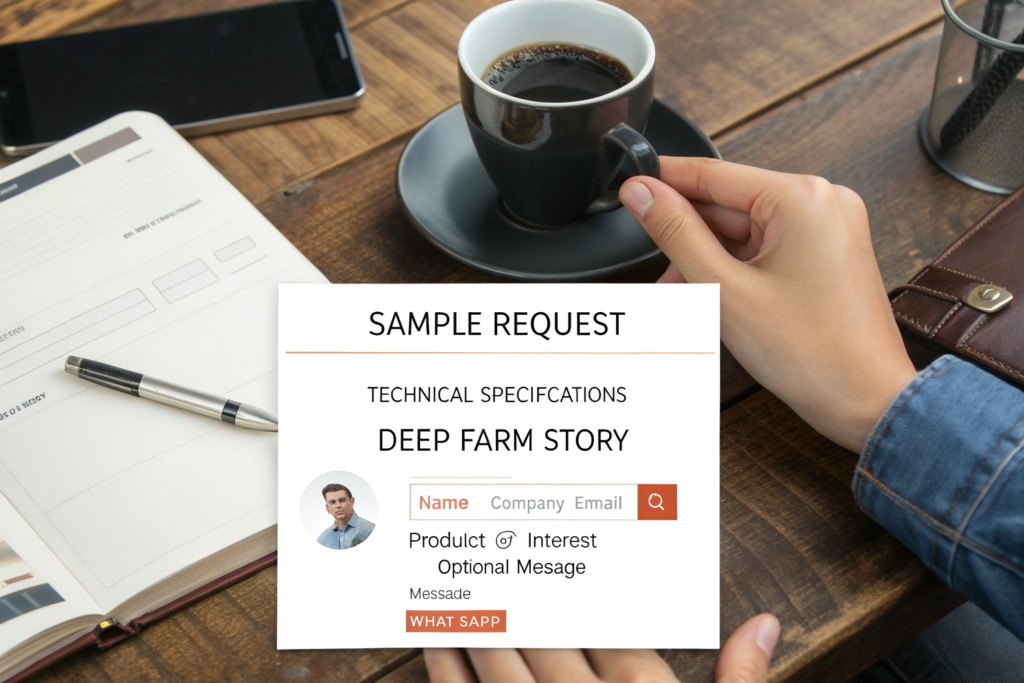
A high-converting B2B coffee catalog structures every product page to end with a clear, low-commitment call to action. The primary CTA is the sample request button, placed prominently after the technical specifications and before the deep farm story. The sample request form should be short—name, company, email, product of interest, and optionally a message field. It should not ask for a phone number, a company size, or any other information that creates friction. The secondary CTA, placed at the very bottom of the page, should be a direct email link or a contact form for a more detailed inquiry. Every page should also feature a live chat option or a prominently displayed WhatsApp number for buyers who want an immediate conversation. The goal is to give the buyer a next step that matches their readiness level, whether that is a quick sample request or a detailed discussion.
We saw our sample request conversion rate improve simply by moving the CTA button higher on the page and reducing the form fields from seven to four. Buyers who were interested but not ready for a phone call could request a sample in seconds. Buyers who wanted to negotiate pricing and logistics could jump to a direct conversation. The key was giving them a choice of pathways, not forcing them through a single, rigid funnel.
Why is a "request a sample" button more effective than a "contact us" button for coffee catalogs?
"Contact us" is vague. It implies a sales conversation, which many buyers want to delay until they have more information. "Request a sample" is specific and low-pressure. It promises a sensory experience, not a sales pitch. The buyer thinks, "I can taste this coffee in my own cupping lab, on my own equipment, without talking to a salesperson." That is a much easier psychological step than committing to a conversation. Once the sample arrives and the quality is verified, the buyer is far more receptive to a sales conversation. The sample is the bridge from digital curiosity to commercial relationship.
How should a B2B catalog page present shipping and logistics information to close international deals?
Shipping information should be concise but complete, presented as a bulleted list near the CTA. Include: available Incoterms, typical lead time from order to shipment, average transit time to major ports, packaging options for ocean freight, and sample shipping policy. A buyer in Germany needs to know whether you quote FOB, CIF, or DDP, and roughly how long it takes to get a container to Hamburg. If they cannot find this information, they assume you do not ship to their market, or that the logistics will be a headache. They move on. At Shanghai Fumao, we include a dedicated logistics section on every product page and a link to our shipping policy page for more detail. For broader logistics reference, the Freightos freight rate platform and the Maersk shipping schedules are tools that buyers and suppliers alike can use to plan.
Conclusion
A B2B coffee catalog that converts online searches is not a document. It is a network of search-optimized, specification-forward, mobile-responsive product pages that meet the buyer at every stage of their procurement journey. It answers the technical questions before the story. It loads fast on a phone. It tells Google exactly what the product is with structured data. And it ends every page with a frictionless path to a sample request. The PDF catalog is a relic of a time when buyers called you first. Today, they search first. Your catalog must be findable, scannable, and actionable in the moment of that search.
If your current online catalog is still a downloadable PDF, or if your product pages are beautiful but not bringing in the right inquiries, I would be happy to share more about what worked for us. We rebuilt our entire digital catalog with the buyer's search behavior as the organizing principle, and the results have been the foundation of our growth. Contact Cathy Cai at cathy@beanofcoffee.com. She can walk you through our live catalog, explain the structure behind it, and send you examples of the pages that convert best for us. The buyers are searching. Make sure they find you.