
Last March, a buyer in Arizona received a full container from a new supplier in Asia. He opened the first bag. The beans smelled musty. Cupped three points lower than the pre-shipment sample. He called me, frustrated. “The contract said specialty grade. What do I do now?” I asked him one question: “Did your quality agreement define ‘specialty’ with a cupping score number?” Silence. Then a long sigh. He knew the answer.
That is the moment most buyers realize the truth. A purchase order is not a quality agreement. A handshake is not a legal guarantee. Words like “premium” or “Grade A” mean nothing unless both sides agree on a measurable standard. And without that, you are gambling.
A binding quality agreement with a coffee exporter must define objective specifications—moisture content, defect count, cupping score, and sampling protocol—and tie those specs directly to remedies like price penalties, replacement shipments, or contract cancellation.
Look. I sell coffee. I want my buyers to write tight quality agreements. Why? Because it protects me too. A clear contract removes ambiguity. No arguments later. No “I thought you meant…” conversations six months after the container landed. Both sides sleep better. Here is how you build one that actually works.
What Specifications Must a Green Coffee Quality Clause Include?
You cannot enforce what you do not define. Sounds obvious. Yet half the contracts I see from new buyers skip the technical specs entirely. They rely on the seller's description. That is dangerous.
I have shipped containers under contracts where the quality clause ran three pages. Every variable pinned down. And you know what? Those buyers are my easiest clients. No disputes. No confusion. The specs speak for themselves. A detail often missed: temperature during transit. Green coffee sweats inside containers. If your spec does not mention arrival temperature limits, you have no grounds to complain about heat damage.
Your green coffee quality clause must specify moisture content range, water activity, screen size uniformity, defect count per 300-gram sample, cupping score minimum, and the exact cupping protocol used to determine acceptance.
Here is the framework I recommend to every first-time buyer who contacts me through Shanghai Fumao. It is not complicated. It just requires discipline. Walk through each element. Negotiate each one. Write it down. Both parties initial the final spec sheet and attach it as an appendix to the sales contract. That appendix becomes legally binding. For more detailed contract templates, the Specialty Coffee Association publishes green coffee standards that many international traders adopt as a baseline.
How Is Green Coffee Moisture Content Measured Accurately?
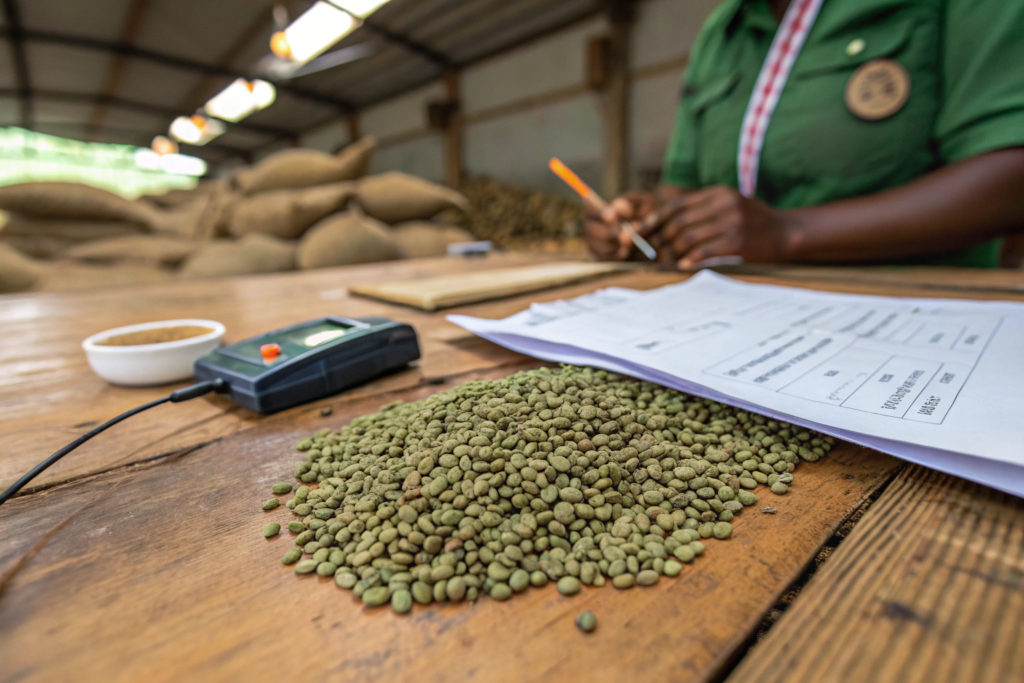
This single number causes more rejections than any other spec. Moisture is tricky. Measure it wrong, and you either accept mold-prone coffee or reject perfectly good beans.
The industry standard is ISO 6673. The method uses a calibrated moisture meter—preferably a capacitive or resistance-based device—on a ground sample. Not whole beans. Ground. The grind size matters. Too coarse, and the reading skews low. Too fine, and the reading spikes. I calibrate our meters monthly against an oven-drying reference method. Most labs accept 10.5 to 12 percent moisture as the safe window.
But here is a nuance most buyers miss. Water activity is different from moisture content. You can have beans at 12 percent moisture that still grow mold because the water activity is above 0.65. Aw measures free water available for microorganisms. I test both numbers before shipment and include them on the spec sheet. Some specialty buyers now demand Aw below 0.60. That is strict but achievable with proper drying. The International Organization for Standardization publishes ISO 6673 for anyone wanting the full laboratory procedure.
What Defect Count Standard Should Importers Demand?
There is no universal answer. It depends on what you are buying and what you plan to sell it as.
For commercial-grade Arabica, the Green Coffee Association of New York allows up to 23 full defects per 300-gram sample. That is loose. That coffee will cup harsh, earthy, maybe even fermented. Fine for a gas station blend. Not fine for a specialty roaster putting their name on the bag.
For specialty-grade, I recommend a maximum of 5 full defects per 350 grams. That is tighter than the standard SCA specialty cutoff. Why? Because my Catimor lots ship with 2 or 3 defects consistently. We sort optically. We hand-pick on raised beds. The quality is there. If a seller claims “specialty” but resists a 5-defect cap, they are telling you something about their processing without saying it. You can reference the Green Coffee Association defect grading handbook for the full count system used in U.S. importing practice.
Which Cupping Protocol Locks in Consistent Import Quality?
I once sent a sample to a prospect in Germany. He cupped it and emailed me a score of 80. Two weeks later, I sent the same lot to a buyer in Melbourne. He scored it 84. Same coffee. Different protocols. Different expectations.
This happens all the time. And it creates friction that a quality agreement should prevent. The fix is simple. Pick one cupping protocol. Write it into the contract. Both sides use that same protocol for all acceptance testing.
To lock in consistent import quality, a binding agreement must name a specific cupping protocol—SCA, COB, or buyer-defined—including parameters like water temperature, grind size, water-to-coffee ratio, and minimum score for acceptance.
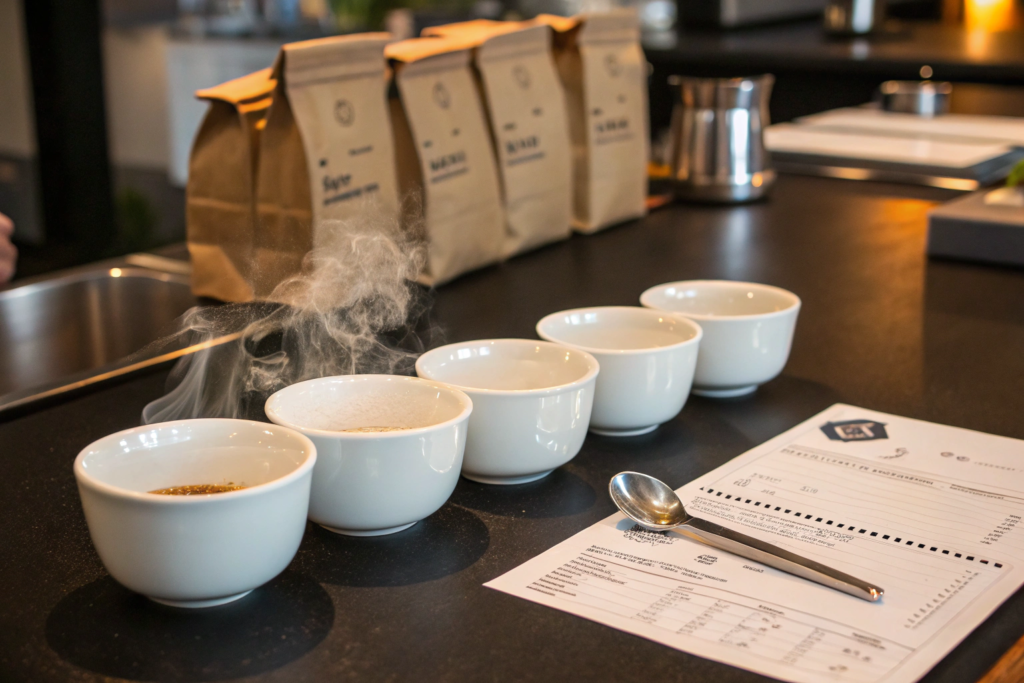
I favor the SCA protocol. It is widely taught. Calibrated across countries. Most professional cuppers know it well. In our contracts, I specify: “Cupping evaluation shall follow SCA cupping protocol version 2023. Water temperature 200°F. Grind size medium-coarse, passing 70-75 percent through a US size 20 sieve. Ratio 8.25 grams coffee to 150 ml water. Acceptance threshold: minimum combined score of 82 points assessed by a certified Q-grader.”
That paragraph eliminates ambiguity. Both sides know the rules before the first spoon breaks crust. If you want to learn the SCA cupping standards in full, the Specialty Coffee Association offers downloadable protocols and certification programs for Q-graders worldwide.
Should Pre-Shipment and Arrival Cupping Scores Match?
Honest answer? They rarely match perfectly. And demanding an exact match sets everyone up for failure.
Coffee changes during transit. Temperature swings. Time. Humidity in the container. A coffee that scored 84 in Baoshan might cup 83 in Oakland. A one-point drop is normal. Not alarming. I write my contracts to allow a one-point tolerance between pre-shipment and arrival cupping scores.
The real question is cause versus correlation. Did the quality degrade because of poor processing? Or did the ocean journey knock off a point? The distinction matters because the remedy differs. If the coffee arrives with a moisture content above 12.5 percent, the fault is likely origin-side drying. If moisture is fine but the cup tastes flat, age or transit conditions likely played a role.
This is why I always include an arrival inspection clause tied to a specific timeframe. The buyer must cup within 14 days of container arrival and report findings within 7 days after. No report within that window means acceptance. Harsh? Maybe. But it prevents disputes about coffee that sat in a hot warehouse for two months before being cupped. Domestic shipping and storage conditions in the U.S. are the buyer's responsibility once the container clears customs. Many importers document this handoff cleanly using standard templates from Shanghai Fumao.
How Does Origin Variety Affect Cupping Score Expectations?
You cannot hold a Catimor to the same flavor profile as a Gesha. That sounds obvious. Yet I see buyers write “minimum 85 points with jasmine and bergamot notes” for a lot of washed Catimor. That is fantasy. And a fast path to disappointment.
Yunnan Catimor cups best in the 82 to 85 point range. The dominant notes are chocolate, nut, caramel, and occasionally dried fruit. Low acidity. Heavy body. That is the genetic reality of the variety. Asking for 87 points with floral complexity is like asking a truck to win a Formula One race. Wrong tool.
I explicitly state the variety in the contract and link it to expected cup descriptors. For example: “Catimor variety grown at 1,400 meters in Baoshan. Expected profile: brown sugar sweetness, roasted almond, cocoa finish, low malic acidity. Cupping score target: 82-84 points by SCA protocol.” That sets realistic expectations. The buyer knows what is coming. No surprises. For information on how different coffee varieties cup, World Coffee Research maintains a comprehensive variety catalog with sensory profiles and agronomic data.
What Binding Remedies Protect Coffee Buyers Most Effectively?
Specs without teeth are just wishes. This is where most quality agreements fail. They describe quality beautifully. Then they go silent on what happens if quality misses.
I learned this the hard way as a young exporter. A buyer claimed the coffee was defective. He wanted a 20 percent discount. We had no agreed remedy in the contract. We argued for two weeks. Lost trust. Lost the account. I promised myself: never again. Now I insist on a remedy clause in every contract I sign.
The most effective quality agreements include a tiered remedy structure: price discount for minor deviations, return-and-replace or full refund for major deviations, and binding third-party arbitration to resolve disputes without litigation.
A tiered system works because it is fair to both sides. Not every quality miss justifies a container rejection. Sometimes a 5 percent discount fixes the problem, the roaster blends the coffee differently, and everyone moves on. Other times the coffee is so far off spec that only a replacement shipment makes sense. Define the tiers. Define the triggers. No ambiguity.

How Should a Price Adjustment Formula Be Structured?
Put a formula in the contract. Math does not argue.
Here is a simple structure I have used with European and American buyers:
| Deviation From Spec | Remedy |
|---|---|
| Moisture 12.1-12.5% | 3% price discount |
| Moisture above 12.5% | Right to reject |
| Defects 6-10 per 350g | 5% price discount |
| Defects above 10 per 350g | Right to reject |
| Cupping score 1 point below minimum | 5% price discount |
| Cupping score 2+ points below minimum | Right to reject or 12% discount at buyer's option |
This table lives in the contract as an appendix. Both parties sign it. When a container arrives and cups one point under, I do not need to negotiate. The math triggers the 5 percent discount. I issue a credit note. The roaster keeps the coffee. The relationship survives.
Notice something? The buyer always has the option to reject at certain thresholds. That is intentional. Some roasters simply cannot use off-spec coffee, no matter the discount. Their brand depends on consistency. Giving them a rejection right at clear trigger points builds trust. They rarely exercise it. Knowing they can is often enough. The International Trade Centre provides model contracts for coffee trade that include sample price adjustment clauses you can adapt.
What Third-Party Arbitration Protects Cross-Border Deals?
Nobody wants to think about arbitration when the deal feels good. But international contracts need a dispute resolution clause. Courts are slow. Expensive. Jurisdiction fights drag on for months.
I specify arbitration in all my contracts now. The seat of arbitration: Singapore. Why Singapore? Neutral territory. Neither China nor the U.S. English-language proceedings. Enforceable awards under the New York Convention, which both countries have ratified.
The clause reads something like: “Any dispute arising from this quality agreement shall be resolved by binding arbitration administered by the Singapore International Arbitration Centre (SIAC) in accordance with its rules. The arbitration shall be conducted in English. The arbitrator's decision shall be final and enforceable in any court of competent jurisdiction.”
Is arbitration perfect? No. But it is faster than litigation. And the award is binding across borders. I have never actually been to arbitration. The clause itself encourages settlement. Both sides know walking away from the table means a formal process with real costs. That clarifies thinking quickly. For a deeper understanding of coffee trade dispute resolution, the International Chamber of Commerce publishes arbitration guidelines and model clauses used widely in commodity trading.
How Do You Document and Track Quality Across Multiple Shipments?
The first shipment is easy. Everyone pays attention. The pre-shipment sample gets cupped twice. Photos get exchanged. The container arrives, and the quality team inspects it within 48 hours. Flawless process.
Shipment number seven is where the cracks show. Complacency sets in. The buyer stops cupping arrival samples. The exporter relaxes the pre-shipment check. One day, a container lands with coffee that has drifted off spec. Nobody noticed the slow decline over shipments four, five, and six. A one-point drop each time. Now the coffee does not meet the contracted standard, and six months of erosion have gone undocumented.
To track quality across multiple shipments, buyers should maintain a shipment-by-shipment log recording moisture, water activity, defect count, cupping score, and any remedy applied. Exporters should supply a standardized Certificate of Analysis with every container.
I make this easy for my buyers. Every container I ship from Shanghai Fumao comes with a pre-shipment COA listing all relevant specs. The buyer compares that COA to their own arrival testing. The data goes into a spreadsheet. Over time, patterns emerge. One variety consistently cups better in winter shipments. Another shows moisture creep during monsoon season. You adjust ordering patterns accordingly. This is strategic sourcing, not just transactional buying. For industry-wide quality tracking tools, the Coffee Quality Institute offers resources on building supplier evaluation programs that emphasize continuous monitoring over spot checks.

What Digital Tools Simplify Quality Documentation?
You do not need a fancy system to start. A shared Google Sheet works better than scattered emails. But as volume grows, dedicated tools help.
Some of my larger buyers use Cropster Lab to manage cupping data. It centralizes scores, generates reports, and tracks trends over time. Other buyers prefer building their own dashboards in Notion or Airtable. The tool matters less than the consistency of data entry.
Here is what I recommend you track, at minimum, for each shipment:
| Data Point | Source | Frequency |
|---|---|---|
| Contract reference number | Sales contract | Per shipment |
| Pre-shipment moisture % | Exporter COA | Per shipment |
| Arrival moisture % | Buyer lab | Per shipment |
| Pre-shipment cupping score | Exporter COA | Per shipment |
| Arrival cupping score | Buyer lab | Per shipment |
| Defect count | Buyer lab | Per shipment |
| Remedy applied (if any) | Agreed outcome | As needed |
This table becomes your negotiation evidence. When the seventh shipment arrives slightly off spec, you can point to the trend. You can have a data-based conversation instead of an emotional one. That is worth the 10 minutes of data entry per container. For software options, Cropster offers lab and sourcing tools specifically designed for coffee quality professionals managing multiple origins and shipments.
Why Does Supplier Scorecarding Improve Long-Term Consistency?
Scorecarding sounds corporate. It is actually just a structured way of answering one question: should I buy from this supplier again?
I encourage my buyers to score me. Seriously. I want to know if I slipped. The scorecard uses four dimensions: quality adherence (did the coffee match specs?), documentation accuracy (were COAs and shipping docs correct?), timeliness (did the container ship and arrive on schedule?), and communication responsiveness (did I answer emails within 24 hours?).
Each dimension gets a 1-to-5 rating per shipment. Average scores across the year create a performance baseline. A score consistently above 4.5? Renew the contract at better terms. A score dipping below 3.5? Time for a corrective conversation.
The power of scorecarding is objectivity. Personal relationships matter in coffee. They really do. But relationships without data breed complacency. A scorecard keeps everyone honest. It also gives your procurement team a clear framework for supplier review meetings. Instead of “I feel like quality slipped lately,” you say, “Arrival cupping scores have declined 1.2 points on average over the last four shipments.” That conversation leads to solutions. For more on supplier performance frameworks, The Institute for Supply Management provides general procurement best practices applicable to coffee importing, including scorecard templates and vendor assessment guidelines.
Conclusion
A binding quality agreement is not just paperwork. It is your insurance policy against disappointment, your framework for fair resolution, and your foundation for a supplier relationship that lasts beyond the first few containers.
We walked through the technical specifications that must anchor any quality clause. Moisture content, water activity, defect count, screen size. These are not negotiable fluff. They are measurable. Enforceable. If your current contract lacks them, fix it tomorrow. We examined cupping protocols and why choosing one standard—and sticking to it—prevents the “your word against mine” disputes that poison trade relationships. We looked at remedies and how tiered structures with clear price adjustments and rejection rights protect both buyer and seller. Finally, we covered the tracking systems and scorecarding approaches that catch quality drift before it becomes a crisis. Data over emotion. Always.
The coffee trade relies on trust. Trust is built on consistency. Consistency is built on clear, binding agreements that leave no room for misinterpretation.
If you are reviewing your current sourcing contracts—or preparing for a new supplier relationship—and want to see how we handle quality commitments at BeanofCoffee, reach out directly to Cathy Cai. She manages our client partnerships and can walk you through our standard quality agreement template, share sample certificates of analysis, and arrange pre-shipment samples so you can cup our Yunnan Arabica before committing to a contract. No pressure. No vague promises. Just clear specs and coffee that meets them. Write to cathy@beanofcoffee.com. She responds within one business day, every time.